Saints Teacher, missionary and foundress · 1874–1949 AD
Saint Laura Montoya
Feast 21 October · Born 1874 AD, Jericó, Antioquia, Colombia · Died 1949 AD, Belencito, Medellín, Antioquia, Colombia
Left fatherless by civil war and taught by her grandparents, St. Laura Montoya became a teacher, went into the mountains of Antioquia to live among the Emberá-Katío, founded a missionary congregation and died at Medellín after nine years in a wheelchair.
Begin the life
In brief
St. Laura Montoya, commonly known as Madre Laura (Mother Laura) in Colombia, was a teacher from Antioquia who went into its mountains as a missionary to the Indigenous peoples. She founded the Missionary Sisters of Mary Immaculate and St. Catherine of Siena (the Lauritas) to work among them. Pope Francis canonized her on May 12, 2013 AD and called her the first saint born in Colombia.
-
1874–1885 AD
A father lost to war
A girl from a small Colombian town loses her father to civil war, and her family loses its property.
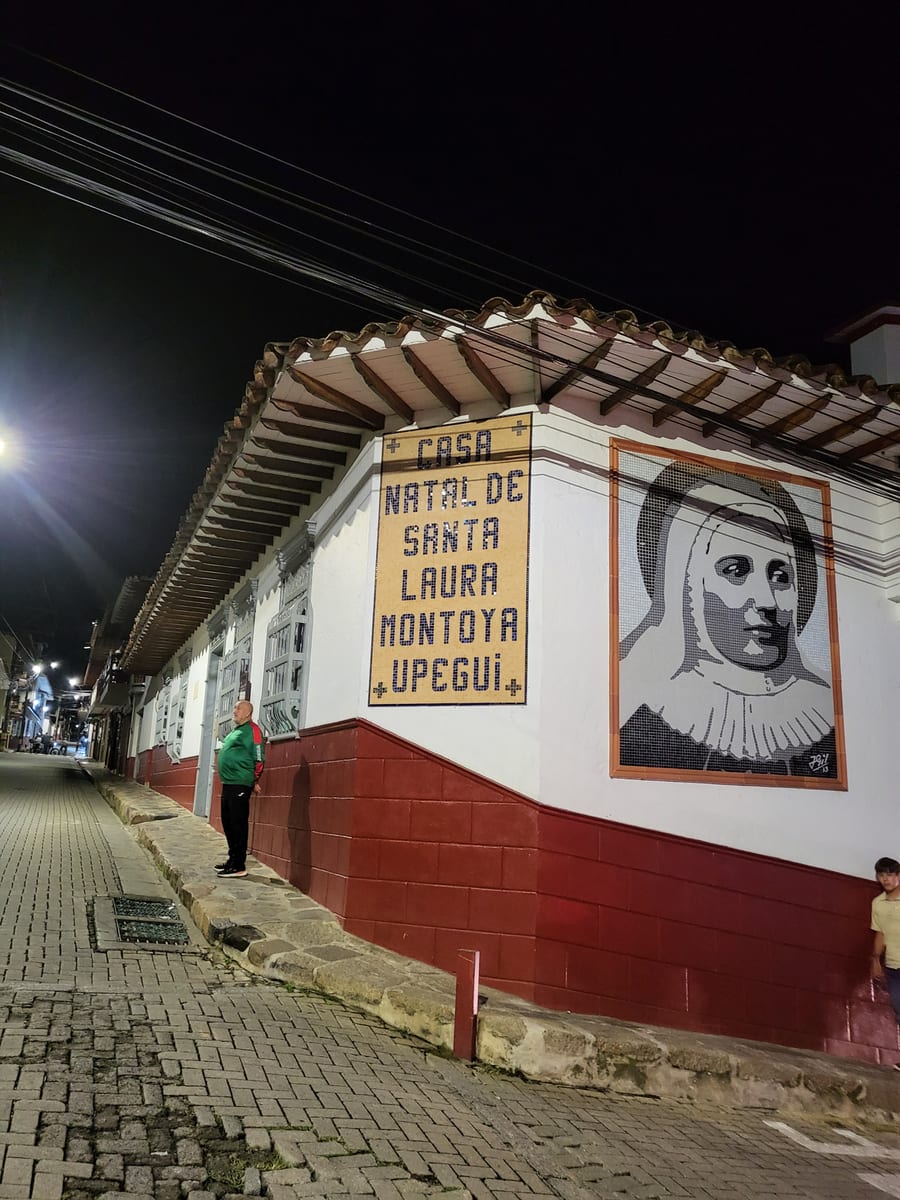
Casa natal de la Beata Montoya (Jericó), Xemenendura (Commons user), August 10, 2025 AD Xemenendura (Commons user), Wikimedia Commons (own work) St. Laura Montoya was born at Jericó, a small town in Antioquia, Colombia, on May 26, 1874 AD. She was baptized four hours after her birth. In 1876 AD her father, Juan de la Cruz Montoya, was killed in a civil war, and his enemies seized the family's property.
Her mother, Dolores Upegui, met the loss with forgiveness and strength, and St. Laura learned from her to forgive. Dolores Upegui could not support three children, so she sent St. Laura to live with relatives. There St. Laura was misunderstood and went without affection, felt like an orphan, and looked to God for refuge.
-
1890–1897 AD
The self-taught teacher
A girl with little schooling trains as a teacher to earn money for her family.
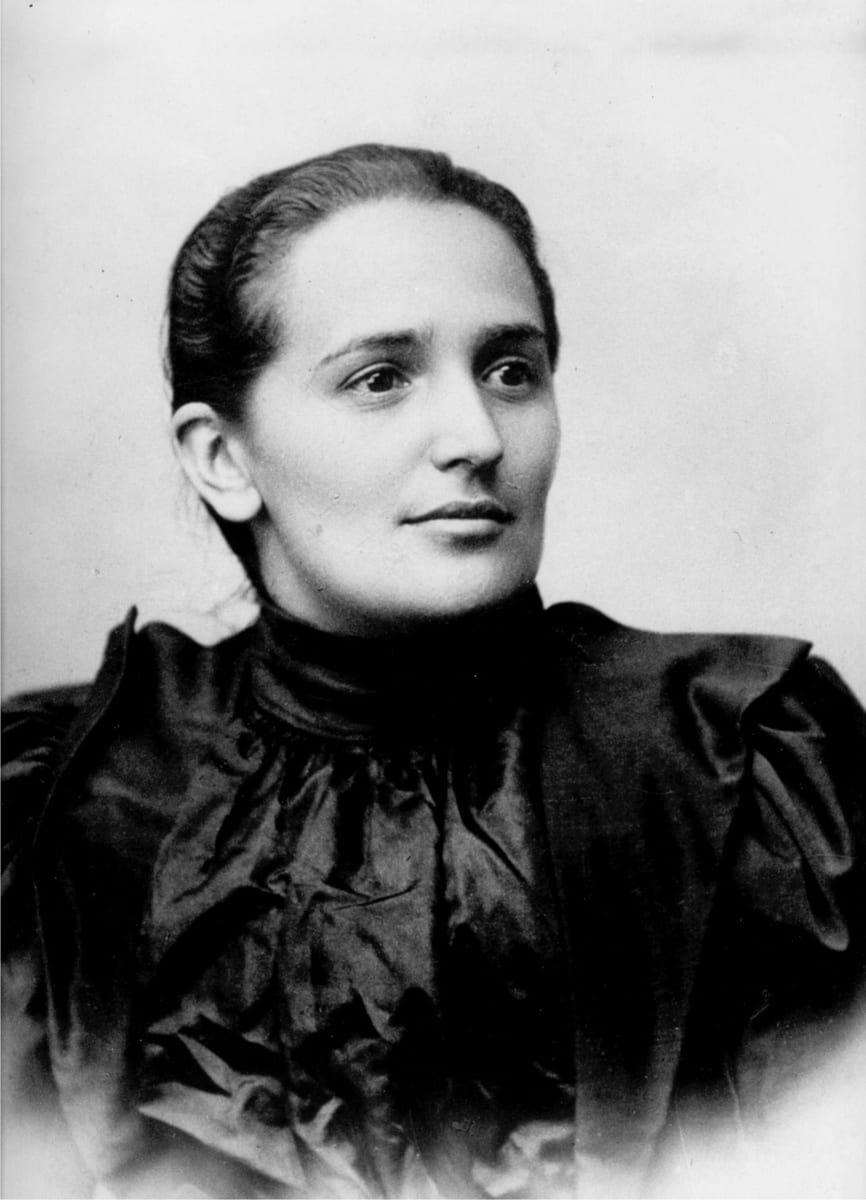
La santa Maria de Jesus Montoya Upegui (1874-1949 AD) — studio portrait as a young laywoman, Unknown photographer, undated (her years as a laywoman and teacher, before the 1914 AD foundation; see description) Unknown photographer, Wikimedia Commons, uploaded May 13, 2013 AD from madrelaura.org (the congregation's website, page 'escritora') St. Laura Montoya had little formal schooling before she was sixteen and taught herself to read and write. In 1890 AD her mother told her to train as a teacher so she could help the family with money. She won a scholarship to the Normal de Institutoras, the teachers' college in Medellín, and stood out for her marks.
At Amalfi, her first post after she qualified in 1893 AD, some of the town's officials disliked how much religion she put into her lessons. When civil war closed all the public schools, she kept teaching her preschool class in her own house. From February 1897 AD, at Santo Domingo, she taught the Catholic faith to the children of farming families.
-
1907 AD
An afternoon at Marinilla
A teacher who hoped to become a Carmelite nun prays before the Blessed Sacrament at Marinilla.
St. Laura Montoya hoped to become an enclosed Carmelite nun. At the same time she wanted to carry the Gospel to the farthest corners of the earth. While teaching in Medellín she heard of Indigenous peoples in the mountains and forests who did not know Christ and were not counted as full citizens.
In 1907 AD, aged thirty-three, she went to Marinilla to found a school for girls. One afternoon after class she went to the church to pray before the Blessed Sacrament. There she had a mystical encounter with the Trinity.
“me vi en Dios y como que me arropaba con su paternidad haciéndome madre, del modo más intenso, de los infieles. Me dolían como verdaderos hijos. (I saw myself in God and it was as if He were wrapping me with his fatherhood, making me mother, mother of those without faith. They caused me to suffer for them as if they were really were my children.)”
St. Laura Montoya, at Marinilla, 1907, 1907 AD -
1908–1914 AD
Into the mountains
St. Laura makes a first missionary journey, then leaves Medellín with her mother for the mountains of Dabeiba.
In 1908 AD St. Laura Montoya made her first missionary journey, with a priest, to the Guapá-Chamí region. Seventy-two Indigenous people were baptized. Afterwards she resolved to give her whole life to the missions.
She chose her companions from among her own pupils. In May 1914 AD she left Medellín with them and with her mother for the mountains of Dabeiba. That year they set up their first mission house at Dabeiba.
-
1914–1917 AD
Living as the people lived
Mother Laura and her sisters settle among the Emberá-Katío and live as they live.
At Dabeiba, Mother Laura and her sisters lived with the Emberá-Katío and as they lived, to remove every difference between the sisters and the people. The congregation's guides told the sisters to bring the people gifts and to accept the gifts they were offered, but never to show that they wanted any. Mother Laura learned the people's language, defended their culture and worked for roads, bridges, workshops and telegraphs.
At one of her first meetings with them, Mother Laura painted a hen on a board and offered it food. She pretended to feed the painted hen so they would see it could not eat, as a step toward showing them a picture of the Blessed Virgin Mary. Some families feared baptism, because they believed the baptized could be taken to Medellín as soldiers.
-
1914–1929 AD
Mocked, then approved
Some churchmen think Mother Laura mad for sending women into the forest, and her congregation wins its first approval in 1916 AD.
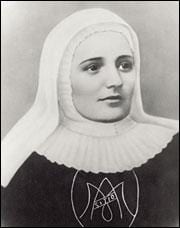
La madre Laura — portrait in the habit of the Missionaries of Mary Immaculate and St Catherine of Siena, Unknown photographer, undated (after the 1914 AD foundation, since she wears the congregation's habit) Unknown photographer, Wikimedia Commons, uploaded September 13, 2006 AD (no source given). The same frame at 355 × 450 is the photograph on the Holy See's 2004 AD beatification page (https://www.vatican.va/news_services/liturgy/saints/img/20040425_montoya.jpg), which carries no free licence and is not used. Young women joined Mother Laura, climbing mountains, pushing into dense forest and crossing rivers to bring the Gospel to the Indigenous peoples. Some churchmen disapproved of sending women out as front-line missionaries, and they thought Mother Laura was mad. Some prelates made accusations against her, and critics mocked the congregation as a family of religious goats heading off into the wilderness.
Pope John Paul II wrote that, beset by slander and hardship, she found her strength in God and in the Virgin Mary. In 1916 AD the congregation received its first approval, and Mother Laura became its first superior general. She governed it until 1929 AD.
-
1915–1936 AD
Camera, typewriter and press
Mother Laura photographs the mission, types her writing and prints it on a press of her own.
From 1915 AD Mother Laura photographed the mission's work with a Kodak A-130 camera she had bought. On her journeys she wrote on whatever she had, down to newsprint and cigarette paper. In 1922 AD she bought a typewriter.
The newspaper El Colombiano printed her letters from Dabeiba without her knowledge. In 1929 AD she set up her own printing press, Santa Teresita, at Santa Fe de Antioquia. In 1936 AD she founded the magazine Almas (Souls) and shared its direction with other sisters and an Indigenous man.
-
1938–1949 AD
Nine years in a wheelchair
Confined to a wheelchair, Mother Laura keeps writing to her sisters until her death at Medellín.
In 1938 AD Mother Laura again became superior general of the congregation, and she held the office until her death. In her illness she grew steadily heavier, and she spent the last nine years of her life in a wheelchair. Almost paralyzed, she prayed and wrote to her sisters, urging them on in their work.
After a long and painful illness, and having received the sacraments, she died at Medellín on October 21, 1949 AD. At her death the congregation had 467 sisters. Her sisters, the priests who knew her well and the whole Colombian people mourned her, and the people of Colombia at once called her the missionary of Colombia.


Pray with the Church
Pope Francis's prayer through St. Laura's intercession
Prayed by Pope Francis at the Regina Caeli in St. Peter's Square after the Mass at which he canonized St. Laura Montoya, May 12, 2013 AD; the Holy See's official English text.
Through the intercession of Mother Laura Montoya may the Lord grant the Church a new missionary and evangelizing impetus and, inspired by this new saint’s example of harmony and reconciliation may the beloved sons and daughters of Colombia continue to work for peace and for the just development of their homeland.