
Saints Dominican tertiary and Doctor of the Church · 1347–1380 AD
Saint Catherine of Siena
Feast 29 April · Born 1347 AD, Strada dell'Oca, by the fountain of Fontebranda, Siena, Italy · Died 1380 AD, Rome, Italy
A dyer's daughter born by the fountain of Fontebranda in 1347 AD, who nursed the plague-stricken, wrote to popes, and died in Rome at thirty-three.
Begin the life
In brief
Saint Catherine of Siena was born in a dyer's house in Siena in 1347 AD and died in Rome in 1380 AD, at thirty-three. She took the habit of the Dominican Sisters of Penance as a girl, and never lived in a convent. Pope Paul VI declared St. Catherine a Doctor of the universal Church on October 4, 1970 AD.
-
1347–1353 AD
The dyer's house at Fontebranda
Born one of twins in a working household, in a city the plague emptied.
Saint Catherine of Siena was born in the Strada dell'Oca, by the fountain of Fontebranda, on March 25, 1347 AD. Her twin sister was born with her and did not survive. Her father, Giacomo Benincasa, dyed cloth in the rented house the city knew as the Fullonica.
The plague reached Tuscany the next year and carried off 80,000 people in Siena. Lapa Benincasa bore twenty-five children, and this was the one among her younger children she nursed herself. At six St. Catherine saw Christ enthroned in pontifical vestments above the Dominican church, and her brother had to pull her away by the hand.
“Oh, if you had seen what I see, you would not distract me from so sweet a vision!”
St. Catherine of Siena to Stephen (her brother), after her vision of Christ was interrupted, 1353 AD -
1354–1362 AD
The house against her
A vow made at seven, and the family that spent years trying to undo it.
At seven she promised the Blessed Virgin and her Son that she would take no other spouse. Her family knew nothing of the vow and began looking for a husband when she was twelve. Her married sister Bonaventura, who had drawn her toward finer dress, died in childbed in August 1362 AD.
On a friar's advice St. Catherine cut off her hair and covered her head with a coif. The household dismissed the kitchen-maid and set her to the servant's work. She then gathered her father, her mother and her brothers and told them she was already vowed.
“During a long time you have resolved that I should marry, and have endeavored to force me to do so; youare aware that I hold this project in horror.”
St. Catherine of Siena to her father, mother, and brothers, declaring her vow of virginity, 1362 AD -
1362–1366 AD
The habit of the Sisters of Penance
An order of widows takes in a girl, who then stops speaking for three years.
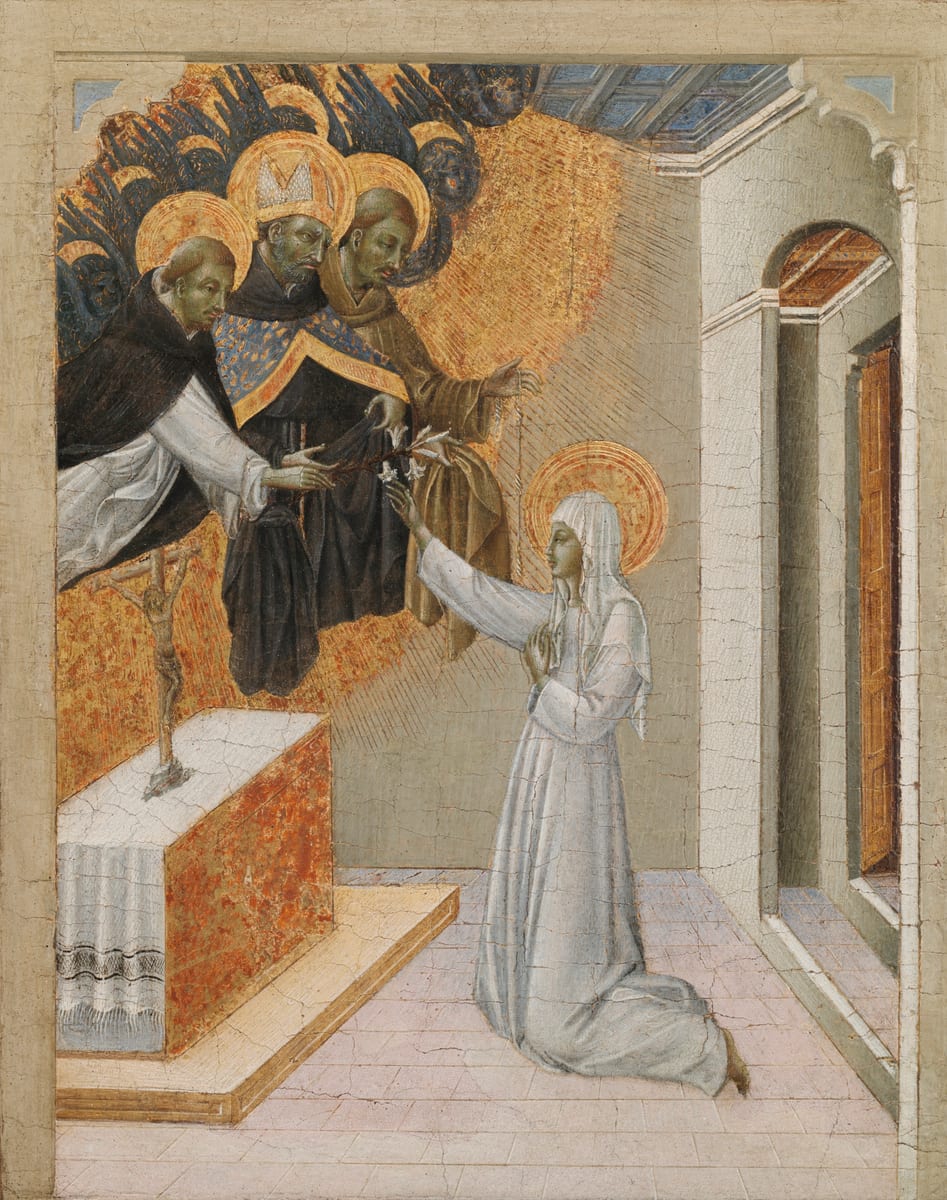
Predella Panel from an Altarpiece: St. Catherine of Siena Invested with the Dominican Habit, Giovanni di Paolo (Italian, c. 1403–1482 AD), the 1460s Giovanni di Paolo (Italian, c. 1403–1482 AD), Cleveland Museum of Art (1966.2) The Dominican Sisters of Penance gave their habit to widows of mature age, not to young girls. Some of them came to examine her while an eruption from illness still disfigured her. They took the opinion of the friars, assembled, and received her unanimously.
St. Catherine was clothed in the black and white habit in the church of the Friar Preachers. The Mantellate took no monastic vows and lived under rule in their own homes. Her first confessor left it written that for three years afterwards she spoke only in confession.
“Dearest mother, if you wish me to recover my health and strength, try to obtain for me the habit of the ‘Sisters of Penance.’ I am convinced that God and St. Dominic who call me, will take me from you, if I wear any other religious dress.”
St. Catherine of Siena to Lapa, while ill, urging her mother to obtain the habit for her, 1362 AD -
1362–1367 AD
The cell under the house
Five metres by three, a plank bed, and three years when she spoke only in confession.
She took a room beneath her father's house, five metres long and three wide. At fifteen she gave up wine and drank only water. She cut her sleep to half an hour in two days and nights, and told her confessor that was her hardest victory.
The assaults of the demons came for days, and she lay face down on the floor of the cell. Christ then appeared to her as he was upon the Cross. On the last day of Carnival he espoused her and put a ring on her finger that no one else ever saw.
“I, your Creator and Saviour, espouse you in the faith, that you will keep ever pure until you celebrate your eternal nuptials with me in Heaven”
Jesus Christ to St. Catherine of Siena, mystical vision of the ring, 1367 AD -
1366–1374 AD
Out of the cell
Hospital wards, a father's death, a ruined family, and a summons to answer for herself.
About 1366 AD St. Catherine left the cell and went back into the life of the family. She served the sick at the hospital of Santa Maria della Scala and at the leper house of St Lazarus. She carried her alms at night and left them outside the doors of poor families.
Her father died in August 1368 AD and was buried at San Domenico. Within a month a revolution overthrew his faction and ended the family's prosperity. In May 1374 AD the Master General of the Order called her to Florence, where she was cleared of the charges against her.
“I would rather be without my mantle than without charity”
St. Catherine of Siena to her companions, explaining why she gave away her mantle -
1375 AD
Pisa, and the stigmata
Sent to hold a city for the Pope, she came away marked.
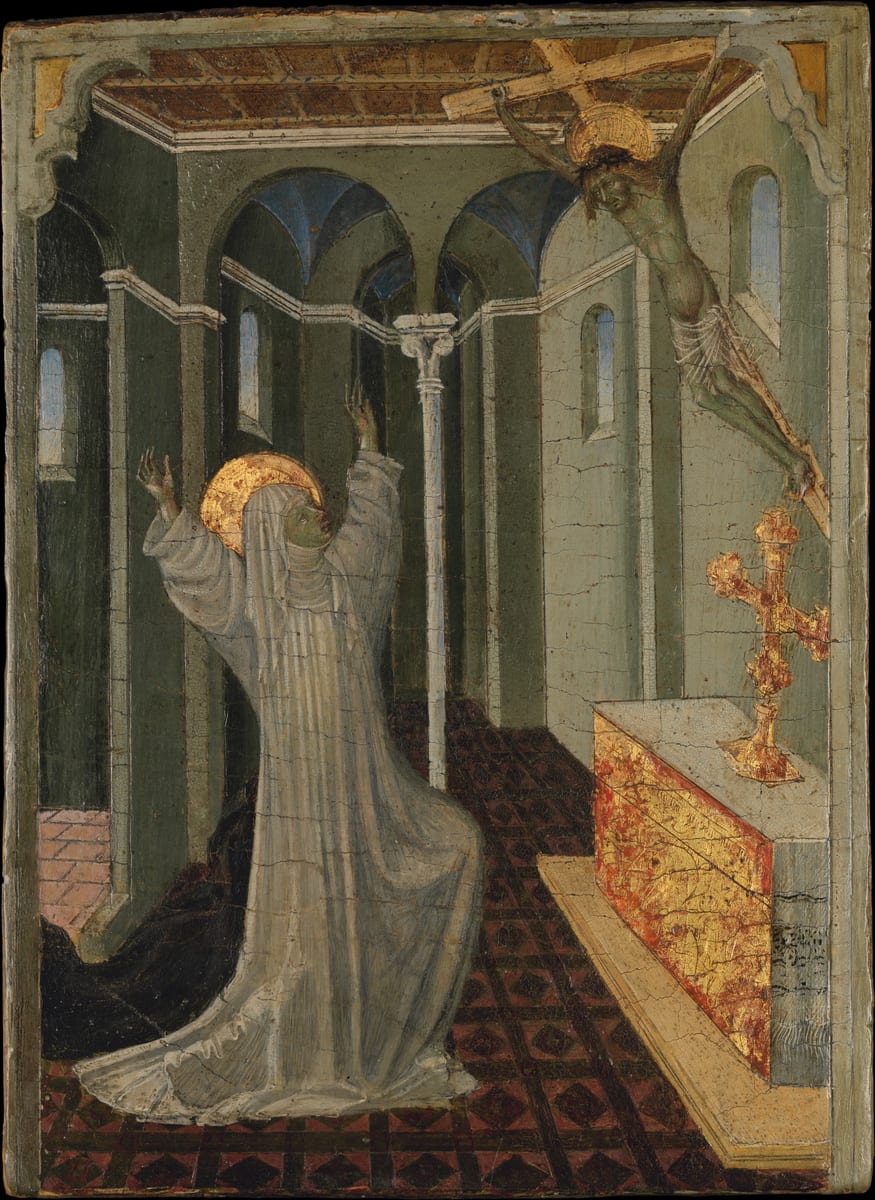
Saint Catherine of Siena Receiving the Stigmata, Giovanni di Paolo (Giovanni di Paolo di Grazia), c. 1447–1465 AD Giovanni di Paolo (Giovanni di Paolo di Grazia), The Metropolitan Museum of Art, New York (1975.1.34, Robert Lehman Collection, 1975 AD) In 1375 AD Pope Gregory XI sent her to Pisa to keep the city out of the anti-papal league. On April 1, 1375 AD she was deep in prayer before the crucifix in the church of Santa Cristina. Blessed Raymond of Capua records that five blood-red rays came down at her hands, feet and heart.
She asked at once that the stigmata be invisible, and the rays changed colour before they reached her. The marks stayed visible to her alone until the moment of her death. Pope Urban VIII recognised the stigmata as valid in 1623 AD.
“Father, I have to make known to you that by the mercy of our Lord Jesus Christ, I now bear His Sacred Stigmas in my body.”
St. Catherine of Siena to F. Raymund of Capua, announcing her reception of the stigmata, April 1, 1375 AD -
1378 AD
Florence, and the book
A peace mission, an armed band in a garden, and a book dictated at Siena.
Pope Gregory XI sent her to Florence early in 1378 AD to make peace between the city and the Holy See. He died at Rome on March 27, 1378 AD, and her commission lost the man who had given it. On June 22 the guilds rose in arms and an armed band came looking for her.
The long war ended with a peace signed on July 28, 1378 AD. She returned to Siena and dictated to her secretaries the book called the Dialogue. It was finished in October 1378 AD, and its closing lines name her as its author.
“"I am she. Take me, and let this family be,"”
St. Catherine of Siena to an armed enemy during the Florence tumult, June 22, 1378 AD -
1378–1380 AD
Rome
Summoned by one pope, she spoke to his cardinals and died in his city at thirty-three.
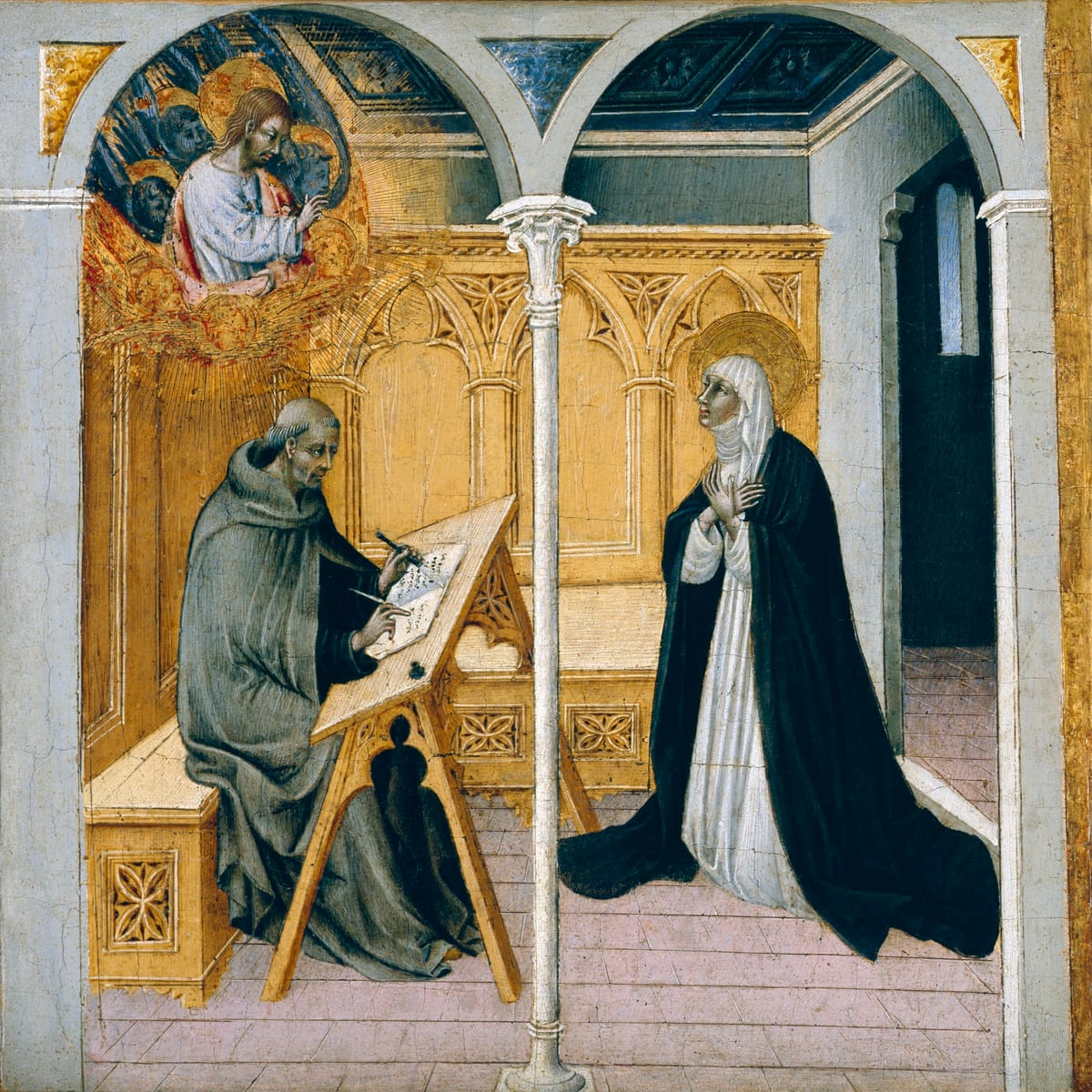
Saint Catherine of Siena Dictating Her Dialogues, Giovanni di Paolo (Italian, c. 1403–1482 AD), c. 1447–1449 AD Giovanni di Paolo (Italian, c. 1403–1482 AD), Detroit Institute of Arts (66.15) Pope Urban VI summoned her to Rome, and she reached the city on November 28, 1378 AD. He had her speak in the consistory of the cardinals about the Schism. She had learned to write only as an adult, and worked by dictating to her secretaries.
Her last illness began at the end of January 1380 AD, and she dictated a final letter to the Pope that evening. From her bed she quieted the revolt of the Romans against Pope Urban VI. St. Catherine died at Rome on Sunday, April 29, 1380 AD, at thirty-three.
“in leaving my body, truly I have consumed and given my life in the Church and for the Holy Church, which is for me a most unique grace”
St. Catherine of Siena, said before she died, 1380 AD


Pray with the Church
The closing prayer of the Dialogue
From the prayer that closes the Dialogue, which St. Catherine dictated to her secretaries at Siena and finished in October 1378 AD.
Oh, eternal Trinity! oh Godhead! which Godhead gave value to the Blood of Thy Son,Thou, oh eternal Trinity, art a deep Sea, into which the deeper I enter the more I find, and the more I find the more I seek;the soul cannot be satiated in Thy abyss, for she continually hungers after Thee, the eternal Trinity, desiring to see Thee with light in Thy light.As the hart desires the spring of living water, so my soul desires to leave the prison of this dark body and see Thee in truth.How long, oh! Eternal Trinity, fire and abyss of love, will Thy face be hidden from my eyes? Melt at once the cloud of my body.
All 6 reports on Saint Catherine of Siena

About this picture
AI-generated image in the manner of Sienese egg tempera on panel, after Giovanni di Paolo, St. Catherine before the Pope at Avignon (c. 1460–1463, Museo Nacional Thyssen-Bornemisza, Madrid) View source artwork.
St. Catherine tells Pope Urban VI "incarnate demons" elected his rival

About this picture
AI-generated image, in the manner of Sienese egg tempera and gold leaf on gessoed poplar panel, from the paper's reference portrait based on St. Catherine before the Pope at Avignon (Giovanni di Paolo, c. 1460–1463, Museo Nacional Thyssen-Bornemisza, Madrid) View source artwork.
Cardinals declare the April election void and elect a second Pope

Siena dyer gives St. Catherine a room and calls off the match

About this picture
AI-generated image, in the manner of Sienese egg tempera and gold leaf on gessoed poplar panel, from the paper's reference portrait based on St. Catherine before the Pope at Avignon (Giovanni di Paolo (Siena, c. 1399–1482), c. 1460–1463, Museo Nacional Thyssen-Bornemisza, Madrid (inv. 162 (1966.6))) View source artwork.
Pope Innocent VI dies at Avignon, leaving the papacy's home in question

For three years St. Catherine of Siena has spoken only in confession
