
Saints Mohawk laywoman and virgin · 1656–1680 AD
Saint Kateri Tekakwitha
Feast 14 July · Born 1656 AD, Ossernenon (or Gandaouagué), near present-day Auriesville, New York, USA · Died 1680 AD, Mission of Saint-François-Xavier du Sault (Kahnawake), near Montreal, Quebec, Canada
Orphaned and scarred by smallpox as a child, a Mohawk woman refused marriage, was baptised at Easter 1676 AD, fled to a Christian mission near Montreal and died there at twenty-four.
Begin the life
In brief
Saint Kateri Tekakwitha, also called the Lily of the Mohawks, was born among the Mohawks of the Iroquois in 1656 AD. She refused the marriages her relatives pressed on her and was baptised, though her uncle, the leading man of her village, was an enemy of the faith. At a Christian mission near Montreal she took a vow of perpetual virginity, and she died there in 1680 AD at twenty-four.
-
1656–1660 AD
Smallpox takes her family
A captive's daughter loses her parents and brother to smallpox at four, and survives with a scarred face and weak eyes.
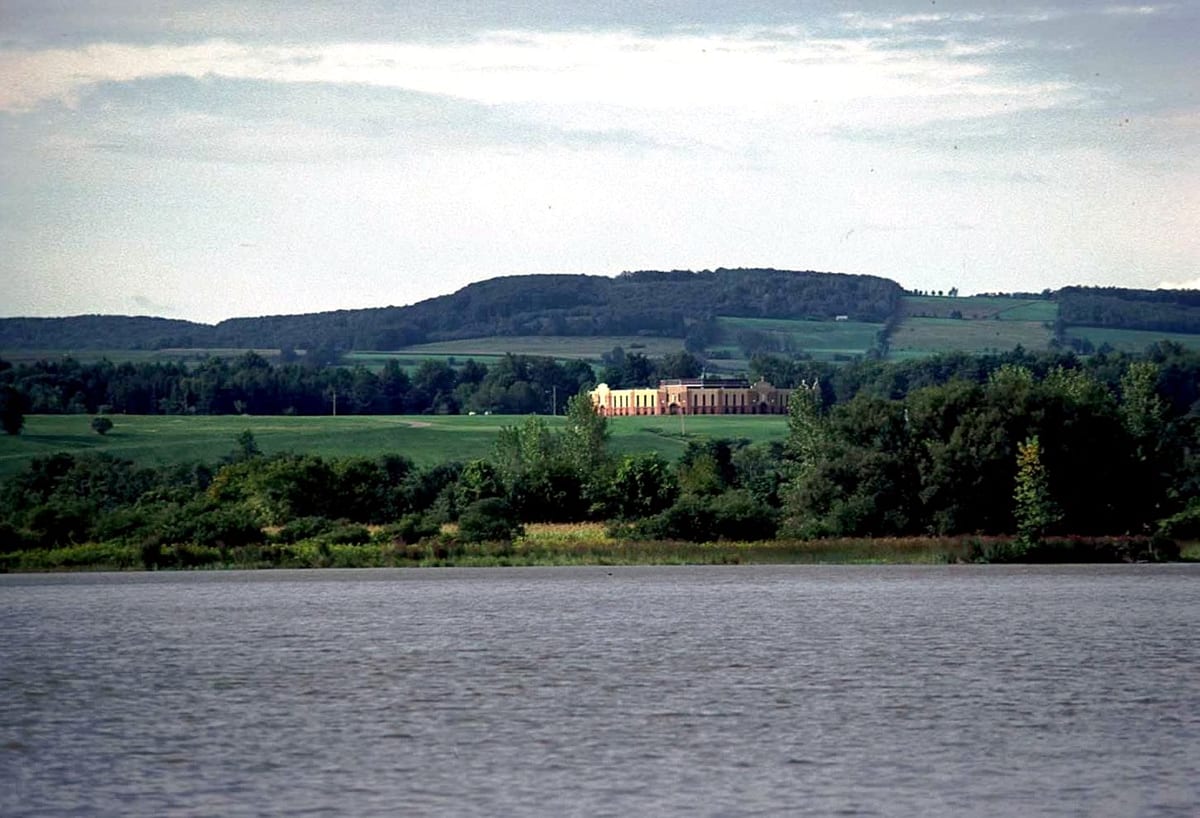
The Shrine of the North American Martyrs at Auriesville, New York, seen from the Mohawk River, Andrew Balet (photograph), 28 July 1986 AD Andrew Balet (photograph), Wikimedia Commons (author's upload) St. Kateri's mother was a Christian Algonquin, baptised at Trois-Rivières. The Iroquois took her prisoner and kept her in their country, where a Mohawk man married her. He was not a Christian.
In 1660 AD smallpox killed St. Kateri's father, mother and brother within a few days. Her mother died regretting only that her two children were not baptised. St. Kateri, aged four, survived with a pock-marked face and eyes that could not bear strong light.
-
1660–1667 AD
Three guests in the lodge
An orphan raised by her uncle, a chief opposed to the faith, looks after three Jesuit missionaries during their three days in his lodge.
St. Kateri was raised by her aunts and her uncle, chief of the Turtle clan. Her uncle was a declared enemy of the Christian faith and held fast to the customs of his people. St. Kateri ground the corn, fetched water and carried wood for the lodge.
After French troops burned Mohawk villages in 1666 AD, the Mohawks made peace and asked for missionaries. In September 1667 AD three Jesuits arrived, and her uncle received them. St. Kateri lodged and served them for three days, and their piety and courtesy impressed her.
-
c. 1670–1675 AD
She walks out of her own engagement
St. Kateri's relatives engage her to a young man without telling her; she walks out of the lodge and pays for it with hard treatment.
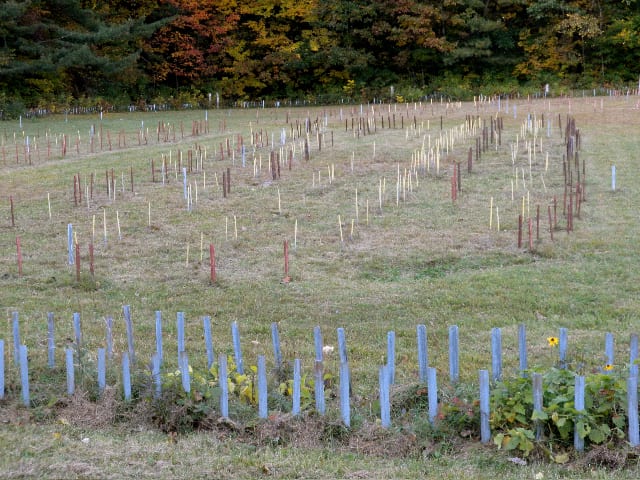
Caughnawaga Indian Village Site, Fonda, New York, Emporostheoros (photograph), October 2009 AD Emporostheoros (photograph), Wikimedia Commons (author's upload); site at the Saint Kateri National Shrine, Fonda Her aunts and uncle wanted her married to a hunter who would bring game to the lodge. They engaged her to a young man without telling her. One evening he came into the lodge and sat down beside her.
St. Kateri blushed, stood up and walked out, and would not come back while he stayed. Among her people it was a disgrace for a woman to stay unmarried. Her relatives then treated her as a slave and gave her the hardest work.
-
c. 1670–1676 AD
A priest at the cabin door
An injured foot keeps St. Kateri at home when a missionary passes, and after months of instruction he baptises her at Easter.
Some thirty or forty Christians left her village for a new mission near Montreal, and her uncle was enraged. St. Kateri went to the missionaries' instructions but never dared see a priest alone, partly from fear of her uncle. One day an injured foot kept her lying in the cabin while most of the women worked in the fields.
Passing through the village, Father Jacques de Lamberville, its missionary, felt a sudden urge to go into her cabin. She told him she had long wanted to become a Christian. He instructed her for months and baptised her on Easter Sunday 1676 AD and named her Kateri, a form of Catherine, after St. Catherine of Siena.
-
1676–1677 AD
Pebbles on the chapel path, then flight
Harassed at home for her new faith, St. Kateri escapes with three converts to a Christian mission across the St. Lawrence from Montreal.
For more than a year after her baptism, her family made her life hard. They sometimes kept food from her because she would not work on Sundays. People threw pebbles at her on her way to the chapel.
Her adopted sister and the sister's husband, both Christians, had already moved to the mission of Saint-François-Xavier, across the St. Lawrence from Montreal. Father de Lamberville urged her to go there too, and in the autumn of 1677 AD she escaped from her village with the help of three converts. She reached the mission at the end of that autumn, aged twenty-one, carrying a letter from Father de Lamberville to its Jesuits.
“ie uous enuoye un threfor gardes le bien. (I send you a treasure; guard it well.)”
Father Jacques de Lamberville to the Jesuit Fathers at the Sault, in the letter St. Kateri carried, 1677 AD -
1677–1679 AD
A vow at the mission
At the mission St. Kateri makes her first Communion, spends much of each day in the chapel, refuses marriage again and takes a vow of virginity.
Father Pierre Cholenec, a Jesuit at the mission, admitted her to first Communion at Christmas 1677 AD. She came to the chapel at four in the morning and heard Mass at dawn and again at sunset. Later she stopped going into the woods with her people each winter to hunt, and spent the winter at the mission village instead.
Her relatives, and Anastasia Tegonhatsihongo, her late mother's friend, kept pressing her to marry. She hoped instead to found a convent on Heron Island with her friend Marie-Thérèse Tegaiaguenta, but the plan was never carried out. On March 25, 1679 AD she took a vow of perpetual virginity.
“Mon Père, sans doute le séjour dans les bois fera du bien à mon corps, parce que j'y serai mieux nourrie et aurai moins de travail, mais mon âme y souffrira de la faim et s'y affaiblira. (Father, no doubt the stay in the woods would do my body good, because I would be better fed and have less work, but my soul would go hungry there and grow weak.)”
St. Kateri Tekakwitha to Father Pierre Cholenec -
April 17, 1680 AD
Holy Week at the mission
St. Kateri dies in the cabin of Anastasia, her late mother's friend, on Wednesday of Holy Week, and her confessor sees her scarred face change.
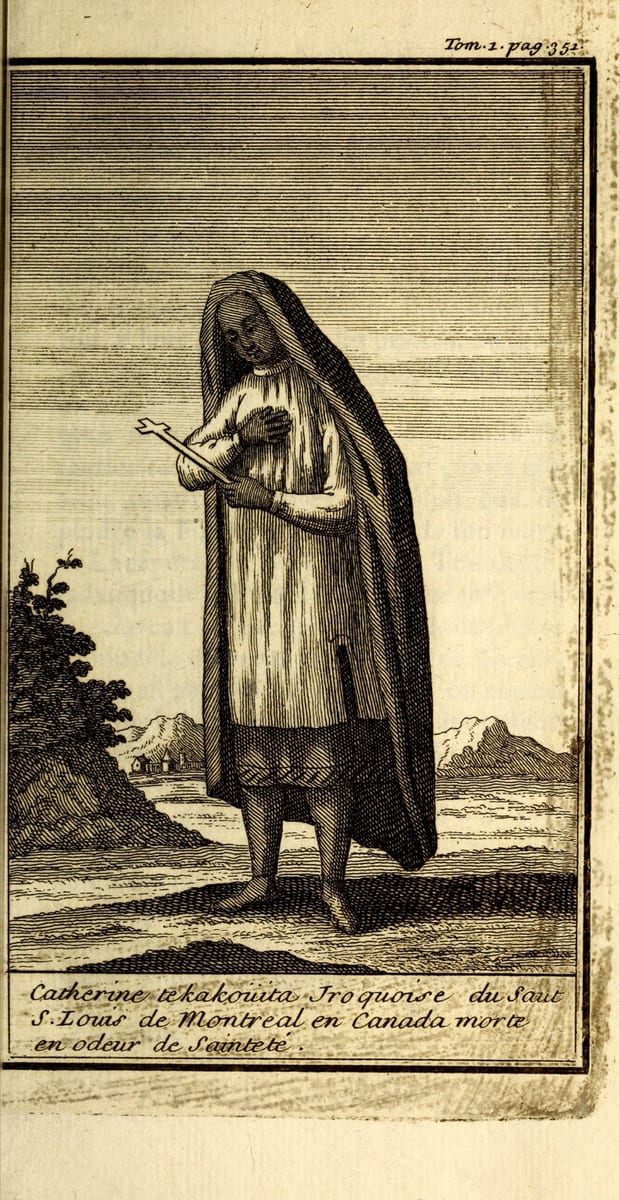
Catherine tekakoüita Iroquoise du Saut S. Louis de Montreal en Canada morte en odeur de Sainteté (plate facing tome 1, p. 351, of Bacqueville de La Potherie, Histoire de l'Amérique septentrionale), Jean-Baptiste Scotin (engraver), for Claude-Charles Le Roy, Bacqueville de La Potherie, plate first published 1722 AD (Paris: Nion and Didot); this impression from the 1753 AD edition Jean-Baptiste Scotin (engraver), for Claude-Charles Le Roy, Bacqueville de La Potherie, Smithsonian Libraries, via Internet Archive Book Images (Flickr Commons) Her last illness came in Lent 1680 AD, and she lay in Anastasia's cabin. On Tuesday of Holy Week Father Cholenec carried the Host from the church to her cabin to give her Viaticum, the Communion of the dying. She received Extreme Unction on Wednesday, April 17.
She lived until three in the afternoon, waiting for the women who had gone into the woods to cut wood to come back. She died with them present, speaking the names of Jesus and Mary. About a quarter of an hour later, Father Cholenec saw her scarred face become beautiful.
“But this face, thus emaciated and marked, changed all at once, about a quarter of an hour after her death; and it became in an instant so beautiful and so fair that, having perceived it at once (for I was in prayer near her), I gave a great cry, so much was I seized with astonishment”
Father Pierre Cholenec, praying beside her body after her death, April 17, 1680 AD -
1681–2012 AD
From a mission grave to the altars
From 1681 AD, cures are reported at the mission through the intercession of St. Kateri.
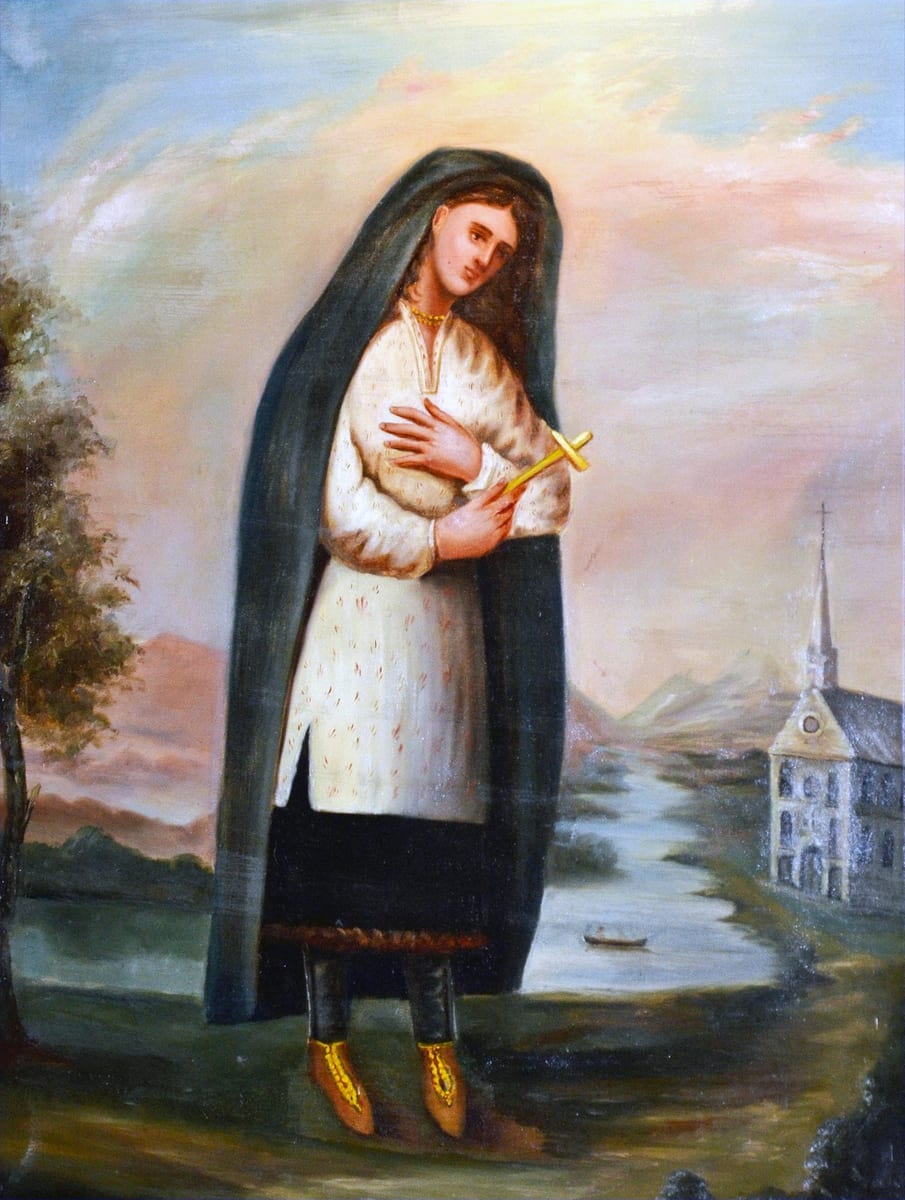
Sainte Kateri (the Kahnawake portrait, long attributed to Claude Chauchetière), Joseph Légaré (attributed; formerly attributed to Claude Chauchetière, SJ), c. 1843 AD Joseph Légaré (attributed; formerly attributed to Claude Chauchetière, SJ), Saint Francis Xavier Mission, Kahnawake (the shrine museum); photographed April 14, 2012 AD From 1681 AD, cures were reported at the mission through her intercession. In 1684 AD her body was moved into the mission church, where people often came to visit it. On January 3, 1943 AD the Church issued the decree on her virtues and named her Venerable.
Pope John Paul II beatified her in St. Peter's on June 22, 1980 AD. In his homily Pope John Paul II said her vow of perpetual virginity was, as far as was known, the first among the North American Indians. Pope Benedict XVI canonized her in Saint Peter's Square on October 21, 2012 AD.
“Her greatest wish was to know and to do what pleased God.”
Pope Benedict XVI to the faithful in Saint Peter's Square, in his homily at her canonization Mass, October 21, 2012 AD


_(14577115098).jpg)

Pray with the Church
Invocation of Saint Kateri at her canonization
Pope Benedict XVI, homily at the Mass of canonization, Saint Peter's Square, October 21, 2012 AD
Saint Kateri, Protectress of Canada and the first native American saint, we entrust to you the renewal of the faith in the first nations and in all of North America!May God bless the first nations!
All 1 report on Saint Kateri Tekakwitha

About this picture
AI-generated image, in the manner of a 17th-century pen-and-sepia-wash manuscript drawing, from the paper's reference image based on The First Six Indians of La Prairie Coming from Oneida over the Snow and Ice (Claude Chauchetière, SJ, c. 1686 AD, Bibliothèque et Archives nationales du Québec) View source artwork.
