
Saints Apostle and martyr · Feast October 28
Saint Jude Thaddeus
Feast 28 October · Died Persia (Tradition names Suanir)
Chosen among the Twelve after a night of prayer, Saint Jude Thaddeus questioned the Lord at the Last Supper, prayed with the Blessed Virgin Mary in the upper room, has long been named as the writer of a short New Testament letter and, in Catholic Tradition, died a martyr in Persia beside St. Simon.
Begin the life
In brief
Saint Jude Thaddeus was one of the Twelve whom Jesus chose after a night of prayer. A short New Testament letter carries his name. The Church keeps his feast with St. Simon on October 28, and he is venerated as the patron saint of hopeless causes.
-
First century AD
Two names, one Apostle
The Gospels give him two names, and Pope Benedict XVI explained how they came to be joined.
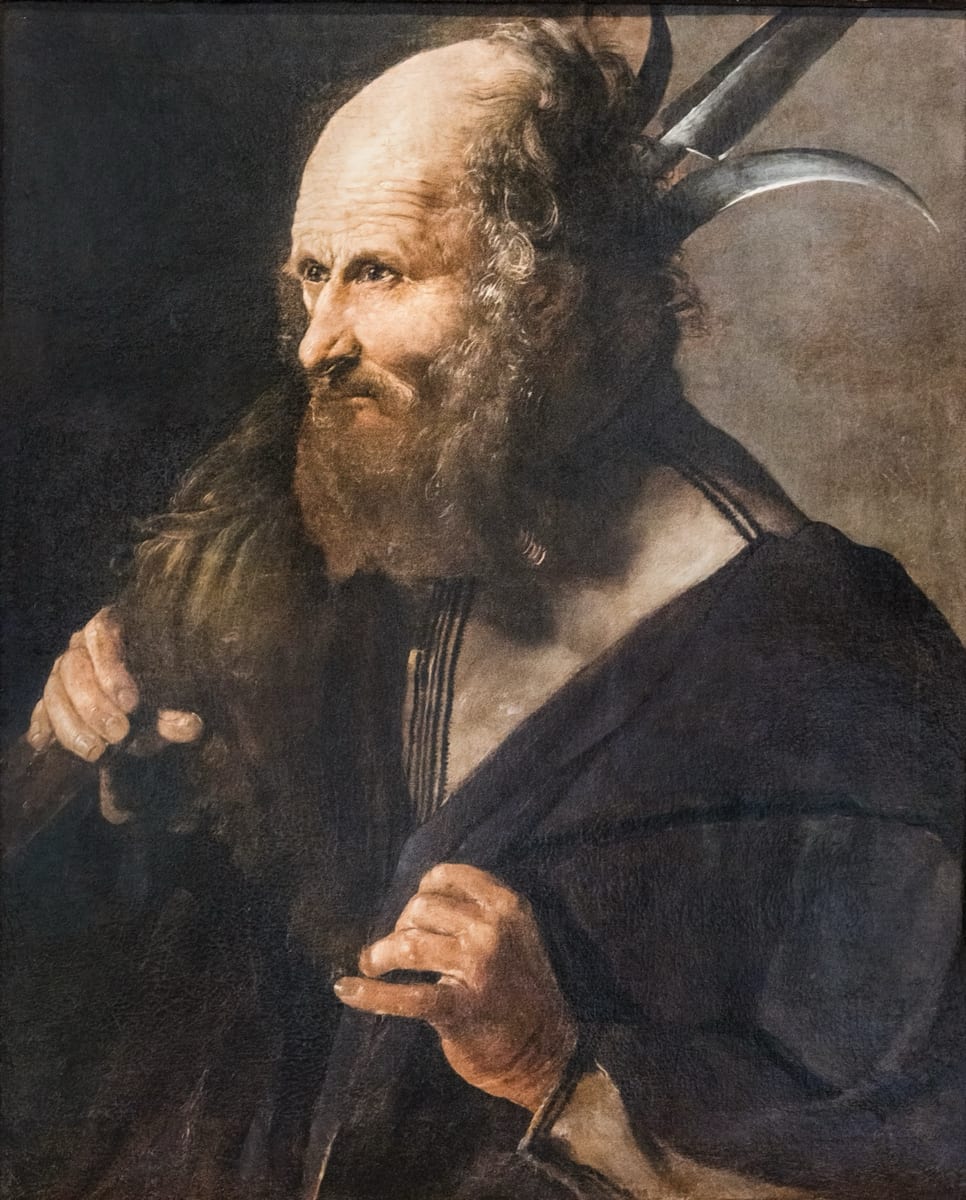
Saint Jude Thaddeus, from the Albi Apostles, Georges de La Tour, circa 1620 AD Georges de La Tour, Musée Toulouse-Lautrec, Albi; photograph Didier Descouens, CC BY-SA 4.0 St. Luke records that Jesus spent a whole night in prayer in the hills and chose twelve apostles at daybreak. In St. Luke's list he is the first of two men named Judas, set apart from Judas Iscariot, who became a traitor. St. Matthew and St. Mark name Thaddaeus instead, right after St. James the son of Alphaeus.
Pope Benedict XVI said that Tradition combined the two names, and the Roman Martyrology calls him Thaddeus, who is called Jude. The Pope said the name Thaddaeus may come from the Aramaic word for breast, and would then suggest a big-hearted man. In every list of the Twelve, St. Jude stands next to St. Simon.
“Simon, whom he named Peter, and Andrew his brother, and James and John, and Philip, and Bartholomew, and Matthew, and Thomas, and James the son of Alphaeus, and Simon who was called the Zealot, and Judas the son of James, and Judas Iscariot, who became a traitor.”
The Gospel according to Luke, the naming of the Twelve, after a night of prayer in the hills -
First century AD
A question at the Last Supper
St. Jude asked the Lord why he would reveal himself to the apostles and not to the world, and Jesus answered him.
At the Last Supper, St. Jude asked Jesus why he would reveal himself to the apostles and not to the world. St. John's Gospel names the speaker Judas, not Iscariot, so that no reader takes him for the betrayer.
Jesus answered that whoever loves him will keep his word. The Father would love that person, Jesus said, and they would come and make their home with him. Pope Benedict XVI noted that St. John is the only evangelist to record the question.
“Lord, how is it that you will manifest yourself to us and not to the world?”
St. Jude Thaddeus to Jesus, at the Last Supper -
First century AD
Praying in the upper room
After the Ascension, St. Jude prayed with the other apostles and the Blessed Virgin Mary.
After the Ascension, the eleven apostles gathered in an upper room in Jerusalem. The Acts of the Apostles lists St. Jude last among them, right after St. Simon the Zealot. The apostles spent their time there in prayer, with the women, the Blessed Virgin Mary and the kinsmen of Jesus whom Scripture calls his brethren.
-
First century AD
A short letter of warning
A brief letter in the New Testament, long attributed to St. Jude, warns against men corrupting the faithful.
The writer of the Letter of St. Jude calls himself a servant of Jesus Christ and the brother of St. James. Most Catholic commentators hold that he is the Apostle St. Jude, the one of the Twelve whom St. Matthew and St. Mark call Thaddaeus.
The writer warned that godless men had crept in among the faithful and were using God's grace as an excuse for immorality. He wrote to urge his readers to stand firm, and he closed by giving glory to God. St. Jerome wrote that many rejected the Letter because it quotes the Book of Enoch, but that age and use won it a place among the Holy Scriptures.
“I found it necessary to write appealing to you to contend for the faith which was once for all delivered to the saints.”
St. Jude Thaddeus to the recipients of his Letter, stating why he writes the Letter -
Tradition
Martyrdom in Persia with St. Simon
Tradition sends St. Jude to Mesopotamia and then to Persia, where he and St. Simon were killed together.
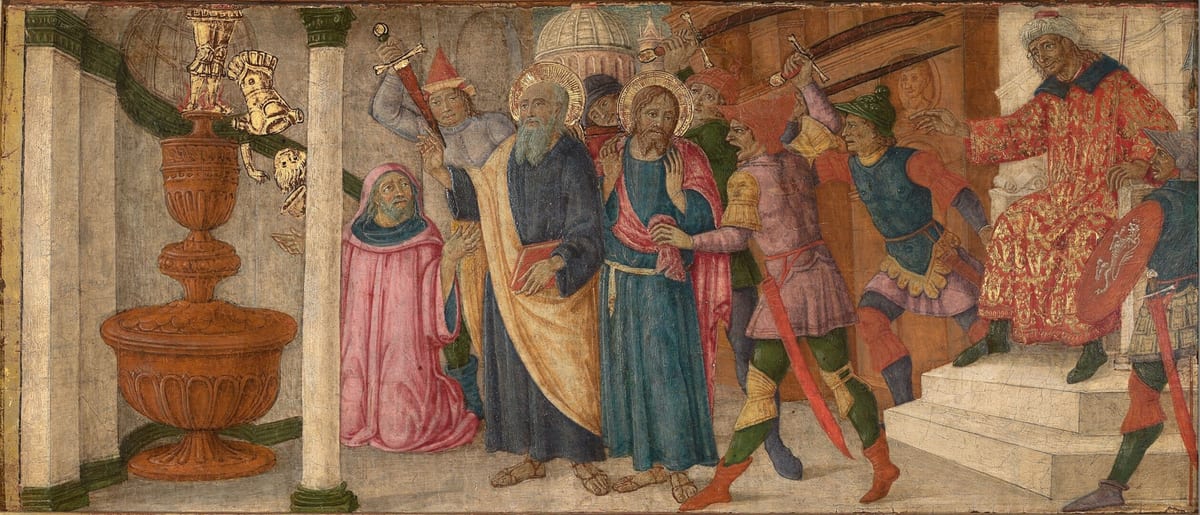
The Martyrdom of St. Simon Zelotes and St. Jude Thaddeus (predella panel), Guidoccio Cozzarelli, 1486 AD Guidoccio Cozzarelli, Museum Boijmans Van Beuningen, Rotterdam According to longstanding Catholic Tradition, kept in the Roman Martyrology, St. Jude preached in Mesopotamia and then entered Persia with St. Simon, where the two converted a great many people. In the Latin Passion ascribed to Abdias, two magicians whom the apostles had defeated, healed and set free went through Persia telling people to kill the apostles when they came. At Suanir the magicians warned the priests that two Hebrews were coming to take away their income, and told them to make the pair sacrifice on arrival.
The priests pressed the apostles to sacrifice in the temple of the sun, and St. Jude told St. Simon that he saw the Lord calling them. An angel then offered them a choice: the death of everyone there, or their own martyrdom. They chose martyrdom, and the priests and the people killed them, along with Sennes, the leading citizen who had given them lodging.
-
Tradition
The Thaddaeus of Edessa
A Tradition of Edessa tells of a Thaddaeus whom St. Thomas sent to heal King Abgarus.
Eusebius records a Tradition from the archives of Edessa in which King Abgarus, who was ill, wrote to Jesus asking him to come and heal him. Jesus wrote back that after he was taken up he would send one of his disciples to heal the king. St. Thomas, one of the Twelve, then sent Thaddaeus, one of the Seventy disciples, to Edessa.
Thaddaeus laid his hand on the king in the name of Jesus, and the king was cured at once. When King Abgarus offered him gold and silver, Thaddaeus refused, saying that men who had given up what was their own could not take what belonged to another. Later Tradition, in the Golden Legend and the Greek Acts of Thaddaeus, says the missionary to Edessa was St. Jude of the Twelve, not one of the Seventy.
-
Feast: October 28
Relics and a shared feast
The relics of St. Jude and St. Simon rest in St. Peter's Basilica, and the Church keeps their feast together.
Catholic Tradition holds, in the Passion ascribed to Abdias, that King Xerxes, whose general the apostles had met on entering Persia, seized the priests' goods three months after the martyrdom and carried the two bodies to his city. There he built a great octagonal church of marble over them. Their relics can be traced from Babylon to Rome and Toulouse, and at Rome they rest under the Altar of the Crucifixion in St. Peter's Basilica.
The Roman Martyrology marks October 28 as the day St. Simon and St. Jude entered heaven. The Western Church keeps their feast together on that day, while the East honours the two apostles separately. Thirty-eight old manuscripts set the same opening prayer for the Mass of their feast, and the Missal of 1962 AD still uses it.
-
1929–1962 AD
The patron of hopeless causes
Novenas at a Chicago shrine spread devotion to St. Jude across America, and an entertainer's vow to him became a children's hospital.
In 1929 AD the Claretian priest Fr. James Tort founded the National Shrine of St. Jude at Our Lady of Guadalupe Church in Chicago. Few Catholics knew St. Jude then, but Fr. Tort had a strong devotion to him, and night after night he asked St. Jude's intercession for the workers of his parish, many of whom depended on the nearby steel mills. On the feast, October 28, 1929 AD, an overflow crowd came for the last night of a novena there.
Through the Great Depression and the Second World War, thousands came to novenas at the shrine, and the devotion spread across the country. As a young entertainer struggling to find work, Danny Thomas made a vow to St. Jude one night in a Detroit church. The shrine he promised became St. Jude Children's Research Hospital, which opened in Memphis on February 4, 1962 AD.
“Show me my way in life, and I will build you a shrine.”
Danny Thomas to St. Jude, one night in a Detroit church, while he was a struggling entertainer


Pray with the Church
The closing doxology of the Letter of St. Jude
The Letter of St. Jude, verses 24–25 (Revised Standard Version, Catholic Edition), the prayer of praise that closes the Letter attributed to St. Jude
Now to him who is able to keep you from falling and to present you without blemish before the presence of his glory with rejoicing,to the only God, our Savior through Jesus Christ our Lord, be glory, majesty, dominion, and authority, before all time and now and for ever. Amen.
All 2 reports on Saint Jude Thaddeus

About this picture
AI-generated image, in the manner of a Caravaggesque Baroque oil on canvas, from the paper's reference portrait based on Saint Jude Thaddeus, from the Albi Apostles (Georges de La Tour, circa 1620, Musée Toulouse-Lautrec, Albi; photograph Didier Descouens, CC BY-SA 4.0) View source artwork.
Given the choice, St. Jude and St. Simon die so their attackers live
