
Saints Carmelite friar, poet and Doctor of the Church · 1542–1591 AD
Saint John of the Cross
Feast 14 December · Born 1542 AD, Fontiveros, Ávila, Old Castile, Spain · Died December 14, 1591 AD, Discalced Carmelite convent, Úbeda, Jaén, Spain
A poor boy from Castile who nursed the sick became the first friar of St. Teresa of Ávila's reform, was jailed at Toledo by friars of his own order, wrote the Spiritual Canticle in his cell, and died stripped of office at Úbeda in 1591 AD.
Begin the life
In brief
Saint John of the Cross, born Juan de Yepes at Fontiveros in Spain in 1542 AD, was the first friar of Saint Teresa of Ávila's reform of the Carmelite Order. Friars of his own order who opposed the reform jailed him at Toledo, and in that cell he composed the Spiritual Canticle. He died at Úbeda in 1591 AD, was canonised in 1726 AD and was declared a Doctor of the Church in 1926 AD.
-
1542–1563 AD
The boy at the hospital in Medina
A disinherited family, a string of failed trades, and a place nursing the sick poor.
Juan de Yepes, the future St. John of the Cross, was born in 1542 AD at Fontiveros, a village near Ávila. His noble family disowned his father, Gonzalo de Yepes, because Gonzalo married Catalina Álvarez, a silk weaver. Gonzalo died while the boy was small, and some days Catalina and her sons had nothing to eat but barley bread.
At Medina del Campo, Juan de Yepes tried carpentry, tailoring, wood-carving and painting, and had no gift for any of them. Don Alonso Álvarez de Toledo, a gentleman who had given up life in society to serve the poor, took the boy on as a nurse at the Hospital of the Conception. Juan de Yepes sat with the sick day and night, begged alms for them, and studied Latin at the new Jesuit college in the town.
-
1563–1567 AD
The young priest who meant to leave
A strict young Carmelite plans to join the Carthusians until Saint Teresa of Ávila asks him to stay.
In 1563 AD Juan de Yepes entered the Carmelite priory of St. Anne at Medina and took the name Fray Juan de Santo Matía. He asked to be a lay brother and was refused. At the Carmelite college in Salamanca he slept on straw in an old bread-kneading trough.
Fray Juan de Santo Matía was ordained a priest in 1567 AD, but he felt unequal to a priest's responsibilities and decided to become a Carthusian. That year St. Teresa of Ávila came to Medina to found a convent, and she asked him to stay in his own order and help her reform its friars. He promised to stay, as long as she opened the first house of reformed friars soon.
“Llámase fray Juan de la Cruz. Yo alabé a Nuestro Señor, y hablándole, contentóme mucho, y supe de él cómo se quería ir también a los Cartujos. Yo le dije lo que pretendía, y le rogué mucho esperase hasta que el Señor nos diese monesterio, y el gran bien que sería, si había de mejorarse, ser en su mesma Orden, y cuánto más serviría al Señor. Él me dió palabra de hacerlo, con que no se tardase mucho. (His name is Fray Juan de la Cruz. I praised our Lord, and when I spoke with him he pleased me very much, and I learned from him that he too wanted to go to the Carthusians. I told him what I had in mind and begged him earnestly to wait until the Lord gave us a monastery, and what a great good it would be, if he was to rise higher, to do it within his own Order, and how much more he would serve the Lord. He gave me his word to do so, provided it was not long delayed.)”
St. Teresa of Ávila, Book of the Foundations, chapter 3, on their first meeting at Medina in 1567 -
1568 AD
First friar at Duruelo
In a lonely farmhouse the young friar puts on the habit of the reform and takes a new name.
On August 9, 1568 AD, Fray Juan de Santo Matía set out with St. Teresa of Ávila for Valladolid to learn her way of life. At the end of September he reached a lonely farmhouse at Duruelo that had been offered to her for the first house of friars. He spent the night in prayer, blessed the habit of the reform on the altar, and put it on after Mass.
For two months he said Mass there alone. On November 28, 1568 AD, the first Sunday of Advent, Fray Antonio de Heredia and a lay brother, Fray José, knelt with him before the Blessed Sacrament and renewed their vows under the original rule. The friars then took new religious names, and Fray Juan de Santo Matía became St. John of the Cross.
-
1572–1577 AD
Confessor to the nuns of Ávila
Five years hearing confessions at the Incarnation, while the older branch of the order turns against the reform.
St. Teresa of Ávila, made prioress of the Incarnation convent at Ávila in 1571 AD, asked for two confessors from her reform. St. John of the Cross was sent with Fray Germán de San Matías, and the two lodged near the convent. He heard the nuns' confessions there for five years.
The reformed friars gave up the relaxations popes had allowed in the original Carmelite rule, and they became the Discalced. The friars of the older observance opposed them, and their general chapter, meeting at Piacenza in the duchy of Parma, resolved to destroy the reform.
“Gran provecho hace este Descalzo, que confiesa aquí: es fray Juan de la Cruz (The barefooted friar who is confessor here is doing great things; he is fra John of the Cross.)”
St. Teresa of Ávila to her sister Doña Juana, letter from the Incarnation, 27 September 1572 -
December 1577 AD–August 1578 AD
Nine months in a Toledo cell
Seized by night, St. John of the Cross is tried by friars of the older branch of his order and locked in a cell, where he writes poetry.
On the night of December 3, 1577 AD, friars of the older observance came with armed men and seized St. John of the Cross and Fray Germán, gagging and binding them. At Toledo, when he refused to return to the older observance, its judges ordered him imprisoned, scourged and fed on bread and water. In March 1578 AD, when word came that Fray Germán had escaped, St. John of the Cross was kept more harshly still.
His cell was so small that even he, a very short man, barely fitted into it. He came close to death there, and in nine months he never changed his tunic. In that cell he composed the Spiritual Canticle and other poems.
“¿A dónde te escondiste, Amado, y me dejaste con gemido? Como el ciervo huiste, Habiéndome herido; Salí tras tí clamando, y eras ido. (Where have you hidden, Beloved, and left me moaning? You fled like the stag, having wounded me; I went out after you, calling, and you were gone.)”
St. John of the Cross, opening stanza of the 'Cántico espiritual', begun in the Toledo prison -
August 1578 AD
Down a rope above the river
A night escape from the priory window, a knock at the nuns' door, and six weeks in hiding.
According to longstanding Catholic Tradition, Our Lady showed St. John of the Cross in a vision a window of the priory above the Tagus, from which he was to climb down. One night in August 1578 AD, at about two in the morning, he took up the rope he had made. He let himself down from a lookout window near his cell, facing the river, into a courtyard of Franciscan nuns.
At about five he knocked at the door of the Discalced Carmelite nuns of Toledo. A sick sister inside was asking for a confessor, and he heard her confession. A canon, Don Pedro González de Mendoza, then hid him for about six weeks in the Hospital of Santa Cruz.
“Hija, fray Juan de la Cruz soy; que me he salido esta noche de la cárcel. Oígaselo a la Madre Priora. (Daughter, I am Fray Juan de la Cruz; I got out of the prison tonight. Tell Mother Prioress.)”
St. John of the Cross to Sister Leonor de Jesús, portress of the Discalced nuns of Toledo -
1578–1588 AD
Prior and writer in the south
Ten years of priories in Andalusia, a move on foot with one donkey, and the treatises written at Granada.
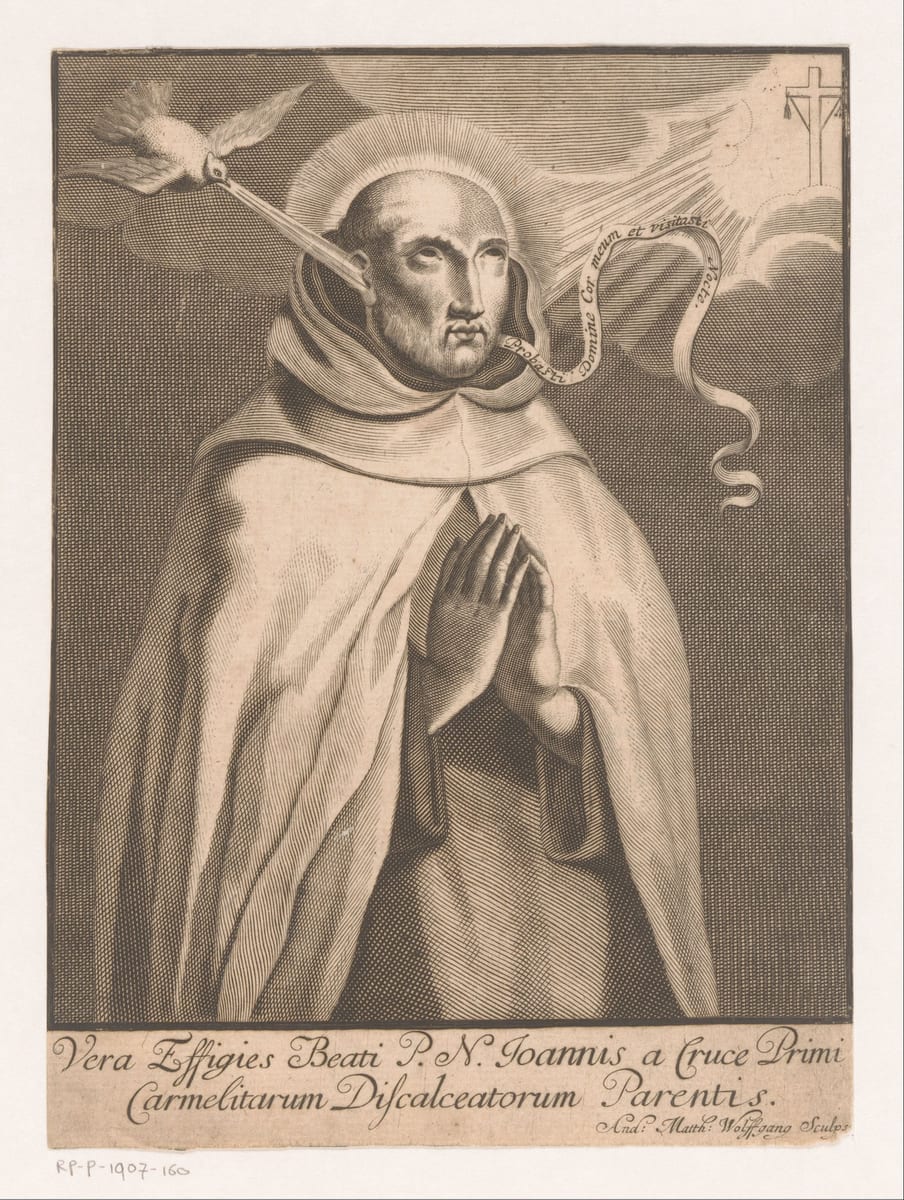
Vera Effigies Beati P. N. Ioannis a Cruce Primi Carmelitarum Discalceatorum Parentis, Andreas Matthäus Wolfgang, between 1670 AD and 1737 AD Andreas Matthäus Wolfgang, Rijksmuseum, Amsterdam Two of Don Pedro's servants then took St. John of the Cross to the Discalced friars at Almodóvar del Campo. In October 1578 AD a chapter there named him prior of El Calvario, a friary deep in the province of Jaén. On his way he stopped, thin and weary, at the Carmel of Beas, where the prioress, Venerable Ana de Jesús, had two nuns sing spiritual verses for him.
In 1579 AD he led his friars from El Calvario to found a house at Baeza, on foot and fasting, with all their furniture on one donkey. As prior of Los Mártires at Granada, he organised relief for the poor in the famine of 1584 AD. At Granada he finished the Spiritual Canticle and the Ascent of Mount Carmel, and wrote the Dark Night and the Living Flame of Love.
“En lo que toca al haber visto escribir a nuestro venerable Padre los libros, se los vi escribir todos; porque, como he dicho, era el que andaba a su lado. La Subida del Monte Carmelo y Noche Oscura escribió aquí en esta casa de Granada, poco a poco, que no lo continuó sino con muchas quiebras. (As to having seen our venerable Father write the books, I saw him write them all, because, as I have said, I was the one who went about at his side. The Ascent of Mount Carmel and the Dark Night he wrote here in this house of Granada, little by little, for he carried it on only with many interruptions.)”
Fray Juan Evangelista to Fray Jerónimo de San José, letter from Granada on where he wrote his books -
1591 AD
Stripped of office, dead at Úbeda
St. John of the Cross loses every office at a chapter in Madrid, falls ill at a friary in the mountains, and dies at Úbeda.
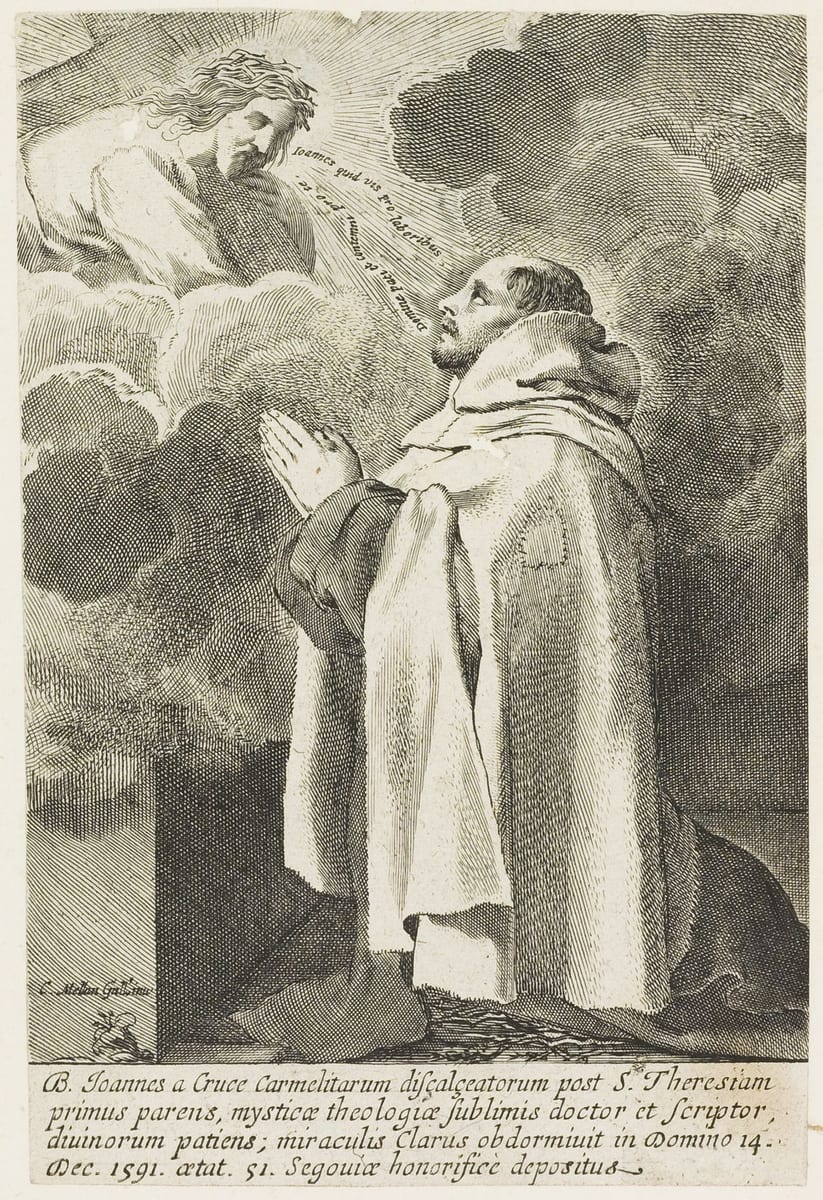
B. Joannes a Cruce, Claude Mellan, 17th century Claude Mellan, KU Leuven Libraries At a chapter of the order in Madrid in June 1591 AD, St. John of the Cross spoke against harsh measures to punish Father Jerónimo Gracián, a former provincial of the Discalced, for disobedience. Nicolás Doria, the vicar general, presided, and the chapter took away the posts St. John of the Cross held in the government of the Discalced, definitor and councillor. Ill with a daily fever at the friary of La Peñuela, near Jaén, he went to Úbeda for treatment in September.
Catholic Tradition, recorded in the bull of his canonisation, holds that he knew beforehand the day and the hour of his death. On December 13, the feast of St. Lucy, he asked what day of the week it was, and after that asked only the hour. He kissed the crucifix and died in the night of December 13–14, 1591 AD, while the friars were reciting Matins.
“Helo preguntado, porque, gloria a mi Dios, tengo de ir esta noche a cantar Maytines al cielo. (I asked it because, glory to my God, I am to go tonight to sing Matins in heaven.)”
St. John of the Cross, after asking the hour on his last day, 13 December 1591


Pray with the Church
Collect for the feast of St. John of the Cross
Roman Breviary, prayer of the Office for his feast, in the English translation transcribed by Divinum Officium
O God, who didst give to blessed John, thy Confessor and Doctor, grace to shew forth a singular love of perfect self-denial and of bearing thy Cross: grant, we beseech thee; that we, cleaving steadfastly to his pattern, may attain to everlasting glory.
All 2 reports on Saint John of the Cross

About this picture
AI-generated image, in the manner of Spanish provincial oil painting of about 1600, from the paper's reference portrait based on Vera Effigies Beati P. N. Ioannis a Cruce Primi Carmelitarum Discalceatorum Parentis (Andreas Matthäus Wolfgang, between 1670 and 1737, Rijksmuseum, Amsterdam) View source artwork.
St. John of the Cross brings St. Teresa's nuns through bitter cold

About this picture
AI-generated image, in the manner of Spanish provincial oil painting of about 1600, from the paper's reference portrait based on Vera Effigies Beati P. N. Ioannis a Cruce Primi Carmelitarum Discalceatorum Parentis (Andreas Matthäus Wolfgang, between 1670 and 1737, Rijksmuseum, Amsterdam) View source artwork.