
Saints Virgin and Martyr of Syracuse
Saint Lucy of Syracuse
Feast 13 December · Born 283 AD, Syracuse, Sicily, Italy · Died 304 AD, Syracuse, Sicily, Italy
A young woman of Syracuse killed in the persecution of Diocletian, whose name has stood in the Canon of the Mass since the time of Pope Gregory the Great.
Begin the life
In brief
Saint Lucy of Syracuse, commonly known as Santa Lucia, was a young Sicilian woman put to death in the persecution of Diocletian. She died at Syracuse on December 13, 304 AD, and the Church has kept that day for her ever since. According to longstanding Catholic Tradition, she was born to a wealthy Syracusan family, vowed her virginity to God, and gave her dowry away to the poor.
-
c. 283–300 AD
A girl of Syracuse
A rich house, a father dead early, and a mother ill for years.
According to longstanding Catholic Tradition, St. Lucy was born at Syracuse about 283 AD to rich and noble parents. Her father was of Roman origin and died while she was still a child. Her mother, Eutychia, did not remarry, and raised her in the faith of Christ.
Eutychia was ill for years with a flux of blood, and her daughter nursed her.
-
c. 301 AD
A marriage she did not want
A vow her mother knew nothing about, and a wedding she kept putting off.
Tradition holds that St. Lucy, while still very young, vowed her virginity to Christ without telling her mother. Knowing nothing of it, Eutychia promised her to a young man of good family who was not a Christian, and pressed the match as an advantageous one.
She kept the wish to herself and put the wedding off with one pretext after another.
-
February 301 AD
At the tomb of Saint Agatha
A journey to Catania for a cure, on the feast day of another Sicilian martyr.
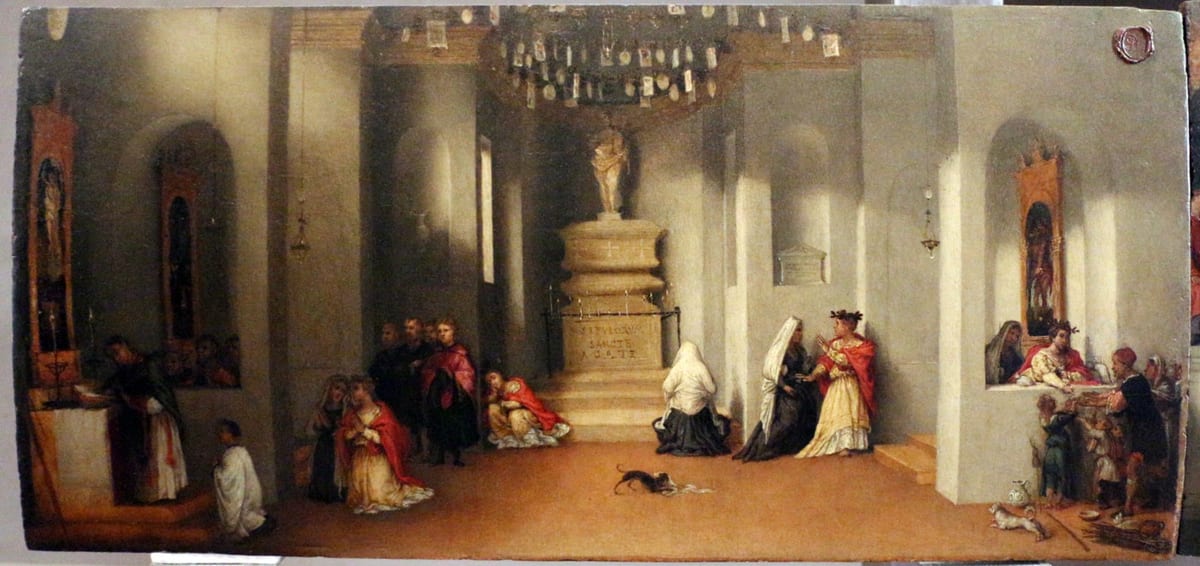
Pala di Santa Lucia, predella, first compartment - St. Lucy at the tomb of St. Agatha: the healing of Eutychia, and the dedication of her goods to the poor, Lorenzo Lotto; photograph by Francesco Bini (Sailko), 1523-1532 AD Lorenzo Lotto; photograph by Francesco Bini (Sailko), Pinacoteca Civica e Galleria di Arte Contemporanea, Jesi Saint Agatha had been executed at Catania fifty-two years earlier, and miracles were worked at her relics there. Tradition holds that St. Lucy took her mother to that tomb, to beg a cure no physician had managed. They came to the foot of Mount Etna on February 5, St. Agatha's own feast day.
She fell asleep at the grave and saw St. Agatha standing among the angels. St. Agatha announced to her both her martyrdom and her patronage of Syracuse. Her mother's bleeding stopped at the tomb.
-
301–303 AD
She sold what she had
A dowry recovered from her mother and given away to the poor.
Tradition holds that St. Lucy asked her mother there never to raise marriage with her again. Eutychia had held the patrimony nine years, and St. Lucy recovered it and dispersed it among the poor.
Mother and daughter gave daily until nearly all their property and their jewels were sold. Word of the selling reached the man she was promised to, and he demanded the truth of it.
-
303–304 AD
Before the governor
A rejected suitor went to the authorities, and a sentence could not be carried out.
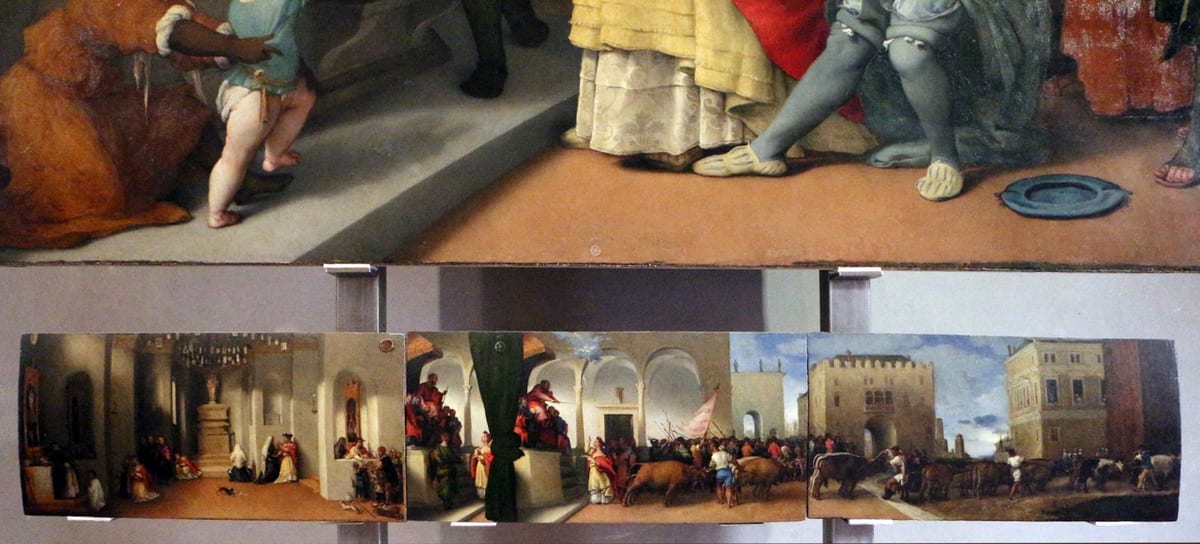
Pala di Santa Lucia, predella - St. Lucy condemned, and dragged in vain by oxen, Lorenzo Lotto; photograph by Francesco Bini (Sailko), 1523-1532 AD Lorenzo Lotto; photograph by Francesco Bini (Sailko), Pinacoteca Civica e Galleria di Arte Contemporanea, Jesi Tradition holds that the rejected suitor went before Paschasius, the governor, and accused her of being a Christian and of breaking the emperor's law. Arrested and questioned, she refused to sacrifice to the gods and professed her faith. The Roman Martyrology records that Paschasius then ordered her handed over to profligates, so that her chastity might be insulted.
The men sent to take her away pushed and dragged at her until they streamed with sweat. Ropes were tied to her hands and feet, and then oxen were yoked to her. She did not move, and the Roman Martyrology records the same failure in its entry for her day.
-
December 13, 304 AD
The day she died
A fire that would not burn her, and then the sword.
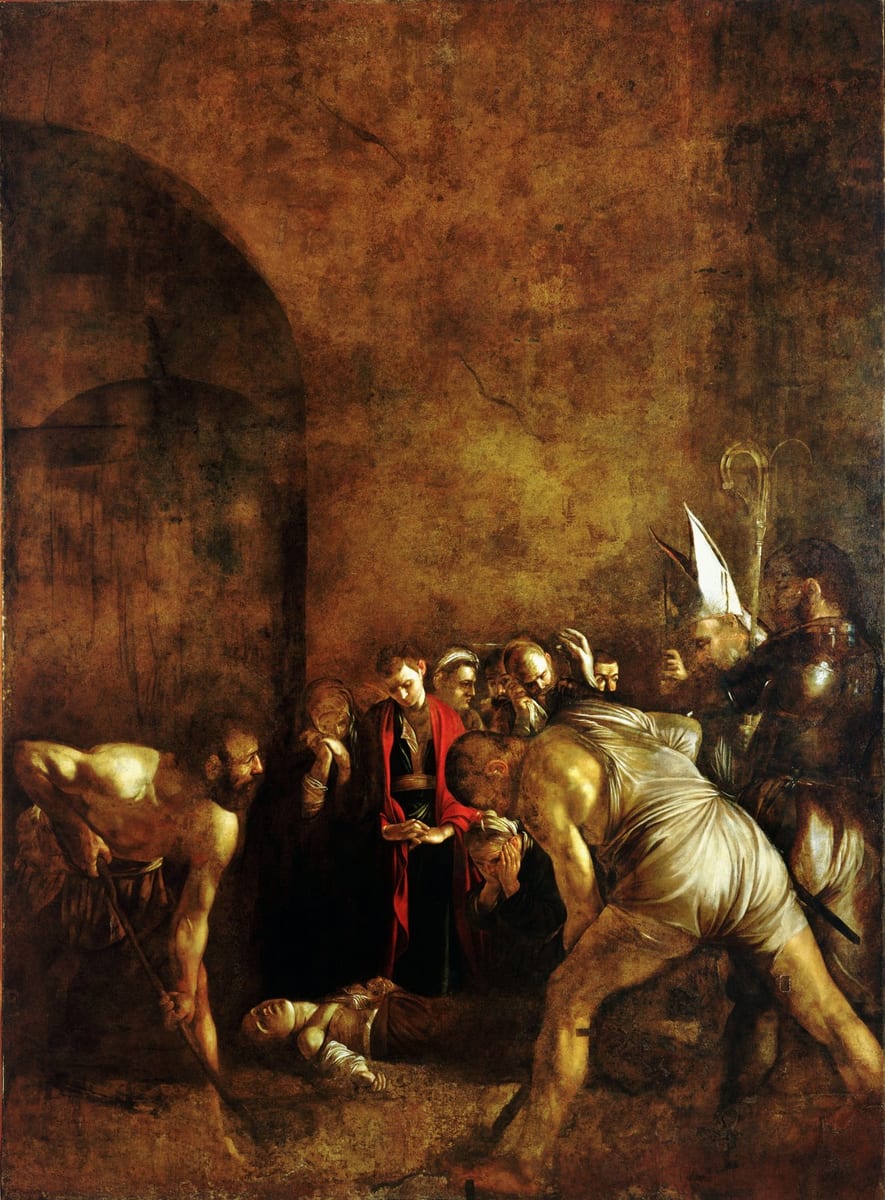
Il seppellimento di Santa Lucia (The Burial of Saint Lucy), Michelangelo Merisi da Caravaggio (1571-1610 AD), 1608-1609 AD Michelangelo Merisi da Caravaggio (1571-1610 AD), Painted as the high altarpiece of the Basilica di Santa Lucia al Sepolcro (fuori le Mura), Syracuse, on the site where Tradition places her martyrdom and her grave; since 2009 AD in the Chiesa di Santa Lucia alla Badia, Syracuse Tradition holds that a fire was heaped about her with pitch, resin and boiling oil, and that she stood in it unharmed. She died by the sword at Syracuse on December 13, 304 AD. By the same Tradition, wounded and still living, she told the people standing by that the Church would have peace.
A church was raised on the place of her death, and her body was laid in the rock-cut galleries of the catacomb that bears her name. Two sites about a hundred metres apart, both within that catacomb, are pointed out as the place of the martyrdom.
“AT Syracuse, in Sicily, the birthday of St. Lucy, virgin and martyr, in the persecution of Dio-cletian.”
The Roman Martyrology, the entry for 13 December -
c. 400–590 AD
A name in the Church's books
A gravestone at Syracuse, a Mass of her own, and her name said at the altar in Rome.
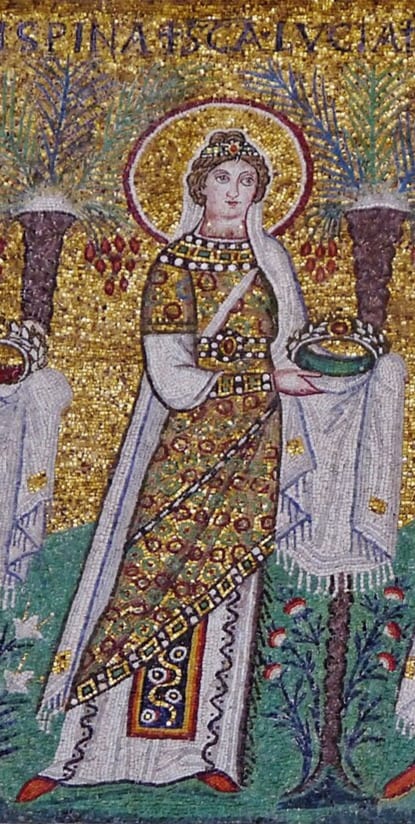
SCA LVCIA, from the mosaic procession of the virgin martyrs, north wall of the nave, Basilica of Sant'Apollinare Nuovo, Ravenna, Byzantine mosaicists of Ravenna, under Bishop Agnellus; crop by the Wikimedia contributor Zairon from his photograph of the nave, sixth century AD, c. 550-561 AD Byzantine mosaicists of Ravenna, under Bishop Agnellus; crop by the Wikimedia contributor Zairon from his photograph of the nave, Basilica di Sant'Apollinare Nuovo, Ravenna A marble plaque cut in Greek at Syracuse in the early fifth century commemorates a young woman named Euskia. Her family dated her death by the feast of St. Lucy, and the stone is the earliest evidence of the martyr's cult. Paolo Orsi found it in the Catacomb of San Giovanni on June 22, 1894 AD.
The Gregorian Sacramentary keeps December 13 as her day, with a Mass of its own. Her name stands in the Roman Canon of the Mass among seven women martyrs, beside St. Agatha's.
“cum tuis Sanctis apostolis et martyribus cum iohanne stephano matthia barnaba ignatio alexandro marcellino petro felicitate perpetua agatha lucia agne cecilia anastasia . et cum omnibus Sanctis tuis.”
The Roman Canon of the Mass, in the Gregorian Sacramentary, in the Nobis quoque peccatoribus of the Canon -
1204–2024 AD
The body and the city
Venice has kept her for eight centuries, and gave her back for twelve days.
The Venetians brought her body to their city in 1204 AD, during the Fourth Crusade. Since July 11, 1860 AD it has lain at the church of Santi Geremia e Lucia on the Canale di Cannaregio. The Archdiocese of Syracuse says the absence of the body has never weakened the devotion paid to her in her own city.
In 2024 AD the Patriarch of Venice consented to a temporary return and the Holy See authorised it. The body was carried to Syracuse on December 14, 2024 AD and stayed until December 26. Pope Francis wrote to the archdiocese on the feast day, and said that the martyrdom of St. Lucy educates the Church in weeping, compassion and tenderness.
“God is light and in Him is no darkness at all”
The First Letter of St. John, quoted by Pope Francis to the Church of Syracuse, December 13, 2024 AD


.jpg)

Pray with the Church
A Prayer to Saint Lucy
From the Advent volume of The Liturgical Year by Dom Prosper Guéranger, at the feast of December 13, in the English of Dom Laurence Shepherd
We present ourselves before thee, O Virgin Martyr, beseeching thee to obtain for us that we may recognise in his lowliness that same Jesus whom thou now seest in his glory.Take us under thy powerful patronage.Thy name signifies Light; guide us through the dark night of this life.O fair Light of Virginity! enlighten us; evil concupiscence has wounded our eyes: pray for us, O thou bright Light of Virginity! that our blindness be healed, and that rising above created things, we may be able to see that true Light, which shineth in darkness, but which darkness cannot comprehend.Pray for us, that our eye may be purified, and may see, in the Child who is to be born at Bethlehem, the new Man, the second Adam, the model on which the life of our regeneration must be formed.Pray, too, O holy Virgin, for the Church of Rome and for all those which adopt her form of the Holy Sacrifice; for they daily pronounce at the Altar of God thy sweet name, and the Lamb, who is present, loves to hear it.Heap thy choicest blessings on the fair Isle, which was thy native land, and where grew the palm of thy martyrdom.May thy intercession secure to her inhabitants firmness of faith, purity of morals, and temporal prosperity, and deliver them from the disorders which threaten her with destruction.
All 1 report on Saint Lucy of Syracuse
