
Saints Redemptorist missionary and fourth Bishop of Philadelphia · 1811–1860 AD
Saint John Neumann
Feast 5 January · Born March 28, 1811 AD, Prachatitz (Prachatice), Bohemia, Austrian Empire · Died January 5, 1860 AD, Philadelphia, Pennsylvania, United States
A Bohemian seminarian his own diocese would not ordain crossed alone to New York, worked among settlers near Niagara Falls, built Philadelphia's parish schools as its bishop, and died on a city street.
Begin the life
In brief
Saint John Neumann, also called John Nepomucene Neumann, was a Bohemian seminarian whose own diocese would not ordain him. He crossed alone to New York in 1836 AD, served German settlers near Niagara Falls and joined a missionary order, the Redemptorists. From 1852 AD until his death in 1860 AD, St. John Neumann was the fourth Bishop of Philadelphia, where the parish schools grew from two to nearly one hundred.
-
1811–1832 AD
The boy with a book
A stocking-weaver's son in Bohemia decides on a riverside walk to go to America.
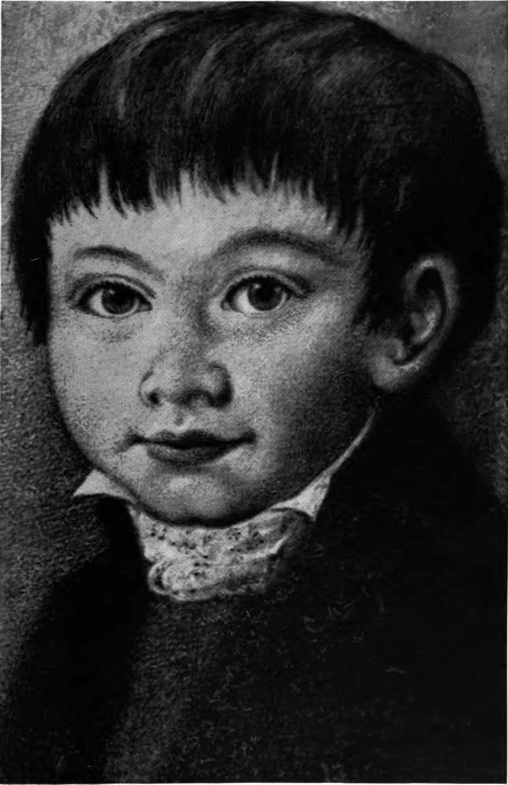
Portrait of John Neumann as a boy (reproduced as 'Portrait of John Neumann About the Age of Ten', Curley 1952 AD, facing p. 18), a friend of the family, unnamed (Curley: 'painted when he was about ten years of age by a friend'; Berger: 'an oil-painting, representing him a little boy of six years'), c. 1817–1821 AD a friend of the family, unnamed (Curley: 'painted when he was about ten years of age by a friend'; Berger: 'an oil-painting, representing him a little boy of six years'), Wikimedia Commons, from the plate in Curley 1952 AD (Google Books 9lHSAAAAMAAJ) St. John Neumann was born at Prachatitz in Bohemia on March 28, 1811 AD, and baptised the same day. He was the third of six children of Philip Neumann, a stocking-weaver from Bavaria, and Agnes Lebis. His mother often scolded him for always having his head in a book.
In 1832 AD, as a seminarian at Budweis, he read letters from missionaries among the Germans of North America. On a walk along the Moldau, he and his friend Adalbert Schmid decided to go there. His parents knew nothing of the plan for nearly three years.
“Indeß hatte ich von meinem Vater, der ein großer Liebhaber von Büchern war, eine gewisse Lesewuth zugezogen, so daß ich die Zeit, die andere mit Spielen und Vögelfangen zubrachten, mit dem Lesen allerlei Bücher zubrachte, deren ich nur habhaft werden konnte. Darum schalt mich die Mutter nicht selten den Büchernarren. (From my good father, who well knew the value of books, I had inherited a passion for reading. Whilst the other boys were romping, catching birds, etc., I was poring over my books. My mother used to chide me, sometimes, and call me book-mad, a bibliomaniac.)”
St. John Neumann, recalling his boyhood -
1835–1836 AD
Turned away at home
With his ordination delayed, the seminarian sets out for America without saying goodbye to his parents.
On July 4, 1835 AD, St. John Neumann learned that every seminarian would be ordained except the men of Budweis. The diocese already had more priests than it could find posts for, and its bishop, eighty and seriously ill, was in no hurry to ordain more. He resolved to go to America without waiting to be ordained.
On February 8, 1836 AD, he left Prachatitz without saying goodbye to his parents. At Strasbourg he learned that Bishop Francis Patrick Kenrick of Philadelphia had withdrawn his call for missionaries. He went on to Paris with no American bishop expecting him.
-
April–June 1836 AD
Ordained in New York
Forty days at sea, then a bishop in New York who takes the young Bohemian in.
On April 20, 1836 AD, St. John Neumann sailed from Le Havre on an American three-masted sailing ship named the Europe. He had set out for Philadelphia with about forty dollars and shabby clothes. After forty days at sea he came ashore in New York on June 2, still a seminarian with no bishop.
Bishop John Dubois of New York received him kindly and accepted him for holy orders. Bishop Dubois ordained him a priest in old St. Patrick's Cathedral on June 25, 1836 AD. The next day he sang his first Mass at St. Nicholas, a German church, and gave thirty children their First Communion.
“Jetzt habe ich denn, mein liebster Jesus, das erreicht, wonach meine Seele sich sehnte. Ach, siehe, das ist Dein Werk, o Gott! (At last, my dearest Jesus, I have attained to that for which my soul has so long sighed! Ah, behold Thine own work!)”
St. John Neumann to Christ, in his journal, in his journal on the day of his ordination, June 25, 1836 AD -
1836–1840 AD
Alone near Niagara Falls
A priest alone among poor settlers, teaching their school because they cannot pay a teacher.
On July 13, 1836 AD, St. John Neumann reached Williamsville in western New York. A vast district near Niagara Falls was entrusted to him alone. He first said Mass in a church with no roof, and neighbours threw stones in, one landing on the altar.
His people were too poor to pay a teacher, so he taught the school himself for seven months. In September 1839 AD his brother Wenzel arrived from Bohemia and became the schoolmaster. Around Easter 1840 AD a violent fever struck him and lasted three months.
“Herr Pax ist ganz der Mann wie ich ihn mir wünschte.... O mein Gott, meine Wünsche sind nun alle erfüllt; ich bin in Amerika, bin Priester, Missionär und habe eine Heerde. — Jesus, Du mußt mich sehr stark gemacht haben, da Du mir einen so gefahrvollen Posten anvertraut hast.... (Father Pax is just the man for me! O God, my desires are now accomplished! I am in America; I am a priest, a missionary; and I have a flock! My Jesus, Thou must have strengthened me by Thy grace, since Thou dost entrust to me so dangerous a post.)”
St. John Neumann to Christ, in his journal, in his journal on taking up his post at Williamsville, July 1836 AD -
1840–1849 AD
Vows in a missionary order
The worn-out missionary joins an order of priests and is the first to make its vows in America.
After the fever, St. John Neumann wrote that he longed to live among other priests rather than face the world's dangers alone. He had first wanted to join the Redemptorists, a missionary order of priests, when he met their superior, Father Joseph Prost, at Rochester in July 1836 AD. On September 4, 1840 AD, he asked to be admitted, and on October 18 he entered their house at Pittsburgh as a novice.
On January 16, 1842 AD, he made his vows in St. James' Church, Baltimore, the first Redemptorist profession made in America. He was later put in charge of the order's houses in America, and complaints from some of his fellow priests followed. In August 1848 AD he asked to be relieved, and in January 1849 AD he handed the post to Father Bernard Hafkenscheid.
“Damals war kein Novitzenmeister noch Noviziat in America und zu viel Arbeit, und so machte ich mit den Andern täglich die 2 gemeinschaftlichen Betrachtungen, Examens, geistliche Lesung, Besuchung und Rosenkranz - und das war alles. (There was no novitiate in America at that time, and no Novice-Master, but an overwhelming amount of work to be despatched. I daily made two meditations and two examens of conscience with the community, spiritual reading in private, and a visit to the Blessed Sacrament. I recited the Rosary, also, and that was all.)”
St. John Neumann to his journal, in his journal, on his Redemptorist novitiate -
1851–1853 AD
Bishop of Philadelphia
Ordered by the Pope to accept, the new bishop sets about building Catholic schools.
In October 1851 AD Archbishop Kenrick, who had just moved from Philadelphia to Baltimore, proposed St. John Neumann for his old diocese, and later said he counted his German an important qualification there. On February 1, 1852 AD, Pope Pius IX named him bishop. Word from Rome on February 21 said the Pope had ordered him, as a matter of obedience, to accept. At his funeral Archbishop Kenrick said St. John Neumann had dreaded governing so vast a flock, and went forward relying on God rather than on himself.
Archbishop Kenrick consecrated him in Baltimore on March 28, 1852 AD, his forty-first birthday. The day before, at his superior's order, he wrote a short account of his life and closed it with a prayer. In May a meeting of pastors and leading laymen at his house in Philadelphia set up a central board of education for the diocese's Catholic schools.
“Tu autem Domine, miserere nobis! Deo Gratias et Mariae. (But Thou, O Lord, have mercy on us! Thanks be to God and to Mary.)”
St. John Neumann, closing the account of his life written on the eve of his episcopal consecration, March 27, 1852 AD -
1855–1858 AD
Asking to be moved
The Bishop of Philadelphia asks Rome again and again for a smaller, poorer diocese.
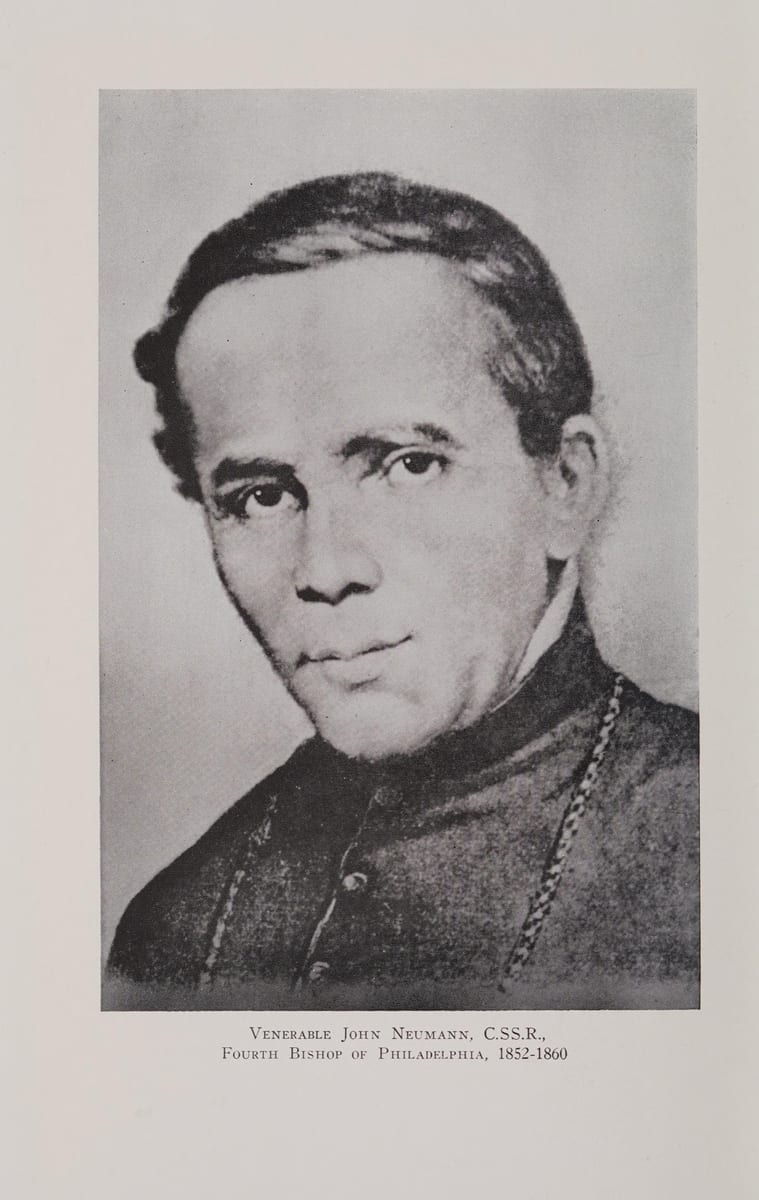
Venerable John Neumann, C.SS.R., Fourth Bishop of Philadelphia, 1852–1860 AD (frontispiece halftone of the Munich photograph), photographer unrecorded (Munich, February 1855 AD); halftone in Michael J. Curley, Venerable John Neumann, C.SS.R. (Washington, D.C.: Catholic University of America Press, 1952 AD), photograph February 1855 AD; reproduction 1952 AD photographer unrecorded (Munich, February 1855 AD); halftone in Michael J. Curley, Venerable John Neumann, C.SS.R. (Washington, D.C.: Catholic University of America Press, 1952 AD), Internet Archive (Princeton Theological Seminary Library copy, venerablejohnneu00curl) In June 1855 AD St. John Neumann wrote to Rome asking to be moved to a poorer diocese, because he grew less fit every day to run the diocese's business affairs. In May he had already proposed splitting his huge diocese and taking the new, smaller see himself. In August 1856 AD Archbishop Kenrick wrote to Rome that St. John Neumann had every virtue but little skill in governing, and that the Philadelphia clergy gave the bishop's authority too little respect.
Rome kept him in Philadelphia and in December 1856 AD gave him an assistant bishop, James Frederick Wood, with the right to succeed him. In 1858 AD he asked again to resign and take a new see at Easton. Rome put off the decision until the next national council of American bishops, and the matter was still unsettled when he died.
“I have myself received as yet no communication from the Propaganda, & wait with all patience & resignation for the decision from Rome. In things of this sort I have to rely only in [sic] divine Providence.”
St. John Neumann to Francis Patrick Kenrick, in a letter awaiting Rome's answer to his request for a transfer -
January 1860 AD
Death on Vine Street
The bishop collapses in a Philadelphia street, and crowds follow his coffin to the grave.
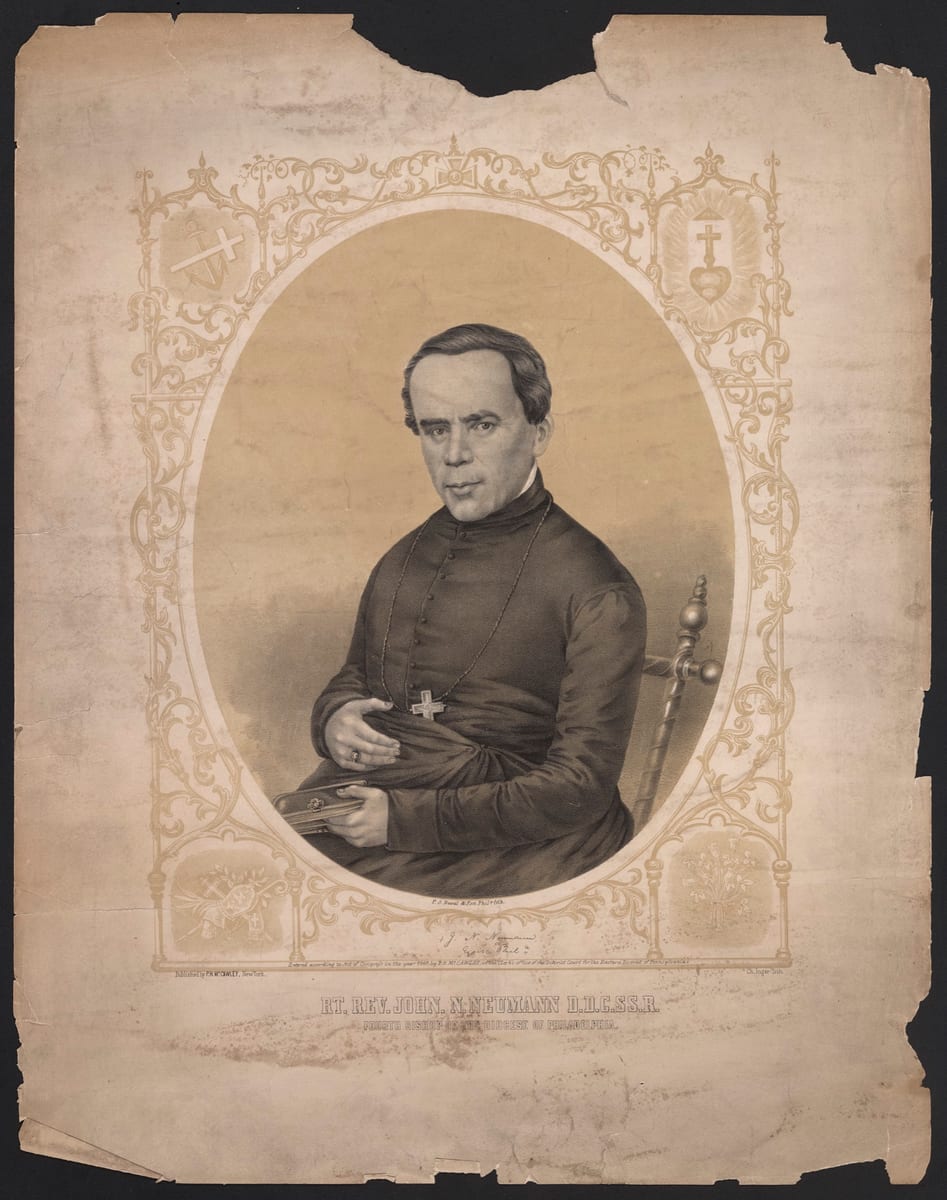
Rt. Rev. John N. Neumann, D.D. C.SS.R. Fourth Bishop of the Diocese of Philadelphia, P. S. Duval & Son, Philadelphia, lithographers; Ch. Inger, lith.; published by P. H. McCawley, New York, 1861 AD P. S. Duval & Son, Philadelphia, lithographers; Ch. Inger, lith.; published by P. H. McCawley, New York, Catholic Historical Research Center of the Archdiocese of Philadelphia, 2010.047.058 On January 5, 1860 AD, St. John Neumann went before a magistrate on church business, signed a paper and set off home on foot. On Vine Street near Thirteenth Street he collapsed on the steps of a Protestant minister's house. A priest was called and anointed him, and he died at about half past three that afternoon.
When his body was carried home, a rough hairshirt was found beneath his clothes. Huge crowds followed his coffin through the city, and on January 10 he was buried at St. Peter's Church. Pope Paul VI declared him a saint on June 19, 1977 AD, and the Church keeps his feast on January 5, the day he died.
“Our church has truly become a pilgrimage church. Indeed, everyone looks upon the deceased bishop as a saint.”
Father Holzer to Father Nicholas Mauron, Redemptorist Superior General, February 1, 1860 AD


Pray with the Church
Prayer to St. John Neumann
Pope Paul VI, closing his homily at the canonisation in St. Peter's Square, June 19, 1977 AD
Saint John Neumann, by the living power of your example and by the intercession of your prayers, help us today and for ever.
All 2 reports on Saint John Neumann

St. John Neumann tells his father his schools now teach 5,000 children
