
Saints Bishop and Apostle of Ireland · Feast March 17
Saint Patrick
Feast 17 March · Born Bannavem Taburniae, Roman Britain · Died Saul, County Down, Ireland
Born in Roman Britain and carried to Ireland as a slave at sixteen, Saint Patrick escaped, answered a dream calling him back, and spent his life among the Irish as a bishop until he died at Saul.
Begin the life
In brief
Saint Patrick, known in Irish as Pádraig, was born in Roman Britain and carried to Ireland as a slave at about sixteen. He later went back to Ireland as a bishop, preaching the gospel and baptising, and was seized and held captive again and again. His Confession and his Letter to the soldiers of Coroticus survive in his own Latin.
-
Boyhood in Roman Britain
A deacon's son from Bannavem Taburniae
In his Confession St. Patrick names his father, his grandfather and the village his family came from.
St. Patrick wrote that his father was Calpornius, a deacon, and his grandfather Potitus, a priest, of the village of Bannavem Taburniae. Calpornius came of a Roman family of high rank, held the office of decurion and kept a small estate near the village, in Roman Britain. In his Letter, St. Patrick wrote that he was born a free man.
As a boy, St. Patrick wrote, he did not believe in the living God. At about fifteen he committed a fault, which he later confessed before he became a deacon.
“Ego Patricius peccator rusticissimus et minimus omnium fidelium (My name is Patrick. I am a sinner, a simple country person, and the least of all believers.)”
St. Patrick, the opening words of his Confession -
From about age sixteen
Taken at sixteen
Raiders carry the boy from his father's estate to Ireland, where he serves one master for six years.
At about sixteen, St. Patrick was seized at his father's estate and taken to Ireland with thousands of others. The raiders killed the men and women who worked in his father's house.
In Ireland he served one master for six years. According to longstanding Catholic Tradition, his master was the druid Miliuc, and St. Patrick herded his animals on the slopes of Slemish. Out with the flocks, St. Patrick began to pray by day and by night, in snow, frost and rain.
“magis ac magis accedebat amor Dei et timor ipsius et fides augebatur et spiritus agebatur, ut in die una usque ad centum orationes et in nocte prope similiter, ut etiam in siluis et monte manebam, et ante lucem excitabar ad orationem per niuem per gelu per pluuiam, et nihil mali sentiebam neque ulla pigritia erat in me — sicut modo uideo, quia tunc spiritus in me feruebat (More and more the love of God increased, and my sense of awe before God. Faith grew, and my spirit was moved, so that in one day I would pray up to one hundred times, and at night perhaps the same. I even remained in the woods and on the mountain, and I would rise to pray before dawn in snow and ice and rain. I never felt the worse for it, and I never felt lazy – as I realise now, the spirit was burning in me at that time.)”
St. Patrick, recalling his captivity, in his Confession -
After six years in captivity
The ship and the wilderness
Three days at sea, twenty-eight days through empty country, and a crew close to starving on the way.
Near the end of the six years, a voice in his sleep told St. Patrick that he would soon go home, and then that a ship was ready for him. He ran from his master and reached the coast on the day the ship was setting out. The captain refused him passage, but as St. Patrick walked away to pray, the pagan crew called him back on board.
After three days at sea they landed and walked for twenty-eight days through empty country. When the crew were close to starving, the captain asked St. Patrick why he could not pray for them, since St. Patrick said his God was great and all-powerful. St. Patrick told them to turn to God, and a herd of pigs appeared on the road in front of them.
“Ueni, quia ex fide recipimus te; fac nobiscum amicitiam quo modo uolueris (Come – we’ll trust you. Prove you’re our friend in any way you wish.)”
The sailors to St. Patrick, taking him aboard the ship -
Some years after the escape
The man with the letters
Home in Britain, St. Patrick dreams of a man bringing letters from Ireland and hears its people calling him back.
A few years after his escape, St. Patrick was home with his parents in Britain, and they begged him never to leave them again. In a vision one night, he saw a man named Victoricus who seemed to come from Ireland, carrying countless letters. The letter St. Patrick was given was headed the Voice of the Irish.
As he read it, he heard the people who lived by the Wood of Foclut, near the western sea, crying out to him with one voice. He was afterwards ordained deacon, priest and bishop for his mission. His relatives and the clergy strongly opposed his consecration and his mission.
“Rogamus te, sancte puer, ut uenias et adhuc ambulas inter nos (We beg you, holy boy, to come and walk again among us.)”
The voice of the Irish to St. Patrick, in the vision of Victoricus and the letter -
His years as bishop in Ireland
Bishop among the Irish
St. Patrick returns to Ireland as a bishop and is seized and held captive again and again, and his dearest friend makes public a fault of his youth.
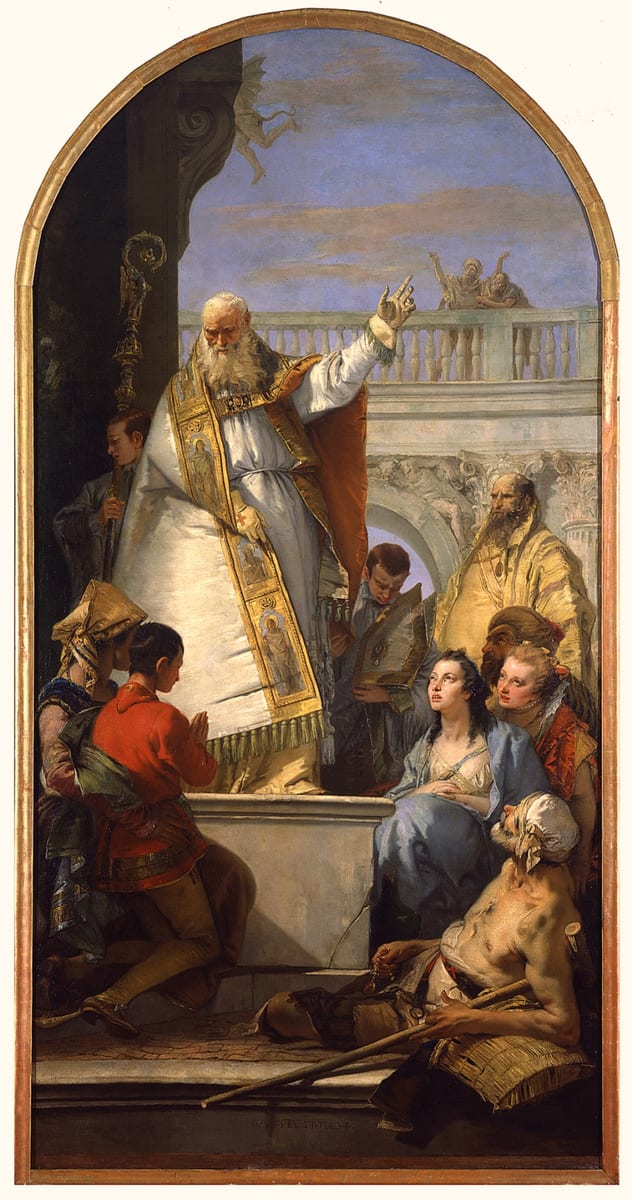
Saint Patrick, Bishop of Ireland, Giovanni Battista Tiepolo, 1746 AD Giovanni Battista Tiepolo, Musei Civici di Padova Back in Ireland as a bishop, St. Patrick wrote that he had come to the Irish to preach the gospel and to bear the insults of unbelievers. He baptised a young Irish noblewoman, and six days later she came back to him asking to give her life to Christ as a consecrated virgin. He and his companions were seized twelve times, and once he was put in chains and sentenced to death.
Thirty years later, his superiors in the Church brought up against him the fault of his youth, though he had confessed it before he became a deacon. He had told the fault to his dearest friend, and that friend, who had once assured him he would be made a bishop, was the man who made it public. Afterwards, in a vision at night, St. Patrick saw a writing set against his name, and a divine voice said it was displeased to see the one who had been chosen stripped of his good name.
“Male uidimus faciem designati nudato nomine (We have seen with displeasure the face of the one who was chosen deprived of his good name.)”
A divine voice to St. Patrick, in a night vision after his seniors brought a charge against him -
During his years as bishop
The Letter to the soldiers of Coroticus
Soldiers kill and carry off St. Patrick's newly baptised converts, and he answers with an open letter.
Soldiers of Coroticus raided a district where St. Patrick had just confirmed many new converts. The converts were still in their white baptismal clothes, and the soldiers killed some and carried others off as captives. The next day St. Patrick sent a priest he had taught from childhood, with other clerics, to ask for the baptised captives back.
The soldiers laughed at them. St. Patrick then wrote an open Letter to the soldiers, opening it as a bishop established in Ireland, and asked that it be read to everyone, Coroticus included. Catholic Tradition holds, in Muirchú's Life, that Coroticus mocked the warnings and, at St. Patrick's prayer, vanished before his own men as a fox.
“Inuidetur mihi. Quid faciam, Domine? Ualde despicior. (They watch me with malice. What am I to do, Lord? I am greatly despised.)”
St. Patrick to the Lord, letter to the soldiers of Coroticus -
His mission in Ireland, as Tradition tells it
St. Patrick as Catholic Tradition remembers him
Later Catholic Tradition gives St. Patrick the Easter fire, the snakes and the shamrock.
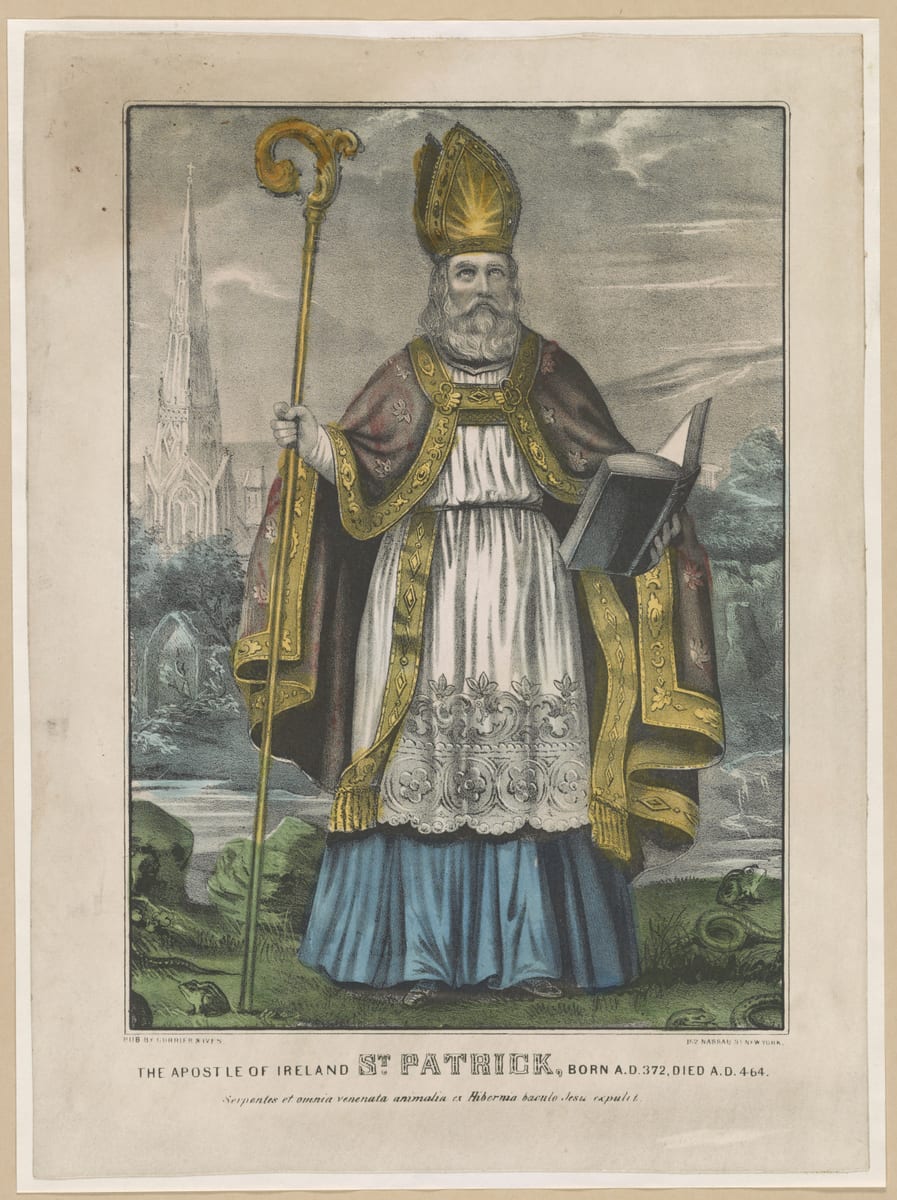
The Apostle of Ireland, St. Patrick, Currier & Ives, between 1857 AD and 1872 AD Currier & Ives, Library of Congress, Prints and Photographs Division Catholic Tradition holds that King Lóegaire forbade any fire on Easter night before his own at Tara, on pain of death. St. Patrick lit and blessed the Easter fire at the burial ground near Slane, and almost everyone on the plain of Brega saw it. Lóegaire rode out that night to kill him, but an earthquake threw the king's chariots together and left him afraid.
Jocelin of Furness's Life, written about 1185 AD, tells that St. Patrick drove every venomous creature off the mountain of Cruachan into the sea. In 1726 AD, the botanist Caleb Threlkeld wrote down the Tradition that St. Patrick used the shamrock's three leaves to teach the Holy Trinity. Threlkeld also noted that people wore shamrock in their hats every March 17, St. Patrick's Day.
-
His death and his feast
Saul, Downpatrick and March 17
Catholic Tradition holds that St. Patrick set out to die at Armagh and an angel turned him back to Saul, where he died.
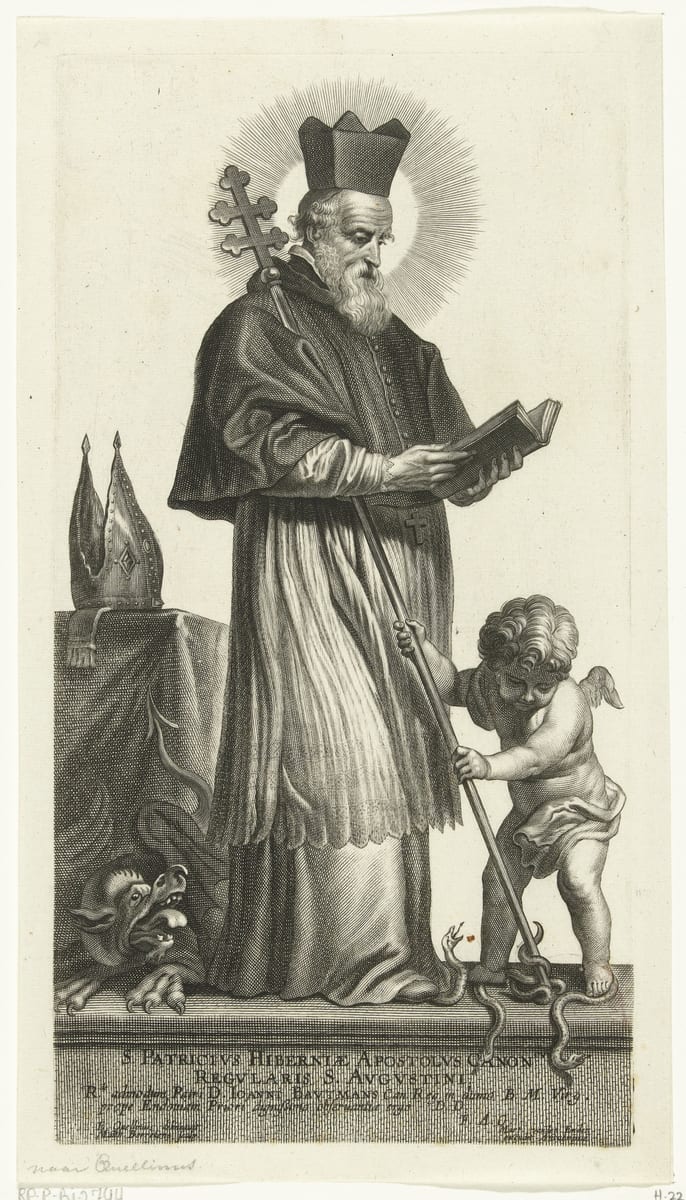
Saint Patrick, Apostle of Ireland, Canon Regular of St. Augustine, Mattheus Borrekens after Erasmus Quellinus II, 1644 AD Mattheus Borrekens after Erasmus Quellinus II, Rijksmuseum, Amsterdam As Catholic Tradition tells it, St. Patrick knew he was dying and set out for Armagh, but an angel turned him back to Saul. There the bishop St. Tassach gave him his last Communion. St. Patrick died at Saul on March 17, the day the Church keeps as his feast.
He was buried at a chieftain's fort two miles from Saul, where the cathedral of Down later rose.
Tradition also ascribes to him the prayer called the Breastplate, whose Old Irish preface says he made it.
“I am very happy to walk among you—in the footsteps of Saint Patrick and in the path of the Gospel that he left yοu as a great heritage—being convinced that Christ is here : "Christ before me, Christ behind me ... Christ in the heart of every man who thinks of me, Christ in the mouth of every man who speaks of me".”
Pope St. John Paul II to the people of Ireland, on arriving at Dublin Airport, September 29, 1979 AD


Pray with the Church
Collect for the Memorial of Saint Patrick
The Roman Missal, March 17, Saint Patrick, Bishop — Collect (ICEL English translation, 2011 AD)
O God, who chose the Bishop Saint Patrick to preach your glory to the peoples of Ireland, grant, through his merits and intercession, that those who glory in the name of Christian may never cease to proclaim your wondrous deeds to all.Through our Lord Jesus Christ, your Son, who lives and reigns with you in the unity of the Holy Spirit, God, for ever and ever.
All 1 report on Saint Patrick

About this picture
AI-generated image, in the manner of a Venetian oil painting after Giambattista Tiepolo, from the paper's reference portrait based on Saint Patrick, Apostle of Ireland, Canon Regular of St. Augustine (Mattheus Borrekens after Erasmus Quellinus II, 1644, Rijksmuseum, Amsterdam) View source artwork.