
Saints Bishop of Myra in Lycia · Fourth century AD
Saint Nicholas of Myra
Feast 6 December · Born Patara, Lycia (Tradition) · Died Myra, Lycia
Tradition holds that the young St. Nicholas gave away his wealth at Patara, paid three dowries in secret and died as bishop of Myra; in 1087 AD sailors from Bari broke open his tomb and carried his relics home.
Begin the life
In brief
Saint Nicholas of Myra was bishop of Myra in the fourth century. His relics reached Bari, in southern Italy, on May 9, 1087 AD.
-
Childhood at Patara
A child asked of God at Patara
Catholic Tradition gives him devout, wealthy parents and a fast kept from the cradle.
According to longstanding Catholic Tradition, St. Nicholas was born at Patara, a city of Lycia, to parents who had prayed to God for a child. Michael the Archimandrite writes that St. Nicholas was his parents' only child.
On Wednesdays and Fridays, the Church's fast days, the baby nursed only once, after sunset, the Roman Breviary tells. The Breviary adds that he kept this fast for the rest of his life.
-
Youth at Patara
Gold through a window at night
According to Catholic Tradition, the orphaned St. Nicholas gave his inherited wealth to the poor, and a needy man with three daughters lived in his city.
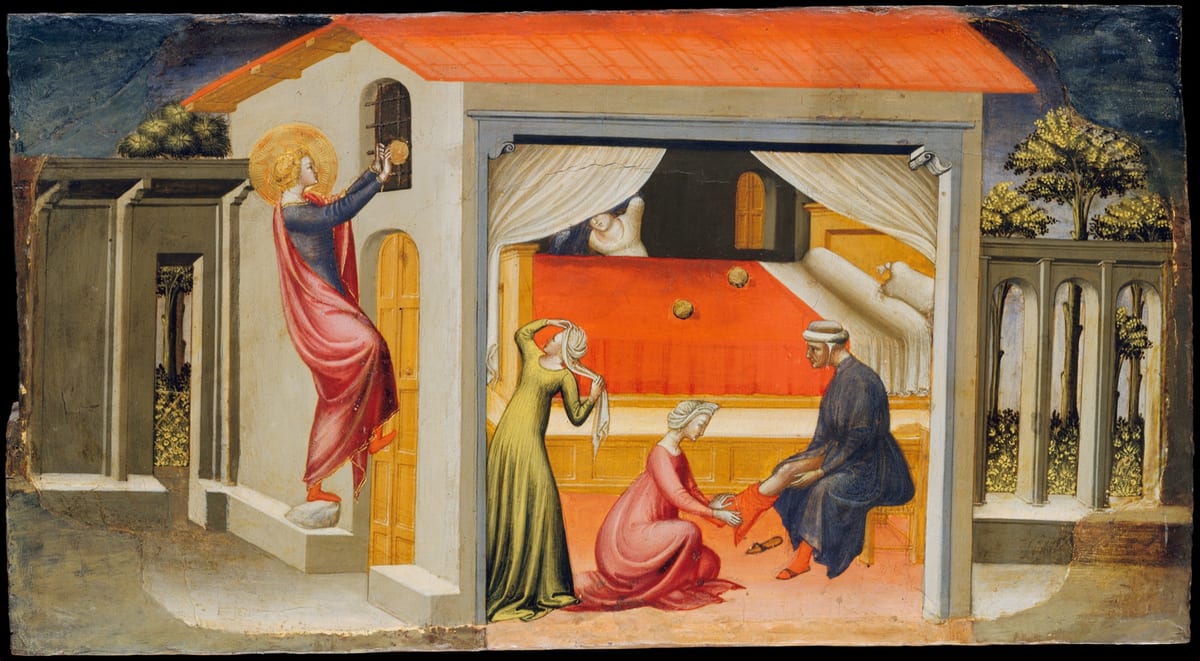
Saint Nicholas Providing Dowries, Bicci di Lorenzo, 1433-1435 AD Bicci di Lorenzo, The Metropolitan Museum of Art, New York (open access) The Roman Breviary relates that St. Nicholas lost both parents as a young man and gave his wealth to the poor. In Catholic Tradition, a ruined neighbour had three daughters, no dowry for any of them, and a plan to give them up to prostitution. John the Deacon writes that even poor men would not marry them.
John the Deacon tells that St. Nicholas went to the house by night and threw gold wrapped in a cloth through a window, so that no one would know the giver. According to Michael the Archimandrite, St. Nicholas came back twice more, and on the third night the father stayed awake and caught him. St. Nicholas made the father swear, Michael writes, to tell no one while St. Nicholas was alive.
-
Pilgrimage to the Holy Land
A storm foretold at sea
The Roman Breviary relates that St. Nicholas warned a ship's crew of a coming storm on his way to Palestine and calmed it by prayer when it struck.
Catholic Tradition holds that St. Nicholas sailed for Palestine to see the holy places and pray in them. The Roman Breviary relates that under a clear sky he warned the sailors of a great storm, and that when it struck he calmed it by prayer. In the legend, the ship reached Alexandria safely and St. Nicholas went on from there to Jerusalem.
-
Bishop of Myra · fourth century AD
The bishop who stopped the axe
Catholic Tradition holds that St. Nicholas, sent back from solitude, came to Myra as a stranger, became its bishop and stopped the beheading of three innocent men.
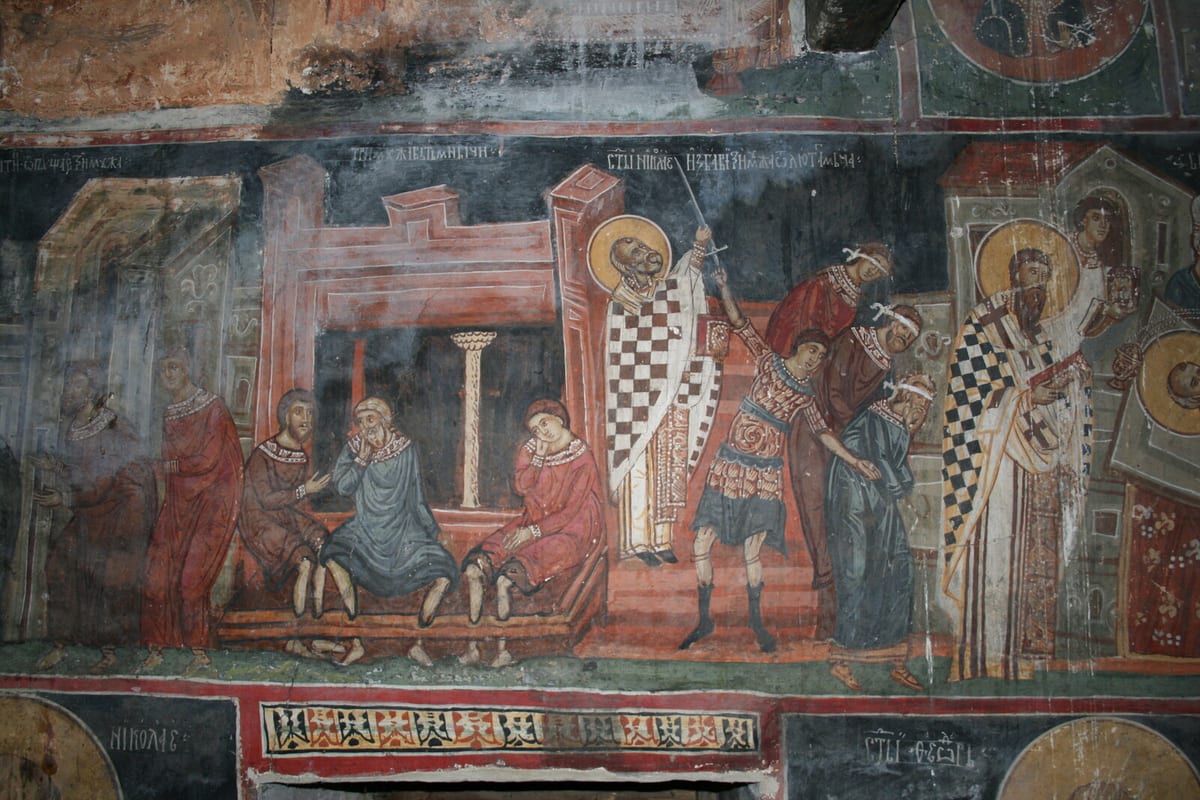
St. Nicholas rescues three men from prison and three men from execution, wall painting in the church of St. Nicholas, Velika Hoča, Anonymous painters, Late medieval Anonymous painters, Church of St. Nicholas, Velika Hoča; photograph by the BLAGO Fund, 2008 AD Giustiniani's Latin Life tells that a voice from heaven sent St. Nicholas back from a life of solitary prayer into the world. He left Patara and his own people, the Life says, for Myra, where no one knew him. There an older bishop was told in a vision that the first man to enter the church at dawn should be made bishop, and that man was St. Nicholas.
As Catholic Tradition tells it, he stopped the beheading of three innocent men of Myra, condemned by a prefect who had taken a bribe. The Roman Breviary tells that St. Nicholas appeared to the Emperor Constantine in a vision and got him to free three army officers. The Roman Martyrology tells the same vision under December 6.
-
Death at Myra · fourth century AD
Oil from a marble tomb
Catholic Tradition holds that St. Nicholas died at Myra, and the Church keeps his feast on December 6.
Catholic Tradition holds that St. Nicholas died at Myra, and the Roman Martyrology marks his death there on December 6, the day the Church keeps as his feast. The Breviary's lessons for the feast tell that he saw angels coming to meet him and died reciting Psalm 30.
In Catholic Tradition, he was buried in his own cathedral at Myra. The Golden Legend says a spring of oil flowed from his marble tomb.
“Nicolai, episcopi Myrensis in Lycia, sanctitate et intercessione apud thronum gratiae divinae praeclari. (Of Nicholas, bishop of Myra in Lycia, renowned for his holiness and his intercession before the throne of divine grace.)”
The Roman Martyrology, the entry for 6 December -
Seventh to eleventh centuries AD
Churches in his name
The Emperor Justinian built a church in honour of St. Nicholas at Constantinople, a later emperor's great church there named St. Nicholas among its patrons, and the archbishop of Myra spoke of him before a council.
The Emperor Justinian built a church in honour of St. Nicholas at Constantinople, in the quarter called Blachernae. It burned in 626 AD, when the Avars and Slavs attacked the city.
At the Second Council of Nicaea in 787 AD, Archbishop Theodore of Myra told the bishops that St. Nicholas had appeared to his archdeacon. On May 1, 881 AD, Patriarch Photios consecrated the Emperor Basil I's great church, the Nea, with St. Nicholas among its patrons. The church over his tomb at Myra was rebuilt in 1042 AD, under the Emperor Constantine IX Monomachos.
-
April–May 1087 AD
Carried off to Bari
Sailors from Bari broke open his tomb at Myra and brought his relics home across the sea.
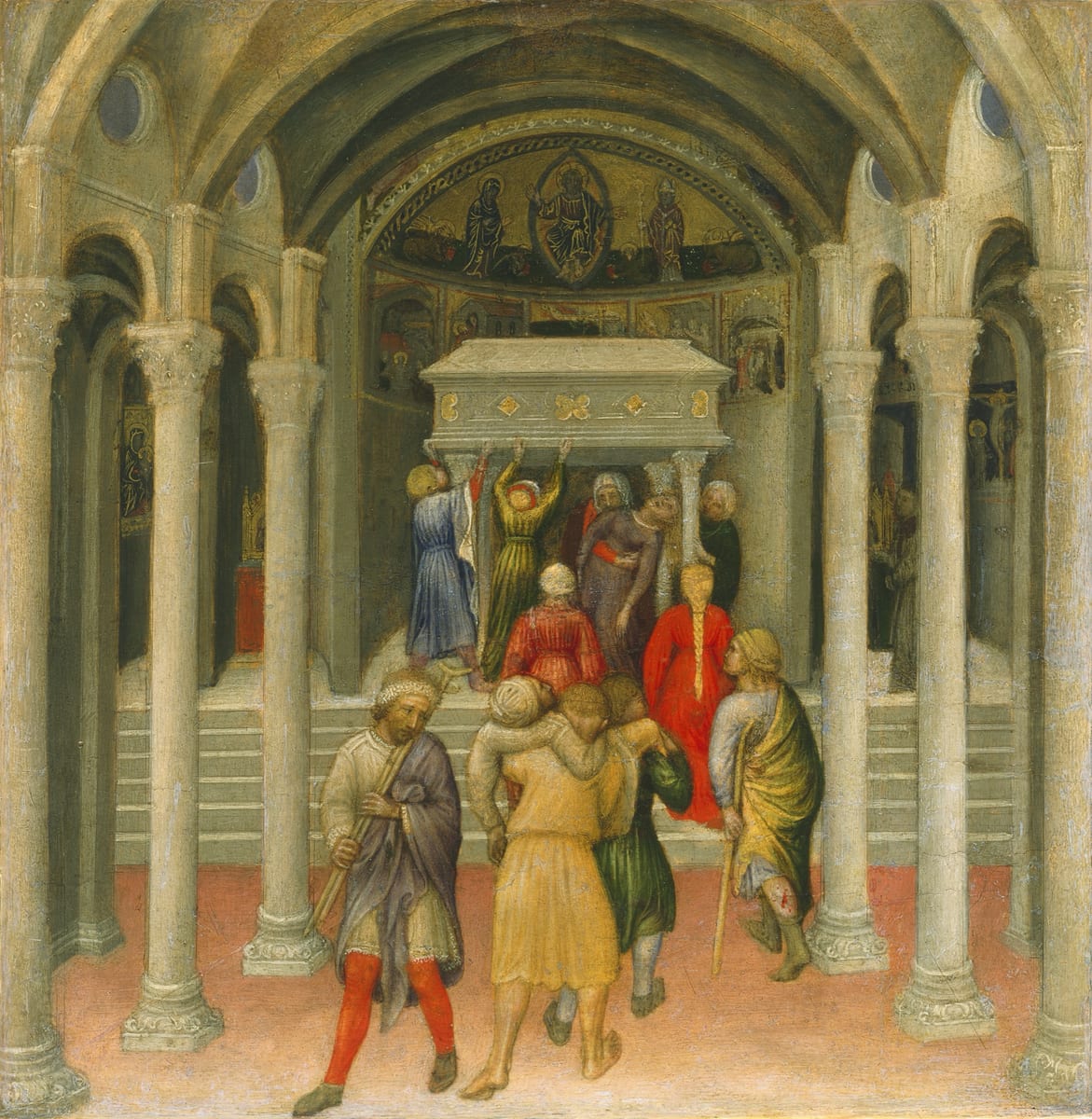
The Crippled and Sick Cured at the Tomb of Saint Nicholas, from the Quaratesi polyptych, Gentile da Fabriano, 1425 AD Gentile da Fabriano, National Gallery of Art, Washington (open access) In 1087 AD, men of Bari in southern Italy set out with three ships and landed at Myra. They told the monks guarding the tomb, falsely, that the Pope had sent them, and then forced their way in. Matthew, a man of Bari, struck the floor over the tomb hard, shattered it, lifted out the remains and handed them to the priests.
Men and women of Myra crowded the wharves and begged to keep some part of St. Nicholas's remains, but the ships sailed. The ships reached Bari on May 9, 1087 AD. Sick people brought from many places were healed there that first evening.
“At Bari, in Apulia, the translation likewise of the holy bishop Nicholas, from Myra, a town of Lycia.”
The Roman Martyrology, the entry for 9 May -
1987–2018 AD
Pope Francis prays at Bari, the city of St. Nicholas
Bari marked nine centuries with the relics of St. Nicholas, which later travelled to Russia, and Pope Francis came there to pray for the Middle East.
In 1987 AD Bari held a year of celebrations for the nine hundred years since the relics of St. Nicholas arrived. Pope St. John Paul II said the year had taken on a clearly ecumenical character, reviving the desire for full union among Christians.
Major relics of St. Nicholas were lent to Russia in May 2017 AD, after Pope Francis and Patriarch Kirill of Moscow agreed to it in 2016 AD. They were scheduled to return to Bari on July 12, 2017 AD. On July 7, 2018 AD, Pope Francis brought the leaders of the Eastern Churches to Bari to pray for the Middle East.
“Here lie the relics of Saint Nicholas, the Oriental Bishop whose veneration crosses seas and bridges boundaries between Churches. May Nicholas, the wonder-worker, intercede to heal the wounds that so many people bear within them.”
Pope Francis to the heads of Churches gathered at Bari, July 7, 2018 AD


Pray with the Church
Collect for the feast of St. Nicholas
The Collect of the Roman Breviary for December 6, the feast of St. Nicholas, Bishop and Confessor, in the English of the Divinum Officium transcription.
O God, who didst glorify the blessed Bishop Nicholas with innumerable miracles; grant, we beseech thee, that, by his merits and prayers, we may be saved from the fires of hell.
All 1 report on Saint Nicholas of Myra

About this picture
AI-generated image, in the manner of Byzantine wall painting, from the paper's reference portrait based on The First Council of Nicaea, with St. Nicholas among the bishops (Byzantine painters, Middle Byzantine, Church of St. Nicholas, Demre) View source artwork.
