
Saints Benedictine abbess · Doctor of the Church
Saint Hildegard of Bingen
Feast 17 September · Born 1098 AD, Bermersheim, near Alzey, Rhineland-Palatinate, Germany · Died 1179 AD, Monastery of Rupertsberg, Bingen, Germany
Born 1098 AD in the Rhineland, died September 17, 1179 AD at Rupertsberg: a life of visions, books, music, and one grave she would not open.
Begin the life
In brief
Saint Hildegard of Bingen, also called Hildegard von Bingen, was a Benedictine nun of the Rhineland who saw visions from her earliest years and was ordered at forty-two to write them down. She governed two monasteries, preached in the cities of the Rhineland and beyond, compiled books of medicine, composed songs, and wrote to popes, an emperor and a queen. Pope Benedict XVI proclaimed her a Doctor of the Universal Church on October 7, 2012 AD.
-
1098–1113 AD
The Tenth Child
A Rhineland girl is given to God and enclosed at eight beside a monastery.
Saint Hildegard of Bingen was born in 1098 AD in the Rhineland diocese of Mainz. She was the tenth child of Hildebert and Mechtild, landowners of noble family. Her parents set her apart as a tithe offered to God.
At eight years old she was enclosed with the recluse Jutta of Spanheim beside the monastery of Saint Disibod. Jutta taught her to read the Latin psalms and to play the psaltery, and she never learned to write. She stirred wonder in many, and until her fifteenth year she did not dare tell what vision was fixed in her soul.
“Up to my fifteenth year I saw much, and related some of the things seen to others, who would inquire with astonishment, whence such things might come. I also wondered and during my sickness I asked one of my nurses whether she also saw similar things. When she answered no, a great fear befell me. Frequently, in my conversation, I would relate future things, which I saw as if present, but, noting the amazement of my listeners, I became more reticent.”
St. Hildegard of Bingen, describing her early visionary experiences -
1136 AD
Chosen to Lead
Jutta dies, and the sisters make the reluctant St. Hildegard their magistra.
Jutta died in 1136 AD, after twenty-four years of monastic life, and was buried amid a great crowd. The sisters chose St. Hildegard to succeed her as magistra of the community at Disibodenberg. She resisted with all her strength, and the abbot's command compelled her to take the office.
Pope Benedict XVI said she filled the office as a woman of culture and lofty spirituality, competent in the organisation of cloistered life. By then the enclosure had grown into a small women's monastery under the Rule of Saint Benedict.
-
1141–1151 AD
The Fiery Light
At forty-two she is told to write what she sees, and works ten years at one book.
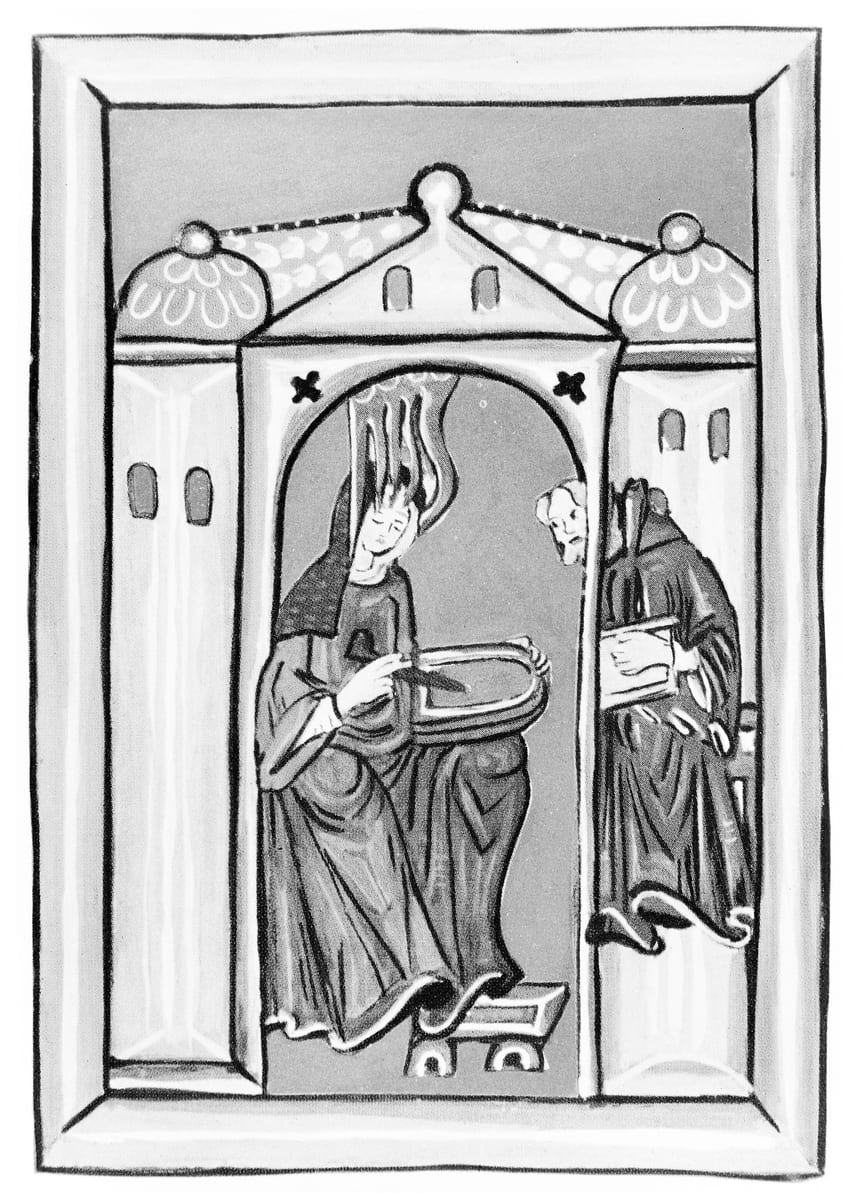
Hildegard receiving the light from Heaven — Scivias, Rupertsberg codex, folio 1 recto (Charles Singer, Studies in the History and Method of Science, 1917 AD, Plate I), Unknown illuminator of the Rupertsberg workshop, working under St. Hildegard's direction, c. 1165–1179 AD (original); photographic plate published 1917 AD Unknown illuminator of the Rupertsberg workshop, working under St. Hildegard's direction, Wellcome Collection, London (photo no. M0005630); the original codex was formerly Wiesbaden, Hessische Landesbibliothek, and has been missing since its evacuation to Dresden in 1945 AD In 1141 AD, forty-two years old, a fiery light came from an opened heaven and irradiated her brain. A voice told her not to delay in setting down what she saw and heard. She hesitated out of modesty, took to her bed, and was healed as soon as she put her hand to writing.
The monk Volmar wrote down what she dictated, with the nun Richardis von Stade. She worked ten years at the book called Scivias and closed it in 1151 AD.
-
1146–1147 AD
She Asks Saint Bernard
Afraid the visions are illusion, she lays them before the abbot of Clairvaux; a text she dictated then reaches a pope at Trier.
Fearing that the visions were illusion, she wrote in 1146 AD to Saint Bernard of Clairvaux. She told him she had no formal training and could read only on the most elementary level. St. Bernard answered briefly, rejoicing in the grace of God in her and urging her to humility.
Presiding at a synod at Trier in 1147 AD, Pope Eugene III read a text she had dictated. He authorised her to write down her visions and to speak in public. Her contemporaries came to call her the Teutonic prophetess.
“The vision fascinates my whole being: I do not see with the eyes of the body but it appears to me in the spirit of the mysteries.... I recognize the deep meaning of what is expounded on in the Psalter, in the Gospels and in other books, which have been shown to me in the vision. This vision burns like a flame in my breast and in my soul and teaches me to understand the text profoundly”
St. Hildegard of Bingen to Bernard of Clairvaux, letter describing her visions -
1150–1165 AD
A House of Her Own
She builds on the Rupertsberg, preaches in the cathedral cities, and fills shelf after shelf.
Around 1150 AD St. Hildegard left Disibodenberg and founded an independent monastery on the Rupertsberg, above the mouth of the Nahe at Bingen. In 1165 AD she founded a second house at Eibingen, across the Rhine, and was abbess of both. She preached in public at Mainz, Würzburg, Bamberg, Trier, Metz and Cologne.
She wrote the Liber vitae meritorum from 1158 AD and began the Liber divinorum operum in 1163 AD. She composed songs and the play Ordo Virtutum. She compiled the works of natural science and medicine known as the Physica and the Causae et curae.
“Moreover, I composed and sang a song with music in praise of God and the saints without being taught by any human being, although I had never learned either neumes or any other aspect of music.”
St. Hildegard of Bingen, autobiographical statement on learning music -
1178–1179 AD
The Grave She Would Not Open
A burial at Rupertsberg brings an interdict, and the singing stops until a few months before her death.
About 1178 AD a young man once bound by censures, long since absolved, was buried in the cemetery at Rupertsberg. The diocesan administrators of Mainz demanded the body be taken up and laid the house under interdict. St. Hildegard answered them that she had heard in the light a voice that the dead man was not to be dishonoured.
She signed the tomb with her staff in the sign of the cross, and the grave could no longer be found. Her sisters ceased the songs of the divine praises and abstained from Communion, and the body stayed where it lay. The interdict was lifted a few months before she died.
“By a vision, which was implanted in my soul by God the Great Artisan before I was born, I have been compelled to write these things because of the interdict by which our superiors have bound us, on account of a certain dead man buried at our monastery, a man buried without any objection, with his own priest officiating.”
St. Hildegard of Bingen to the Prelates of Mainz, letter 23, opening of the letter concerning the interdict -
1179–1180 AD
Her Last Day
She dies among her sisters at Rupertsberg, and the crowds come to the tomb.
Stricken by illness in the summer, St. Hildegard died at the monastery of Rupertsberg on September 17, 1179 AD, surrounded by her sisters. Pope Benedict XVI records that she was eighty-one, and had always been in poor health. She was buried in front of the altar in her own monastic church.
The twelfth-century Life records that she foresaw her death long beforehand and foretold it to her sisters. So many miracles followed at the tomb, and so great a crowd came, that the Archbishop of Mainz came in person and commanded the signs to cease.
-
1226–2021 AD
Doctor of the Universal Church
Eight centuries of unfinished process end in Saint Peter's Square.
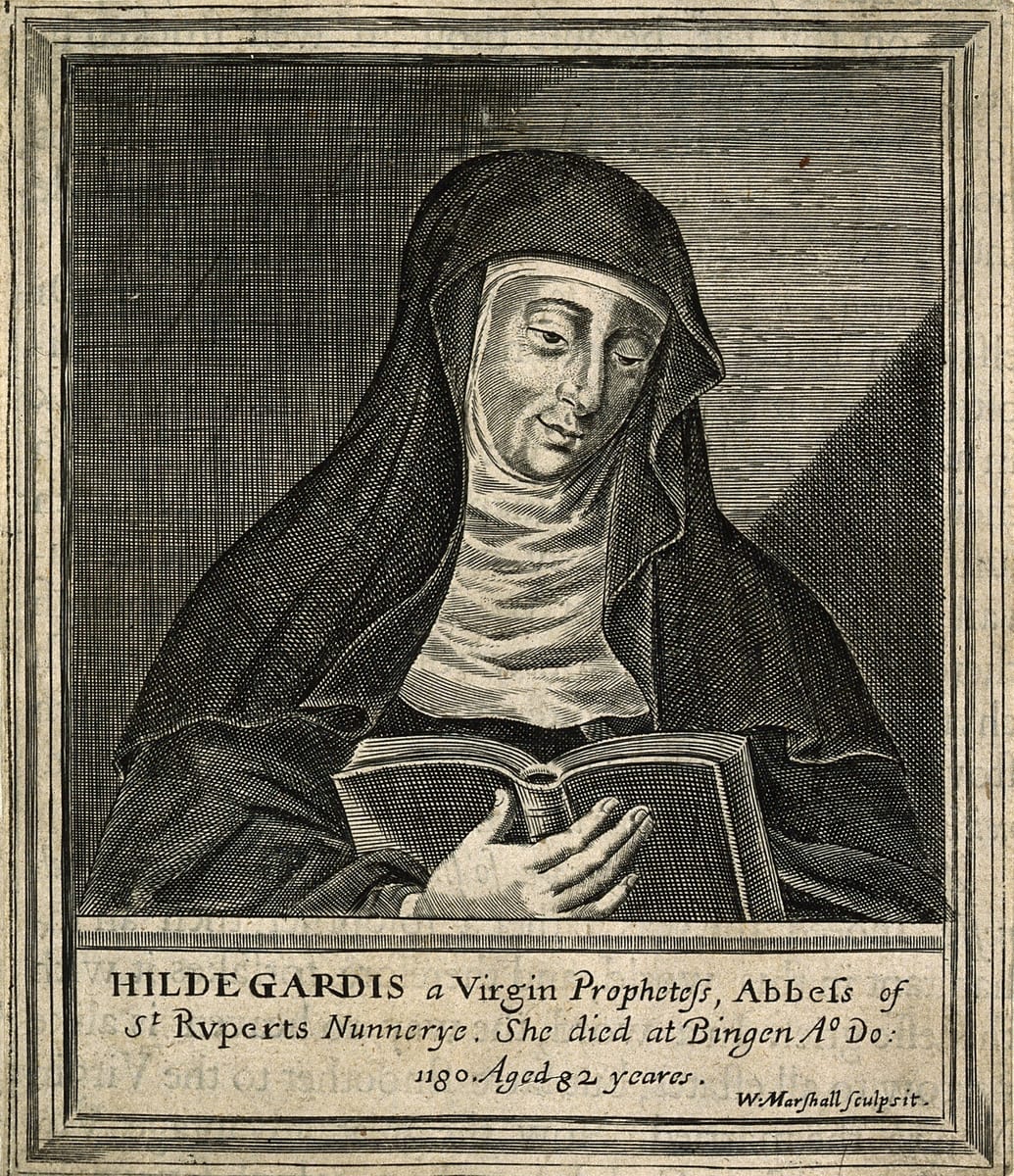
Hildegard von Bingen. Line engraving by W. Marshall, William Marshall, engraver, seventeenth century William Marshall, engraver, Wellcome Collection, London (reference V0002761; library reference ICV No 2956 AD) The abbess and convent of Rupertsberg petitioned for her canonization in 1226 AD, and Pope Gregory IX opened the process. It was taken up again under Popes Innocent IV, Clement V and John XXII, and left unfinished each time. Her name was entered in the Roman Martyrology at September 17 in 1498 AD.
Pope Benedict XVI signed the decree of canonization in 2012 AD, dispensing from the miracle usually required. On October 7, 2012 AD, at the Mass opening the Synod of Bishops, he proclaimed her a Doctor of the Universal Church in Saint Peter's Square. By a decree of January 25, 2021 AD, Pope Francis ordered her celebration inscribed in the General Roman Calendar on September 17.
“Fulfilling the wishes of numerous brethren in the episcopate, and of many of the faithful throughout the world, after due consultation with the Congregation for the Causes of Saints, with certain knowledge and after mature deliberation, with the fullness of my apostolic authority I declare Saint John of Avila, diocesan priest, and Saint Hildegard of Bingen, professed nun of the Order of Saint Benedict, to be Doctors of the Universal Church. In the name of the Father, and of the Son, and of the Holy Spirit.”
Pope Benedict XVI to pilgrims and faithful in Saint Peter's Square, October 7, 2012 AD


Pray with the Church
O ignee Spiritus — Hymn to the Holy Spirit
A hymn to the Holy Spirit written by St. Hildegard, in the English translation of Nathaniel M. Campbell.
O fiery Spirit, praise to you,who on the tympana and lyrework and play!By you the human mind is set ablaze,the tabernacle of its soulcontains its strength.So mounts the willand grants the soul to taste—desire is its lamp.In sweetest sound the intellect upon you calls,a dwelling-place prepares for you,with reason sweating in the golden labor.Yet in your hand you always hold the swordto cut awaythe deadly apple offeringits blackened heart—a homicide,when once that cloud reached outto overshade the will and its desires,in which the soul takes flight and circles round about.But of the will and of desire the mind serves as the bond.For when the spirit rears itselfto seek to see the evil eye, the gaping maw of wickedness,then swiftly in your fire do you consume it, when you will.But when the reason strays and, working evil things,falls flat and low,then as you will, you draw, constrain, and bring it backthrough floods of trials and ordeals.When evil yet its sword against youdraws, you break its blade into its heart—the thrust against the fallen angel firstyou made when into Hell you casthis tower of pride.Another tower you raised up in its place,amongst the taxmen and the sinners—to you their sins they do confess by their own works and deeds.So ev’ry creature, as it takesits life from you, returns to you its praise,for you are that most precious balmfor broken, fetid wounds,transforming them intomost precious gems.Now deign to gather us, to draw us all to you,and to direct us on the upright course.Amen.
All 5 reports on Saint Hildegard of Bingen

Pope who signed the 1979 AD request names St. Hildegard a Doctor

St. Hildegard dies at Rupertsberg with her nuns singing again

St. Hildegard writes a sung play in which Virtues fight the Devil

About this picture
AI-generated image, in the manner of twelfth-century Rhineland manuscript illumination, from the paper's reference portrait based on Hildegard receiving the light from Heaven — Scivias, Rupertsberg codex, folio 1 recto (Unknown illuminator of the Rupertsberg workshop, working under St. Hildegard's direction, c. 1165–1179 AD; photographic plate published 1917, Wellcome Collection, London) View source artwork.
At forty-two, St. Hildegard begins a book she cannot write

About this picture
AI-generated image, in the manner of twelfth-century Rhineland manuscript illumination, from the paper's reference portrait based on Hildegard receiving the light from Heaven — Scivias, Rupertsberg codex, folio 1 recto (unknown illuminator of the Rupertsberg workshop, working under St. Hildegard's direction, c. 1165–1179 AD; photographic plate published 1917, Wellcome Collection, London) View source artwork.