
Saints Duchess of Silesia · about 1174–1243 AD
Saint Hedwig of Silesia
Feast 16 October · Born 1174 AD, Andechs Castle, Bavaria · Died 1243 AD, Trzebnica (Trebnitz), Silesia
Married at twelve, she founded Silesia's first convent for women, won her captive husband's release and lost a son to the Mongols.
Begin the life
In brief
Saint Hedwig of Silesia, also called Jadwiga Śląska, was a Bavarian count's daughter who became Duchess of Silesia. With her husband, Duke Henry the Bearded, she founded the convent of Trebnitz (Trzebnica), where she lived as a widow and died in 1243 AD. The Church keeps her memorial on October 16.
-
About 1174–1187 AD
A count's daughter, married at twelve
Born in a Bavarian castle, she was sent to Silesia as a child bride.
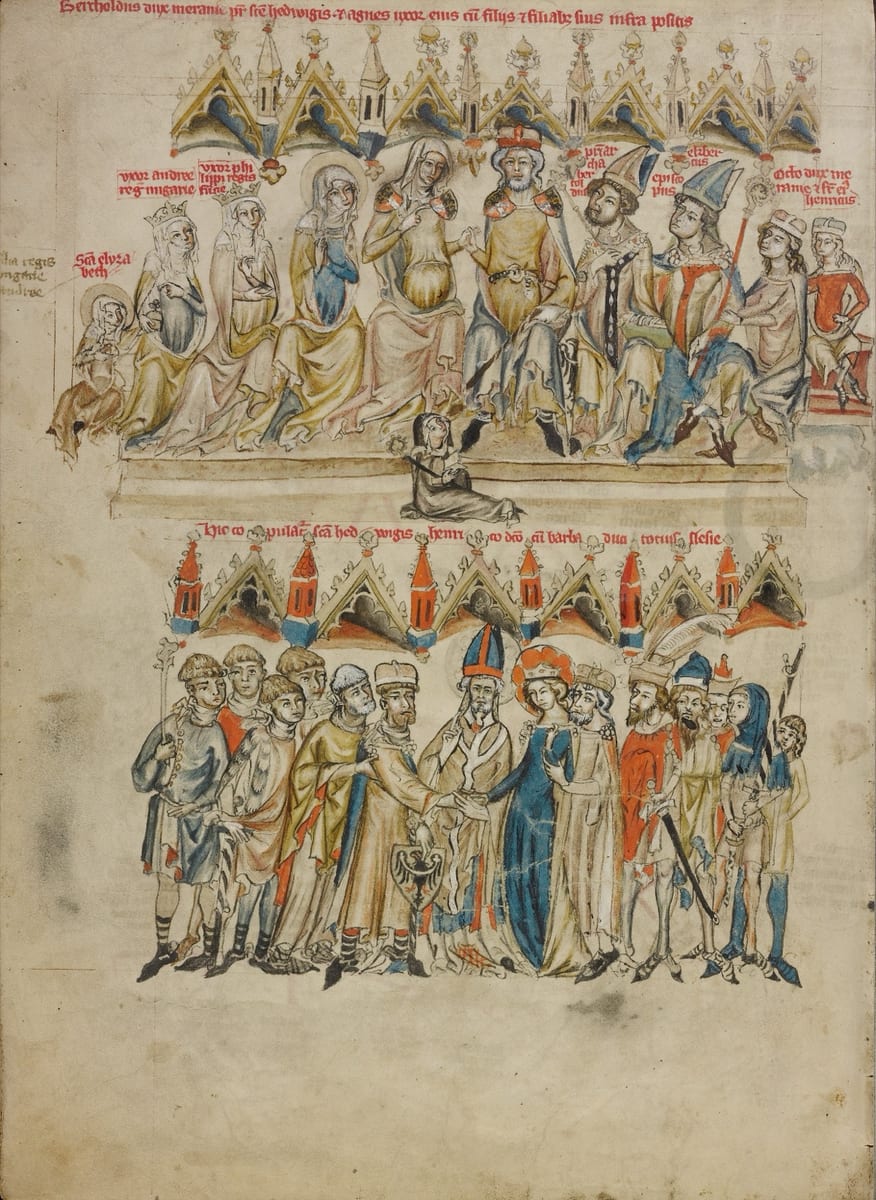
The Family of Berthold VI; The Marriage of Saint Hedwig and Heinrich (Vita beatae Hedwigis, Ms. Ludwig XI 7, fol. 10v), Unknown Silesian illuminator (court workshop of Duke Ludwig I of Liegnitz and Brieg); scribe Nicolaus of Prussia, 1353 AD Unknown Silesian illuminator (court workshop of Duke Ludwig I of Liegnitz and Brieg); scribe Nicolaus of Prussia, J. Paul Getty Museum, Los Angeles (Ms. Ludwig XI 7, 83.MN.126 AD) St. Hedwig was born about 1174 AD at the castle of Andechs in Bavaria. She was one of eight children of Berthold IV, Count of Andechs, and his wife Agnes. Her sister Gertrude became Queen of Hungary and the mother of St. Elizabeth of Hungary.
St. Hedwig was educated at the monastery of Kitzingen. At twelve she was married to Henry, a son of Duke Boleslaw of Silesia. She was expecting her first child at thirteen years and thirteen weeks old.
-
1202–1203 AD
A convent for the women of Silesia
On her advice the duke built Trebnitz, and she gave it her own estate.
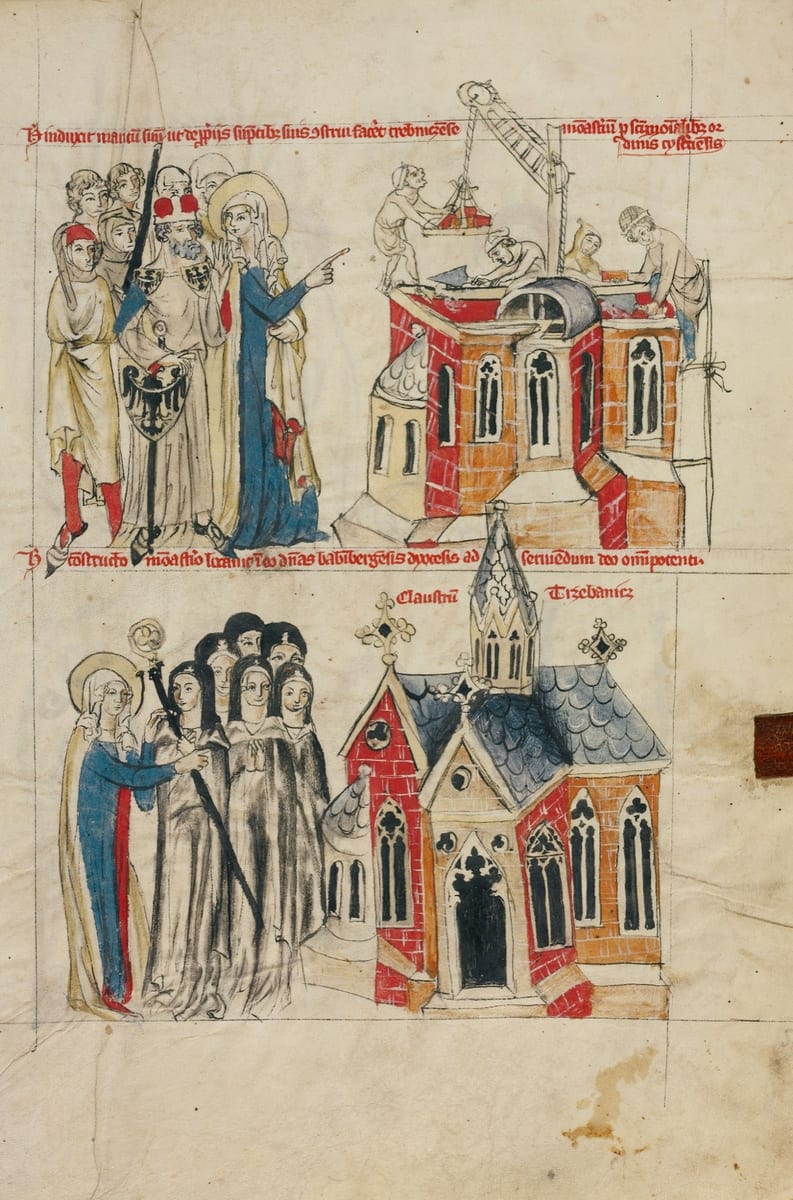
Saint Hedwig and the New Convent; Nuns from Bamberg Settling at the New Convent (Ms. Ludwig XI 7, fol. 56), Unknown Silesian illuminator; digital image J. Paul Getty Museum, 1353 AD Unknown Silesian illuminator; digital image J. Paul Getty Museum, J. Paul Getty Museum, Los Angeles On St. Hedwig's advice, Duke Henry built a convent for Cistercian nuns at Trebnitz, north of Breslau, at his own cost. His founding charter gave the reason: his lands had houses for men of three orders, and none for women. St. Hedwig gave the convent her dower estate of Schawoine and its villages.
While it was being built, she let no one condemned to death by the duke's court be executed. The condemned worked on the building instead. On January 13, 1203 AD, Bishop Cyprian of Wrocław installed the first nuns, who had come from Bamberg.
-
About 1209–1238 AD
The duchess in worn clothes
She and her husband vowed continence, and she gave her days to fasting and the sick.
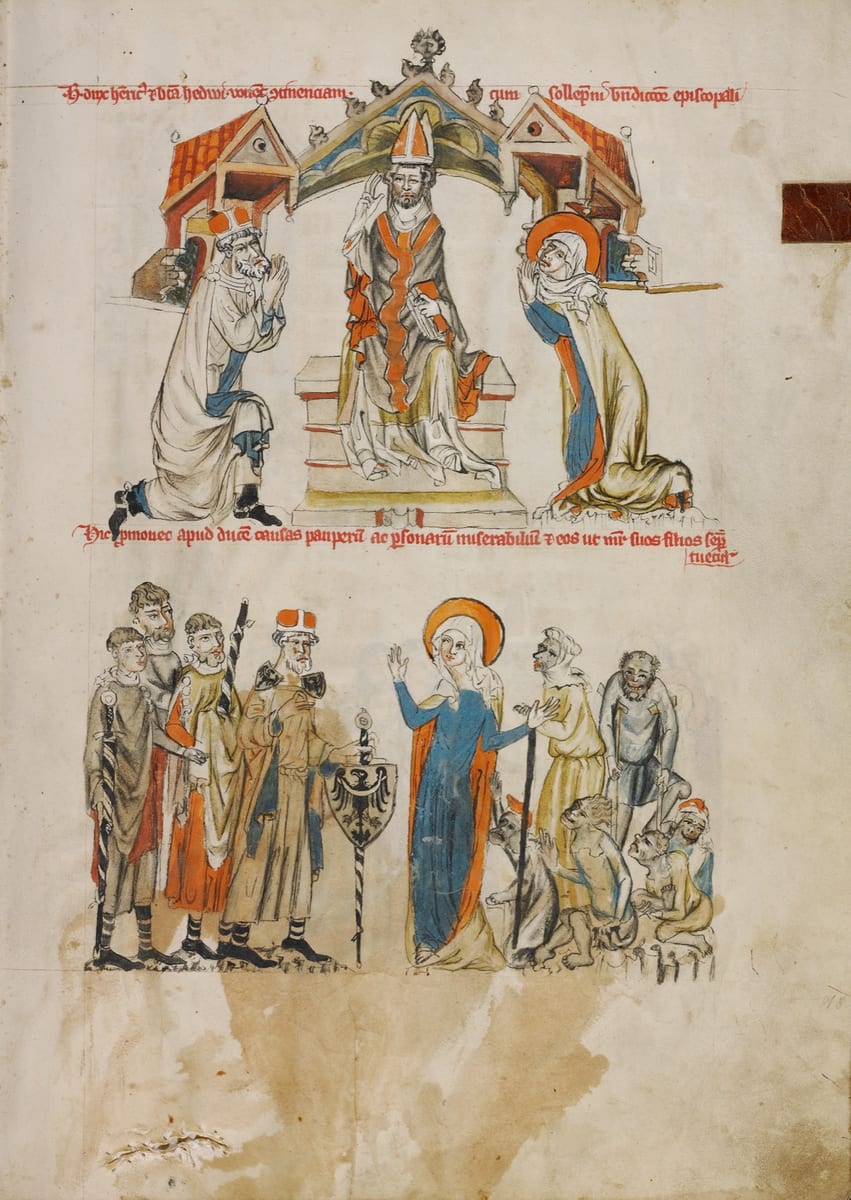
The Pledge of Chastity; Saint Hedwig Assisting the Poor and Sick (Vita beatae Hedwigis, Ms. Ludwig XI 7, fol. 18), Unknown Silesian illuminator (court workshop of Duke Ludwig I of Liegnitz and Brieg); scribe Nicolaus of Prussia, 1353 AD Unknown Silesian illuminator (court workshop of Duke Ludwig I of Liegnitz and Brieg); scribe Nicolaus of Prussia, J. Paul Getty Museum, Los Angeles (Ms. Ludwig XI 7, 83.MN.126 AD) St. Hedwig persuaded her husband to vow lifelong continence with her before Bishop Lawrence of Wrocław. They kept the vow for nearly thirty years. Duke Henry took the tonsure and grew his beard like a Cistercian lay brother, and so he was called the Bearded.
She fasted every day except Sundays and certain great feasts. She would not wear a new garment until another woman of her household had partly worn it out. She nursed the leper women in the hospital at Neumarkt.
-
1212–1229 AD
A family at war
Her sons fought each other, and later her husband was taken captive at Mass.
In 1212 AD her sons Henry and Conrad went to war with each other over the division of the duchies. Duke Henry favoured the younger son, Conrad, and St. Hedwig took the part of the elder, Henry. Conrad died young after a fall from his horse.
In 1229 AD Duke Conrad of Masovia seized her husband at Mass and carried him captive to Płock. Their son Henry raised a powerful army to free his father. St. Hedwig went to Duke Conrad in person, and she won her husband's release.
-
1238 AD
Widowed, she moved into the convent
After the duke's death she lived at Trebnitz in the sisters' habit, but took no vows.
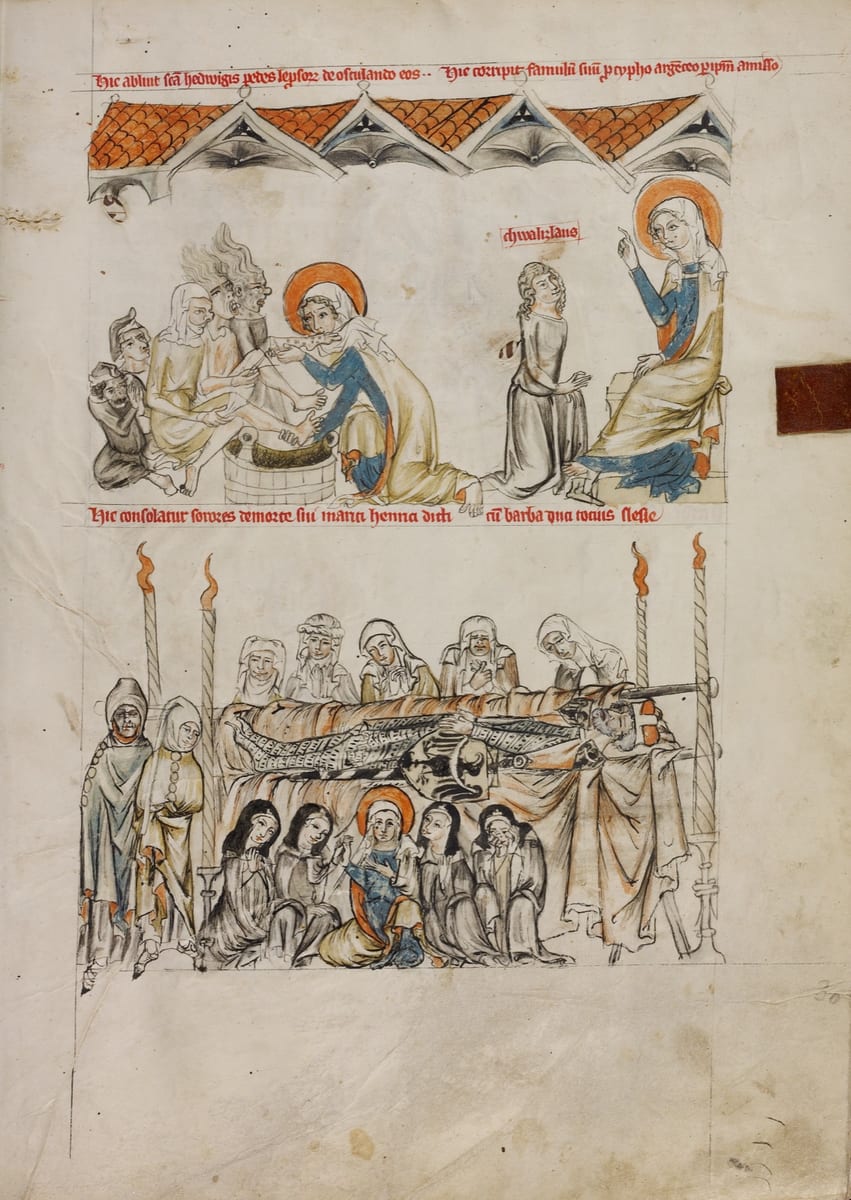
Saint Hedwig Washing the Feet of Lepers; The Burial of Saint Hedwig's Husband Heinrich (Ms. Ludwig XI 7, fol. 30), Unknown Silesian illuminator; digital image J. Paul Getty Museum, 1353 AD Unknown Silesian illuminator; digital image J. Paul Getty Museum, J. Paul Getty Museum, Los Angeles Duke Henry died at Krosno on March 19, 1238 AD, and was buried before the altar at Trebnitz. When the nuns wept at the news, St. Hedwig stayed calm and comforted them.
She made Trebnitz her home, where her daughter Gertrude was abbess. She put on the sisters' grey habit but took no vows. That left her free to spend her income on the poor.
“Would you oppose the will of God? Our lives are his. We ought to find our comfort in whatever he is pleased to ordain, whether as to our own death, or as to that of our friends.”
St. Hedwig of Silesia to The nuns of Trebnitz, 1238 AD -
1241 AD
Her son falls at Legnica
Duke Henry II died fighting the Mongols, and the invaders turned back.
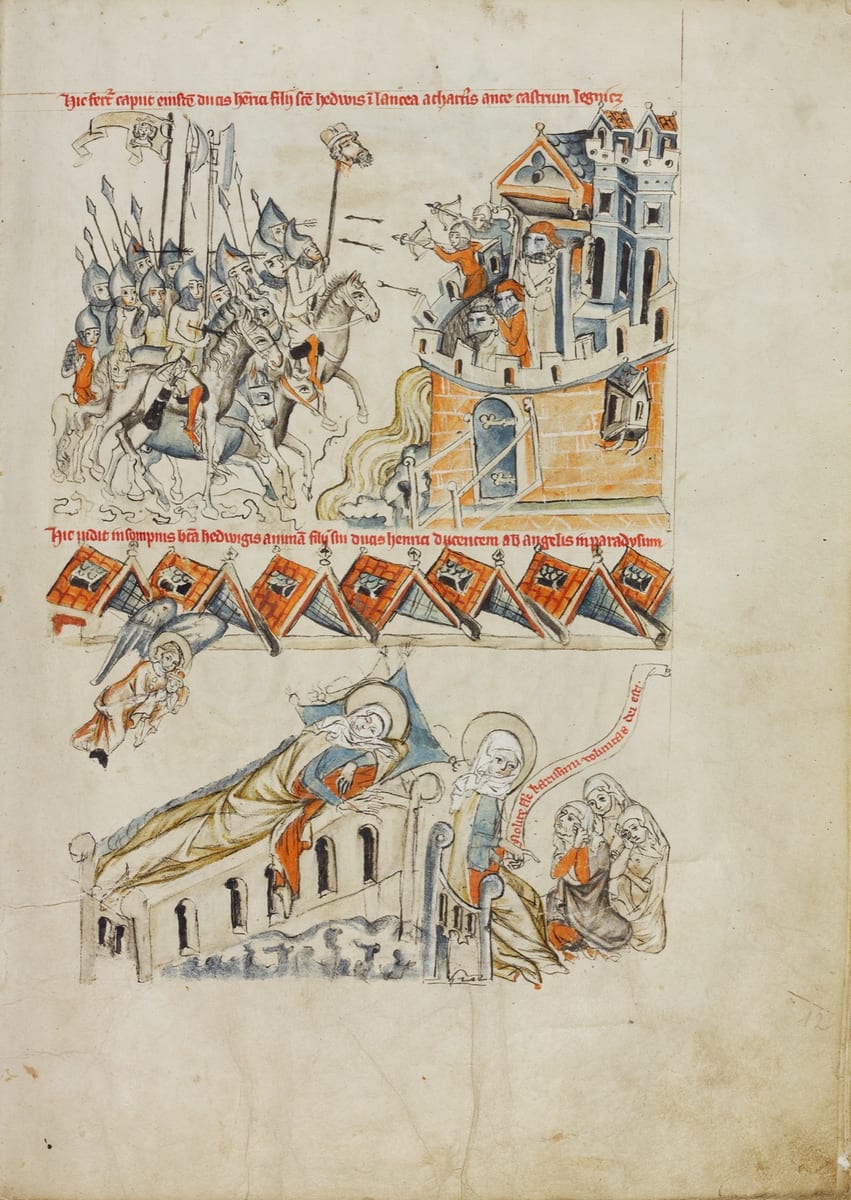
The Tartars Carrying the Head of Heinrich before Castle Liegnitz; Saint Hedwig Seeing in a Dream Her Son's Soul Carried to Heaven (Vita beatae Hedwigis, Ms. Ludwig XI 7, fol. 12), Unknown Silesian illuminator (court workshop of Duke Ludwig I of Liegnitz and Brieg); scribe Nicolaus of Prussia, 1353 AD Unknown Silesian illuminator (court workshop of Duke Ludwig I of Liegnitz and Brieg); scribe Nicolaus of Prussia, J. Paul Getty Museum, Los Angeles (Ms. Ludwig XI 7, 83.MN.126 AD) In 1241 AD the Mongols invaded Silesia, and St. Hedwig withdrew with her nuns to the fortress of Krosno. On April 9, 1241 AD, her son, Duke Henry II the Pious, was killed fighting them at Legnica. Pope John Paul II said the invaders were then forced to retire and never again came so close to the West.
The German Legend of St. Hedwig, printed in 1504 AD, says she then went to the battlefield. She knew her son's headless body by a silk girdle she had given him.
“God hath disposed of my son as it hath pleased him. We ought to have no other will than his.”
St. Hedwig of Silesia to Her daughter Gertrude, the abbess, and her daughter-in-law Anna, 1241 AD -
1243 AD
Death at Trebnitz
She refused burial beside her husband, and the sisters found a hair shirt under her clothes.
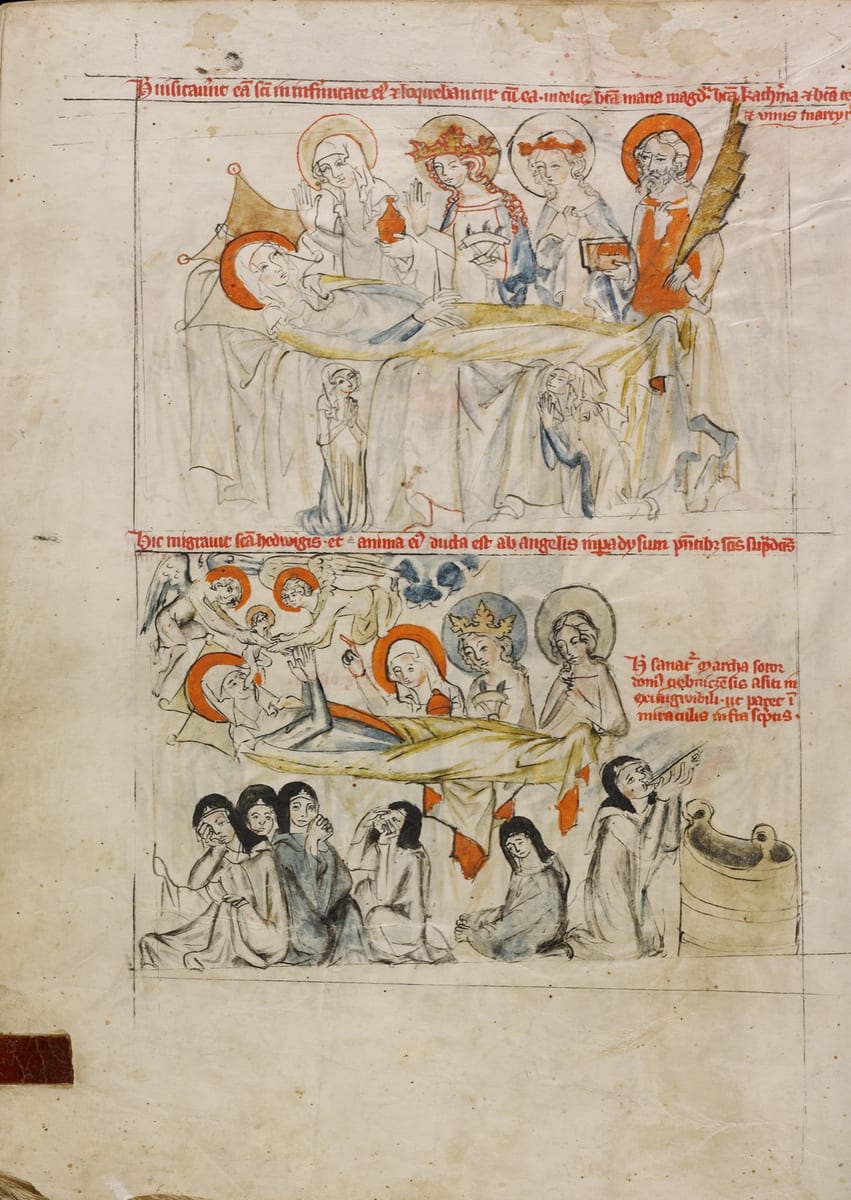
Saint Hedwig on Her Sickbed Surrounded by Saints; The Death of Saint Hedwig and Her Soul Received into Paradise (Vita beatae Hedwigis, Ms. Ludwig XI 7, fol. 82v), Unknown Silesian illuminator (court workshop of Duke Ludwig I of Liegnitz and Brieg); scribe Nicolaus of Prussia, 1353 AD Unknown Silesian illuminator (court workshop of Duke Ludwig I of Liegnitz and Brieg); scribe Nicolaus of Prussia, J. Paul Getty Museum, Los Angeles (Ms. Ludwig XI 7, 83.MN.126 AD) In her last illness St. Hedwig asked for Extreme Unction before anyone else thought she was in danger. Her daughter Gertrude asked whether St. Hedwig wished to be buried beside her husband, and St. Hedwig refused. She died at Trebnitz on October 15, 1243 AD, at about the hour of Vespers.
When the sisters came to wash her body, they found a rough hair shirt against her skin and a girdle of twisted horsehair. Sister Iuttha testified that the calluses on St. Hedwig's knees were as large as two fists. St. Hedwig was buried in the nuns' cemetery at Trebnitz, as she had wished.
-
1262–1267 AD
Declared a saint at Viterbo
Papal examiners heard the witnesses, and Pope Clement IV canonised her.
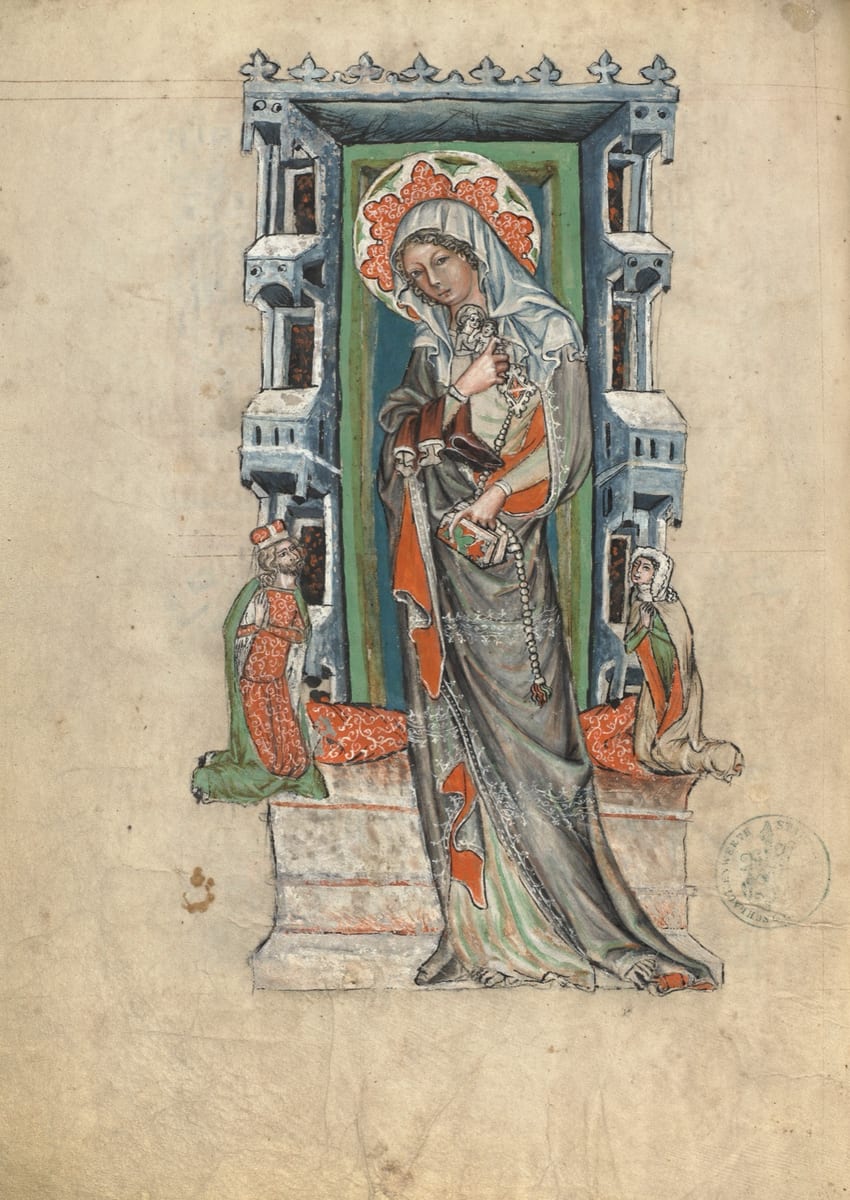
Saint Hedwig of Silesia with Duke Ludwig I of Liegnitz and Brieg and Duchess Agnes (Vita beatae Hedwigis, Ms. Ludwig XI 7, fol. 12v), Unknown Silesian illuminator (court workshop of Duke Ludwig I of Liegnitz and Brieg); scribe Nicolaus of Prussia, 1353 AD Unknown Silesian illuminator (court workshop of Duke Ludwig I of Liegnitz and Brieg); scribe Nicolaus of Prussia, J. Paul Getty Museum, Los Angeles (Ms. Ludwig XI 7, 83.MN.126 AD) On October 26, 1262 AD, examiners appointed by the Holy See opened an inquiry into her life and miracles. One father told them of his son's cure and could barely speak for tears. A healed boy was brought before the examiners in good health.
Pope Clement IV declared St. Hedwig a saint by a bull given at Viterbo on March 26, 1267 AD. The bull set her feast for October 15, the day of her death.


Pray with the Church
Collect for the Memorial of Saint Hedwig
The Collect of the Roman Missal for the Memorial of Saint Hedwig, October 16 (ICEL translation)
Grant, we pray, almighty God,that the revered intercession of Saint Hedwigmay bring us heavenly aid,just as her wonderful lifeis an example of humility for all.Through our Lord Jesus Christ, your Son,who lives and reigns with you in the unity of the Holy Spirit,God, for ever and ever.
All 1 report on Saint Hedwig of Silesia
