
Saints Landgravine of Thuringia · 1207–1231 AD
Saint Elizabeth of Hungary
Feast 17 November · Born 1207 AD, Hungary (probably Pressburg, now Bratislava, Slovakia) · Died 1231 AD, Marburg, Hesse, Germany
A king's daughter sent abroad at four and widowed at twenty, she spent her last three years nursing the sick at Marburg and died at twenty-four.
Begin the life
In brief
Saint Elizabeth of Hungary, also called St. Elizabeth of Thuringia, was a king's daughter who married the ruler of Thuringia and was widowed at twenty. She spent her last three years caring for the sick in the hospital she founded at Marburg, and she died there at twenty-four. Pope Gregory IX declared her a saint four years after her death.
-
1207–1216 AD
A princess sent away at four
The King of Hungary's daughter is promised to a German ruling family and taken to their castle as a small child.
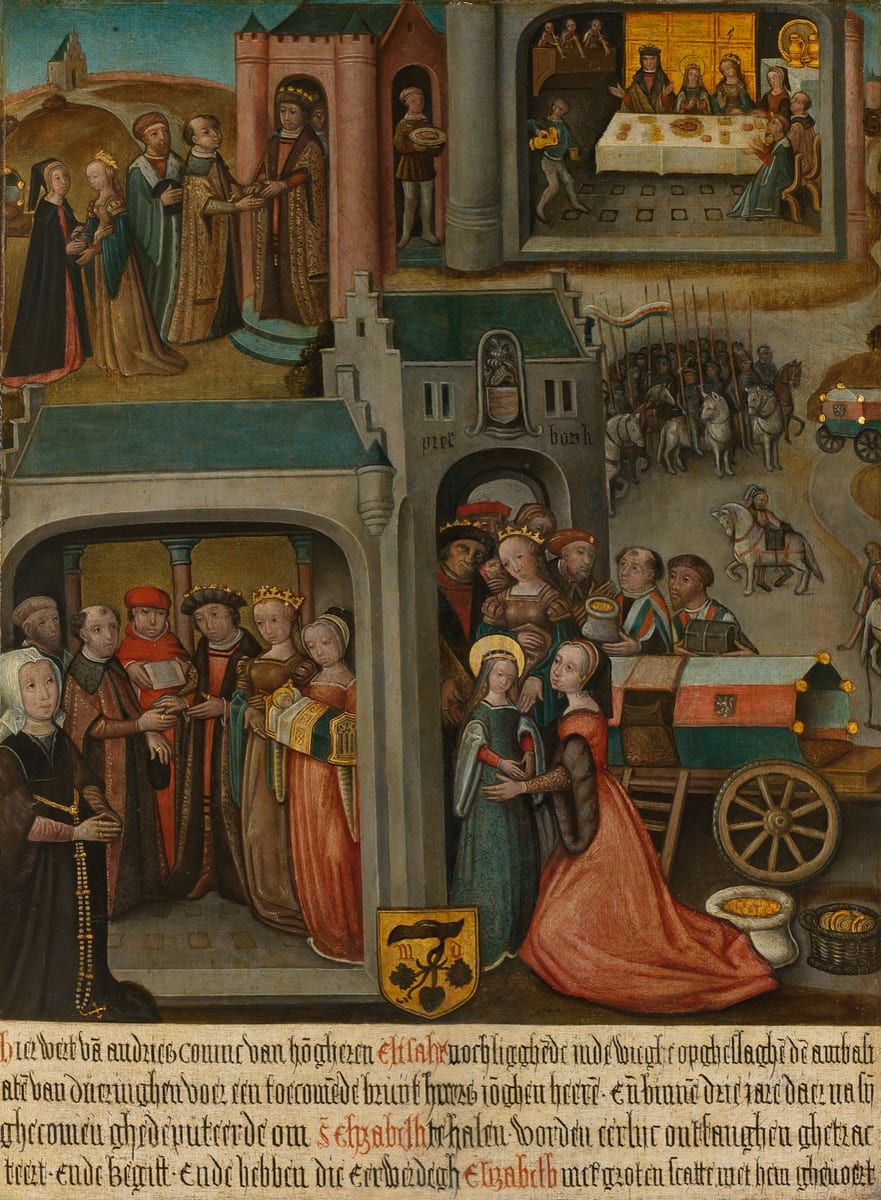
Four scenes from the legend of St Elizabeth of Hungary (Vier taferelen uit de legende van de heilige Elisabeth van Hongarije), Anonymous, Northern Netherlands, c. 1500 AD Anonymous, Northern Netherlands, Rijksmuseum Amsterdam, SK-A-2237 AD (oil on panel, 83 × 61 cm) St. Elizabeth was born in Hungary in 1207 AD, a daughter of King Andrew II and Queen Gertrude. Her father promised her in marriage to the family of Landgrave Hermann I, ruler of Thuringia in central Germany. In 1211 AD Thuringian knights took the four-year-old to the Wartburg, the landgrave's castle above Eisenach.
In 1213 AD nobles in Hungary murdered her mother. In 1216 AD the landgrave's eldest son, Hermann, died, and she was betrothed instead to his brother Ludwig.
-
1211–1221 AD
A young girl takes off her crown in church
Criticised at court because her ways do not fit a princess, she marries the ruler of Thuringia.
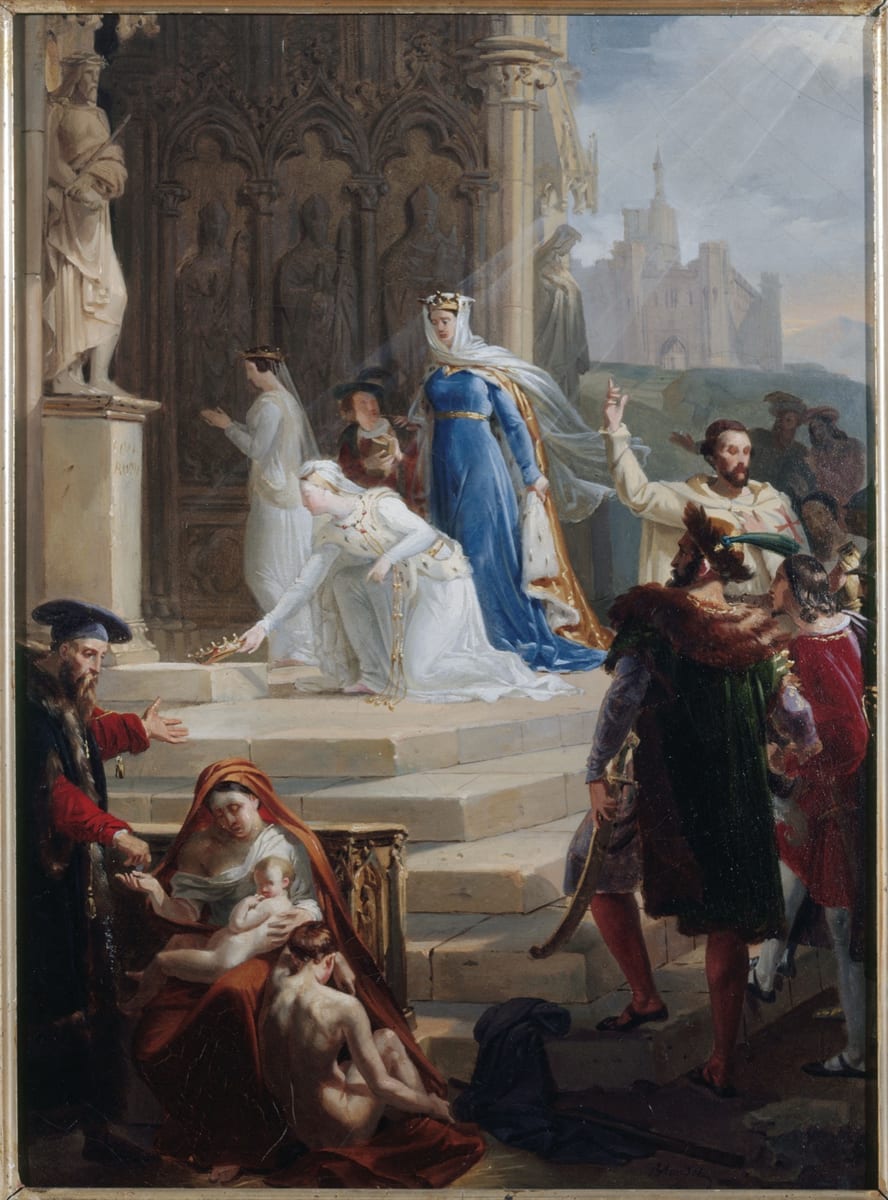
Esquisse pour l'église Sainte-Elisabeth : Sainte Elisabeth, reine de Hongrie, déposant sa couronne aux pieds de l'image de Jésus-Christ, Merry-Joseph Blondel (oil sketch), 1824 AD Merry-Joseph Blondel (oil sketch), Petit Palais, Musée des Beaux-Arts de la Ville de Paris, PPP4514 At court, people whispered that her ways did not fit a princess. On the feast of the Assumption she took off her crown in church, laid it before the crucifix and lay face down on the floor. Landgravine Sophia, Ludwig's mother, reproached her for it.
St. Elizabeth married Ludwig at the Wartburg in her early teens. By then Ludwig ruled Thuringia as landgrave. Part of the money meant for the wedding banquet went to the poor.
“How can I, a wretched creature, continue to wear a crown of earthly dignity, when I see my King Jesus Christ crowned with thorns?”
St. Elizabeth of Hungary to Landgravine Sophia, her mother-in-law -
1225–1226 AD
Nine hundred fed a day at the castle gate
She refuses any food not lawfully her husband's, and in a famine year she feeds the hungry at the Wartburg.
In 1225 AD Conrad of Marburg, a preacher known for his sternness, became St. Elizabeth's confessor. With Ludwig's consent she vowed to obey Conrad, and to stay unmarried if she were widowed. At her husband's table she refused any food that did not come from his lawful income.
In 1226 AD famine struck Thuringia while Ludwig was away in Italy. She opened the granaries and fed nine hundred people a day at her gate. When Ludwig came home, he approved everything she had done.
“So long as she does not sell the castle, I am happy with her!”
Landgrave Ludwig IV of Thuringia to those who complained of St. Elizabeth's almsgiving -
June–October 1227 AD
Her husband leaves on crusade and does not come back
She lets her husband go on crusade, and he dies of fever at Otranto before he reaches the Holy Land.
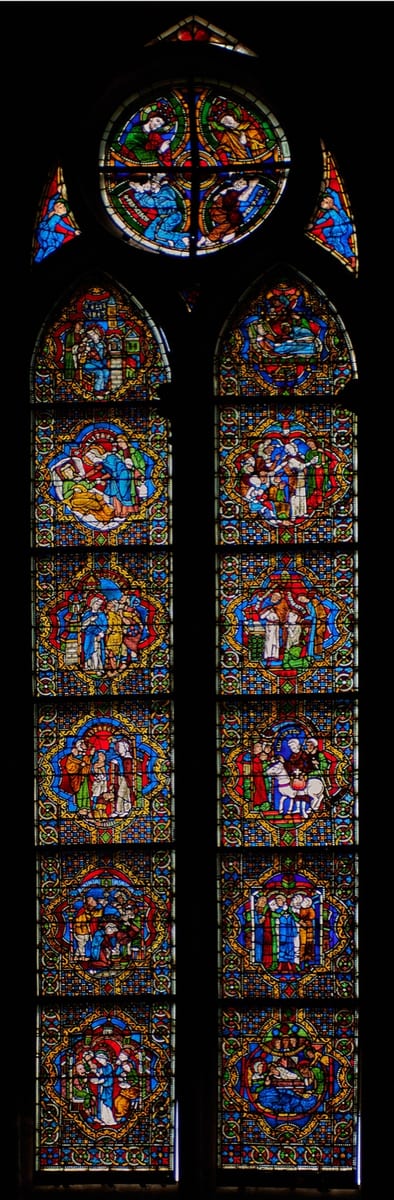
Elisabeth medallion window, right lancet: Elizabeth takes leave of her husband Ludwig, Workshop of the Elisabeth medallion window; photograph by Tilman2007, corrected by Heinrich Stürzl (September 2, 2021 AD), c. 1245–1250 AD Workshop of the Elisabeth medallion window; photograph by Tilman2007, corrected by Heinrich Stürzl (September 2, 2021 AD), St. Elizabeth's Church (Elisabethkirche), Marburg, high choir Ludwig took the cross to join Emperor Frederick II's crusade to the Holy Land. St. Elizabeth parted from him at the end of June 1227 AD, when she was twenty and pregnant with their third child.
Fever spread through the crusading army, and Ludwig died at Otranto in September. The news reached her in October, just after she gave birth to a daughter, Gertrude. She wept bitterly.
“Far be it from me to detain you. I have given my whole self to God and now I must also give you”
St. Elizabeth of Hungary to Landgrave Ludwig IV of Thuringia, June 1227 AD -
1227–1228 AD
A widow lays her hands on a bare altar
Pushed aside from power, she asks permission to beg, is refused, and gives up the world on Good Friday.
Ludwig's brother, Heinrich Raspe, took over the government and called St. Elizabeth a pious woman unfit to rule. In tears she begged Conrad to let her beg for alms from door to door. Conrad refused.
On Good Friday, with the altars stripped, she laid her hands on the altar of the friars' chapel at Eisenach. In front of friars and relatives she gave up her own will and all worldly show. Conrad ordered her to keep her widow's income, and it paid for her charity.
“On Good Friday in 1228, having placed her hands on the altar in the chapel of her city, Eisenach, to which she had welcomed the Friars Minor, in the presence of several friars and relatives Elizabeth renounced her own will and all the vanities of the world. She also wanted to resign all her possessions, but I dissuaded her out of love for the poor. Shortly afterwards she built a hospital, gathered the sick and invalids and served at her own table the most wretched and deprived. When I reprimanded her for these things, Elizabeth answered that she received from the poor special grace and humility”
Conrad of Marburg to Pope Gregory IX, in his letter to the Pope on her life (Epistula magistri Conradi, 14-17), 1232 AD -
1228–1231 AD
A grey dress and a hospital at Marburg
She nurses the poorest patients with her own hands; Conrad sends away her companions and has her flogged.
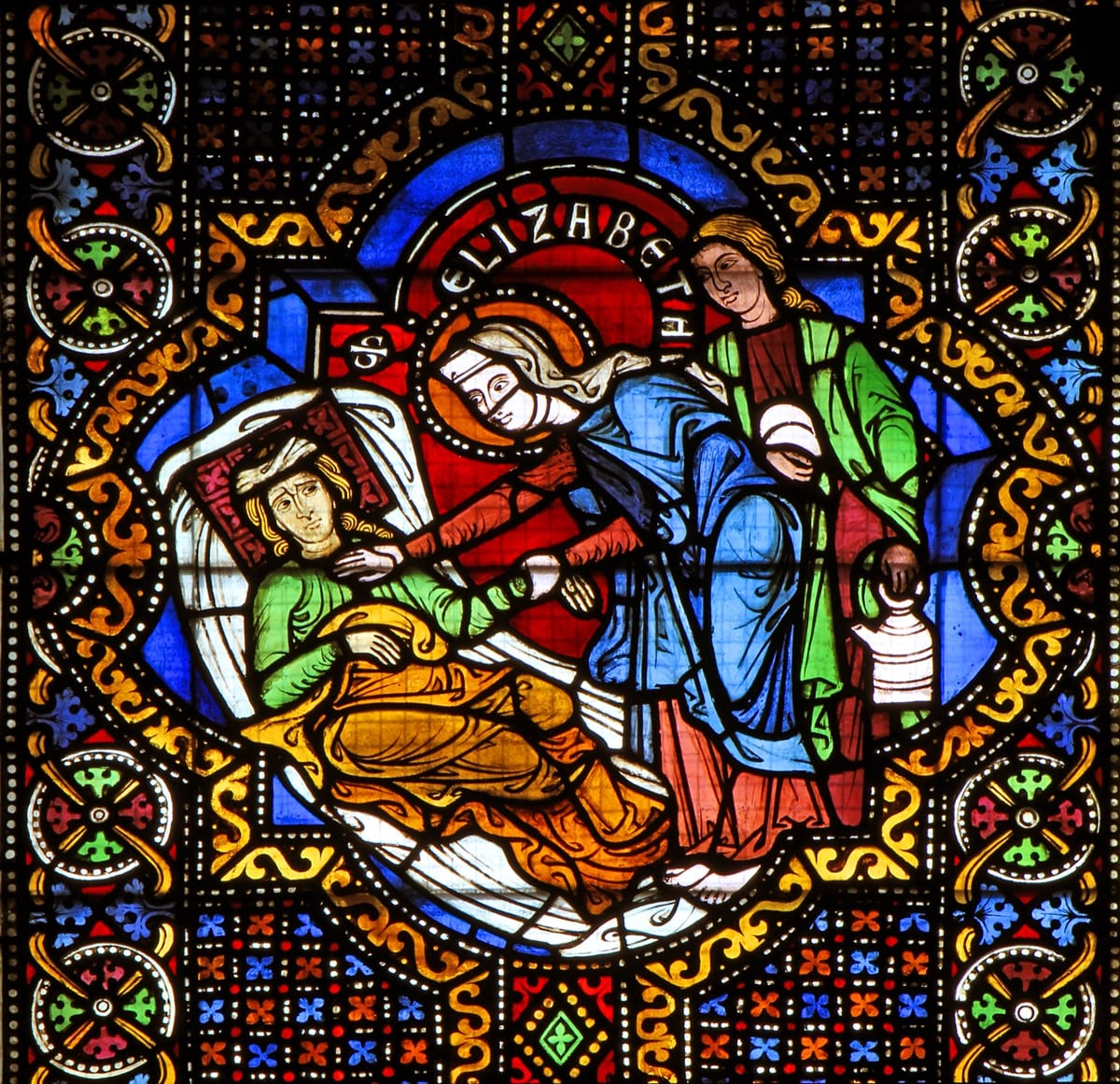
Elisabeth medallion window, left lancet: Elizabeth nurses the sick (Elisabeth pflegt Kranke), Workshop of the Elisabeth medallion window; photograph by Heinrich Stürzl (June 11, 2021 AD), c. 1240–1250 AD Workshop of the Elisabeth medallion window; photograph by Heinrich Stürzl (June 11, 2021 AD), St. Elizabeth's Church (Elisabethkirche), Marburg, high choir St. Elizabeth moved to Marburg, where Conrad lived, and took a plain grey habit from him. There she founded a hospital and sat the most wretched patients at her own table. She carried the sick in her arms, washed their sores and cleaned their sheets.
Conrad sent away Guda and Isentrud, the women who had been with her since childhood and marriage. After she visited the convent at Altenberg, where her little daughter Gertrude lived, he had her flogged. The marks were still visible three weeks later.
“The sedge grass lies flat when the river is in flood, and when the water recedes, the sedge straightens up. So, when some affliction befalls us, we should bow to it humbly and, when it passes, be lifted up by spiritual joy to God.”
St. Elizabeth of Hungary to her companions, after Conrad had her beaten -
November 1231 AD
Everything to the poor but one worn dress
Dying of fever at her hospital, she gives away all she has and dies at twenty-four.
In November 1231 AD St. Elizabeth fell ill with a high fever. When Conrad asked about her goods, she told him that whatever seemed to be hers belonged to the poor. She asked him to give away everything except one worn dress to be buried in.
She died at her hospital in Marburg, as if falling gently asleep, at twenty-four. The General Roman Calendar keeps her memorial on November 17, the day of her death.
“The midnight approacheth in which Jesu Christ was born; it is now time that God call his friends to his heavenly weddings.”
St. Elizabeth of Hungary to her women, on the night of her death, November 1231 AD -
1231–1236 AD
Healings at the grave, and a saint within four years
Sworn witnesses come forward at Marburg, the Pope declares her a saint, and an emperor comes barefoot to her tomb.
St. Elizabeth was buried in the chapel of her hospital, and miracles of healing soon began at her grave. Papal commissioners took sworn testimony from people who had been healed. On January 1, 1235 AD, four of her women gave sworn testimony about her life.
Pope Gregory IX declared her a saint at Perugia at Pentecost 1235 AD. In 1236 AD her body was raised at Marburg in front of a vast crowd. Emperor Frederick II came to it barefoot, in a plain grey garment.


Pray with the Church
Collect for the memorial of Saint Elizabeth of Hungary
The Roman Missal, collect of the memorial on November 17 (English translation)
O God, by whose gift Saint Elizabeth of Hungaryrecognized and revered Christ in the poor,grant, through her intercession,that we may serve with unfailing charitythe needy and those afflicted.Through our Lord Jesus Christ, your Son,who lives and reigns with you in the unity of the Holy Spirit,God, for ever and ever.
All 1 report on Saint Elizabeth of Hungary
