
Saints Passionist student, 1838–1862 AD
Saint Gabriel of Our Lady of Sorrows
Feast 27 February · Born 1838 AD, Assisi, Papal States (Italy) · Died 1862 AD, Retreat of the Immaculate Conception, Isola del Gran Sasso, Abruzzo, Italy
He left the ballrooms of Spoleto at eighteen and died in an Abruzzi retreat before his twenty-fourth birthday.
Begin the life
In brief
Saint Gabriel of Our Lady of Sorrows, commonly known as Gabriel Possenti, was born at Assisi on March 1, 1838 AD and christened Francesco. He entered the Passionists at eighteen and died of tuberculosis at Isola del Gran Sasso on February 27, 1862 AD, a student in minor orders who was never ordained. Pope Benedict XV canonized him in 1920 AD, and the Church named him co-patron of Catholic youth six years later.
-
1838–1849 AD
A governor's son at the font of St. Francis
Born at Assisi, motherless before he was four, schooled at Spoleto by the Christian Brothers.
St. Gabriel was born at Assisi on March 1, 1838 AD, the eleventh child of a lawyer who held office for the Papal States. His father, Sante Possenti, carried him to San Rufino the same day, to the font where St. Francis of Assisi had been baptized.
The family moved to Spoleto, and in the winter of 1842 AD two of his sisters died and then his mother, Agnese Frisciotti Possenti, at forty-one. He was not yet four, and his sister Maria Luisa and the household governess raised him. The Brothers of the Christian Schools taught him his first letters and his catechism.
-
1850–1855 AD
The gold medals and the ballrooms
At the Jesuit college he took the gold medals, and his schoolfellows gave him a nickname.
At twelve St. Gabriel passed to the college of the Jesuits at Spoleto, where he took excellent results in Latin oration and verse and in the study of the Italian ode, and in 1854 AD a prose composition of his in Italian won a prize at the Accademia di poesia. At the end of the course he took the gold medals of philosophy and of honour, and his sister Teresa kept one of them.
He spent hours dressing for parties, read novels, and went to the ballrooms and the theatres. His schoolfellows called him *il damerino* (*the society young man*). Through all those years he heard Mass every morning and said the rosary every night.
-
1851–1853 AD
Twice near death, twice he promised and stayed
Illness drew a vow of religious life from him; recovery drew nothing.
In 1851 AD an illness of the throat brought him near death, and he promised God to enter religious life if he recovered. His health came back and the promise went unkept. He promised again after he narrowly escaped being shot on a hunting trip, and forgot that promise too.
Two years later the throat illness returned, and brought him nearer to death than the first. The Passionist lives, drawing on the sworn depositions taken for his cause, record that he wrapped a picture of the Jesuit martyr Blessed Andrew Bobola about his throat, renewed his promise, and woke the next morning cured. He asked the Jesuits to receive him, they accepted him, and he did not go.
“My God, have mercy on me and spare me this time, and I swear that my broken promise shall be fulfilled!”
St. Gabriel of Our Lady of Sorrows to God, at Spoleto, during the throat illness that brought him near suffocation -
1856 AD
Cholera takes his sister, and his mind turns back to religion
Maria Luisa dies in the epidemic; after the procession he settles on the Passionists.
Cholera at Spoleto killed his sister Maria Luisa, who had cared for him since their mother's death. The Dicastery for the Causes of Saints records that the loss tested him enormously and turned his mind again to religious life, while his father tried to dissuade him.
According to longstanding Catholic tradition, when the epidemic ended the ancient icon of Mary was carried in procession through the city, on August 22, 1856 AD. According to longstanding Catholic tradition, carried by the early biographies and the canonization-process testimonies, the Blessed Virgin asked him as the image passed why he had not kept his promise. He took a priest's advice and resolved to enter the Congregation of the Most Holy Passion.
-
1856 AD
Sante Possenti refuses, and then gives way
The father had already given one son to the Dominicans and another to the seminary.
St. Gabriel told his father he had already applied to the Passionist Provincial. Sante Possenti was sixty-six, had given one son to the Dominicans and another to the seminary, and refused. The Sanctuary of San Gabriele records that he took the choice for a passing mood, because his son had made such resolutions before and they had come to nothing.
His father, hoping to keep that son at home, sent his brother Michele, back for a short time from Rome, to talk him out of the novitiate; Michele came away from the conversation and told their father to let him go. After a restless night the father gave his consent and his blessing. A letter went to Morrovalle, where the novice house had exactly one place free.
“Father, I have made up my mind to become a religious, and I desire your consent and blessing.”
St. Gabriel of Our Lady of Sorrows to his father, Sante Possenti, telling his father of his vocation at Spoleto, 1856 AD -
1856–1861 AD
Confrater St. Gabriel of Our Lady of Sorrows
Six years in the Passionist houses of the Marches and the Abruzzi, under one director and one illness.
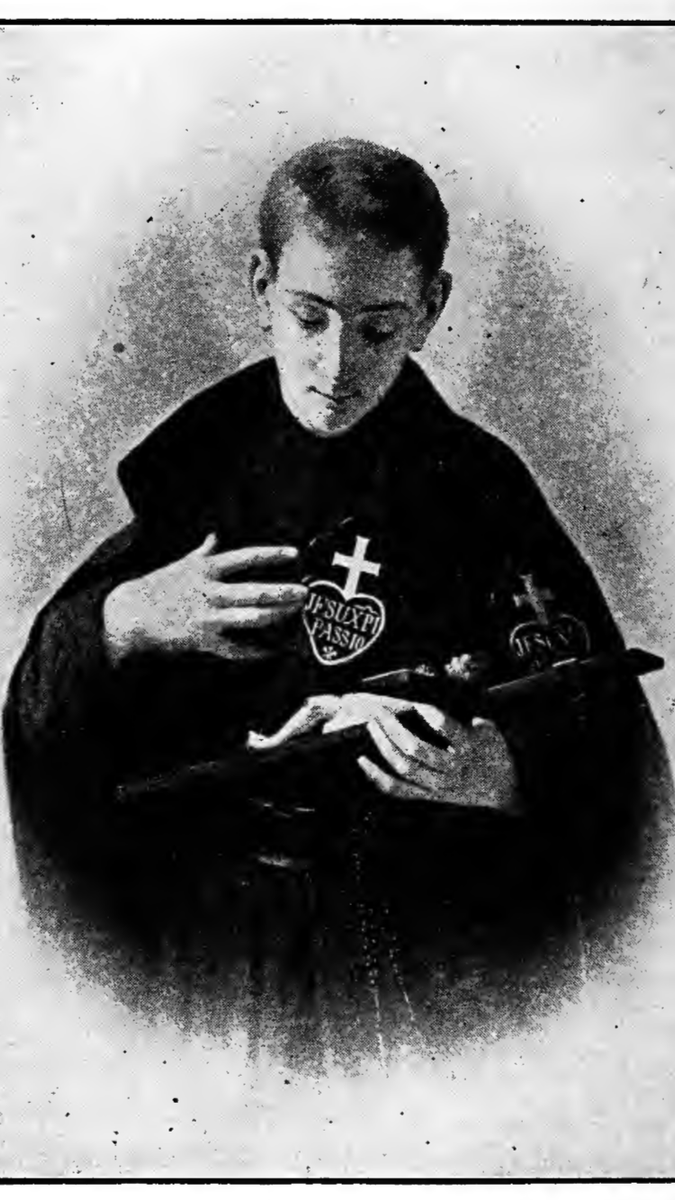
Saint Gabriel in his Passionist habit, after the painting by Professor Grandi — frontispiece to 'The Life of Blessed Gabriel of Our Lady of Sorrows', Francesco Grandi (1831-1891 AD), painted 1879 AD; this reproduction published 1910 AD Francesco Grandi (1831-1891 AD), Wikimedia Commons, from the H. L. Kilner & Co. edition (Philadelphia, 1910 AD); the original oil is catalogued by the Istituto Centrale per il Catalogo e la Documentazione as 'Prima immagine di S. Gabriele', oil on canvas, 65 x 55 cm, Isola del Gran Sasso d'Italia (Teramo), record 1300087572, and a version is recorded by Hage as preserved in the Passionist retreat of the Scala Santa in Rome At eighteen St. Gabriel was clothed in the Passionist habit and took the name Gabriel of Our Lady of Sorrows. Father Norbert, his vice-master and then his spiritual director, was with him from the day he entered until the day he died.
In 1861 AD his superiors let him bind himself by vow to be Our Lady's champion for life. He received minor orders that May, and the subdiaconate was arranged for the September ember days. A cold caught at Pievetorina had settled on his chest and never cleared, and that summer he began visibly to waste.
“No, indeed, my heaven is the dolorous heart of my dear Mother!”
St. Gabriel of Our Lady of Sorrows to Father Bernard, asked whether he had made his evening meditation on heaven -
1861–1862 AD
The last winter at Isola
Too weak for the midnight Mass at Christmas, he asked for the viaticum in February.
By Christmas 1861 AD he was too weak to go down to the church, and Father Norbert forbade him the Mass of Christmas night. He had sent his father his last letter on December 19, 1861 AD, and he wrote to his brother Michele eleven days later. A violent hemorrhage came in the middle of February 1862 AD, and the physician advised that the last sacraments be given.
He asked for the viaticum on February 18, 1862 AD, nine days before he died. His fellow students did not leave his bedside through the night of February 26. He died at half past six the next morning, holding to his heart the image of the Crucified with the Sorrowful Mother.
“Vulnera tua, merita mea: Thy wounds, O Lord, are my merits!”
St. Gabriel of Our Lady of Sorrows, cried out in a loud voice on the night of 26 February 1862, February 26, 1862 AD -
1862–1920 AD
Four thousand on the hill at Isola
Thirty years after the burial the village barred the church door against the men sent to open his grave.
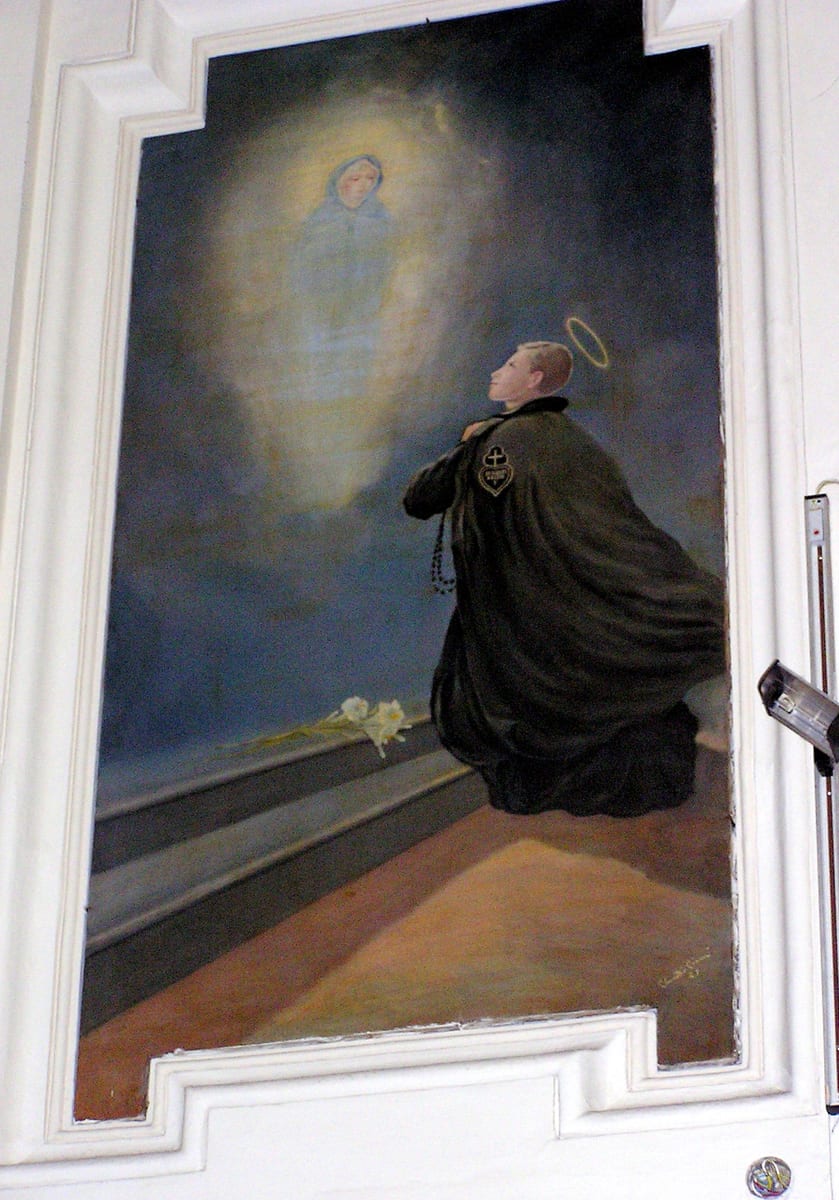
S. Gabriele dell'Addolorata, church of San Domenico, Ancona, Unrecorded; photograph by the Wikimedia contributor 'Gep', painting undated, after Grandi; photographed April 19, 2015 AD Unrecorded; photograph by the Wikimedia contributor 'Gep', Chiesa di San Domenico, Ancona; file on Wikimedia Commons St. Gabriel was buried in the crypt of the church beside the retreat, and lay there thirty years. When a commission came to open the grave on October 17, 1892 AD, hundreds of men and women barricaded the church and dared them to touch the tomb. The next day about four thousand people covered the hill, and the delegates found nothing in the vault but his bones.
Cures were reported at the tomb from that week, and the register at Isola recorded about ninety in 1897 AD alone. Pope Pius X beatified him in St. Peter's on May 31, 1908 AD. Pope Benedict XV canonized him there on May 13, 1920 AD, before more than sixty thousand people.


Pray with the Church
Saint Gabriel's prayer to the Mother of Sorrows
The prayer St. Gabriel said before images of Our Lady of Sorrows and recited with his fellow students on their recreation walks, preserved in the Passionist life of Father Camillus J. Hollobough, C.P. (1953 AD).
O Mother of Sorrows, by the anguish and love with which thou didst stand at the cross of Jesus, stand by me in my last agony.To thy maternal heart I commend the last three hours of my life.Offer these hours to the Eternal Father in union with the agony of our dearest Lord, in atonement for my sins.Offer to the Eternal Father the most precious blood of Jesus, mingled with your tears on Calvary, that I may obtain the grace of receiving Holy Communion with the most perfect love and contrition before my death, and that I may breathe forth my soul in the adorable presence of Jesus.Dearest Mother, when the moment of my death has at last come, present me as your child to Jesus.Ask Him to forgive me for having offended Him, for I knew not what I did.Beg Him to receive me into His kingdom of glory to be united with Him forever.Amen.
All 2 reports on Saint Gabriel of Our Lady of Sorrows

Dying Roman woman recovers after friend brings dust from St. Gabriel's grave

About this picture
AI-generated image, in the manner of mid-nineteenth-century Roman academic oil painting, from the paper's reference portrait based on Saint Gabriel in his Passionist habit, after the painting by Professor Grandi — frontispiece to 'The Life of Blessed Gabriel of Our Lady of Sorrows' (Francesco Grandi, 1831-1891; painted 1879, this reproduction published 1910, Wikimedia Commons, from the H. L. Kilner & Co. edition, Philadelphia, 1910) View source artwork.