
Saints The seven sorrows · Memorial of September 15
Our Lady of Sorrows
Feast 15 September
The Church honours the Blessed Virgin Mary in her sorrows, and Christian piety has counted seven of them: three from her Son's infancy and four from his Passion.
Begin the life
In brief
The Church honours the Blessed Virgin Mary under the title of her sorrows, and Christian piety has singled out seven particular incidents of sorrow in her life. They are the prophecy of St. Simeon, the flight into Egypt, the three days' loss, the meeting with her Son on the road to Calvary, the Crucifixion, the taking down from the cross and the burial: three belong to his infancy and four to his Passion. The Church keeps her memorial on September 15.
-
The first sorrow · the Temple at Jerusalem
A sword foretold in the Temple
Forty days after the birth, an old man in the Temple tells her that a sword shall pierce her own soul.
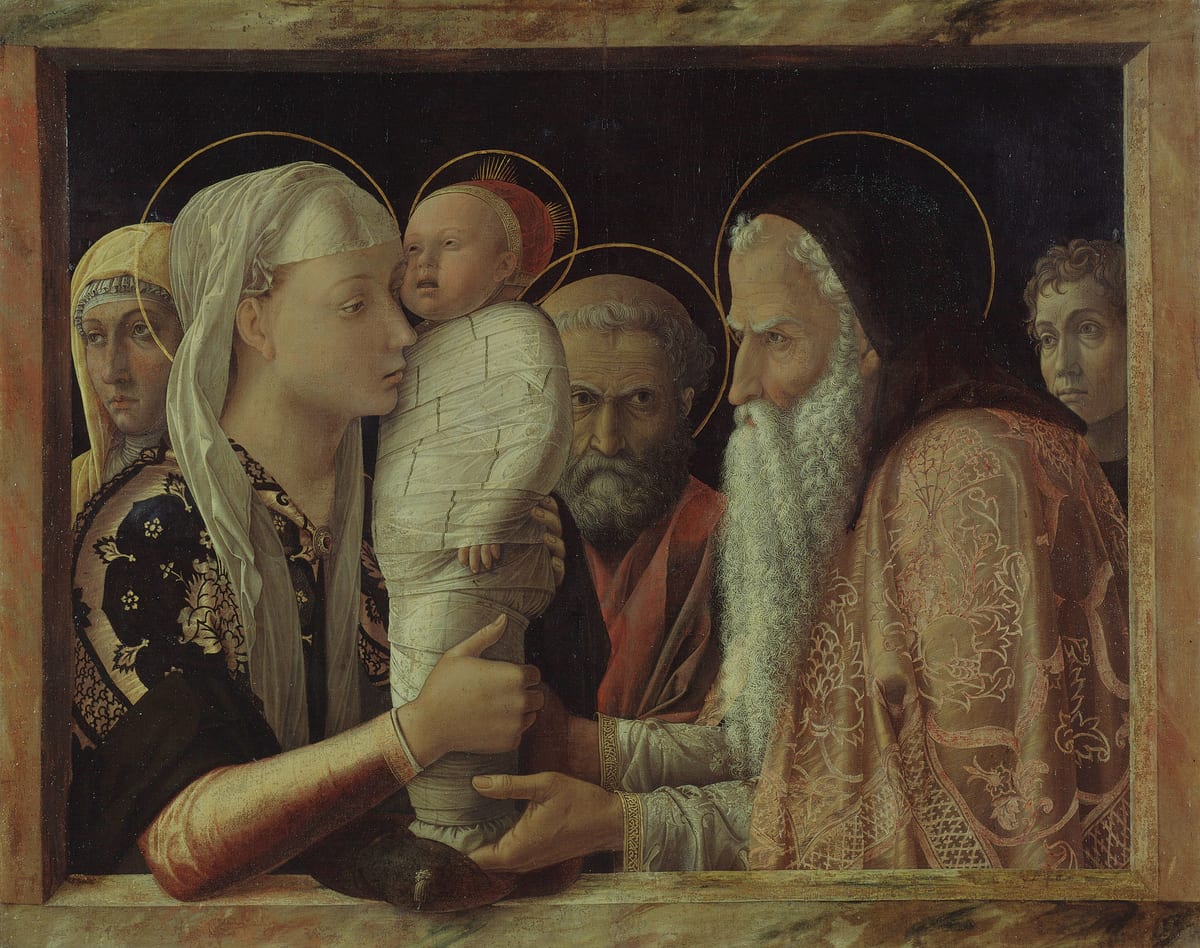
The Presentation in the Temple, Andrea Mantegna, c. 1454 AD Andrea Mantegna Forty days after the birth, in accordance with the Law of Moses, she and St. Joseph brought the child up to Jerusalem to present him to the Lord. St. Simeon, a just and devout man of Jerusalem who was waiting for the consolation of Israel, had been told by the Holy Ghost that he should not see death before he had seen the Christ of the Lord. He took the child in his arms and acknowledged him as the Messiah.
Then he turned to his mother and said that the child was set for the fall and the resurrection of many in Israel, and that a sword should pierce her own soul. The sermon read at the Office of the memorial says that the martyrdom of the Virgin is set forth both in this prophecy and in the story of the Lord's passion. St. Alphonsus Liguori identifies the sword St. Simeon promised with the spear that opened the side of her Son.
“Behold this child is set for the fall, and for the resurrection of many in Israel, and for a sign which shall be contradicted; And thy own soul a sword shall pierce, that, out of many hearts, thoughts may be revealed.”
St. Simeon to the Blessed Virgin Mary, the presentation of the child Jesus in the temple -
The second sorrow · Bethlehem, and the road into Egypt
Out of Bethlehem by night
An angel's warning sends the family into Egypt by night, and Herod kills the children of Bethlehem.
An angel of the Lord told St. Joseph to take the child and his mother and fly into Egypt, because Herod would seek the child to destroy him. They went by night. Herod, finding himself deceived by the wise men, killed the male children of Bethlehem two years old and under.
They stayed in Egypt until the death of Herod, and then went back and settled at Nazareth. Pope Paul VI describes her as a woman of strength who knew poverty and suffering, flight and exile. According to longstanding Catholic tradition, St. Joseph worked at his trade as a carpenter in Egypt and she contributed to the support of the household.
“Arise, and take the child and his mother, and fly into Egypt: and be there until I shall tell thee. For it will come to pass that Herod will seek the child to destroy him.”
An angel of the Lord to St. Joseph, warning Joseph to flee to Egypt -
The third sorrow · Jerusalem, and the road home
Three days without him
The boy stays behind at the Pasch, and his parents seek him sorrowing.
The Law required the Jews to go up to Jerusalem to worship three times in the year, at the Pasch, at Pentecost and at the feast of tabernacles. When he was twelve the boy stayed behind in the city, and she and St. Joseph sought him sorrowing and found him after three days in the Temple. All who heard him there were astonished at his wisdom and his answers.
She asked him why he had done so to them. He answered that he must be about his father's business, and they did not understand the word he spoke to them. St. Alphonsus Liguori teaches that she understood the cause and the end of her other sorrows, but that in the loss of her Son in the Temple she did not.
“Son, why hast thou done so to us? behold thy father and I have sought thee sorrowing.”
Our Lady of Sorrows to Jesus, finding the twelve-year-old Jesus in the temple after three days -
The fourth sorrow · the road out to Calvary
She meets him on the road
He goes out bearing his own cross, and she follows the road behind him.
Pilate scourged him, sat in judgment at Gabbatha and delivered him to be crucified. Bearing his own cross he went out to Calvary, and his mother followed the road behind him. The fourth of the seven sorrows is this meeting on the road.
According to longstanding Catholic tradition, Father Frederick Faber describes her coming forward to embrace her Son, the soldiers thrusting her back, and her following on slowly. The Via Matris dolorosae, modelled on the Via Crucis, keeps seven stations answering to the seven sorrows, and was approved by the Apostolic See.
-
The fifth sorrow · Calvary
Standing by the cross
She stands by the cross while he dies, and he gives her to the beloved disciple.
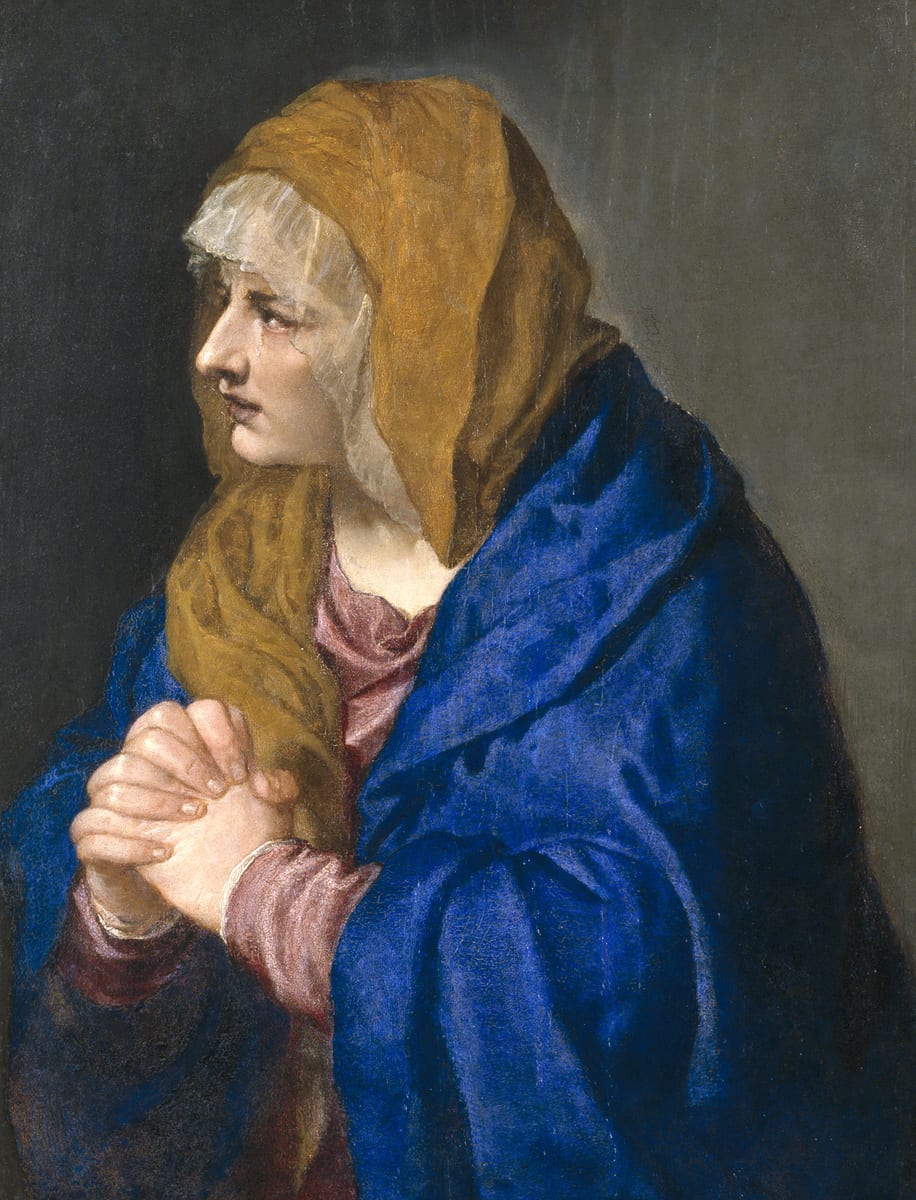
Mater Dolorosa with Clasped Hands, Titian, 1554 AD Titian, Museo Nacional del Prado, Madrid There stood by the cross of Jesus his mother, and his mother's sister Mary of Cleophas, and St. Mary Magdalen. Before he died he gave her to the beloved disciple as his mother, and the disciple took her to his own. He said that it was consummated, bowed his head and died, with his mother standing by. A soldier opened his side with a spear, and blood and water came out.
Pope Benedict XVI, preaching at Lourdes on this memorial, says that at the foot of the Cross the prophecy of St. Simeon is fulfilled and her mother's heart pierced through. The sermon read at the Office says that the spear which did not touch her Son's soul pierced her heart. Pope Francis says that at Calvary, in her overwhelming grief, she understood that prophecy, and that the Mother of Sorrows remains at the foot of the cross and does not run away or try to save herself.
“Woman, behold thy son.”
Christ to the Blessed Virgin Mary, at the cross, entrusting her -
The sixth sorrow · Calvary, at the foot of the cross
The body in her arms
He is taken down from the cross and laid in her arms.
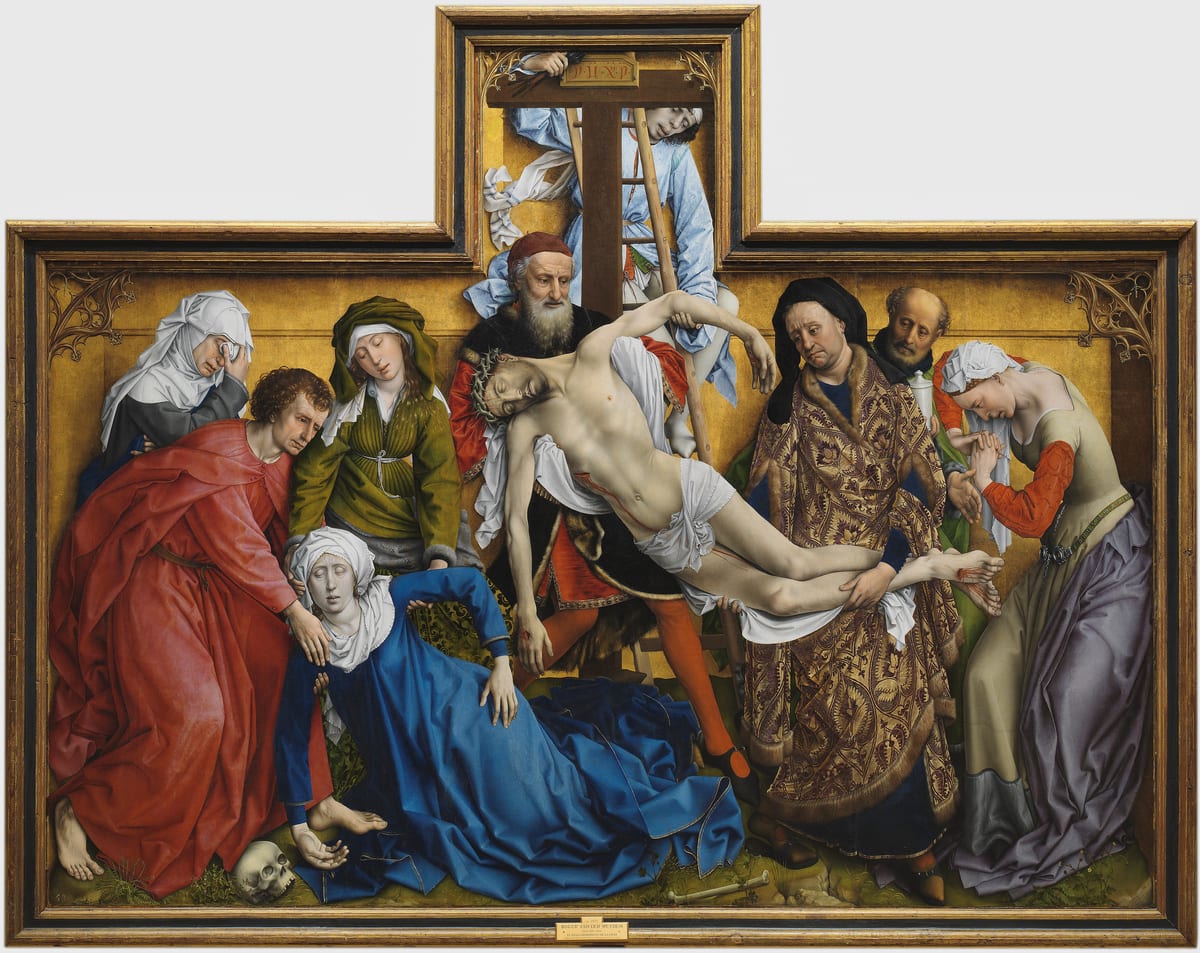
The Descent from the Cross, Rogier van der Weyden, c. 1435 AD Rogier van der Weyden, Museo Nacional del Prado, Madrid The body of her Son was taken down from the cross and laid in his mother's arms. The sixth of the seven sorrows is this taking down from the cross.
According to longstanding Catholic tradition, she told St. Bridget that she closed her Son's eyes when he was taken down, but could not close his arms. Pope Benedict XVI teaches that she too was led to perfection through suffering, so as to be capable of receiving the new spiritual mission entrusted to her.
-
The seventh sorrow · a garden near Calvary
The body, and the waiting
His body is bound in linen and laid in a new tomb, and she waits.
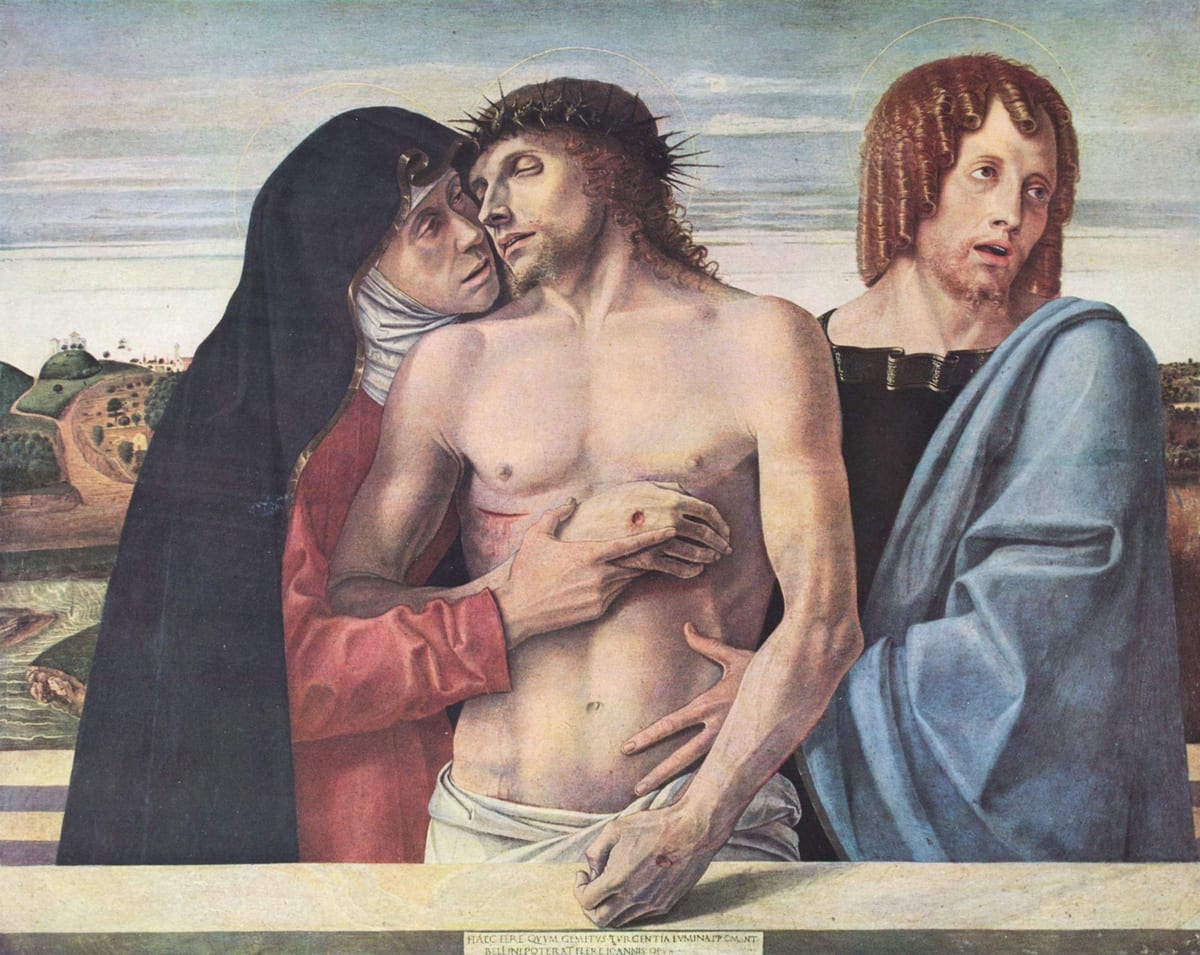
Pietà, Giovanni Bellini, c. 1460 AD Giovanni Bellini, Pinacoteca di Brera, Milan He was bound in linen cloths with spices and laid in a new sepulchre in a garden nearby. The seventh of the seven sorrows is the burial.
In the pious exercise of the Ora di Maria, while the body of her Son lies in the tomb, the Blessed Virgin awaits in faith his victorious triumph over death. According to tradition the whole body of the Church is represented in her, and as she waits near the tomb she is an icon of the Church keeping vigil. According to longstanding Catholic tradition, Father Frederick Faber holds the three days' loss to have been the greatest of her sorrows, approached in severity only by this last one.


Pray with the Church
The Collect of the Memorial
The Collect of the Mass of September 15, in the Roman Missal.
O God, who willedthat, when your Son was lifted high on the Cross,his Mother should stand close by and share his suffering,grant that your Church,participating with the Virgin Mary in the Passion of Christ,may merit a share in his Resurrection.Who lives and reigns with you in the unity of the Holy Spirit,God, for ever and ever.
All 4 reports on Our Lady of Sorrows

From the cross, Jesus gives his mother to the disciple beside her

A hymn about Our Lady at the Cross turns on one verb

About this picture
AI-generated image, in the manner of an early-fifteenth-century Cologne school panel painting, tempera on oak — a view of the city and its unfinished cathedral only, with no likeness of any person and no reference image used.
Cologne bishops answer broken images with a feast of Our Lady's sorrow

About this picture
AI-generated image, in the manner of a Tuscan tempera panel painting; a landscape of the place only, with no figures, no likeness of any person and no reference image used.