
Saints Wife, widow, foundress · Feast day July 23
Saint Bridget of Sweden
Feast 23 July · Born 1303 AD, Finsta, Uppland, Sweden · Died 1373 AD, Rome, Italy
Widowed in 1344 AD, a Swedish noblewoman followed her revelations to Rome and pressed the Popes not to rule from Avignon.
Begin the life
In brief
Saint Bridget of Sweden, also called Birgitta, was a Swedish noblewoman and the mother of eight children, widowed in 1344 AD. She then began to receive revelations, and in 1346 AD one sent her to Rome. In 1370 AD she met Pope Urban V at Montefiascone and pressed him not to take the papal court back to Avignon. She died in Rome in 1373 AD, and in 1999 AD Pope John Paul II declared her a Co-Patroness of Europe.
-
1303–1314 AD
A lawman's daughter at Finsta
She was born on her father's estate in Uppland, into a devout and powerful family.
St. Bridget was born in 1303 AD at Finsta, her father's estate in the Swedish province of Uppland. Her father, Birger Persson, was lawman of Uppland, the province's judge and governor, and one of the richest landholders in Sweden. Her mother died when she was not yet twelve, and an aunt raised her.
According to longstanding Catholic Tradition, at ten she heard a sermon on the Passion, and that night Christ appeared to her as if he had just been crucified.
“O Lord, who has done this to Thee?”
St. Bridget of Sweden to Christ, in a vision at about ten, after a sermon on the Passion -
1316–1340 AD
Married at thirteen
Her father gave her to Ulf Gudmarsson. They had eight children and kept a house open to the poor.
In September 1316 AD, at thirteen, St. Bridget married Ulf Gudmarsson. Her father arranged the match against her wishes. Ulf later became lawman of Närke and a councillor of the realm.
They lived at Ulvåsa in Östergötland and had eight children, four sons and four daughters. Together they founded a small hospital and often nursed the sick themselves. Every day St. Bridget fed twelve poor people at her table and served them herself.
-
Before 1344 AD
At the king's court
King Magnus called her to court to teach his young queen, and some courtiers resented her.
King Magnus Eriksson called St. Bridget to his court to teach Swedish ways to his queen, Blanche of Namur, who was only sixteen or seventeen. Over time St. Bridget gained great influence over the king. The king now listened less to one courtier than before, and the man resented St. Bridget for it.
As she passed through a narrow street, he poured water on her from a high window. Another time an envious knight had a man who pretended to be drunk mock her at table in front of the great lords. The people at table wanted revenge, and St. Bridget forbade it.
“Permittite eum loqui, quia Deus misit eum. Ego enim, que in tota vita mea quesiui laudem meam et blasphemaui Deum, quare non audiam iusticiam meam? Iste enim dicit michi veritatem. (Let him speak. Almighty God has sent him here because all my life I have sought praise. Why should I not also hear criticism? This man speaks the truth to me.)”
St. Bridget of Sweden to those at table who wanted to avenge the insult -
1341–1344 AD
The road to Compostela
A long pilgrimage with Ulf, his near-death at Arras, and his death at Alvastra.
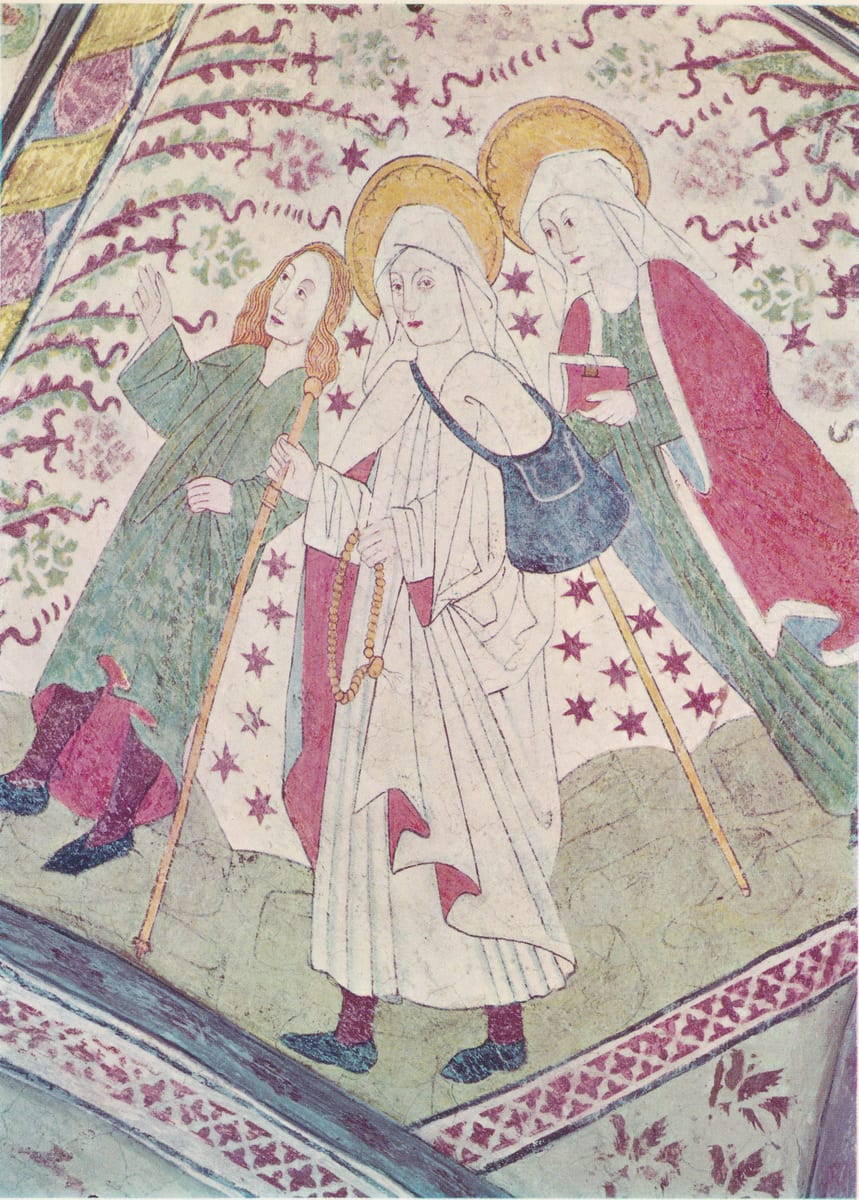
Birgitta som pilgrim: late-medieval wall painting in Harg church, Uppland, Unknown Uppland church painter, late medieval; photograph C. Hultgren, 1967 AD, published in Kulturhistoriskt lexikon för nordisk medeltid, vol. 13 (1968 AD), late 15th century AD (mural); 1967 AD (photograph) Unknown Uppland church painter, late medieval; photograph C. Hultgren, 1967 AD, published in Kulturhistoriskt lexikon för nordisk medeltid, vol. 13 (1968 AD), Harg church (Hargs kyrka), Uppland, Sweden In 1341 AD St. Bridget and Ulf made the pilgrimage to Santiago de Compostela with other relatives. On the way home Ulf fell so ill at Arras that he was expected to die, and the bishop of Arras gave him the last sacraments. As she prayed, St. Denis appeared to St. Bridget and told her Ulf would not die of this illness.
Ulf recovered enough to reach home, then retired to the Cistercian monastery of Alvastra, where he died on February 12, 1344 AD. As he lay dying, he put his wedding ring on her finger, and she soon took it off. She said her love had died with him, and that she now wished to give herself to God.
-
1344–1346 AD
A widow called to speak
Widowed, she began to receive revelations and set about founding an order at Vadstena.
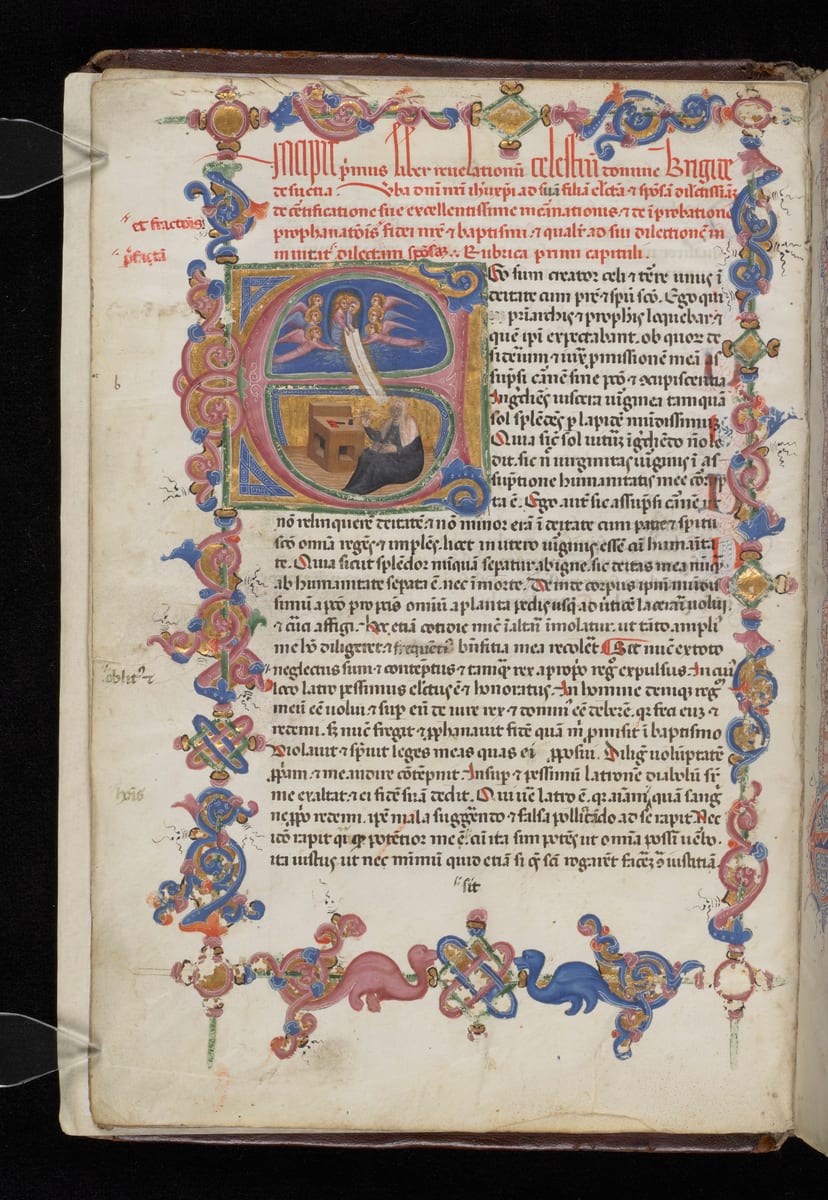
Revelationes (Rps 3310 AD II), opening of Book I, 'Ego sum creator celi et terre': historiated initial E with St. Bridget receiving the first revelation, Neapolitan illuminator; manuscript of the First Redaction of Alfonso of Jaén, 1375–1377 AD Neapolitan illuminator; manuscript of the First Redaction of Alfonso of Jaén, Biblioteka Narodowa, Warsaw (Rps 3310 AD II); image via Polona In 1344 AD, the year Ulf died, St. Bridget began to receive the revelations she would dictate for the rest of her life. She doubted them until her confessor, Master Mathias, a canon of Linköping, persuaded her.
Catholic Tradition holds that two years after Ulf's death, the Rule of a new order was revealed to her. The order, the Order of St. Saviour, known as the Brigittines, was to have its chief monastery at Vadstena. In 1346 AD King Magnus and Queen Blanche made a large gift toward the future monastery.
“Tu autem, filia mea, quam elegi michi et cum qua spiritu meo loquor, dilige me toto corde, non sicut filium et filiam seu parentes, sed plus quam aliquid in mundo! (I have chosen you for myself, love me with all your heart... more than all that exists in the world)”
Christ to St. Bridget, the first revelation of Book I -
1346–1370 AD
Rome, and a Pope who left
A revelation sent her to Rome, and she went to Pope Urban V to keep him from returning to Avignon.
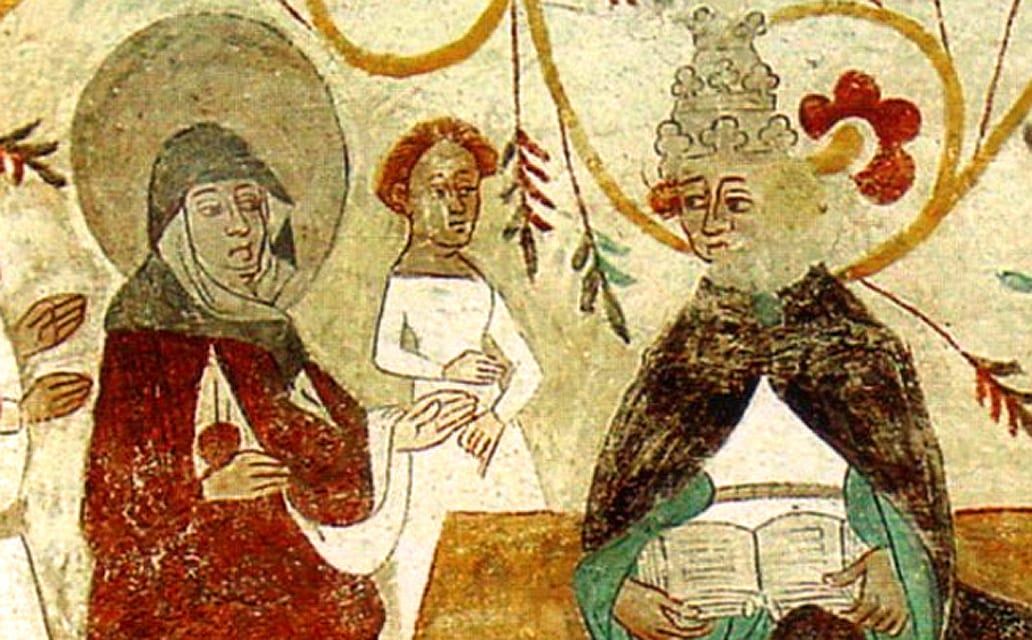
St. Bridget and Pope Urban V, wall painting in the western bay of the nave, Tensta church, Uppland (detail, scanned from a book on Urban V), Johannes Rosenrod, 1437 AD Johannes Rosenrod, Tensta church (Tensta kyrka), Uppland, Sweden In 1346 AD a revelation told St. Bridget to go to Rome. In 1349 AD she left Sweden for good, parting from her children and relatives. That year Pope Clement VI invited the faithful to Rome for the Jubilee of 1350 AD, and Rome stayed her home until her death.
In those years the Popes lived at Avignon, in France, but Pope Urban V brought the papal court back to Rome in 1367 AD. When he decided in 1370 AD to leave again, St. Bridget went to him at Montefiascone with a revelation warning him against the return, and with the Rule of her order. He sailed for France on September 7, 1370 AD, and died on December 19, soon after he got there.
“Thy time is short and thou must take care to save the souls which have been confided to thy care. I am giving thee this rule of a new order which I have personally dictated and which shall be inaugurated and maintained at the Convent of Vadstena, in Sweden.”
St. Bridget, speaking for Christ, to Pope Urban V, at her audience with the pope at Montefiascone, 1370 AD -
1371–1372 AD
The last pilgrimage
Christ sent her to Jerusalem, and her eldest son died at Naples on the way.
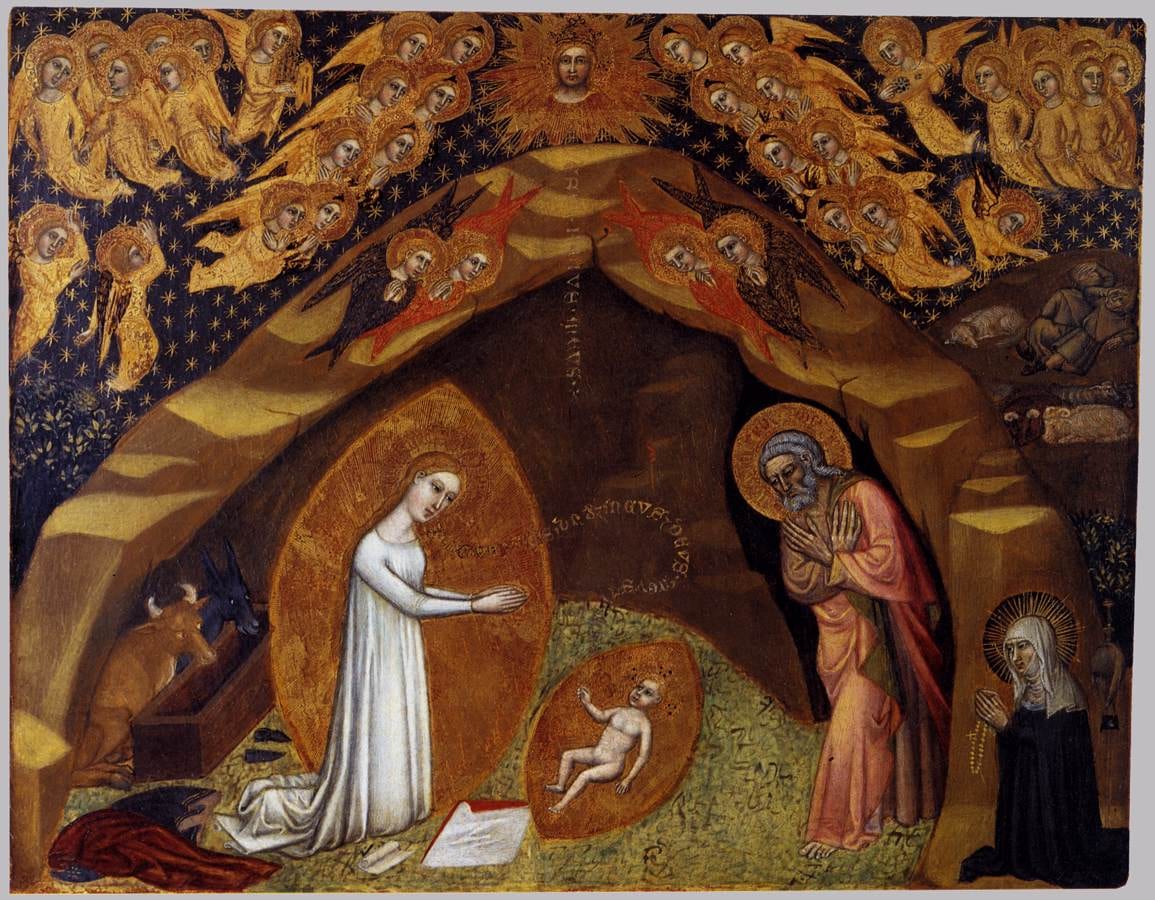
St Bridget and the Vision of the Nativity, Niccolò di Tommaso, after 1372 AD Niccolò di Tommaso, Pinacoteca Vaticana, Vatican City In May 1371 AD, as St. Bridget prayed in Rome, Christ told her to prepare for a pilgrimage to Jerusalem. At Naples her eldest son, Karl, died on March 9, 1372 AD, and he was buried in the cathedral there. Two days later she sailed for the Holy Land with her son Birger and her daughter, St. Catherine of Vadstena.
She entered Jerusalem on Ascension Day, May 13, 1372 AD. On Calvary she had a vision of the Passion. At Bethlehem she had a vision of the birth of Christ.
“Ad montem Caluarie dum essem mestissima plorans, vidi Dominum meum nudum et flagellatum ductum per Iudeos ad crucifigendum. (While I was at Mount Calvary weeping bitterly, I beheld my Lord, naked and scourged, led out by the Jews to be crucified)”
St. Bridget of Sweden, in the chapel of Mount Calvary, Jerusalem, May 1372 AD -
1373–1391 AD
Death in Rome
She died at dawn in Rome, and her children carried her body home to Vadstena.
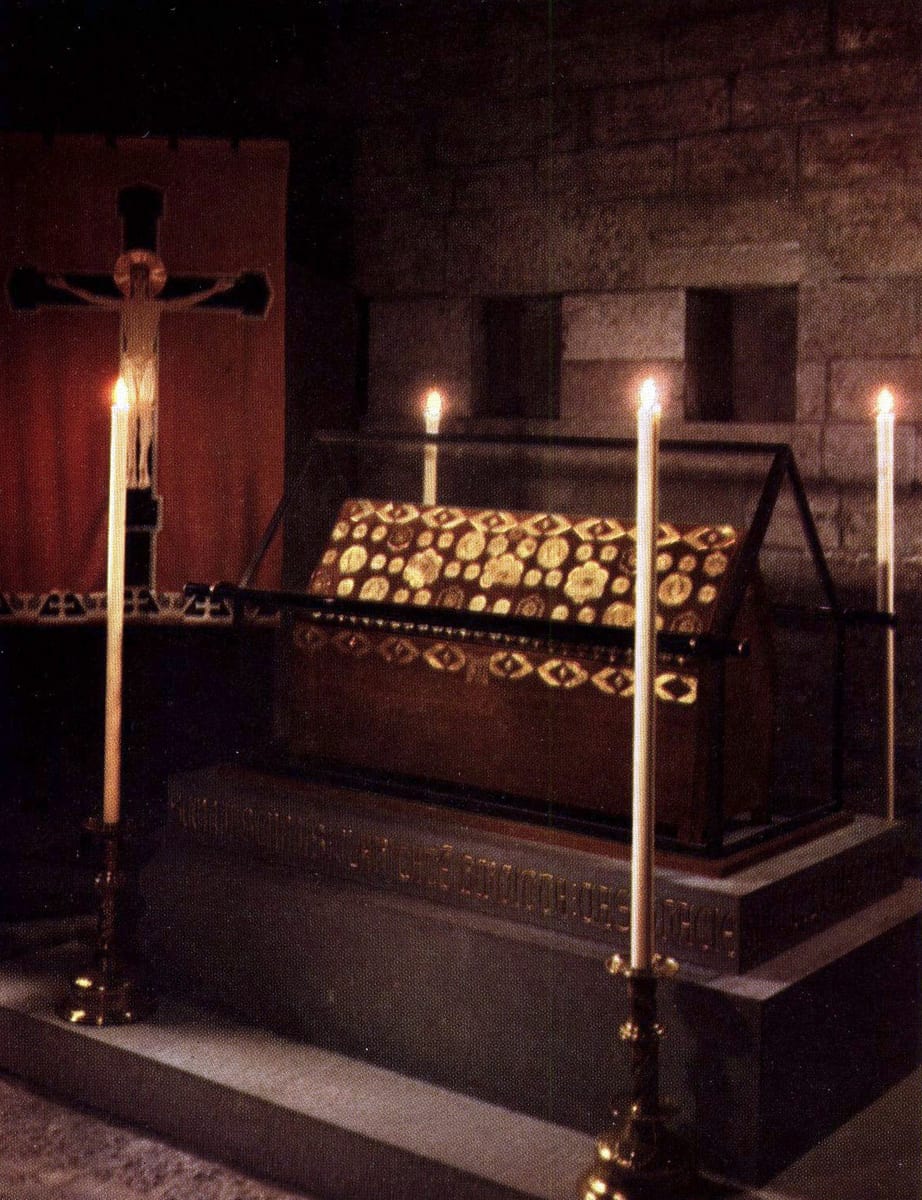
Vadstena klosterkyrka: the reliquary shrine (relikskrinet), Folke Johansson and Lennart Sääf, 1958 AD (photograph) Folke Johansson and Lennart Sääf, Vadstena Abbey Church Back in Rome, in July 1373 AD St. Bridget sent Pope Gregory XI at Avignon a revelation about his return to Rome. She died at dawn on July 23, 1373 AD, after Holy Communion, with Birger and St. Catherine beside her. Pope Gregory XI had not yet come back to Rome for good.
In 1374 AD Birger and St. Catherine carried her body home to Vadstena, as she had wished. Pope Boniface IX canonized her in 1391 AD.
“In manus tuas domine commendo spiritum meum (Lord, into Thy hands I commend my spirit.)”
St. Bridget of Sweden to God, at her death in Rome, after receiving the Body of Christ, July 23, 1373 AD


.jpg)


Pray with the Church
Collect for the Memorial of St. Bridget of Sweden
The collect of the Mass on her memorial, July 23, from the Roman Missal (ICEL English translation).
O God, who guided Saint Bridget of Swedenalong different paths of lifeand wondrously taught her the wisdom of the Crossas she contemplated the Passion of your Son,grant us, we pray,that, walking worthily in our vocation,we may seek you in all things.Through our Lord Jesus Christ, your Son,who lives and reigns with you in the unity of the Holy Spirit,God, for ever and ever.
All 3 reports on Saint Bridget of Sweden

About this picture
AI-generated image, in the manner of a hand-coloured woodcut of the Revelationes printed at Lübeck in 1492 AD, from the paper's reference portrait based on Revelationes caelestes, fol. 16v: St. Bridget enthroned between the clergy and the princes (unknown Lübeck woodcut designer, printed by Bartholomaeus Ghotan, 1492 AD, Bayerische Staatsbibliothek, Munich, BSB Ink B-530) View source artwork.

St. Bridget warns the king of Cyprus his people must amend or perish

Pope Boniface IX canonizes St. Bridget, who urged popes home from Avignon

About this picture
AI-generated image, in the manner of a hand-coloured woodcut, from the paper's reference portrait based on Birgitta som pilgrim, wall painting in Harg church, Uppland (unknown Uppland church painter, late 15th century AD, Harg church, Uppland, Sweden) View source artwork.