Saints Apostle and Martyr
Saint Bartholomew
Feast 24 August · Born Cana of Galilee · Died Greater Armenia (Albanopolis, by tradition)
Saint Bartholomew was called at Cana; the Church remembers him preaching in India and martyred in Greater Armenia. His body lies today under the high altar of a church on the Tiber Island in Rome.
Begin the life
In brief
Saint Bartholomew, also called Nathanael, was a Galilean of Cana and one of the twelve apostles Christ chose and named. Pope Benedict XVI said that he has traditionally been identified with Nathanael, a name meaning God has given. The Church keeps his feast on August 24, the day Catholic Tradition gives for his martyrdom in Greater Armenia.
-
c. 27 AD
St. Philip brings news in Galilee
A message about a man from Nazareth meets a flat objection.
St. Philip came to him in Galilee with word of Jesus, the son of Joseph, from Nazareth. Cana, where he lived, lay about eight kilometres away, and he knew the village well. He answered with a blunt question about the place, and St. Philip did not argue with him.
St. John Chrysostom preached that he had studied the prophets more closely than St. Philip, and knew from them that the Christ was to come from Bethlehem. He went to see Jesus for himself.
“Can anything that is good come from Nazareth?”
St. Bartholomew to St. Philip, answering Philip's news, before he had seen Christ -
c. 27 AD
Under the fig tree
Jesus speaks about a man he has not met, and is answered with a confession.
Jesus spoke about him to those standing by before he had said a word. Asked how he was known, Jesus told him he had been seen under a fig tree before St. Philip ever called him. He answered by confessing Jesus as the Son of God and the King of Israel.
Pope Benedict XVI said that what happened under that fig tree is not known, and that it was clearly a decisive moment in his life. Jesus promised him greater things still: heaven opened, and the angels of God going up and coming down upon the Son of Man.
“Thou, Master, art the Son of God, thou art the King of Israel.”
St. Bartholomew to Christ, at their first meeting, after the words about the fig tree -
c. 28–29 AD
Chosen on the mountain-side
After a night on the mountain-side, twelve disciples are named apostles and sent out.
Jesus passed a night on the mountain-side, and at daybreak called his disciples and chose twelve of them. St. Bartholomew stands sixth in all three Gospel lists, beside St. Philip in St. Matthew and St. Luke.
The Twelve were appointed to be Christ's companions and to go out preaching, with power to cure diseases and cast out devils. Jesus sent them first to the lost sheep of the house of Israel, and into no city of Samaria.
“Preach as you go, telling them, The kingdom of heaven is at hand. Heal the sick, raise the dead, cleanse the lepers, cast out devils: give as you have received the gift, without payment.”
Christ to the Twelve, sending out the Twelve -
c. 30 AD
A night's fishing after the Resurrection
The risen Christ on the shore at daybreak, and a room in Jerusalem afterwards.
After the Resurrection he went out fishing on the sea of Tiberias with St. Peter, St. Thomas and the sons of Zebedee, and they caught nothing all night. At morning Jesus stood on the shore, unrecognised, and the net came in with a hundred and fifty-three great fish and did not break.
Forty days of appearances ended on the Mount of Olives, where he watched a cloud take Jesus out of his sight. In the upper room at Jerusalem he prayed with the other apostles and with the Blessed Virgin Mary, the mother of Jesus.
-
c. 30–190 AD
East, as far as India
A Gospel in Hebrew left behind, and found still in use generations later.
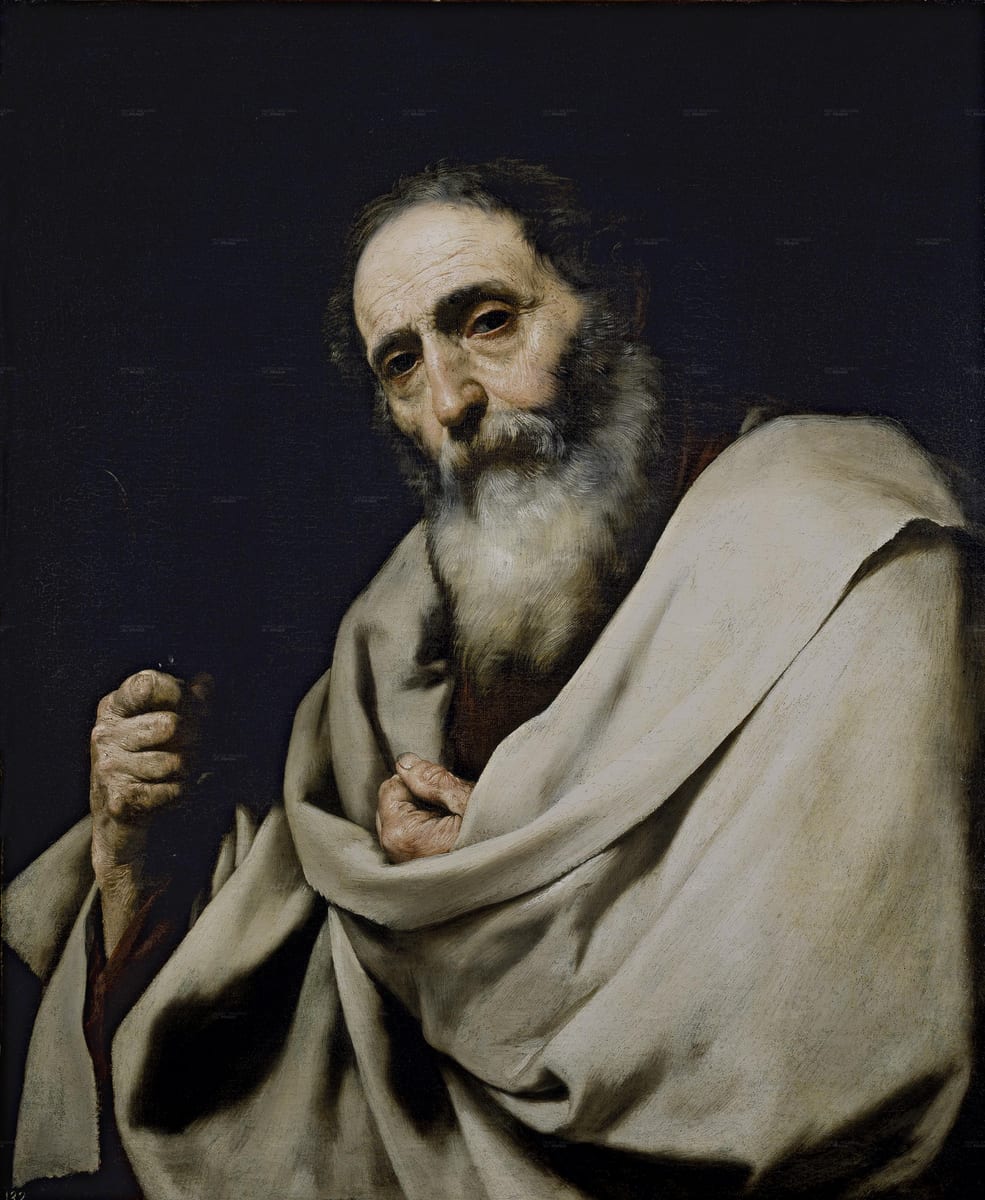
San Bartolomé, from Ribera's apostolado (series of half-length Apostles against a neutral ground, each holding his attribute), Jusepe de Ribera (1591-1652 AD), circa 1630 AD Jusepe de Ribera (1591-1652 AD), Museo Nacional del Prado, Madrid (P001099), oil on canvas, 77 x 64 cm; file on Wikimedia Commons He received the Holy Spirit with the rest of the apostles at the first Pentecost, and afterwards set out to preach. The Roman Martyrology records that he preached the Gospel of Christ in India, and Tradition holds that he passed from there into Greater Armenia.
Tradition reaching back to Eusebius holds that he left the Christians of India the Gospel of St. Matthew in Hebrew. About 190 AD a philosopher sent out from Alexandria found Christians in India, and that Gospel already with them.
-
1st century AD
The idol falls silent
A king's daughter unchained, and a kingdom baptised.
According to longstanding Catholic Tradition, he lodged in the temple of Astaroth in India as one of the poor, and from the day he entered the idol answered nobody and healed nobody. The Golden Legend tells that a man held by a demon cried out that the apostle's prayers were burning him, and was freed that hour.
The same Tradition holds that King Polymius sent for him to his daughter, kept in chains for tearing at her own limbs, and that the apostle told her keepers to loose her and let her go. Tradition holds that the king, the queen and their two sons were baptised with the whole city, and that the king laid down his crown.
-
1st century AD
Flayed alive in Greater Armenia
The temple priests go to the king's brother, and a thousand armed men are sent.
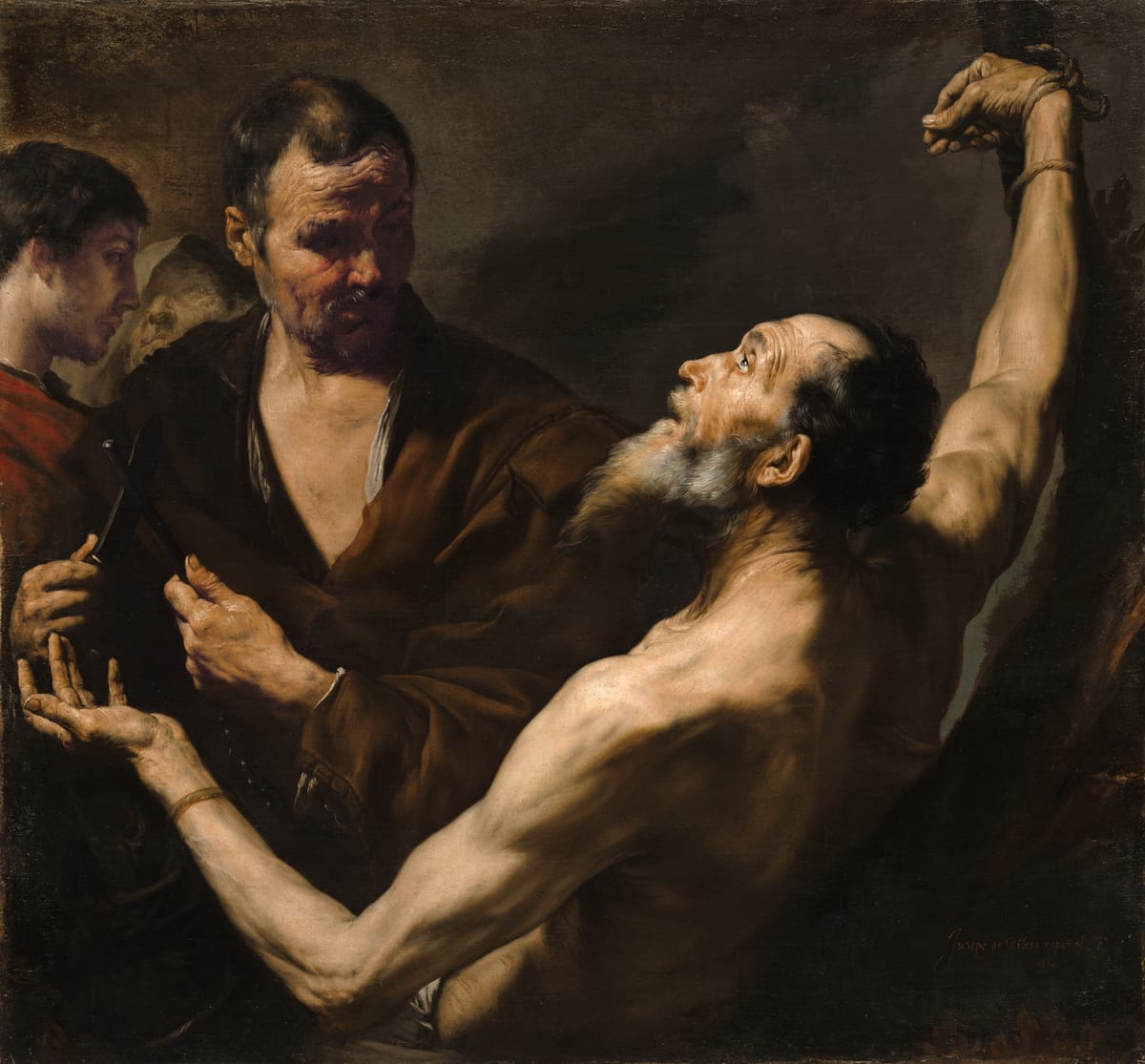
The Martyrdom of Saint Bartholomew, Jusepe de Ribera (1591-1652 AD), 1634 AD Jusepe de Ribera (1591-1652 AD), National Gallery of Art, Washington, D.C. (1990.137.1), oil on canvas, 104 x 113 cm; file on Wikimedia Commons Tradition holds that the temple priests went to Astyages, the elder brother of the converted king, and complained that a magician had broken their gods. A thousand armed men brought the apostle to him bound, and he was accused of perverting his brother.
According to longstanding Catholic Tradition, recorded in the Roman Martyrology, St. Bartholomew converted many to the faith in Greater Armenia, was flayed alive by the barbarians and was beheaded by order of king Astyages. Tradition holds that twelve thousand believers carried his remains away with singing and laid them in the royal tomb.
-
508–2006 AD
The body comes to the Tiber Island
Duras, Lipari, Benevento, Rome: the stages of a long journey west.
The Emperor Anastasius had the relics moved to his new city of Duras in Mesopotamia in 508 AD. Before the end of the sixth century they were carried to the isle of Lipari near Sicily, and in 809 AD on to Benevento. In 983 AD they were conveyed to Rome, and in 998 AD the Emperor Otto III built a church on the Tiber Island to hold them, with the body of St. Adalbert of Prague.
The Roman Martyrology records the body venerated by the faithful on the island of the Tiber, and enters the apostle under August 24. Preaching on him in 2006 AD, Pope Benedict XVI said that attachment to Jesus can be lived and witnessed to without performing sensational deeds.


Pray with the Church
The Collect of the Feast of St. Bartholomew
The Roman Missal, the Collect prayed at Mass on the Feast of St. Bartholomew, August 24
Strengthen in us, O Lord, the faith, by which the blessed Apostle Bartholomew clung wholeheartedly to your Son, and grant that through the help of his prayers your Church may become for all the nations the sacrament of salvation.Through our Lord Jesus Christ, your Son, who lives and reigns with you in the unity of the Holy Spirit, God, for ever and ever.
All 1 report on Saint Bartholomew

About this picture
AI-generated image, in the manner of Spanish Baroque oil on canvas, from the paper's reference portrait based on San Bartolomé (Jusepe de Ribera, circa 1630, Museo Nacional del Prado, Madrid) View source artwork.