
Saints Desert Father of Egypt
Saint Anthony of Egypt
Feast 17 January · Born 251 AD, Coma (Qiman al-'Arus), near Heracleopolis Magna, Middle Egypt · Died 356 AD, the Inner Mountain at Mount Qulzum, Eastern Desert, Egypt
He gave away three hundred acres at twenty, shut himself in a tomb and then in a deserted fort, and came out after twenty years to find the desert filling with monks behind him.
Begin the life
In brief
Saint Anthony of Egypt, commonly known as Anthony the Great, was born about 251 AD to a wealthy Christian family in the Nile village of Coma. At about twenty he heard the Gospel read in his village church and handed his inherited land to the villagers. He died on the Inner Mountain in the Eastern Desert at about a hundred and five, and the Church keeps his memorial on January 17.
-
251–265 AD
The boy who would not learn letters
St. Anthony was born about 251 AD to a wealthy Christian family in a Nile village, and refused schooling as a boy.
St. Anthony was born about 251 AD at Coma, near Heracleopolis Magna in Middle Egypt. His parents were Christians of an illustrious family, with considerable wealth and slaves of their own. He clung to them, and ran on ahead of them when they walked to church.
Grown to boyhood, he would not learn letters and did not care to be with the other boys. He could not bear the rough behaviour of the boys at the school, and so he never learned to read or write. He neglected no season of the Church's year, in childhood or in early manhood.
-
270–271 AD
The Gospel read in the village church
At about twenty he heard the Gospel read in church and gave away three hundred acres of inherited land.
His father and mother died, leaving him at about twenty with one small sister and the family estate. Not six months later he was walking to church, thinking of how the Apostles had left everything and followed the Saviour. He came in while the Gospel was being read, and took the words as spoken to him.
He gave the three hundred acres he had inherited to the people of his village. The rest he sold, and gave the money to the poor. His sister he placed with virgins he knew and trusted, giving them the means to bring her up.
“If you would be perfect, go and sell that you have and give to the poor; and come follow Me and you shall have treasure in heaven.”
The Lord, in the Gospel heard by St. Anthony in church to the rich young man of the Gospel, 271 AD -
c. 280–286 AD
Shut in a tomb outside the village
He shut himself in a tomb, was beaten senseless there, and had himself carried straight back.
St. Anthony left the edge of the village for the tombs, which lay some way off. He shut the door of one of them on himself, and an acquaintance brought him loaves at intervals. Demons came one night and beat him until he lay speechless from the torture.
The man found him next day as though dead, and carried him to the church in the village. About midnight he came to himself and asked to be carried back to the tombs that same night. A ray of light came down into the tomb, the demons vanished, and the pain of his body stopped.
“Antony, I was here, but I waited to see your fight; wherefore since you have endured, and hast not been worsted, I will ever be a succour to you, and will make your name known everywhere.”
Christ to St. Anthony, answering him in the tomb after the ray of light -
286–305 AD
Twenty years inside a deserted fort
He crossed the Nile into a deserted fort and stayed nearly twenty years without being seen.
At about thirty-five St. Anthony asked the old hermit of the next village to come into the desert with him, and went on alone when he refused. A large silver dish lay in the road, and it vanished like smoke when he spoke to it. Further on lay gold, and the gold was real, and he passed it by.
He crossed the Nile to a fort so long deserted that it was full of creeping things, blocked the entry, and stored loaves for six months. For nearly twenty years no one saw him, and the men who climbed up expecting to find him dead heard him singing inside. The Sayings of the Fathers tell that dejection rose in him in those years, and that an angel appeared to him working and praying by turns.
“Whence comes a dish in the desert? This road is not well-worn, nor is there here a trace of any wayfarer; it could not have fallen without being missed on account of its size; and he who had lost it having turned back, to seek it, would have found it, for it is a desert place. This is some wile of the devil. O thou Evil One, not with this shall you hinder my purpose; let it go with you to destruction.”
St. Anthony of Egypt to the devil, finding a silver dish lying in his path on the road, 286 AD -
305–338 AD
He comes out, and the desert fills
He came out vigorous at about fifty-four, and monks settled around the places where he lived.
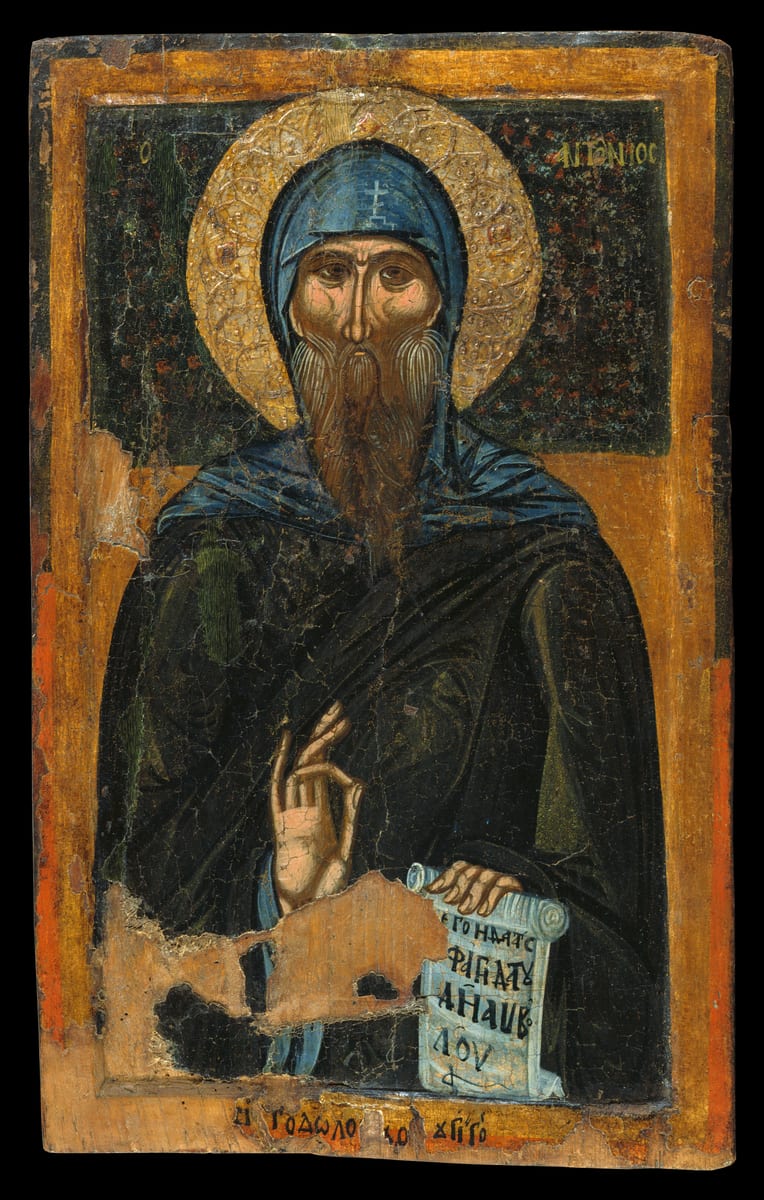
St Anthony, Macedonian workshop (anonymous), 1370-1399 AD Macedonian workshop (anonymous), Benaki Museum, Athens, accession GE_31408 About 305 AD St. Anthony gave way to the men pressing him from outside and came out of the fort. He was not emaciated but vigorous in body and mind. Disciples settled around the ruins, and the monastic life grew in the places where he had lived.
Some twenty years after he shut himself into the fort by the Nile, he went with bedouin guides to the foot of Mount Qulzum, about twenty miles from the Red Sea. He lived there about forty years on the work of his hands and the produce of his garden. The Emperor Constantine wrote asking for his prayers, and the brethren pressed him until he wrote back.
“Wonder not if a king writes to us, for he is but a man: but wonder rather that God has written his law to man, and spoken to us by his own Son.”
St. Anthony of Egypt to his monks, when letters came from the Emperor Constantine and his sons -
311–350 AD
Twice down to Alexandria
He went to Alexandria in the persecution seeking martyrdom, and again at the end of his life to answer the Arians.
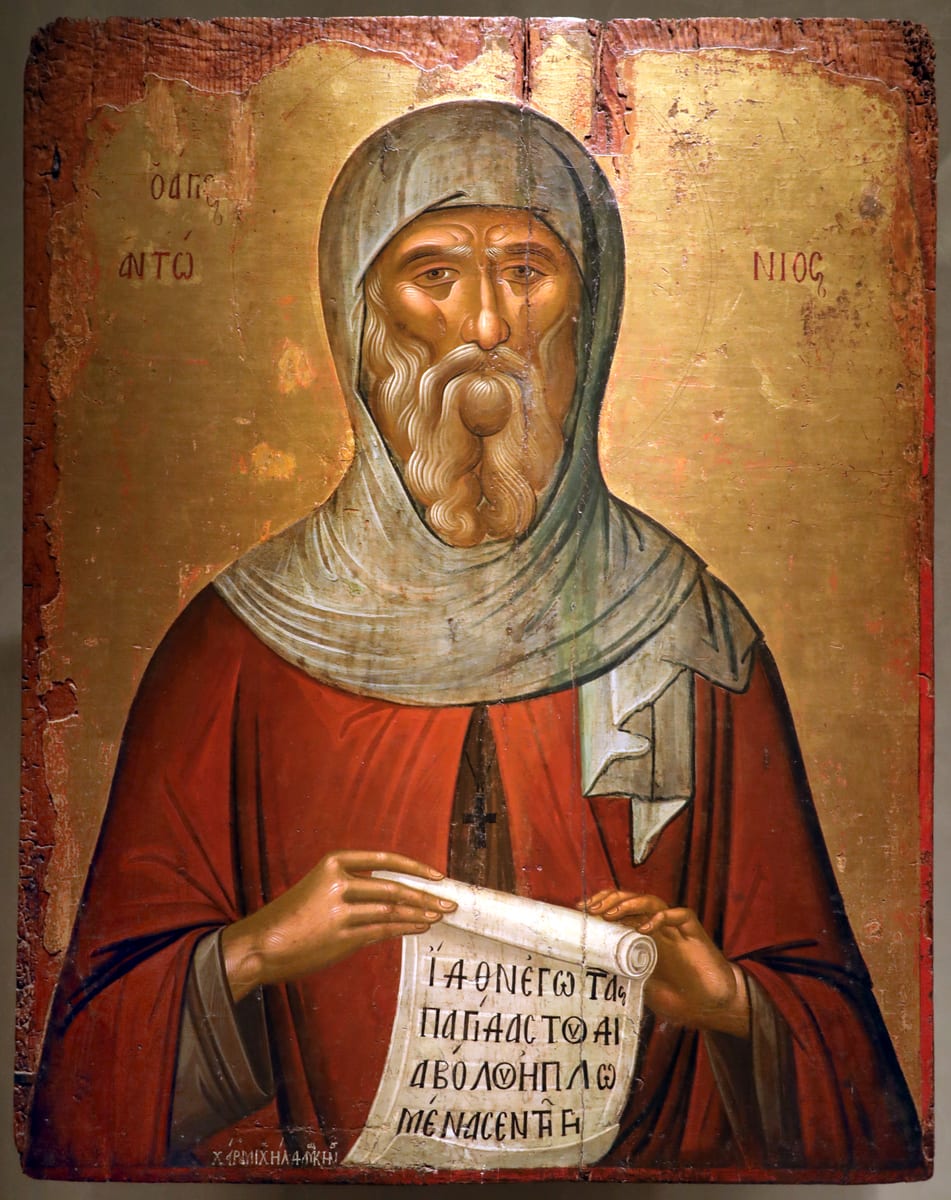
Icona di sant'Antonio abate, Michael Damaskenos (Cretan school); photograph by Francesco Bini (Sailko), icon c. 1550-1600 AD; photograph July 24, 2023 AD Michael Damaskenos (Cretan school); photograph by Francesco Bini (Sailko), Byzantine and Christian Museum, Athens In the persecution of 311 AD St. Anthony came down from the desert to Alexandria. He sought martyrdom for himself and served the Christians who were on trial. He was not put to death, and went back to the desert when the persecution ended.
The Arians put it about that he had come round to their faith. At the close of his life the bishops asked him to make the journey to Alexandria again, and he went. He preached aloud in the city that God the Son is not a creature but of the same substance with the Father.
“Do not have any communication with these most impious Arians; for there is no communion between light and darkness.”
St. Anthony of Egypt to the people of Alexandria, denouncing the Arians in the city, 350 AD -
356 AD
The last day on the Inner Mountain
He died at about a hundred and five and ordered his grave kept secret.
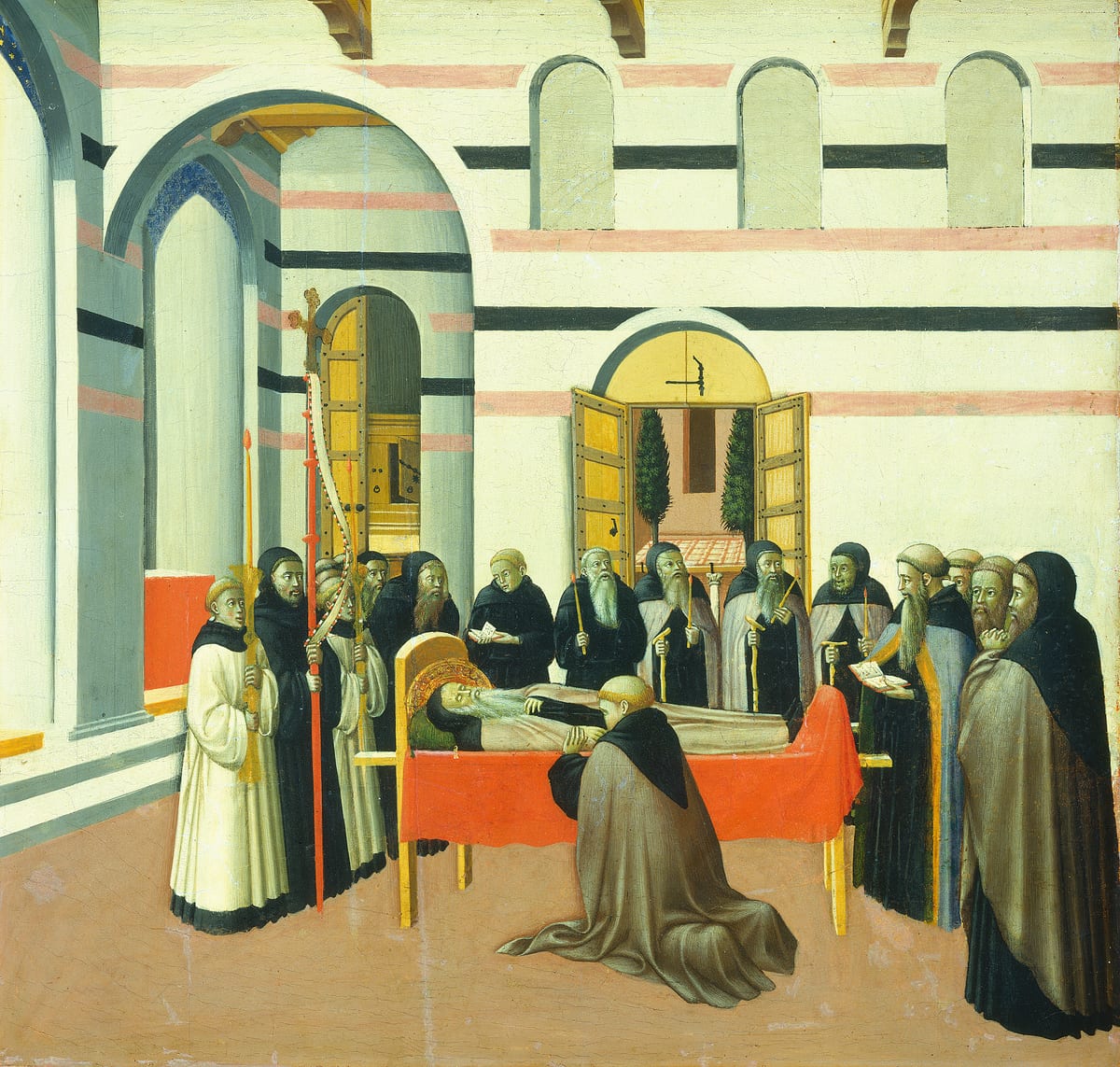
The Death of Saint Anthony, Master of the Osservanza (possibly the young Sano di Pietro), c. 1430-1435 AD Master of the Osservanza (possibly the young Sano di Pietro), National Gallery of Art, Washington, accession 1952.5.73, Samuel H. Kress Collection St. Anthony came down to the brethren of the outer mountain one last time and told them he was near a hundred and five. He told them he did not expect to see them again in this life. He had reproved in public the Egyptian custom of keeping the bodies of the holy dead unburied in houses.
He died on the Inner Mountain on January 17, 356 AD, with two monks beside him. He had told them to bury his body in the ground and to let no one know the place. Amathas and St. Macarius buried him there, and the place of the grave was never disclosed.
“For the rest fare ye well, my children, for Antony is departing, and is with you no more.”
St. Anthony of Egypt to the two monks attending him, his last words -
From 356 AD
The book that carried him out of Egypt
St. Athanasius wrote his life, and the book turned readers as far away as Trier and Milan.
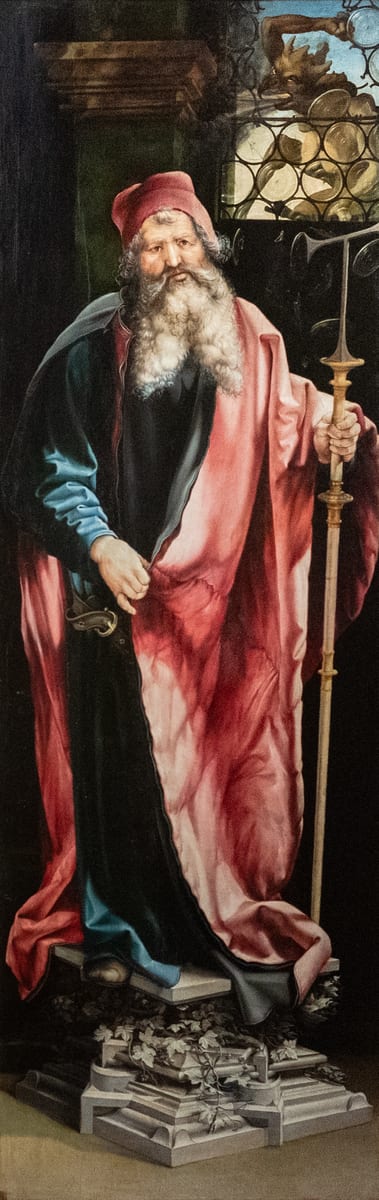
Saint Anthony the Great, wing of the Isenheim Altarpiece, Matthias Grunewald (Mathis Gothart Nithart, c. 1475/80-1528 AD), c. 1512-1516 AD Matthias Grunewald (Mathis Gothart Nithart, c. 1475/80-1528 AD), Musee Unterlinden, Colmar, France St. Athanasius of Alexandria wrote the account of his life within a few years of the death. He wrote it for monks in foreign parts who had asked what manner of man St. Anthony was, and said he had served him and poured water on his hands. Two imperial officers at Trier read the book in a hermit's cabin and left the emperor's service.
St. Augustine heard both stories at Milan, and records in the Confessions that St. Anthony was converted on the spot by that reading of the Gospel. The most ancient Martyrologies name him on January 17, and the Greek empire kept the day soon after his death. Pope Benedict XVI called the book the bestseller of early Christian literature.
“For from whence into Spain and into Gaul, how into Rome and Africa, was the man heard of who dwelt hidden in a mountain, unless it was God who makes his own known everywhere, who also promised this to Anthony at the beginning? For even if they work secretly, even if they wish to remain in obscurity, yet the Lord shows them as lamps to lighten all, that those who hear may thus know that the precepts of God are able to make men prosper and thus be zealous in the path of virtue.”
St. Athanasius, in the Life of Anthony, 93, quoted by Pope Benedict XVI, June 20, 2007 AD


Pray with the Church
Collect for the Memorial of Saint Anthony of Egypt
The Collect the Church prays at Mass on his memorial, January 17.
O God, who brought the Abbot Saint Anthonyto serve you by a wondrous way of life in the desert,grant, through his intercession,that, denying ourselves,we may always love you above all things.Through our Lord Jesus Christ, your Son,who lives and reigns with you in the unity of the Holy Spirit,God, for ever and ever.
All 2 reports on Saint Anthony of Egypt

About this picture
AI-generated image, in the manner of a Byzantine and Coptic narrative icon in egg tempera, from the paper's reference portrait based on St. Anthony (Theodoros Apsevdis, wall painting, December 1192 AD, Church of the Panagia tou Arakos, Lagoudera, Cyprus) View source artwork.

St. Anthony gives away even the money he kept for his sister

About this picture
AI-generated image, in the manner of a Byzantine and Coptic narrative icon in egg tempera on a gesso panel. No person appears in it.