
Saints Holy Cross lay brother and porter of Montreal · 1845–1937 AD
Saint André Bessette
Feast 6 January · Born August 9, 1845 AD, Saint-Grégoire-d'Iberville (Mont-Saint-Grégoire), Quebec, Canada · Died January 6, 1937 AD, Saint-Laurent, Montreal, Quebec, Canada
A sickly orphan who could barely read kept a Montreal college door for nearly forty years, sent the sick who came to him to St. Joseph, built the chapel that grew into St. Joseph's Oratory, and died in 1937 AD mourned by more than a million people.
Begin the life
In brief
Saint André Bessette, known in Montreal as Brother André, was a lay brother of the Congregation of Holy Cross. For nearly forty years he was the porter of the Collège Notre-Dame, and he prayed with the sick who came to him there. He built the small chapel that became St. Joseph's Oratory on Mount Royal, and Pope Benedict XVI canonised him in 2010 AD.
-
1845–1867 AD
Alfred Bessette, the future St. André
A frail child loses both parents, leaves school early and goes to work in the New England mills.
Alfred Bessette, the future St. André Bessette, was born on August 9, 1845 AD, in the parish of Saint-Grégoire, Quebec. He was so frail that the parish priest baptised him the next day, for fear he would not live. His father, Isaac Bessette, a wheelwright, was killed at Farnham on February 20, 1855 AD, by a tree he was felling.
His mother, Clothilde Foisy, died of tuberculosis on November 20, 1857 AD, and Alfred was an orphan at twelve. Poverty and poor health ended his schooling, and he worked as a farmhand and as a baker's and shoemaker's apprentice. At eighteen he went to the cotton mills and farms of New England, and after each day's work he shut himself in his room to pray.
-
1867–1874 AD
A letter to the novice master
His parish priest sends the young labourer to Holy Cross as a saint, and the order doubts his health.
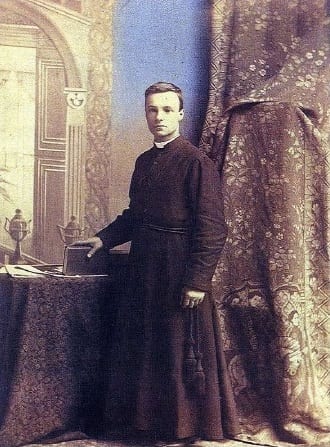
St. André Bessette at his perpetual vows, Photographer unknown, 1874 AD Photographer unknown, Archives de l'Oratoire Saint-Joseph du Mont-Royal, via Wikimedia Commons When Alfred came home to Saint-Césaire, Louis Ouimet, the farmer he worked for, told the parish priest, Father André Provençal, how devout he was. Alfred thought he knew too little for religious life, but Father Provençal told him that with Holy Cross he could pray and do useful work. In October 1870 AD, Father Provençal wrote to the master of novices that he was sending him a saint.
Alfred came to the Collège Notre-Dame in Montreal on November 22, 1870 AD, and the superior at first turned him away for his poor health. Bishop Ignace Bourget of Montreal took his side, and on December 27, 1870 AD, Alfred took the habit and the name André, after Father Provençal. His superiors hesitated again over his health, but St. André made his first vows on August 22, 1872 AD, and his final vows on February 2, 1874 AD.
“Si ce jeune homme devient incapable de travailler, il saura au moins bien prier. (If this young man becomes unable to work, he will at least be able to pray well.)”
Amédée Guy, master of novices to the superiors of the Congregation of Holy Cross -
1870–1909 AD
The porter
Unfit to teach, St. André Bessette is put at the college door and stays nearly forty years.
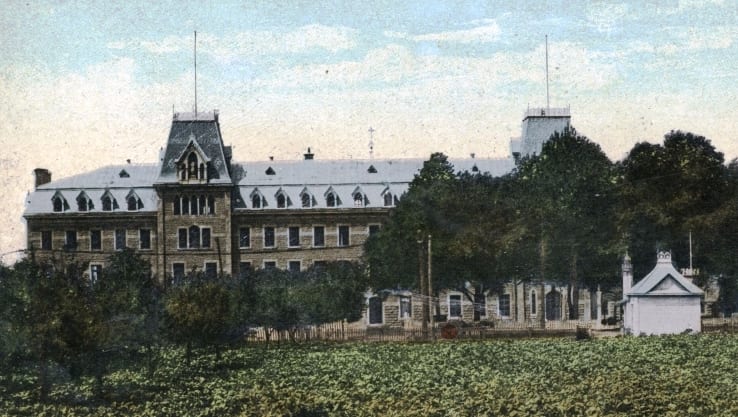
Notre Dame Boys' College, Côte-des-Neiges, Montreal, Anonymous, about 1910 AD Anonymous, McCord Stewart Museum, Montreal, via Wikimedia Commons His age and lack of schooling ruled out the priesthood and teaching, so his superiors made St. André porter of the college. Besides the door, he cleaned, did the shopping, gave alms, carried the mail and nursed sick boys. He cut most of the boarders' hair at five cents a head.
Before the Blessed Sacrament he prayed long and fervently for the sick. He remained the porter until July 1909 AD, when he was made keeper of the Oratory full time. In later years St. André made a joke of the appointment.
“À peine mon noviciat fini, mes supérieurs m'ont mis à la porte et j'y suis resté quarante ans sans partir ! (At the end of my novitiate, my superiors showed me the door, and there I stayed for forty years.)”
St. André Bessette, joking about his forty years as porter -
1878–1910 AD
Oil, a medal and the sick at the door
St. André gives the sick oil and a medal of St. Joseph, and parents, colleagues, the school physician and some fellow brothers object.
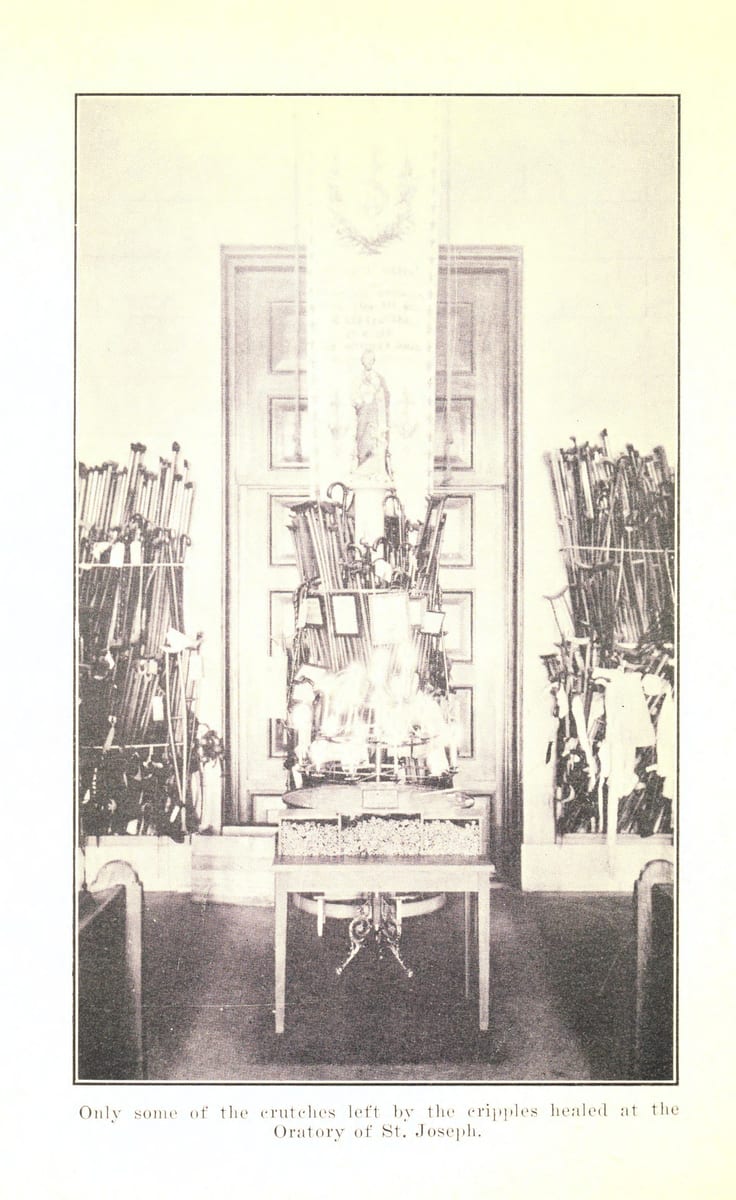
Crutches left at the Oratory of St. Joseph, from George H. Ham's The Miracle Man of Montreal, Photographer unknown, 1922 AD Photographer unknown, University of Toronto, via the Internet Archive St. André gave the sick a medal of St. Joseph and a few drops of oil from the lamp before St. Joseph's statue in the college chapel, and told them to rub it on. In 1878 AD Brother Aldéric reported in print, in the Annales of the Association de Saint-Joseph in Paris, his own cure and several others through St. André. Around 1900 AD St. André was sent to receive the sick in a shelter at the streetcar stop across the road.
Parents, colleagues and the school physician complained about sick people near the boys, and some fellow brothers called him a fraud. Martin Hannon, a railwayman with crushed legs, put away his crutches in 1910 AD after St. André rubbed his limbs with oil and prayed over him. When anyone gave St. André the credit for a cure, he wept and named St. Joseph's intercession as its source.
“Ce n'est pas moi qui guéris. C'est saint Joseph. (It is not I who heals. It is St Joseph.)”
St. André Bessette to those who gave him the credit for cures, when he was thanked for favours received -
1904–1926 AD
The chapel on the mountain
A chapel fifteen feet by eighteen rises on Mount Royal in 1904 AD, and the pilgrims outgrow it again and again.
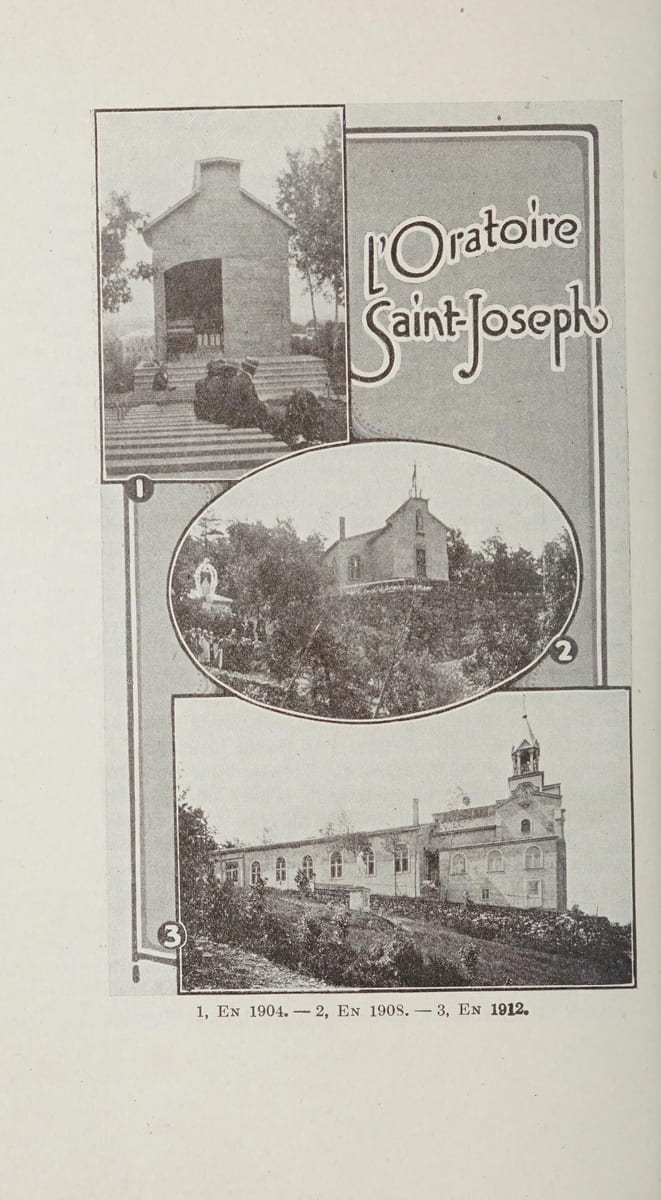
The chapel on Mount Royal in 1904 AD, 1908 AD and 1912 AD, from Arthur Saint-Pierre's L'Oratoire Saint-Joseph du Mont-Royal, Photographer unknown, 1922 AD Photographer unknown, University of Toronto, via the Internet Archive His superiors refused St. André a chapel to St. Joseph on Mount Royal, until illness put him in the infirmary beside his superior, Father Lecavalier. There Father Lecavalier let him spend the $200 he had saved from cutting hair, and work on the chapel began on July 28, 1904 AD. The wooden chapel measured fifteen feet by eighteen, and pilgrims crowded it so that it was enlarged four times by 1912 AD.
From 1915 AD he took short rests in Quebec, Ontario and New England, where stationmasters announced his train and crowds waited for him. A crypt church seating a thousand opened on December 16, 1917 AD, and within a year it was too small. Work on the basilica's foundations began in 1926 AD, and St. André would not let the Oratory borrow money to build it faster.
“Je ne sais pas, je n'ai plus d'argent! (I don't know, I have no more money!)”
St. André Bessette to the workers building the chapel, answering the workers who asked whether to come back on Monday -
1930–1937 AD
A million in the cold
St. André Bessette dies at ninety-one, and more than a million people file past his coffin in freezing weather.
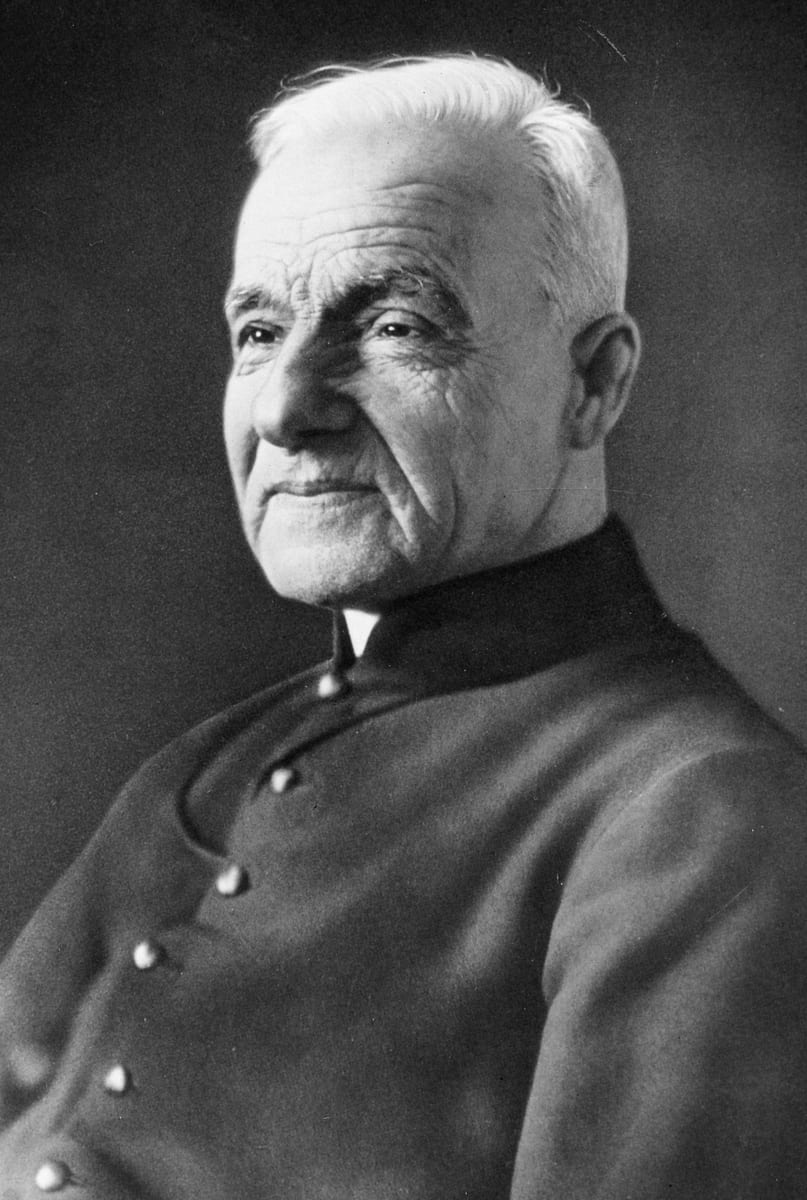
St. André Bessette in old age, Photographer unknown, before 1937 AD Photographer unknown, Wikimedia Commons At ninety, old and sick, St. André had a statue of St. Joseph set in the roofless basilica and was carried up the hill to see it. After a few last words about the Oratory, he spoke no more. He died at Saint-Laurent, in Montreal, on January 6, 1937 AD, aged ninety-one.
His body lay in state at the Oratory, day and night, until January 12, 1937 AD, and more than a million people came through the freezing cold to pray beside him. On a Saturday morning the coffin was carried slowly over snow-glazed streets to the cathedral, where Premier Maurice Duplessis and Montreal's mayor sat in the front rows. On the Tuesday after, his body was brought back to the Oratory for a second service and burial.
“L'oratoire . . . les grâces que . . . le bien qui se fait (The Oratory . . . the graces that . . . the good that is being done)”
St. André Bessette, his last words, as death came at Saint-Laurent, January 1937 AD -
From 1958 AD
The Church's verdict
Two miracles carry St. André Bessette to beatification in 1982 AD and canonisation in 2010 AD.
Joseph Audino of Rochester, New York, was cured of cancer in 1958 AD after invoking St. André, and the healing became the miracle that opened the way to his beatification. Pope St. Paul VI declared St. André Venerable on June 12, 1978 AD, recognising his heroic virtue. Pope St. John Paul II beatified St. André in St. Peter's Square on May 23, 1982 AD.
A child gravely hurt in a street accident in 1999 AD recovered after the family prayed to him, and Pope Benedict XVI approved the decree recognising the healing as the miracle for his canonisation. Pope Benedict XVI canonised St. André Bessette on October 17, 2010 AD, the first saint of the Congregation of Holy Cross. The Oratory keeps his heart as a relic and draws more than two million visitors a year.
“«Ne cherchez pas à vous faire enlever les épreuves», «demandez plutôt la grâce de bien les supporter». (Do not seek to have your trials removed, ask rather for the grace to bear them well.)”
St. André Bessette to those who came to him for help


Pray with the Church
Prayer of Pope St. John Paul II at the tomb of St. André Bessette
Prayed by Pope St. John Paul II at the tomb in St. Joseph's Oratory, Montreal, on September 11, 1984 AD; the closing invocations of the prayer, in the Pope's French.
Et toi, bienheureux Frère André Bessette,portier du collège et gardien de cet Oratoire,ouvre à l’espérancetous ceux qui continuent à solliciter ton aide.Apprends-leur la confiance dans la vertu de la prière,et, avec elle, le chemin de la conversion et des sacrements.Que par toi et par saint Joseph,Dieu continue à répandre ses bienfaitssur la Congrégation de Sainte-Croix,sur tous ceux qui fréquentent cet Oratoire,sur la cité de Montréal,sur le peuple de Québec,sur tout le peuple canadien,et sur l’Eglise entière.