
Saints Saints of England · Martyr
Saint Thomas More
Feast 22 June · Born 1478 AD, Milk Street, Cheapside, City of London, England · Died 1535 AD, Tower Hill, London, England
A London lawyer rose to be Henry VIII's Lord Chancellor, would not swear the oath the King demanded, and died on Tower Hill in 1535 AD.
Begin the life
In brief
Saint Thomas More was a London lawyer who served King Henry VIII as Lord Chancellor of England. Henry VIII wanted his marriage to Queen Catherine declared void and his headship of the Church in England acknowledged, and St. Thomas More would not give his assent to either. He was beheaded on Tower Hill on July 6, 1535 AD, and Pope Pius XI canonized him in 1935 AD.
-
1478–1494 AD
A lawyer's son in Milk Street
Born before dawn in the City of London, St. Thomas More was waiting at a cardinal's table by thirteen.
St. Thomas More was born in Milk Street, in the City of London, before dawn on February 7, 1478 AD. His father, John More, was a lawyer who later became a judge. At thirteen he was sent by his father to wait at table in the household of Cardinal John Morton, Archbishop of Canterbury.
At Christmas, when actors put on plays in the household, the boy would step in among them and make up a part on the spot. Cardinal Morton told the nobles at his table that this boy would grow into a remarkable man. On the cardinal's advice he went to Oxford, and after two years his father brought him home to London to train as a lawyer.
-
1499–1511 AD
The Charterhouse, a wife, and a city court
Four years of prayer beside the monks, then marriage, a seat as a London judge, and a young wife's death.
At about twenty-one St. Thomas More went to live beside the London Charterhouse, a monastery of Carthusian monks, and joined in their daily prayers. He lived that way for about four years without taking vows. His friend the scholar Erasmus wrote that in the end he chose to be a chaste husband rather than an impure priest.
In 1505 AD he married Jane Colt, though he had preferred her younger sister, because he did not want the elder shamed by being passed over. On September 3, 1510 AD the City of London made him Under-Sheriff, a judge in the city's sheriff's court. Jane died in 1511 AD, leaving him four small children.
“While I do daily bestow my time about law matters — some to plead, some to hear, some as an arbitrator with mine award to determine, some as an umpire or a judge with my sentence finally to discuss; while I go one way to see and visit my friend; another way about mine own private affairs; while I spend almost all the day abroad amongst other, and the residue at home amongst my own; I leave to myself, I mean to my book, no time.”
St. Thomas More, 1516 AD -
1511–1527 AD
The King's man at Chelsea
A second wife, the book Utopia, a place in the King's service, and Henry VIII in the garden at Chelsea.
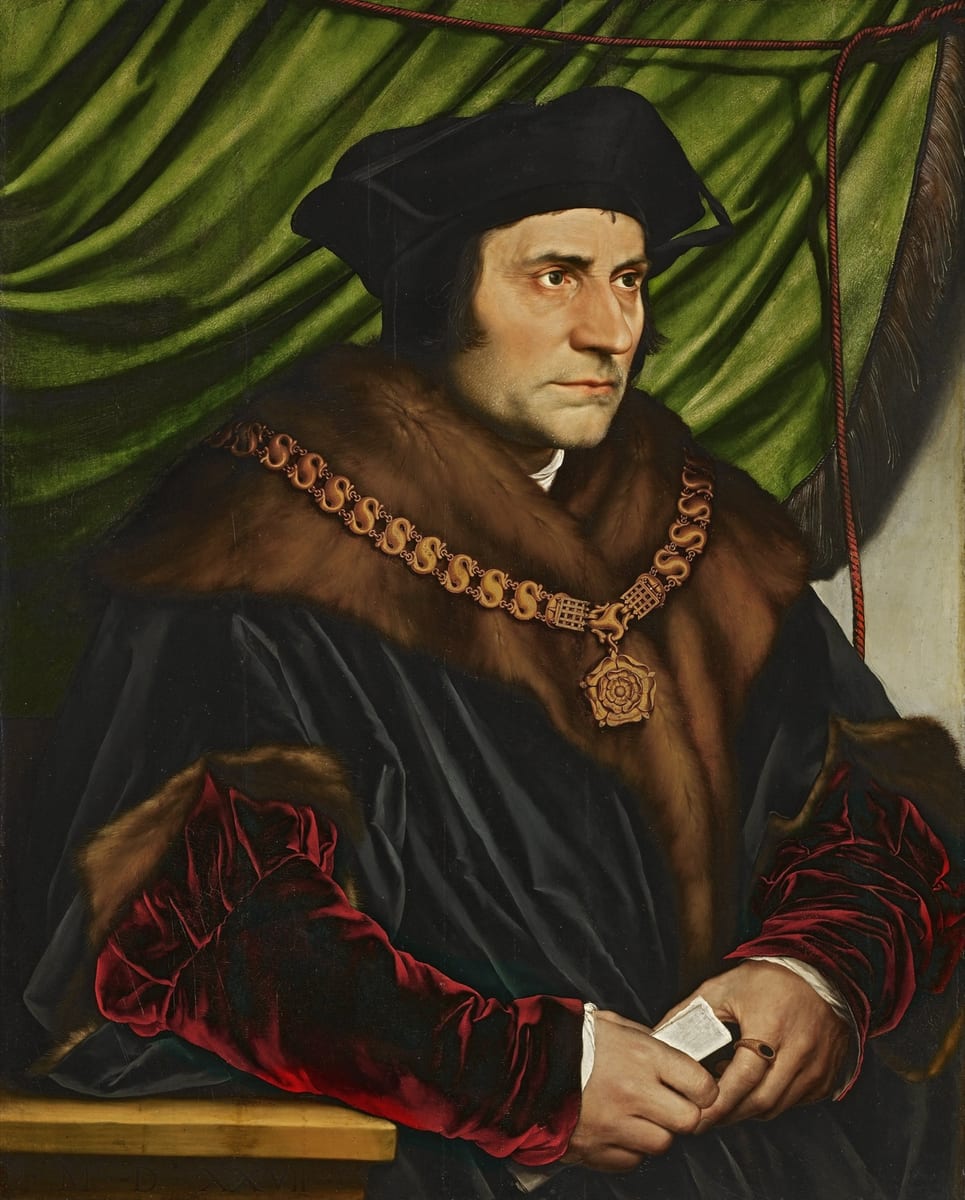
Portrait of Sir Thomas More, Hans Holbein the Younger (1497/1498-1543 AD), 1527 AD Hans Holbein the Younger (1497/1498-1543 AD), The Frick Collection, New York (acc. 1912.1.77); digitised by the Google Art Project He soon married again, to Alice Middleton, a widow seven years older than he was, who looked after his young children. His book Utopia, about an imaginary island, was printed at Louvain in December 1516 AD. In 1518 AD Henry VIII took him into his service and his council, and charged him to put God first and the King second.
In 1523 AD St. Thomas More built a house by the Thames at Chelsea and lived there with his wife, his children and eleven grandchildren. His eldest daughter, Margaret, lived there with her husband, William Roper. Henry VIII came uninvited to dinner there and walked in the garden with his arm around St. Thomas More's neck.
“I have no cause to be proud thereof, for if my head would win him a castle in France, it should not fail to go.”
St. Thomas More, 1525 AD -
1527–1532 AD
The King's marriage, and the great seal given back
Henry VIII asked St. Thomas More about his marriage, St. Thomas More could not agree with him, and in 1532 AD he gave up the chancellorship.
In September 1527 AD Henry VIII first told him of his doubts that his marriage to Queen Catherine, his elder brother's widow, was lawful. At the King's command he said how he read the Scripture passages Henry VIII showed him, but he gave no opinion on the marriage. On October 25, 1529 AD the King made him Lord Chancellor, the first layman ever to hold the office.
Asked again as Chancellor, he told the King he could not agree with him about the marriage. In 1531 AD the King ordered the clergy to acknowledge him as supreme head of the Church. Three days after opposing the King in council over church payments to Rome, St. Thomas More resigned on May 16, 1532 AD, and his income fell to about a hundred pounds a year.
“then may we yet, with bags and wallets, go a-begging together, and hoping that for pity some good folk will give us their charity, at every man's door to sing Salve Regina, and so still keep company and be merry together”
St. Thomas More, 1532 AD -
1534 AD
Lambeth, and the gate shut behind him
St. Thomas More would accept the new heirs to the crown, but not the oath that came with them.
In March 1534 AD a new law, the Act of Succession, gave the crown to the children of the King's second wife, Anne Boleyn. Everyone called on had to swear an oath upholding it, and the King's commissioners added words rejecting the authority of any foreign ruler and made the clergy renounce the Pope. On April 13, 1534 AD St. Thomas More was summoned to Lambeth Palace to take it, the only layman called with the priests of London.
That morning he heard Mass and received communion, then shut the gate on his wife and children and took the boat to Lambeth with his son-in-law, William Roper. At Lambeth he said he would swear to the new line of succession, but could not swear the oath offered him without putting his soul in danger. The King's commissioners told him he was the very first man to refuse it.
“Son Roper, I thank our Lord the field is won.”
St. Thomas More, April 13, 1534 AD -
1534–1535 AD
Fifteen months in the Tower
Visits from Margaret, a new treason law, three questionings, and the report that sent St. Thomas More to trial.
St. Thomas More was sent to the Tower of London on April 17, 1534 AD, and remained a prisoner there until his death. Margaret won permission to visit, and each time they prayed the psalms together before talking of anything else. In November 1534 AD Parliament named the King Supreme Head of the Church and made it high treason to deny any of his titles maliciously.
In April, May and June 1535 AD the King's council came three times to demand his opinion of that law, and each time he would not give it. In June, Richard Rich, the King's Solicitor, came to take away his books and put questions to him while the others packed them. Rich later claimed St. Thomas More had told him that Parliament could not make the King head of the Church, and that report was used to charge St. Thomas More with treason.
“me thinketh God maketh me a wanton, and setteth me on his lap and dandleth me”
St. Thomas More, May 1534 AD -
1535 AD
A quarter of an hour in Westminster Hall
Tried as a sick prisoner and found guilty in a quarter of an hour, St. Thomas More spoke his mind at last.
St. Thomas More was tried in Westminster Hall on July 1, 1535 AD, so weak after fifteen months in prison that a chair was brought for him. He argued that no law punished a man for silence, and said he had never told anyone what his conscience held. He denied Rich's sworn evidence, saying that if it were true he prayed never to see the face of God.
The jury went out for a quarter of an hour and came back with a verdict of guilty. Only then did he speak his mind, saying no king could by law take over the government of the Church, and that he had been condemned for refusing to accept the King's second marriage. He told his judges he hoped they would all meet happily in heaven, as Saint Paul and Saint Stephen, whose death St. Paul had approved, were friends there now.
“as St. Paul and St. Stephen whom he persecuted are now friends in Paradise, so we, though differing in this world, shall be united in perfect charity in the other. I pray God to protect the King and give him good counsel.”
St. Thomas More, July 1, 1535 AD -
1535 AD
Tower Hill, and the head his daughter saved
A last letter written in coal, a joke on the scaffold, and a daughter who saved her father's head.
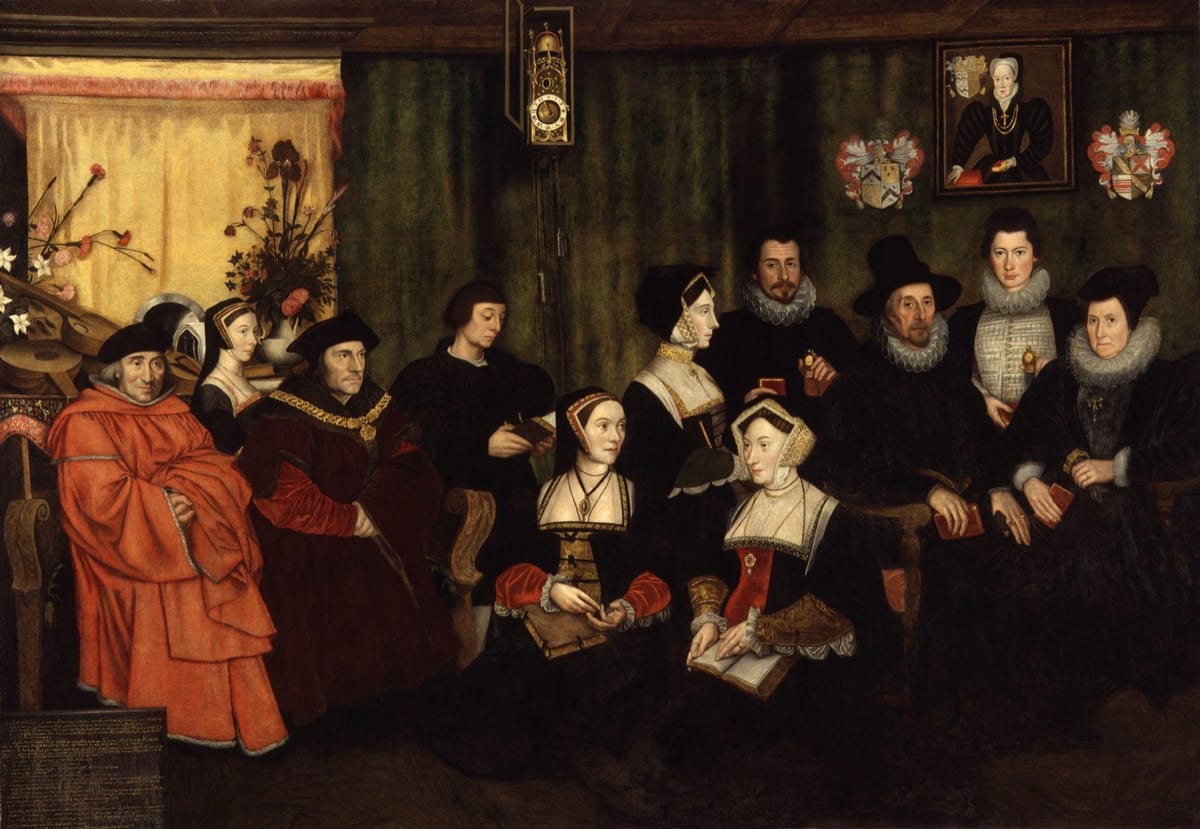
Sir Thomas More, his father, his household and his descendants (after the lost group by Hans Holbein the Younger), Rowland Lockey (c. 1565-1616 AD), 1593 AD Rowland Lockey (c. 1565-1616 AD), National Portrait Gallery, London (NPG 2765); oil on canvas, 2274 x 3302 mm On July 5, 1535 AD he wrote his last letter to Margaret with a piece of coal, asking to die the next day, the eve of the feast of Saint Thomas of Canterbury. On the morning of July 6 he was brought out of the Tower, pale and thin, carrying a red cross in his hand. The scaffold on Tower Hill was so weak it seemed ready to fall, and as he climbed he asked the lieutenant to see him safely up and leave him to manage the way down himself.
He asked the people to pray for him and to witness that he died for the faith of the Catholic Church, and then said he died the King's good servant, and God's first. He knelt and prayed the psalm that begs God for mercy, kissed the executioner, and was beheaded with a single blow. About a month later, when his head was to be thrown from London Bridge into the river, Margaret bought it and kept it.
“Pluck up thy spirits, man, and be not afraid to do thine office: my neck is very short, take heed, therefore, thou strike not awry, for saving of thine honesty.”
St. Thomas More, July 6, 1535 AD


Pray with the Church
A Prayer Written in the Tower
Written by Saint Thomas More in the Tower of London after he was condemned to death, and preserved among his English works.
Good Lord, give me the grace, in all my fear and agony, to have recourse to that great fear and wonderful agony that Thou, my sweet Saviour, hadst at the Mount of Olivet before Thy most bitter passion, and in the meditation thereof to conceive ghostly comfort and consolation profitable for my soul.Almighty God, take from me all vain-glorious minds, all appetites of mine own praise, all envy, covetise, gluttony, sloth, and lechery, all wrathful affections, all appetite of revenging, all desire or delight of other folk's harm, all pleasure in provoking any person to wrath and anger, all delight of exprobation or insultation against any person in their affliction and calamity.And give me, good Lord, an humble, lowly, quiet, peaceable, patient, charitable, kind, tender, and pitiful mind with all my works, and all my words, and all my thoughts, to have a taste of Thy holy, blessed Spirit.
All 7 reports on Saint Thomas More

About this picture
AI-generated image, in the manner of oil and tempera on oak panel after Hans Holbein the Younger, from the paper's reference portrait based on Portrait of Sir Thomas More (Hans Holbein the Younger, 1527, The Frick Collection, New York) View source artwork.
St. Thomas More writes the cardinal he served as a boy into Utopia

About this picture
AI-generated image, in the manner of an oil and tempera panel by Hans Holbein the Younger, from the paper's reference portrait based on Portrait of Sir Thomas More (Hans Holbein the Younger, 1527, The Frick Collection, New York) View source artwork.
St. Thomas More plans his family's descent, stage by stage, to begging

About this picture
AI-generated image, in the manner of an oil and tempera panel by Hans Holbein the Younger, from the paper's reference portrait based on Portrait of Sir Thomas More (Hans Holbein the Younger (1497/1498-1543), 1527, The Frick Collection, New York (acc. 1912.1.77)) View source artwork.
The King asks St. Thomas More if his marriage is lawful

Pope Benedict XVI addresses Britain's leaders where St. Thomas More was condemned

About this picture
AI-generated image, in the manner of an oil and tempera panel by Hans Holbein the Younger, from the paper's reference portrait based on Portrait of Sir Thomas More (Hans Holbein the Younger (1497/1498-1543), 1527, The Frick Collection, New York (acc. 1912.1.77)) View source artwork.
Under investigation, St. Thomas More sets down the King's first question

About this picture
AI-generated image, in the manner of an oil and tempera panel by Hans Holbein the Younger, from the paper's reference portrait based on Portrait of Sir Thomas More (Hans Holbein the Younger, 1527, The Frick Collection, New York, acc. 1912.1.77) View source artwork.
London makes St. Thomas More judge of its everyday quarrels

About this picture
AI-generated image, in the manner of an oil and tempera panel by Hans Holbein the Younger, from the paper's reference portrait based on Sir Thomas More, his father, his household and his descendants (Rowland Lockey, after the lost group by Hans Holbein the Younger, 1593, National Portrait Gallery, London, NPG 2765) View source artwork.