
Saints Deacon and first martyr · Feast December 26
Saint Stephen, the First Martyr
Feast 26 December · Died Jerusalem
Saint Stephen was chosen to serve the widows of the Jerusalem church, answered his accusers before the council, and died under the stones praying for his killers, and the persecution that followed carried the Gospel far beyond the city.
Begin the life
In brief
Saint Stephen, the first martyr, was one of seven men chosen to serve the widows of the first church in Jerusalem. Men who could not win their arguments with him had him accused before the council of blasphemy against Moses and the temple. He was stoned outside the city shortly after the Ascension, praying for the men who killed him.
-
First century AD, Jerusalem
Seven chosen to serve the widows
A complaint over neglected widows leads the Apostles to call for seven helpers, and the disciples choose St. Stephen first among them.
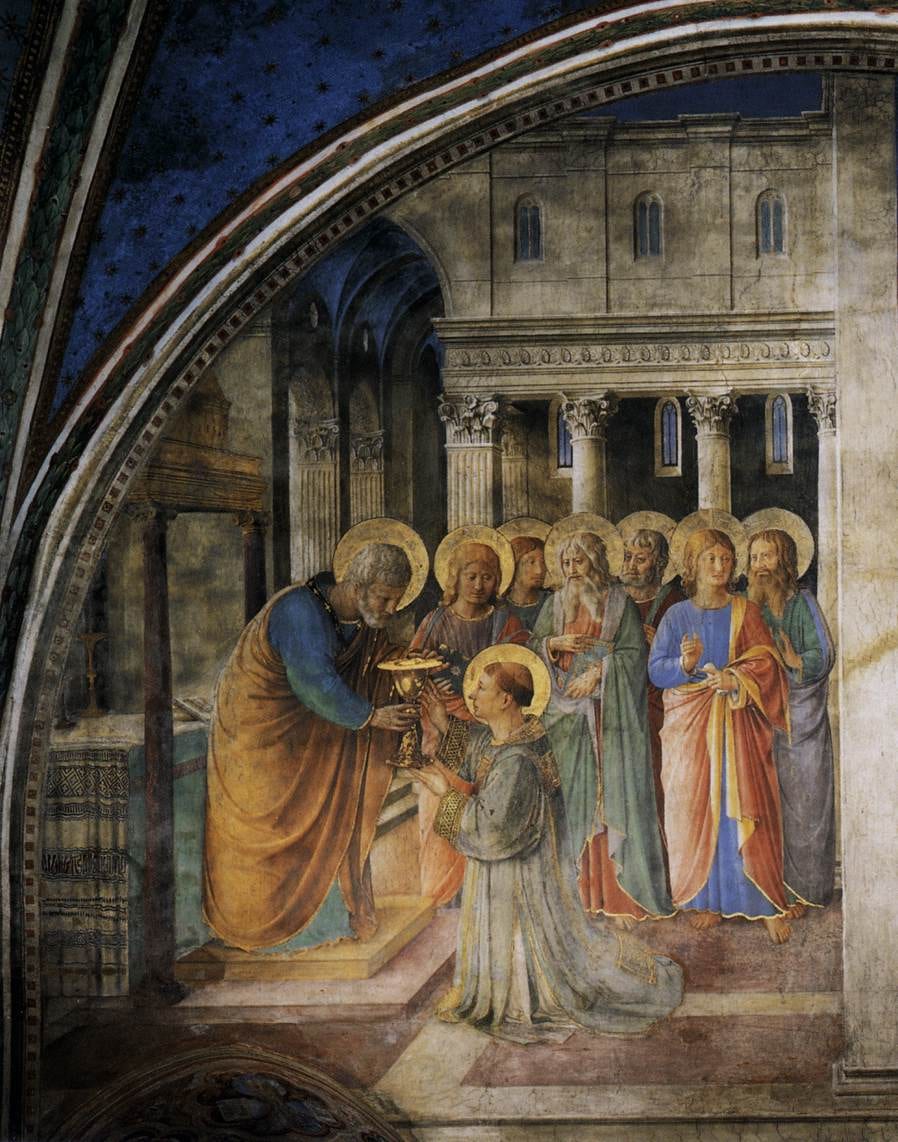
St. Peter Consecrates St. Stephen as Deacon (Niccoline Chapel), Fra Angelico and workshop, 1447–1449 AD Fra Angelico and workshop, Cappella Niccolina, Palazzo Apostolico, Vatican City The first church in Jerusalem was made up of Jewish believers, some from the land of Israel and some from Greek-speaking lands abroad. The Greek speakers complained that their widows were being neglected in the daily distribution of rations. The Twelve asked the disciples to choose seven trusted men to hand out the food, so that the Apostles could keep to prayer and preaching.
The disciples chose St. Stephen first, a man full of faith and of the Holy Spirit. With him they chose St. Philip the Deacon, Prochorus, Nicanor, Timon, Parmenas and Nicolaus, a convert from Antioch. They set the seven before the Apostles, who prayed and laid their hands on them.
“Therefore, brethren, pick out from among you seven men of good repute, full of the Spirit and of wisdom, whom we may appoint to this duty.”
The Twelve Apostles to the disciples, calling for the seven -
First century AD, Jerusalem
Wonders, a dispute and false witnesses
Men who lose an argument with St. Stephen have him seized and accused before the council.
St. Stephen worked great wonders and signs among the people. Men of the synagogue of the Freedmen, with Jews from Cyrene, Alexandria, Cilicia and Asia, rose to argue with him. They could not stand against the wisdom and the Spirit with which he spoke.
So they secretly persuaded men to accuse him of blasphemy against Moses and God, and had him seized and brought before the council, the Sanhedrin. False witnesses told the council he had said Jesus of Nazareth would destroy the temple and change the customs Moses handed down. Everyone sitting in the council looked at him and saw that his face was like the face of an angel.
“This man never ceases to speak words against this holy place and the law; for we have heard him say that this Jesus of Nazareth will destroy this place, and will change the customs which Moses delivered to us.”
False witnesses to the council, testifying against St. Stephen -
First century AD, Jerusalem
His answer to the council
Asked whether the charges are true, St. Stephen answers with the history of Israel and ends with a rebuke.
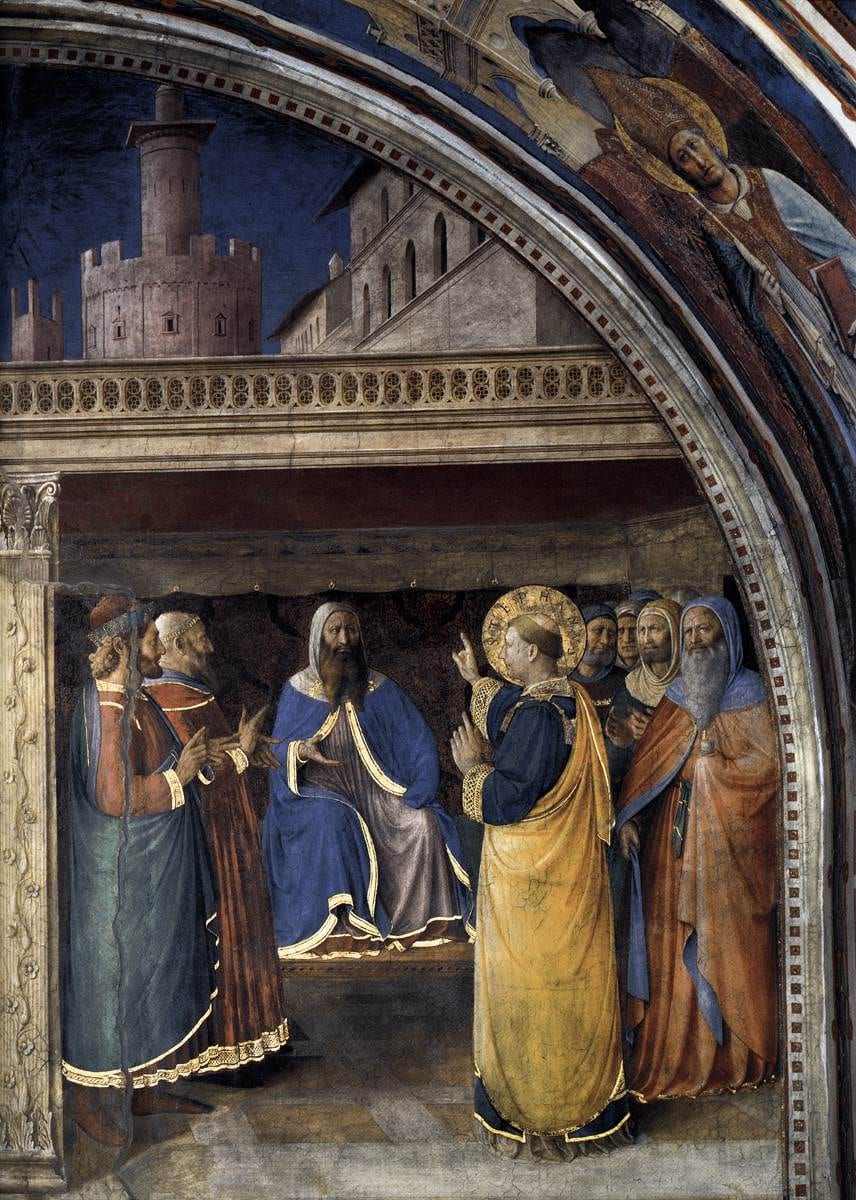
Dispute before the Sanhedrin (Niccoline Chapel), Fra Angelico and workshop, 1447–1449 AD Fra Angelico and workshop, Cappella Niccolina, Palazzo Apostolico, Vatican City The high priest asked St. Stephen whether the charges were true. He answered with Israel's history: God's call to Abraham, Joseph sold into Egypt, Moses at the burning bush, the tabernacle and the temple. St. Augustine wrote that St. Stephen, accused of speaking against the law, answered by explaining the law itself to his accusers.
Pope Benedict XVI said the speech showed that the worship of the temple was over and that the risen Jesus was the new, true temple. St. Stephen ended by charging his hearers with always resisting the Holy Spirit and with betraying and murdering the Righteous One. St. Augustine wrote that St. Stephen seemed angry as he said this, but spoke out of love.
“You stiff-necked people, uncircumcised in heart and ears, you always resist the Holy Spirit. As your fathers did, so do you. Which of the prophets did not your fathers persecute? And they killed those who announced beforehand the coming of the Righteous One, whom you have now betrayed and murdered, you who received the law as delivered by angels and did not keep it.”
St. Stephen to the council, closing his defence -
First century AD, outside the walls of Jerusalem
The heavens opened
St. Stephen sees Christ in glory, is driven out of the city and stoned, and dies praying for his killers.
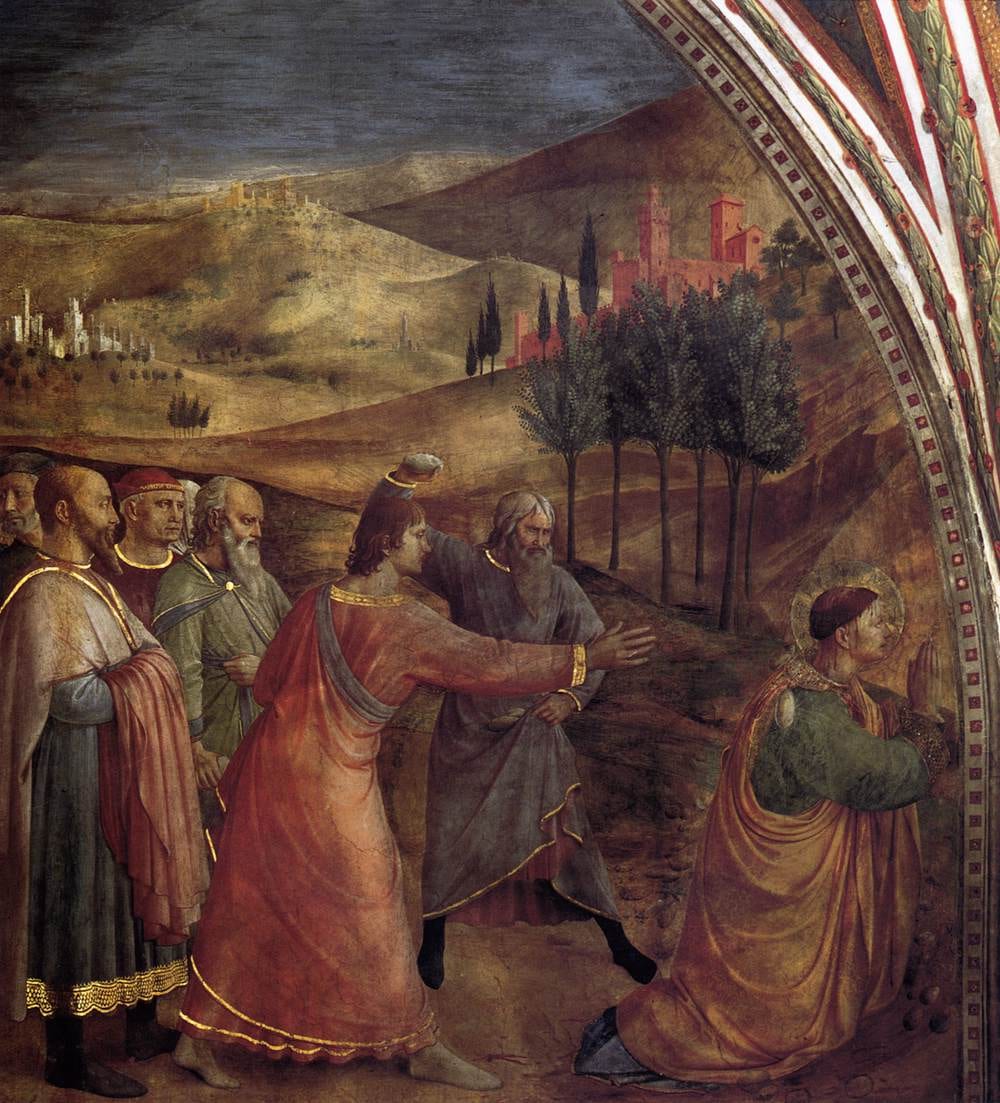
The Stoning of St. Stephen (Niccoline Chapel), Fra Angelico and workshop, 1447–1449 AD Fra Angelico and workshop, Cappella Niccolina, Palazzo Apostolico, Vatican City His hearers were enraged and ground their teeth at him. Filled with the Holy Spirit, St. Stephen looked up and saw the glory of God, with Jesus standing at God's right hand. When he told them what he saw, they shouted, covered their ears, rushed at him and drove him out of the city to stone him.
The witnesses laid their cloaks at the feet of a young man named Saul, the future St. Paul, who approved of the killing. As the stones struck him, St. Stephen prayed to the Lord Jesus to receive his spirit. Then he knelt and prayed aloud for the men stoning him, and died.
“Lord, do not hold this sin against them.”
St. Stephen to the Lord, kneeling under the stones, his last words -
First century AD, Jerusalem to Antioch
Buried, and the Church scattered
The persecution that begins on the day of his death drives his fellow believers out of Jerusalem, preaching as they go.
Devout men buried St. Stephen and mourned him deeply. That same day a great persecution broke out against the church in Jerusalem, and all but the Apostles fled through Judea and Samaria. Before his conversion, St. Paul went from house to house, dragging men and women off to prison.
Those who fled preached as they went, and St. Philip the Deacon proclaimed Christ in a city of Samaria. Other believers who fled reached Phoenicia, Cyprus and Antioch, and at first preached there only to fellow Jews. After his conversion, St. Paul told a crowd in Jerusalem of a vision in the temple, in which he said to the Lord that he had stood by approving when St. Stephen's blood was shed.
“And when the blood of Stephen thy witness was shed, I also was standing by and approving, and keeping the garments of those who killed him.”
St. Paul to the Lord, praying in the temple at Jerusalem after his conversion -
415 AD and after
The tomb at Caphargamala
The priest Lucian is sent to dig at Caphargamala, St. Stephen's relics are carried to Jerusalem, and in Africa an old nobleman asks for baptism.
For centuries the place of St. Stephen's grave was lost. The Roman Martyrology records that his body was found in the reign of the Emperor Honorius through a divine revelation to the priest Lucian. The tomb lay at Caphargamala, about twenty miles from Jerusalem. Bishop John of Jerusalem sent Lucian to dig, and when St. Stephen's coffin was opened the earth shook, a fragrance filled the place and many of the sick were healed.
On December 26, the relics were carried with psalms and hymns to the church of Sion in Jerusalem. At Calama in Africa, Martial, an old nobleman with a great aversion to Christianity, fell ill, and his Christian son-in-law prayed for him at St. Stephen's oratory and laid flowers from it by his head. Before dawn Martial called for the bishop and was baptized, and for the rest of his life he prayed that Christ would receive his spirit, not knowing St. Stephen had prayed the same under the stones.
“Christe, accipe spiritum meum (Christ, receive my spirit)”
Martial to Christ, on his lips for the rest of his life after his baptism -
Feast, December 26
The day after Christmas
The Church keeps St. Stephen's feast the day after Christmas as his birthday into heaven, and preachers from St. Fulgentius of Ruspe to Pope Benedict XVI have spoken of him.
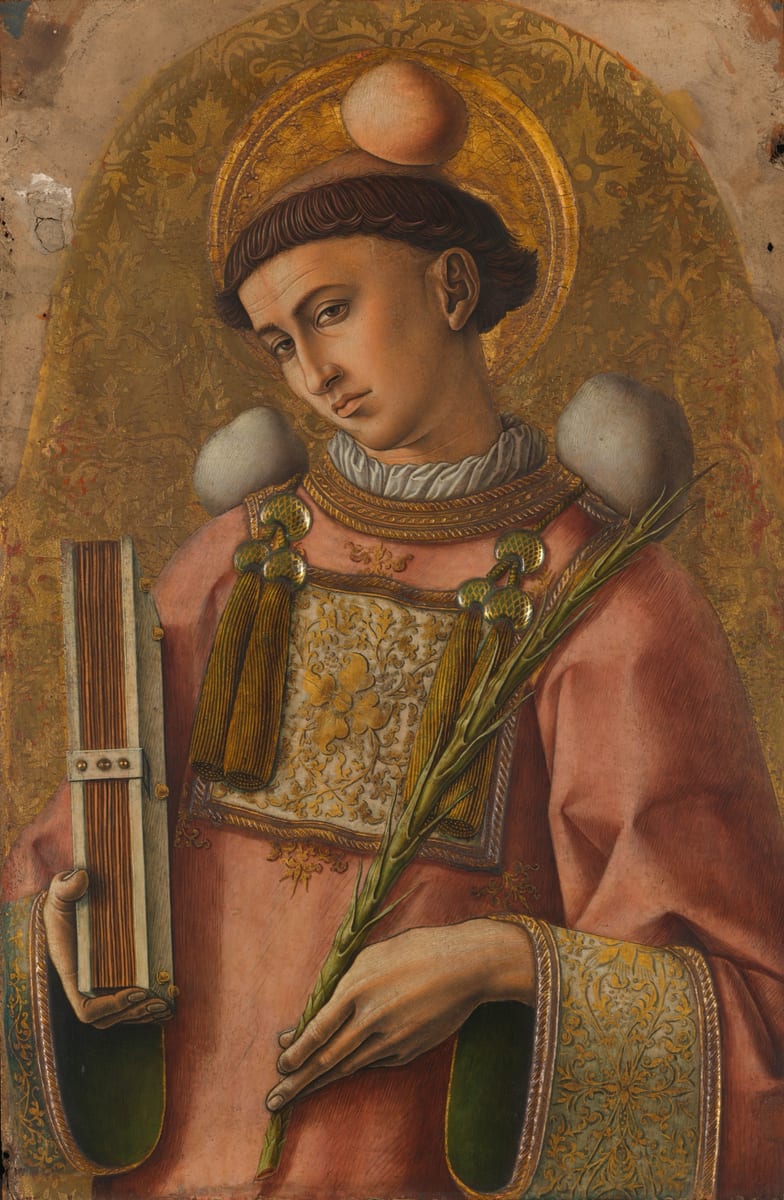
Saint Stephen (upper-tier panel of the Demidoff Altarpiece), Carlo Crivelli, 1476 AD Carlo Crivelli, The National Gallery, London The Church keeps St. Stephen's feast on December 26, and the Roman Martyrology calls it his birthday. St. Fulgentius of Ruspe, read in the Office of the day, preached that on this day St. Stephen left his body behind and went to heaven in triumph.
Pope Benedict XVI called St. Stephen the Church's first deacon and commended all deacons and altar servers to him as their patron. St. Fulgentius also preached that love of neighbour made St. Stephen pray for the men stoning him.
“Yesterday we celebrated the birth in time of our eternal King. Today we celebrate the triumphant suffering of his soldier.”
St. Fulgentius of Ruspe to his hearers, preaching on St. Stephen's feast, the day after Christmas


Pray with the Church
Collect for the Feast of St. Stephen, the First Martyr
The Roman Missal, Proper of Saints, Collect for December 26, as printed with the Office of Readings for the feast
Grant, Lord, we pray,that we may imitate what we worship,and so learn to love even our enemies,for we celebrate the heavenly birthdayof a man who knew how to pray even for his persecutors.Through our Lord Jesus Christ, your Son,who lives and reigns with you in the unity of the Holy Spirit,God, for ever and ever.