
Saints Martyr of Rome · feast January 20
Saint Sebastian
Feast 20 January · Died Rome, Italy
Saint Sebastian died for the faith at Rome; Catholic Tradition holds that he lived through being shot with arrows, went back to confront the emperor and was beaten to death with clubs, and cities struck by plague later took him as their patron.
Begin the life
In brief
Saint Sebastian, also called Sebastian the Martyr, died for the faith at Rome and was buried on the Appian Way. By 354 AD the Church of Rome kept his feast on January 20, and the Church keeps it on that day still. According to longstanding Catholic Tradition, he was an officer in the imperial guard who lived through being shot with arrows on the emperor's order and was later beaten to death with clubs.
-
Fourth century AD
A grave at the Catacombs
By 354 AD Rome keeps his day at his grave, and St. Ambrose of Milan preaches on his feast.
In 354 AD the Church of Rome kept a calendar of its martyrs' feasts. For January 20 it lists St. Sebastian at his grave in the Catacombs, on the Appian Way. Pope St. Fabian shares the day.
Late in the fourth century St. Ambrose preached at Milan on the martyr's feast. St. Ambrose said that St. Sebastian was Milanese by origin, and that he left Milan, where the faith was hardly being tested, for Rome.
“Romam profectus est, ubi propter fidei studium persecutiones acerbae feruebant; ibi passus est, hoc est ibi coronatus. (He went to Rome, where bitter persecutions were raging because of zeal for the faith; there he suffered, that is, there he was crowned.)”
St. Ambrose to his congregation at Milan, preaching on Psalm 118 on St. Sebastian's feast -
280s AD
The officer who strengthened the prisoners
In Catholic Tradition, an officer close to the emperors hides his faith and stands by two brothers condemned to die.
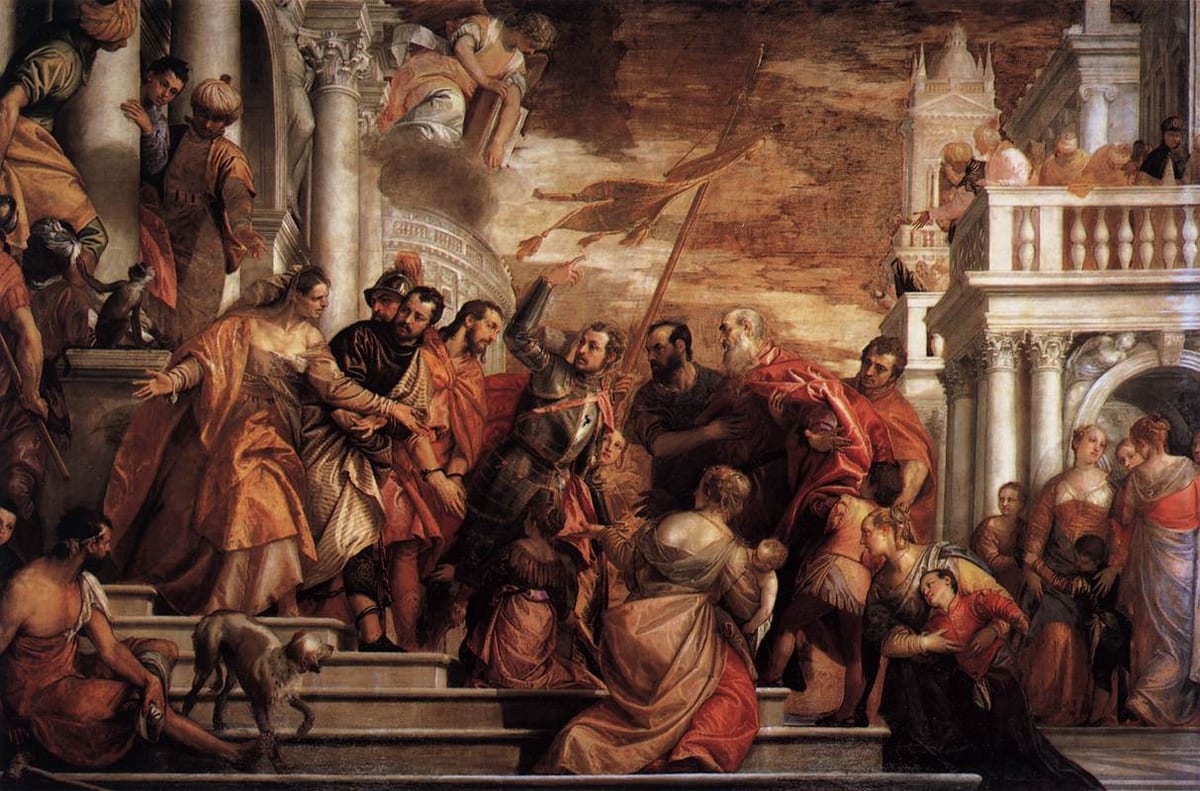
St. Sebastian Exhorting Sts. Mark and Marcellian, Paolo Veronese, circa 1565 AD Paolo Veronese, Church of San Sebastiano, Venice As Catholic Tradition tells it, St. Sebastian commanded the first cohort of the guard under the Emperor Diocletian and the Emperor Maximian. In that telling the emperor did not know his officer was a Christian, and St. Sebastian used his post to help Christians in prison in secret.
As the Passion tells it, twin brothers, St. Mark and St. Marcellian, were sentenced to beheading unless they offered sacrifice, while their families begged them to give in. In the Passion St. Sebastian visited the brothers every day and urged them to stand firm, and they did not give in. In Catholic Tradition, kept in the Roman Martyrology, their father, St. Tranquillinus, was converted to Christ by St. Sebastian's preaching.
-
280s AD
The arrows
Catholic Tradition holds that, denounced to the emperor, he is shot by archers and left for dead, and a widow who comes to bury him finds him alive.
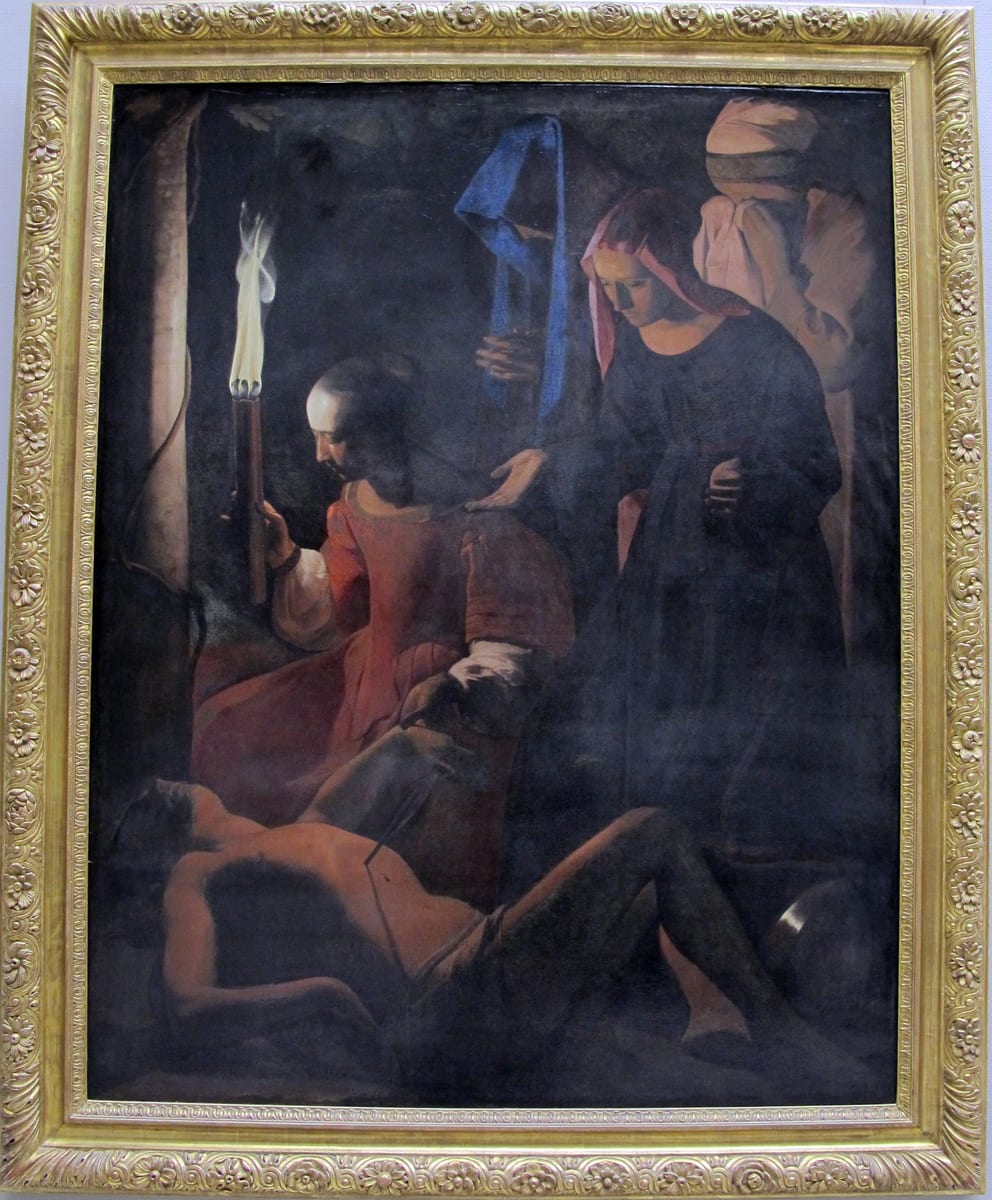
Saint Sebastian Tended by Irene, Georges de La Tour, circa 1649 AD Georges de La Tour, Musée du Louvre, Paris; photograph Sailko, CC BY-SA 3.0 Catholic Tradition holds that the prefect denounced St. Sebastian to the Emperor Diocletian, who charged him with hiding his faith while serving in the palace. In the Passion St. Sebastian answered that he had always worshipped Christ for the emperor's welfare and for Rome, since it was foolish to ask idols of stone for help. The emperor had him tied up in an open field as a target, and archers shot him until, in the Passion's image, he bristled with arrows like a hedgehog.
In the same telling, St. Irene, the widow of the martyr St. Castulus, came by night to take his body for burial and found him alive. The Passion says she took him to her house near the palace, and within a few days he was well.
-
280s AD
On the palace steps
As Catholic Tradition tells it, once healed, St. Sebastian rebukes the emperors in public; he is clubbed to death, and Lucina buries him.
As Catholic Tradition tells it, once St. Sebastian was well he refused to flee, and he stood on the palace steps where the emperors would pass. In the Passion the Emperor Diocletian asked whether this was the man he had ordered shot, and St. Sebastian answered that Christ had given him back his life to accuse them, before all the people, of persecuting Christians unjustly. The same account has him tell the emperors that the temple priests lied about the Christians, who never stopped praying for the empire and its army.
The Passion says the Emperor Diocletian then had him taken to the palace hippodrome and beaten with clubs until he died. In that account his body was thrown by night into the Cloaca Maxima, the great sewer of Rome, so that Christians could not honour him as a martyr. Tradition holds that he appeared in a dream to Lucina, a Roman matron, and that she went at midnight with her servants to recover his body and bury it in the Catacombs.
-
400s–826 AD
The tomb on the Appian Way
Two Roman priests dedicate his church on the Appian Way, a Pope rebuilds it, and in 826 AD part of his relics is carried north to Soissons.
Early in the fifth century two Roman priests dedicated the basilica on the Appian Way to St. Sebastian, to fulfil a vow. Late in the eighth century Pope Hadrian I rebuilt the church, which had fallen into ruin.
In 826 AD Abbot Hilduin of Saint-Denis obtained part of the martyr's relics from Rome, with the consent of Pope Eugenius II. On December 9, 826 AD the relics were carried in procession into Soissons and laid beside the tomb of St. Medard. While the relics still lay there unburied, healings of every kind followed, too many to count.
“et ecclesiam Apostolorum foris porta Appia, miliario tertio in loco qui appellatur Gatacumbas, ubi corpus beati Sebastiani martyris cum aliis quiescit, in ruinis praeventam noviter restauravit. (and he restored anew the church of the Apostles outside the Appian Gate, at the third milestone, in the place called the Catacombs, where the body of blessed Sebastian the martyr rests with others, which had fallen into ruin.)”
The Liber Pontificalis, in the life of Pope Hadrian I -
680–1599 AD
Patron against plague
A plague at Pavia ends when his altar is raised, and later cities turn to him in time of plague.
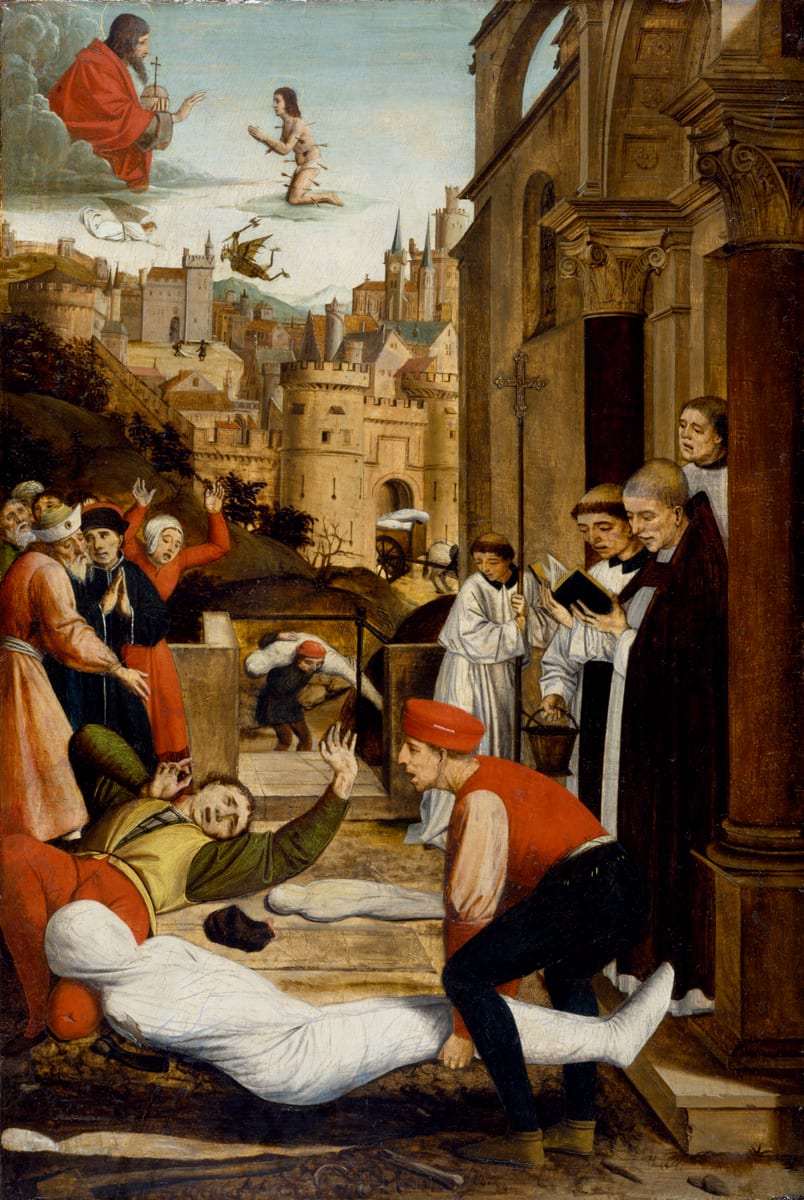
Saint Sebastian Interceding for the Plague Stricken, Josse Lieferinxe, between 1497 AD and 1499 AD Josse Lieferinxe, The Walters Art Museum, Baltimore In 680 AD plague struck Pavia, and its people fled to the mountains until grass and bushes grew in the market place and the streets. Paul the Deacon, in his History of the Lombards, wrote that a man in the city was told in a revelation that the plague would not end until an altar to St. Sebastian stood in the church of St. Peter ad Vincula. Relics of St. Sebastian were brought from Rome, and the plague stopped as soon as the altar was set up.
Milan credited its deliverance from the plague of 1575 AD to St. Sebastian's intercession, and Lisbon turned to him in the plague of 1599 AD. Tradition at Lisbon tells of a statue of St. Sebastian there that became famous for turning back a plague.


Pray with the Church
Collect for the feast of Pope St. Fabian and St. Sebastian
The Roman Missal, Proper of Saints, Collect for January 20, the feast of Pope St. Fabian and St. Sebastian, Martyrs.
O Thou, Almighty God, have regard to our frailty,and since the weight of our own actions beareth us down,may the glorious intercession of Thy blessed Martyrs Fabian and Sebastian protect us.