
Saints Religious of the Sacred Heart and missionary to America · 1769–1852 AD
Saint Rose Philippine Duchesne
Feast 18 November · Born August 29, 1769 AD, Grenoble, Dauphiné, France · Died November 18, 1852 AD, St. Charles, Missouri, United States
A Grenoble girl who longed for the missions lost her convent to the Revolution, waited eleven years for permission to go, crossed to the Missouri frontier at forty-eight, reached the Potawatomi at seventy-one and died at St. Charles in 1852 AD.
Begin the life
In brief
Saint Rose Philippine Duchesne was born at Grenoble, France, on August 29, 1769 AD. St. Philippine Duchesne crossed to America in 1818 AD and on September 14 that year opened the first free school west of the Mississippi, at St. Charles, Missouri. She died there on November 18, 1852 AD, and Pope St. John Paul II canonised her in 1988 AD.
-
1769–1786 AD
A Jesuit's stories
A Grenoble girl hears about the Louisiana missions, is drawn to the convent and refuses the marriage her parents want for her.
St. Philippine Duchesne was eight or ten when a Jesuit who had served in the Louisiana missions told the children stories of the native peoples there. She loved the lives of the saints, above all the martyrs. At twelve her mother sent her to board with the Visitation nuns at Sainte-Marie-d'en-Haut, above Grenoble, to prepare for her First Communion.
There she felt drawn to the nuns' life of prayer. Her parents suspected she wanted to become a nun and took her out of the school. At seventeen she refused the marriage they pressed on her.
“Ma première estime pour l'état de missionnaire vint des conversations d'un bon Père jésuite qui avait fait les missions de la Louisiane, et qui nous racontait des histoires de sauvages. Je n'avais que huit ou dix ans, et néanmoins j'estimais heureux les missionnaires. (My first enthusiasm for missionary life was excited by the conversations of a good Jesuit Father who had been labouring in Louisiana, and used to tell us stories about the savages. I was only eight years old at that time, but I already thought it must be a great happiness to be a missionary.)”
St. Rose Philippine Duchesne to St. Madeleine Sophie Barat, in her memoir on her vocation, 1818, February 1818 AD -
1788–1800 AD
The novice and the prison
She enters the Visitation, the Revolution sends her home, and her old monastery becomes a prison.
In 1788 AD, against her family's wishes, she entered the Visitation novitiate at Sainte-Marie. Her father, Pierre-François Duchesne, forbade her to take vows before the age of twenty-five. Then the Revolution scattered the community, and she had to go home.
Sainte-Marie became a prison, and during the Terror she formed a group of women, the Ladies of Mercy, to help the prisoners held there. She visited prisoners condemned to the guillotine and brought priests out of hiding to the dying. Once she carried a dying woman to her own lodging and prayed beside her all night until the woman died.
“Toute ma gloire et mon bonheur consiste à servir mon divin Sauveur dans la personne des malheureux. (All my glory and my happiness lie in serving my divine Saviour in the person of the unfortunate.)”
St. Rose Philippine Duchesne, answering those who questioned her work among the poor -
1801–1805 AD
Back up the hill
She wins back the empty monastery, watches the returning nuns leave, and gives the house to a new order.
On December 10, 1801 AD, the government let her have the empty monastery for a rent of eight hundred francs, with the repairs at her cost. She moved in four days later in heavy rain, and boys from her catechism class carried her things up the hill. At Christmas the small group she had gathered put on the Visitation habit again.
In Passion Week 1802 AD, Mother d'Auberjon de Murinais, the Visitation superior from before the Revolution, came back with some of her sisters. The deed was made out in St. Philippine Duchesne's name alone and not the Visitation order's, and this led to misunderstanding with the returning nuns. On August 26, 1802 AD, all but one of them left, and in 1804 AD she gave herself and the house to Saint Madeleine Sophie Barat's Society of the Sacred Heart, then four years old, making her vows in it on November 21, 1805 AD.
“Nous prîmes aussitôt nos robes comme un présent de Jésus naissant. (We looked upon our habits as presents from our Infant Lord.)”
St. Rose Philippine Duchesne, the Christmas clothing, December 25, 1801 AD -
1806–1818 AD
Eleven years of asking
She asks again and again to be sent to the missions until a bishop from Louisiana knocks at the door.
In January 1806 AD, praying about how the Magi left everything, she conceived the desire to leave everything herself for the distant missions. That month she wrote to St. Madeleine Sophie Barat asking to be sent, the first of many such requests over the next eleven years. In 1810 AD some missionaries sailed from Bordeaux for the Levant, and when she complained that she had been kept from the chance to go, St. Madeleine Sophie Barat answered her with a mother's reproach.
On January 14, 1817 AD, Bishop Louis William DuBourg of Louisiana called at the Society's house in Paris, where she was secretary general, and St. Philippine Duchesne opened the door to him. He was looking for teachers to help him bring the Gospel to the Indians and to the French young people of his diocese, and on May 17, 1817 AD, St. Madeleine Sophie Barat let her go. She sailed on the Rebecca with four companions on March 21, 1818 AD, and the next day, Easter Sunday, she lost sight of France for good.
“Oh! que j'aurais de joie si enfin vous deveniez plus docile et plus douce! Pourquoi, ma chère fille, ne voulez-vous pas comprendre que vous ne pouvez rien pour Dieu, en quelque coin de la terre que vous soyez, si vous n'avez pas les vertus que vous devez enseigner aux autres! (Oh, how glad I should be if you showed a more docile and gentle spirit! Why will you not understand, my dear child, that you will never be able to do anything for God in whatever corner of the earth you may be if you do not practise yourself the virtues you want to teach to others.)”
St. Madeleine Sophie Barat, July 3, 1810 AD -
1818–1820 AD
The frontier
She lands in Louisiana, opens a free school at St. Charles and moves the community to Florissant.
She landed near New Orleans on May 29, 1818 AD, the feast of the Sacred Heart, and knelt to kiss the ground. After forty-two days up the Mississippi she reached St. Louis on August 21. On September 14 she opened a school at St. Charles, the first free school west of the Mississippi.
In November 1818 AD Bishop DuBourg found the St. Charles convent without bread and disapproved of building in a village where, he said, the nuns would starve. He chose a site for a house at Florissant, and in December 1819 AD her sisters walked there through the snow, driving their cattle before them. There, in 1820 AD, she opened the Society's first novitiate in America.
“Personne ne nous voit, baisez-la aussi. (No one is looking at us, kiss it too.)”
St. Rose Philippine Duchesne to her companions, after kissing the ground of America, May 29, 1818 AD -
1822–1834 AD
Fever on the river and a letter from her superior general
Yellow fever nearly kills her on the Mississippi, and later her superior proposes to replace her.
Returning to Missouri in 1822 AD from a visit to the house at Grand Coteau, Louisiana, she boarded the steamboat Hecla, where yellow fever killed the captain, the first mate and a passenger. Stricken with the fever, she was put ashore near Natchez with her pupil, Theresa Pratte, and for four days she sat upright in bed in a stranger's house, fighting it and praying. Weeks later she sailed again, ran aground near New Madrid, and reached St. Louis on November 28, four months after setting out.
In November 1831 AD reports from America made St. Madeleine Sophie Barat uneasy about the St. Louis house, and she proposed replacing St. Philippine Duchesne as superior there. St. Philippine Duchesne answered that she would accept whatever was decided, and on the advice of Bishop Joseph Rosati of St. Louis she stayed in office. On October 11, 1834 AD a letter arrived from St. Madeleine Sophie Barat, who thought St. Philippine Duchesne had urgently asked to be moved, telling her to hand St. Louis to Mother Thiéfry and take charge at Florissant, and St. Philippine Duchesne left St. Louis the next morning.
“Ce temps d'arrêt, avec dix ou douze jours qui nous restent à voyager sur l'eau, si le voyage est heureux, ce sera en tout soixante jours sans messe, sans communion! C'est le jeûne le plus rigoureux que j'aie peut-être fait en ma vie, même pendant la révolution! (What with the time of stoppage and the ten or twelve days more which the rest of the journey will require, even if all goes on well, we shall have been sixty days without Mass or Communion. Not even during the Revolution did I endure so long a fast from spiritual food.)”
St. Rose Philippine Duchesne, aground near New Madrid, November 1822 AD -
1841–1842 AD
Among the Potawatomi
At seventy-one she goes west to teach Potawatomi girls, and her health sends her back a year later.
Early in 1841 AD Father Pierre-Jean De Smet, a Jesuit missionary, proposed a Sacred Heart foundation among the Potawatomi. On June 29 St. Philippine Duchesne set out up the Missouri with her companions, guided by a priest. Near the mission, one hundred and fifty Potawatomi warriors on ponies rode out to welcome them, waving red and white flags.
At Sugar Creek, Kansas, the sisters opened a school for Potawatomi girls, and within six weeks the work was in good order. The Potawatomi called her the woman who prays always. She had hoped to die in their village, but in July 1842 AD her health forced her back to St. Charles.
“Je ne puis m'ôter la pensée des sauvages. Mon ambition se portait jusqu'aux Montagnes Rocheuses. Je ne puis qu'adorer les desseins de Dieu, qui me prive ainsi de l'objet de tant de désirs. (I can only think of my dear savages. My ambition extended to the Rocky Mountains. I can only adore the will of God, which deprives me of what I had so ardently desired.)”
St. Rose Philippine Duchesne, August 1842 AD -
1842–1852 AD
The last years at St. Charles
She teaches a small class, writes her farewells and dies at noon as the Angelus rings.
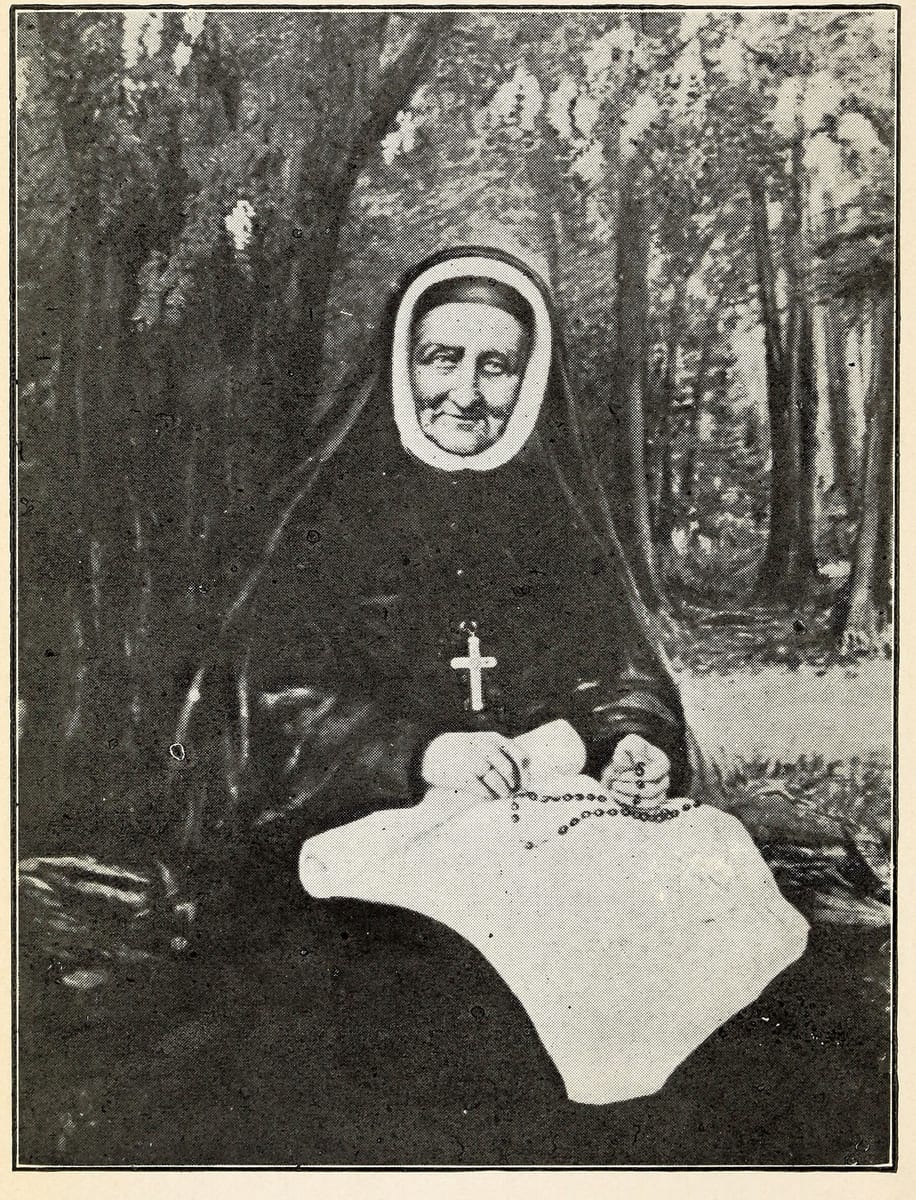
St. Rose Philippine Duchesne in old age, Unknown painter, after 1852 St. Rose Philippine Duchesne in old age, Unknown painter, after 1852, frontispiece to G.E.M., Venerable Philippine Duchesne, New York, 1914; Internet Archive Back at St. Charles, St. Philippine Duchesne taught a small class in the basement of the house. A fever in the summer of 1852 AD left her so weak that on August 16 she asked for and received the last sacraments. The next day she wrote three farewell letters with a steady hand, one of them to St. Madeleine Sophie Barat.
She kept to the community's life until November 16, when she was told to stay away from choir and took to her bed. She died at noon on November 18, 1852 AD, as the Angelus rang, in the arms of the infirmary sister. Her funeral was held in the parish church of St. Charles Borromeo, because the convent chapel could not hold the crowd, and Protestants came with the rest.
“Oh! que je suis heureuse de mourir dans une maison où règne la charité! (Oh, what a happiness it is, to die in a home where such charity exists!)”
St. Rose Philippine Duchesne, hearing the community praying in the next room, November 17, 1852 AD

Pray with the Church
Her last words
Her last plea on her deathbed at St. Charles, Missouri, toward noon on November 18, 1852 AD.
Come, Lord Jesus, delay no longer
All 5 reports on Saint Rose Philippine Duchesne

St. Philippine Duchesne gives a new order her convent, then herself

About this picture
AI-generated image, in the manner of 1850s oil painting, from the paper's reference portrait based on St. Rose Philippine Duchesne in old age (Unknown painter, after 1852, frontispiece to G.E.M., Venerable Philippine Duchesne, New York, 1914; Internet Archive) View source artwork.
St. Philippine Duchesne dies at eighty-three, photographed in case she is canonised

About this picture
AI-generated image, in the manner of American river genre painting of the 1830s, from the paper's reference portrait based on St. Rose Philippine Duchesne in old age (Unknown painter, after 1852, frontispiece to G.E.M., Venerable Philippine Duchesne, New York, 1914; Internet Archive) View source artwork.
At sixty, St. Philippine Duchesne heads south on a mission she dreaded

About this picture
AI-generated image, in the manner of French Restoration provincial oil painting, from the paper's reference portrait based on St. Rose Philippine Duchesne in old age (Unknown painter, after 1852, frontispiece to G.E.M., Venerable Philippine Duchesne, New York, 1914; Internet Archive) View source artwork.
St. Philippine Duchesne leaves her Grenoble convent for Paris and never returns

About this picture
AI-generated image, in the manner of French provincial oil painting of the 1790s, from the paper's reference portrait based on St. Rose Philippine Duchesne in old age (Unknown painter, after 1852, frontispiece to G.E.M., Venerable Philippine Duchesne, New York, 1914; Internet Archive) View source artwork.