
Saints Priest, mission preacher and founder of the Passionists · 1694–1775 AD
Saint Paul of the Cross
Feast 20 October · Born January 3, 1694 AD, Ovada, Republic of Genoa (Piedmont, Italy) · Died October 18, 1775 AD, Retreat of Sts. John and Paul, Rome, Papal States
The eldest son of a struggling family in the Republic of Genoa put on a black tunic in mourning for Christ's Passion, fought two decades for papal approval of his Rule, preached through illness and inner darkness, and died in Rome in 1775 AD at the head of the order he had founded.
Begin the life
In brief
Saint Paul of the Cross, born Paul Francis Danei at Ovada in 1694 AD, founded the Congregation of the Passion (the Passionists) and the Passionist nuns. The Roman Martyrology records that from his youth he burned with a singular love for Christ crucified, whom he saw in the faces of the poor and the sick. He died in Rome on October 18, 1775 AD, and the Church keeps his memorial on October 19.
-
1694–1713 AD
The eldest of sixteen
A boy from a poor family of noble descent grows up rising at night to pray beside his younger brother.
St. Paul of the Cross was born at Ovada, in the Republic of Genoa, on January 3, 1694 AD. He was the eldest of the sixteen children of Luca Danei and Anna Maria Massari. The family was of noble descent but had become nearly poor.
According to longstanding Catholic Tradition, kept in the Roman Breviary, he fell into a river as a boy and the Blessed Virgin Mary pulled him out unharmed. His brother John Baptist Danei, born in 1695 AD, was St. Paul of the Cross's companion from childhood. In their youth the two rose at night and walked barefoot to an oratory under a staircase to pray the Divine Office.
-
1713–1716 AD
A soldier at prayer
A young soldier at Crema leaves the army after praying before the Blessed Sacrament exposed for the Forty Hours.
In 1713 AD St. Paul of the Cross turned to a life of penance and lived as a hermit, though he belonged to no order. For the rest of his life he called that turn his conversion. Wanting to die a martyr, he then joined the army being raised at Venice to fight the Turks.
On February 20, 1716 AD, at Crema, he was praying before the Blessed Sacrament exposed for the Forty Hours when he understood that God had other plans for him. He obtained his discharge and went home. He longed for a life of solitude, but he told only his spiritual director, because his father, mother and brothers needed him at home.
“Ma siccome non potevo seguire la santa ispirazione per la necessaria assistenza alla casa, cioè a mio padre, madre e fratelli, tenevo la sopraddetta vocazione sempre coperta nel cuore, fuoriché la conferivo col Rev.do mio P. Direttore. (But as I could not then execute this holy inspiration on account of my services being needed at home by my father, mother, and brothers, I kept the above-mentioned vocation always concealed in my heart, except that I consulted over it with my Reverend Father Confessor.)”
St. Paul of the Cross, in the preface to the first text of the Rule -
1720 AD
A black tunic for the Passion
A vision on the road home from Communion, then the Bishop of Alessandria's own hands clothing St. Paul of the Cross in black.
In the summer of 1720 AD, walking home from Communion at the Capuchin church in Castellazzo, St. Paul of the Cross had a vision of himself in a black robe that reached the ground. A white cross was on his breast, with the Name of Jesus beneath it in white letters. He wrote that the black was meant as mourning for the Passion and Death of Jesus.
On November 22, 1720 AD, the day the Passionists count as their beginning, Bishop Francesco Maria Arborio di Gattinara of Alessandria dressed him with his own hands in a black tunic of the coarsest local wool. The bishop then sent him to spend forty days alone at a church in Castellazzo, praying for long hours, caring for the altars and keeping a diary of his meditations. In six days of that retreat he wrote the Rule of a new congregation, which he called the Poor of Jesus.
“mi vidi in spirito vestito di nero sino a terra, con una croce bianca in petto e sotto la croce avevo scritto il Nome santissimo di Gesù in lettere bianche, ed in quest'istante mi sentii dire queste istesse parole: "E' questo in segno di quanto debba essere puro e candido quel cuore, che deve portare scolpito il Nome SS.mo di Gesù"; ed io vedendo e sentendo ciò, mi posi a piangere, e poi cessò. (I saw myself — in spirit — clothed with a black dress reaching the ground, with a white cross on my breast, and under the cross the most holy name of 'Jesus,' written in white letters; and, at the same instant, I heard these very words addressed to me: — 'This is for a sign how pure and white that heart must be which has to bear engraved upon it the most holy name of Jesus.' Seeing and hearing this, I began to weep, and so the vision ended.)”
St. Paul of the Cross, 1720 AD -
1721–1727 AD
A Rule refused
Turned down by his bishop and sent away from the papal palace, St. Paul of the Cross finds friends in Rome, nurses the sick and is ordained by a Pope.
In January 1721 AD the same bishop turned down the Rule and refused him every companion except his brother John Baptist. On September 22, 1721 AD, St. Paul of the Cross went to the Quirinal palace to ask to see Pope Innocent XIII and was sent away abruptly. In 1722 AD the two brothers moved into a hermitage on Monte Argentario, on the Tuscan coast, with the permission of the Spanish governor.
In the Holy Year of 1725 AD, Monsignor Crescenzi, a canon of St. Peter's, saw the brothers praying in the basilica and asked them about their calling. Through him St. Paul of the Cross met Cardinal Corradini, who sent the brothers in 1726 AD to nurse the sick at the new hospital of San Gallicano in Rome. Their superiors wanted them ordained, and on June 7, 1727 AD, Pope Benedict XIII ordained both brothers priests in St. Peter's Basilica.
-
1728–1737 AD
The first retreat
Back on the mountain, the two brothers preach missions and build their first house, entered behind a cross.
In March 1728 AD the brothers went back to Monte Argentario to stay, with written permission from the Pope to live in solitude. From there they began to preach missions. A mission was a set course of preaching, catechism and the sacraments, which the missionaries carried out under the bishops' authority.
In 1733 AD they gave their first mission in Orbetello. On March 4 that year the first stone was laid for their first retreat, as the order called its houses. On September 14, 1737 AD, the feast of the Exaltation of the Holy Cross, St. Paul of the Cross carried the cross at the head of eight companions into the new Retreat of the Presentation.
“Dopo non pochi travagli, usci. un Breve Apostolico, ed ai 14 settembre, giorno dell'Esaltazione di S. ffi festa principale della nostra minima nascente Congregazione, si fece il solenne ingresso, e Santa Benedizione della Chiesa e Ritiro. Io ebbi la sorte andare avanti con la Croce iaalberata, con fune · al collo, e mi seguitarono otto compagni, cioè _cinque sacerdoti con me, e 4 laici. Si fece il discorso confacente all'opera, e si terminò la sacra funzione. … tutti servono Dio con fervore, fuorchè l'indegno che scrive, (After some trouble we procured a Brief from Rome. When the church and house had been blessed, our little Congregation made its solemn entry into the retreat on the Feast of the Exaltation of the Holy Cross. It was my office to head this procession with the cross. I was followed by eight companions, four priests and four brothers. The function concluded with a discourse suitable to the occasion. All serve God fervently here, except the unworthy writer of this epistle.)”
St. Paul of the Cross to a friend, letter on the opening of the first Retreat on Monte Argentario, September 1737 AD -
1737–1748 AD
Approved, elected, sued and desolate
St. Paul of the Cross wins papal approval of his Rule, is elected by every vote but his own, and confides a desolation he hides from others.
In 1737 AD St. Paul of the Cross left for Rome to defend his Rule point by point, writing that he was going there to fight. Pope Benedict XIV approved the Rule on May 15, 1741 AD, and that June he and his first companions made four vows, the fourth to promote devotion to the Passion of Jesus. In 1742 AD the Bishop of Viterbo asked him to preach a mission at Vetralla, and all through its sermon on death he was deathly pale and shook from head to foot.
On April 10, 1747 AD, the first general chapter elected him Superior General, and the only vote not cast for him was his own. In 1748 AD friars of a whole province pressed a case in Rome against his new foundations at Ceccano and Terracina. That year he wrote in confidence to Father Fulgenzio, the rector of one of his retreats, that he was desolate inside and out.
“lo sto in mare fra grandi tempeste (lo dico in segreto al suo cuore) desolato intus et foris, calpestato dai diavoli in modo orrendo, che pare non abbia più nè fede, nè speranza, nè carità. (I am tossed upon a stormy sea, and I tell you, in confidence, that I am in desolation, intus et foris; tormented by devils in a horrible manner, so that I no longer seem to have faith, hope, or charity.)”
St. Paul of the Cross to Father Rector (Father Fulgenzio), 1748 AD -
1765–1775 AD
Last years in Rome
A brother buried, the first nuns founded from a sickbed, and a death in the house a Pope gave the order.
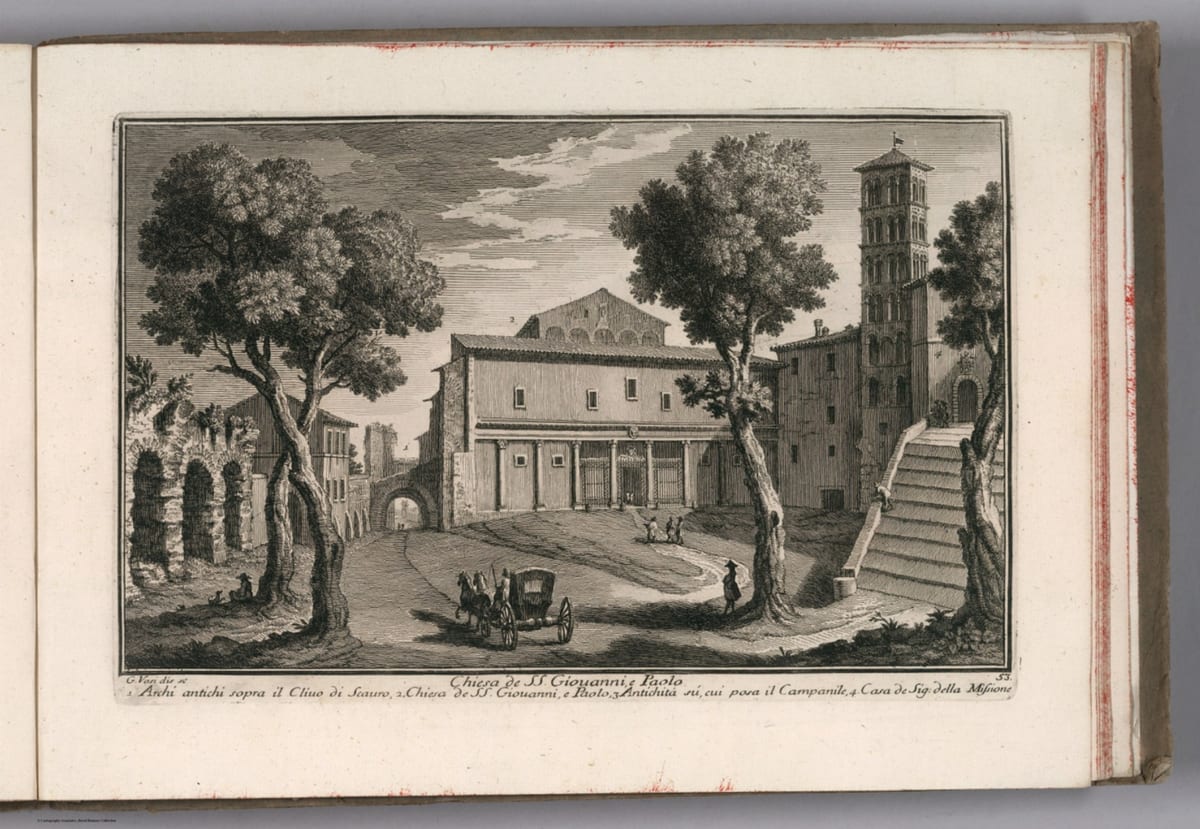
Chiese de SS. Giovanni e Paolo (Delle magnificenze di Roma antica e moderna, Libro Terzo, plate 53), Giuseppe Vasi (1710–1782 AD), designer and engraver, 1753 AD Giuseppe Vasi (1710–1782 AD), designer and engraver, David Rumsey Map Collection, David Rumsey Map Center, Stanford Libraries (via Internet Archive) His brother John Baptist died at the Retreat of Sant'Angelo on August 30, 1765 AD, with St. Paul of the Cross beside him, and St. Paul of the Cross then fell dangerously ill. In 1770 AD he knelt before Pope Clement XIV with the plan and Rules for an order of nuns, but when the first of them took the habit at Corneto on May 3, 1771 AD, he was too ill to go. On December 9, 1773 AD, he led his community into the church and house of Sts. John and Paul in Rome, a gift of Pope Clement XIV.
On August 30, 1775 AD, he received Viaticum before the whole community, and two religious in the next room wrote down the counsels he left to his religious, present and future. On October 18, the feast of St. Luke, he received Communion, saw visitors and held up a small picture of the Crucifixion to show one of them. He died towards evening, about two hours before sunset, aged eighty-one.
“E voi, o Vergine Immacolata, Regina dei martiri, ancor voi per quei dolori che provaste nella Passione e Morte del vostro amabilissimo Figlio, date ancor voi a tutti la vostra materna benedizione, mentre io tutti li ripongo e li lascio sotto il manto della vostra protezione! (Thou, O immaculate Virgin, Queen of Martyrs, by the sorrows which thou hast felt in the Passion of thy beloved Son, give to us all thy maternal benediction, for I place all my children, and leave them all, under the mantle of thy protection.)”
St. Paul of the Cross to Our Lady, in his spiritual testament, after receiving Viaticum, August 30, 1775 AD -
1775–2020 AD
Canonised in St. Peter's
St. Paul of the Cross's room is preserved, a dying boy's cure is accepted as a miracle, and in 1867 AD a Pope declares him a saint.
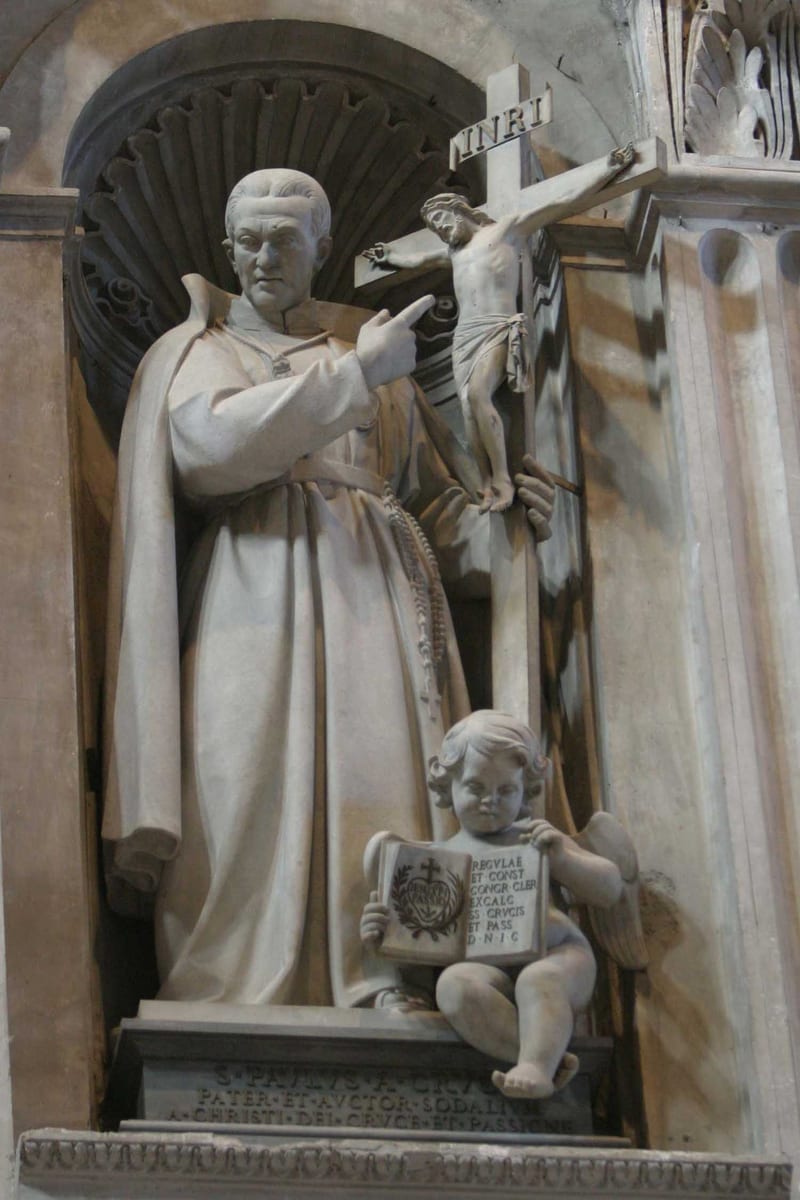
Statue of Saint Paul of the Cross, at the Vatican Basilica of S. Peter. By Ignazio Iacometti, 1876 AD, Ignazio Jacometti (sculptor); photograph by Bocachete Ignazio Jacometti (sculptor); photograph by Bocachete, St. Peter's Basilica, Vatican City (right transept, founders' niches) His room at Sts. John and Paul and the chapel beside it, where he said Mass, have been preserved with some of his belongings since the day he died, and pilgrims still visit them. In 1816 AD a dying boy at Fondi swallowed water holding a relic of St. Paul of the Cross's habit, then opened his eyes, called his mother and asked for food. The Church accepted that cure as the first miracle for the beatification of St. Paul of the Cross.
Pope Pius IX canonised him in St. Peter's Basilica on June 29, 1867 AD, the eighteen-hundredth anniversary of St. Peter's martyrdom. In 2020 AD, writing to the Passionists for their congregation's three hundredth year, Pope Francis quoted St. Paul of the Cross's words on the Passion of Jesus.
“la più grande e stupenda opera dell’amore di Dio (the greatest and most overwhelming work of God's love)”
St. Paul of the Cross, his definition of the Passion of Jesus, in a letter (Lettere II, 499)


Pray with the Church
Collect of St. Paul of the Cross
The collect of the Roman Breviary for his former feast of April 28, in the English carried by the Divinum Officium project.
Lord Jesus Christ, Who didst gift thine holy servant Paul with great love that he might preach the mystery of thy cross, and hast been pleased that through him a new family should grow up in thy Church, grant unto us at his prayers that upon earth we may so call thy sufferings to mind as worthily to gain the fruit thereof in heaven.
All 5 reports on Saint Paul of the Cross

About this picture
AI-generated image, in the manner of Italian religious oil painting of the 1720s, from the paper's reference portrait based on St. Paul of the Cross, 'Venerabile Servo di Dio P. Paolo della Croce' (anonymous Italian engraver, after 1775, Wellcome Collection, London; CC BY 4.0) View source artwork.

Bishop clothes St. Paul of the Cross, and a new order begins

About this picture
AI-generated image, in the manner of a Roman oil still life of about 1770. No person appears in it.
St. Paul of the Cross's order wins a Pope's approval after 48 years

Pope Clement XIV hands St. Paul of the Cross his order's approval

About this picture
AI-generated image, in the manner of Italian oil painting of the 1720s, from the paper's reference portrait based on St. Paul of the Cross, 'Venerabile Servo di Dio P. Paolo della Croce' (Anonymous Italian engraver, after 1775, Wellcome Collection, London; CC BY 4.0) View source artwork.
Saint Paul of the Cross sees himself in a habit no one wears

About this picture
AI-generated image, in the manner of Roman oil painting of the 1770s, from the paper's reference portrait based on 'Venerabile Servo di Dio P. Paolo della Croce' (anonymous Italian engraver, after 1775, Wellcome Collection, London; CC BY 4.0) View source artwork.