
Saints Gaul, c. 316–397 AD
Saint Martin of Tours
Feast 11 November · Born 316 AD, Sabaria, Pannonia (Szombathely, Hungary) · Died 397 AD, Candes, Touraine, Gaul (Candes-Saint-Martin, France)
A conscript who cut his cloak for a beggar at Amiens, walked out of the army at Worms, and gave Tours twenty-six years as its bishop.
Begin the life
In brief
Saint Martin of Tours was born at Sabaria in Pannonia, now Szombathely in Hungary, about 316 AD. He served in the imperial guard, founded the monasteries of Ligugé and Marmoutier, and was third bishop of Tours from 371 AD. Pope Benedict XVI called him one of the most celebrated and venerated saints of Europe.
-
c. 316–328 AD
Sabaria and Pavia
A tribune's son who kept going to a church his parents had no use for.
St. Martin was born to heathen parents at Sabaria in Pannonia. His father was first a soldier and afterwards a military tribune. The family moved to Ticinum in Italy, the town now called Pavia.
At ten he went to the church against his parents' wish. He asked to be enrolled among the catechumens, and the request was granted. At twelve he wanted the life of a hermit, and his age prevented it.
-
c. 331–334 AD
The gate of Amiens
Conscripted on his father's information, he cut his last cloak in two at the city gate.
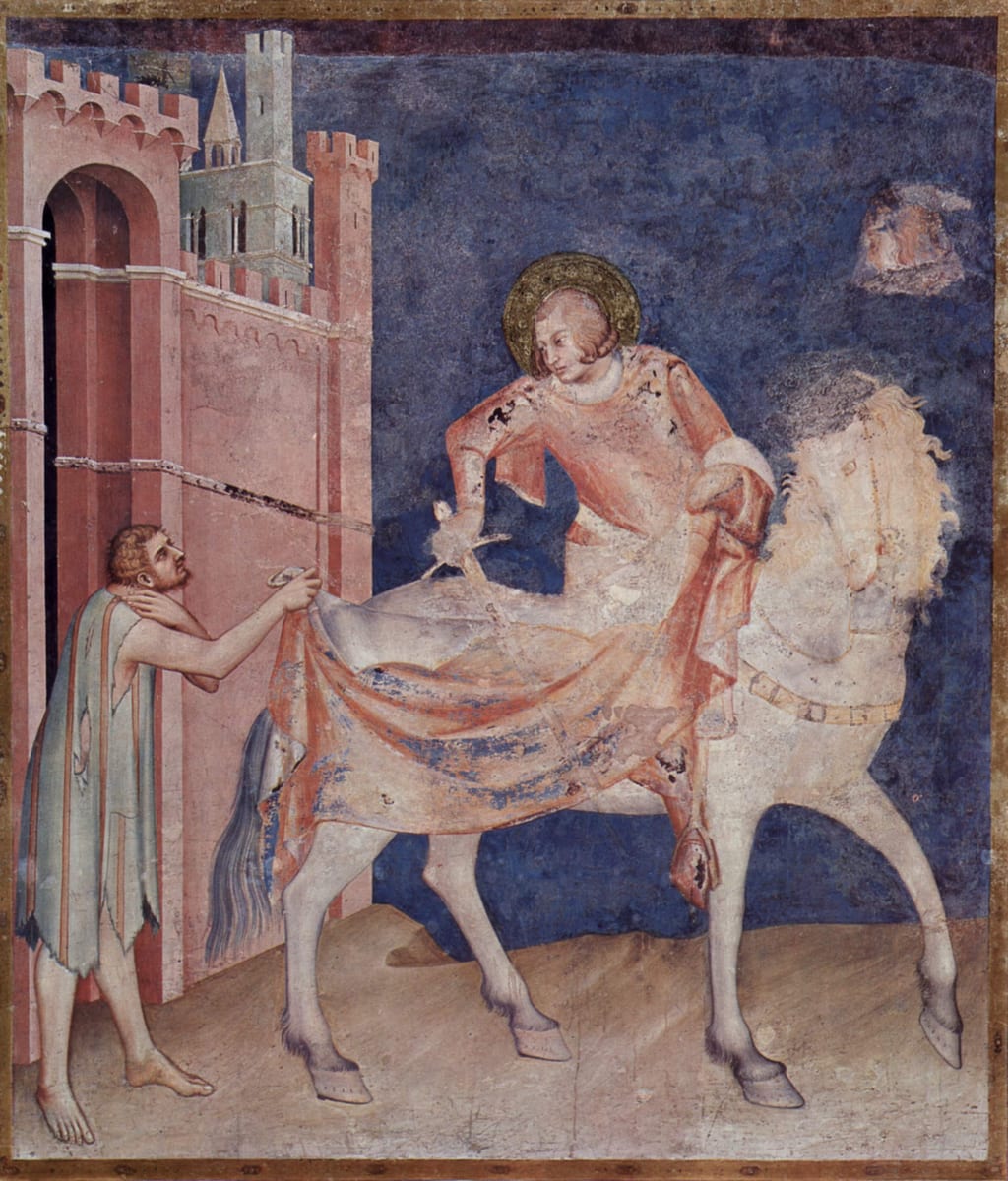
Fresco cycle with scenes from the life of St. Martin of Tours, scene: St. Martin divides his cloak, Simone Martini (1284-1344 AD), c. 1312-1317 AD (catalogued 1322-1326 AD by the Yorck Project) Simone Martini (1284-1344 AD), Chapel of St. Martin, Lower Basilica of San Francesco, Assisi An imperial edict required the sons of veterans to be enrolled for service. St. Martin's father furnished the information against him. He was seized, put in chains and made to swear the military oath at fifteen.
One winter at Amiens the cold was proving fatal to many. St. Martin met a beggar at the city gate and had nothing left but his cloak. He took his sword, cut the cloak in two and gave the man half.
-
c. 334–336 AD
The half cloak
That night he saw who had been wearing it.
In the following night St. Martin saw Christ arrayed in the half cloak he had given away. Pope John Paul II said that in giving that half St. Martin put the words of Jesus about the Last Judgment into a concrete gesture.
After the vision he hastened to receive baptism. At his tribune's entreaty he stayed on in the army nearly two years more.
“Martin, who is still but a catechumen, clothed me with this robe.”
Christ to the angels -
358 AD
The pay parade at Worms
He asked for his discharge in front of the Caesar and the assembled army.
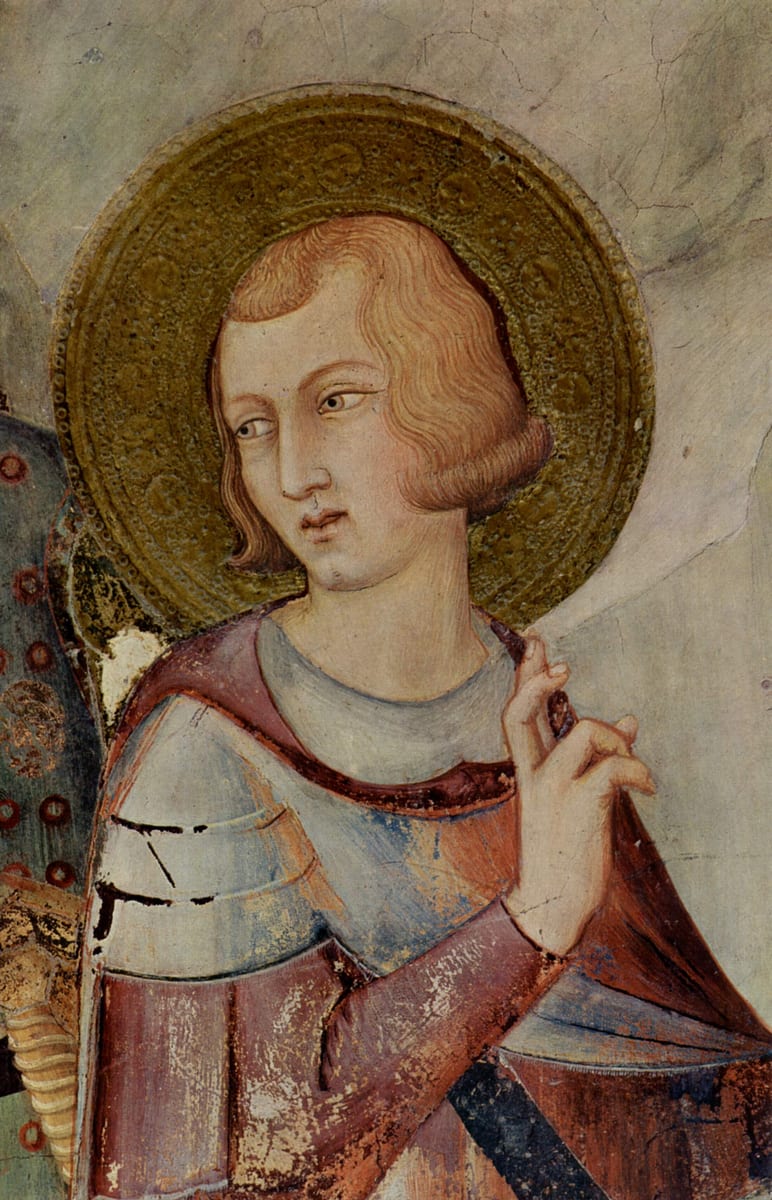
Fresco cycle with scenes from the life of St. Martin of Tours, scene: St. Martin has himself released from military service by the emperor (the encounter with the crucifix), detail: St. Martin, Simone Martini (1284-1344 AD), c. 1312-1317 AD (catalogued 1322-1326 AD by the Yorck Project) Simone Martini (1284-1344 AD), Chapel of St. Martin, Lower Basilica of San Francesco, Assisi Julian Caesar was distributing a donative to the army at Worms on the Rhine. St. Martin asked for his discharge instead of the money. Julian answered that this was fear of the next day's battle.
St. Martin offered to stand unarmed before the line of battle. He was thrust into prison, and the next day the enemy surrendered. He went then to Saint Hilary at Poitiers, who appointed him an exorcist.
“Hitherto I have served you as a soldier: allow me now to become a soldier to God: let the man who is to serve you receive your donative: I am the soldier of Christ: it is not lawful for me to fight.”
St. Martin of Tours -
361–371 AD
Ligugé
A deserted place near Poitiers, and the first man he raised there.
In 361 AD St. Martin took up the solitary life in the deserted place now called Ligugé. Pope Benedict XVI called it the oldest monastery known in Europe. He stayed about ten years, leaving often to preach in central and western Gaul.
A catechumen there died of fever, unbaptised, while St. Martin was three days away. He cleared the cell, bolted the door and stretched himself on the body in prayer. Scarcely two hours later the dead man moved and opened his eyes.
-
371–372 AD
Taken to Tours
The city fetched him out of his cell with a lie, and the crowds drove him outside the walls again.
When the second bishop of Tours died, the clergy and people wanted the hermit of Ligugé. A citizen named Ruricius knelt at his knees and pretended his wife was dying. Some of the bishops objected that his clothing was mean and his hair disgusting.
He was consecrated third bishop of Tours in 371 AD. Unable to bear the crowds at his cell, he built a monastery two miles outside the city. Eighty disciples lived at Marmoutier owning nothing and practising no art but transcribing.
-
384–385 AD
Trier
He put the case to the emperor and got a promise, then went back to save whoever was left.
Priscillian appealed to the emperor Maximus at Trier, where St. Martin was then staying. St. Martin told Maximus that a church case did not belong before a civil judge. The emperor promised him not to carry the condemnation to the shedding of blood.
After St. Martin left the city, Priscillian and four others were beheaded. He returned to stop tribunes being sent into Spain to hunt heretics. He took part once in the communion at the ordination of Felix, judging it better to yield than to leave men under the sword, and never attended a synod again.
“Justly, O Martin, do you feel compunction, but you could not otherwise get out of your difficulty. Renew your virtue, resume your courage, lest you not only now expose your fame, but your very salvation, to danger.”
An angel to St. Martin -
397 AD
Candes
A quarrel among country clergy, and the last journey he made to settle it.
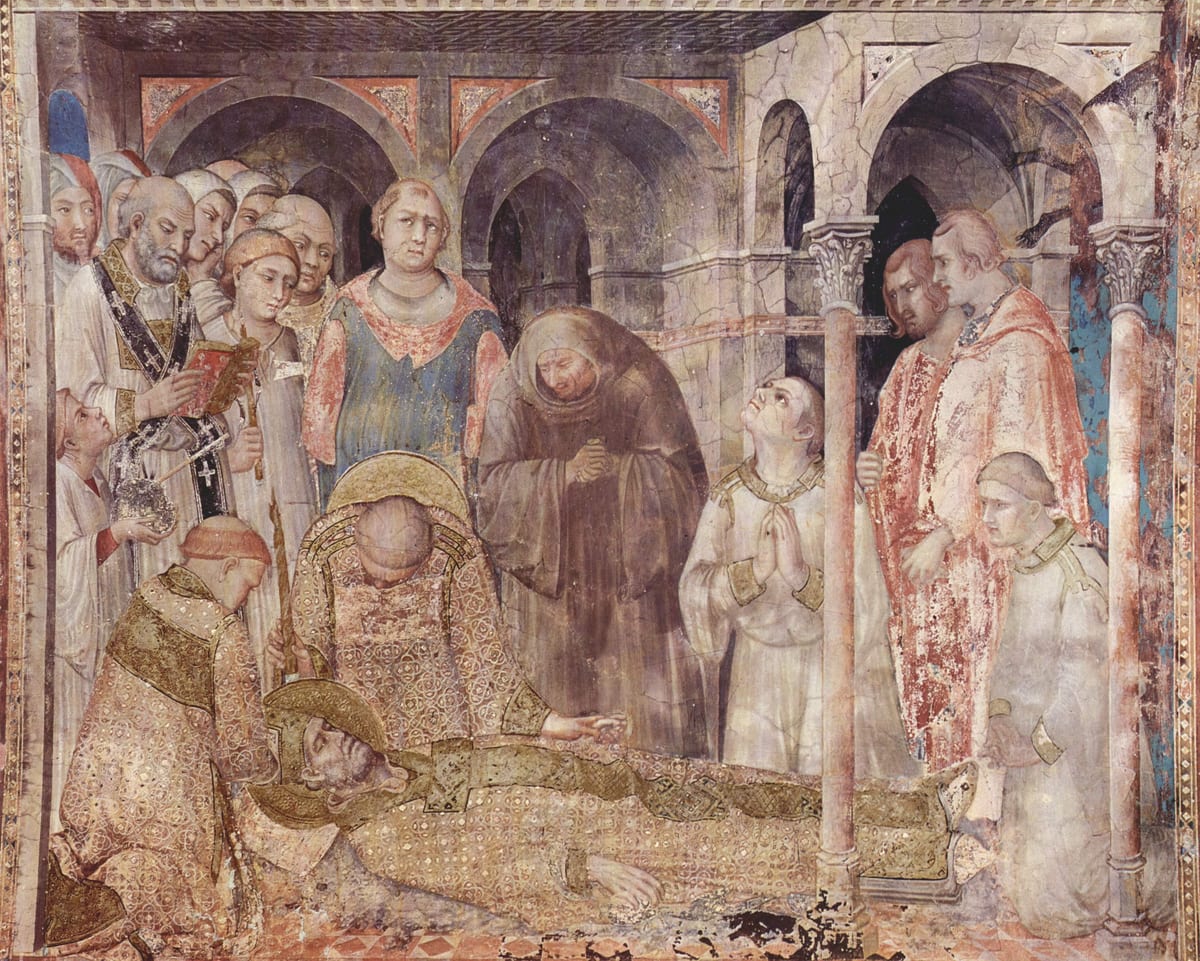
Fresco cycle with scenes from the life of St. Martin of Tours, scene: the death of St. Martin, Simone Martini (1284-1344 AD), c. 1312-1317 AD (catalogued 1322-1326 AD by the Yorck Project) Simone Martini (1284-1344 AD), Chapel of St. Martin, Lower Basilica of San Francesco, Assisi The clerics of Candes were at variance, and St. Martin went to restore peace among them. He knew the end of his own days was at hand and did not shrink from the journey. Peace was restored, and then his bodily strength suddenly failed.
His brethren wept and asked to whom he would leave them. He refused the straw they offered and lay on sackcloth and ashes until he died. Tours buried him on November 11, 397 AD, with about two thousand monks in the streets.
“O Lord, if I am still necessary to your people, I do not shrink from toil: your will be done.”
St. Martin of Tours


Pray with the Church
Prière à saint Martin
Prayer to Saint Martin composed by Mgr Vincent Jordy, archbishop of Tours and 135th successor of Saint Martin, and published by the diocese of Tours. Printed in French exactly as the diocese gives it.
Saint Martin,Toi qui as parcouru les routes d’Europe, (you who travelled the roads of Europe,)Toi qui as vécu à la suite de Jésus en vrai disciple, (you who lived in the following of Jesus as a true disciple,)Toi qui as partagé ton manteau avec un pauvre par amour du Christ, (you who shared your cloak with a poor man for the love of Christ,)Toi qui nous aides à reconnaître son visage en toute personne pour servir et aimer, (you who help us to recognise his face in every person, to serve and to love,)Toi qui as lutté contre le mal et qui es passé sur la terre en faisant le bien, (you who fought against evil and passed over the earth doing good,)Intercède pour nous lors des temps difficiles, (intercede for us in difficult times,)Protège-nous lors des temps de détresse, (protect us in times of distress,)Donne-nous d’être persévérants et de garder la paix dans les épreuves, (grant us to be persevering and to keep peace in trials,)Sois notre protecteur et conduis-nous sur le chemin de la vie éternelle. (be our protector and lead us on the way of eternal life.)
All 4 reports on Saint Martin of Tours

About this picture
AI-generated image, in the manner of a nineteenth-century reportage drawing in pen, ink and wash. No person appears in it.
A red cross and a lamp mark the wall hiding St. Martin's tomb

Pope John Paul II reads Saint Martin's cloak against the Last Judgment

St. Martin walks into the emperor's court to stop a manhunt

About this picture
AI-generated image, in the manner of Italian trecento fresco, from the paper's reference portrait based on Miracle of Fire (scene 8) (Simone Martini (1284-1344), between 1312 and 1317, Chapel of St. Martin, Lower Basilica of San Francesco, Assisi) View source artwork.
_-_WGA21388.jpg)