
Saints Pope and Doctor of the Church · 440–461 AD
Saint Leo the Great
Feast 10 November · Born 400 AD, Etruria (Tuscany), Italy · Died November 10, 461 AD, Rome, Italy
Saint Leo the Great, a Roman deacon chosen Pope while he was away in Gaul, wrote the letter on Christ that a council of the whole Church adopted, went out to meet Attila and Genseric, and died in Rome in 461 AD.
Begin the life
In brief
Saint Leo the Great, also called Pope St. Leo the Great, was Bishop of Rome from 440 AD to 461 AD. He was born toward the end of the fourth century and called Rome his homeland. The Church keeps his memorial on November 10, the day he died. In 1754 AD Pope Benedict XIV declared him a Doctor of the Church.
-
c. 422–439 AD
A deacon at the service of Pope Sixtus III
As a deacon in Rome he suggested a book on the Incarnation and urged Pope Sixtus III to keep a Pelagian out.
In the years of Pope Celestine I, 422–432 AD, St. Leo the Great served the Church of Rome as a deacon. He had joined the Roman clergy as a young man. His friends included St. Prosper of Aquitaine and Cassian, who founded an abbey at Marseilles.
At the deacon's suggestion, Cassian wrote a work on the Incarnation against the Nestorians. In 439 AD Julian of Eclanum, a follower of the Pelagian heresy, pretended to repent so that he could be taken back into the Church. St. Leo the Great urged Pope Sixtus III to see through him, and the Pope turned Julian away.
“the ornament of the Roman church and of the Divine ministry”
Cassian, describing Leo while he was archdeacon under Pope Celestine -
440 AD
Chosen Pope while away in Gaul
Rome waited more than forty days for its new bishop to come home.
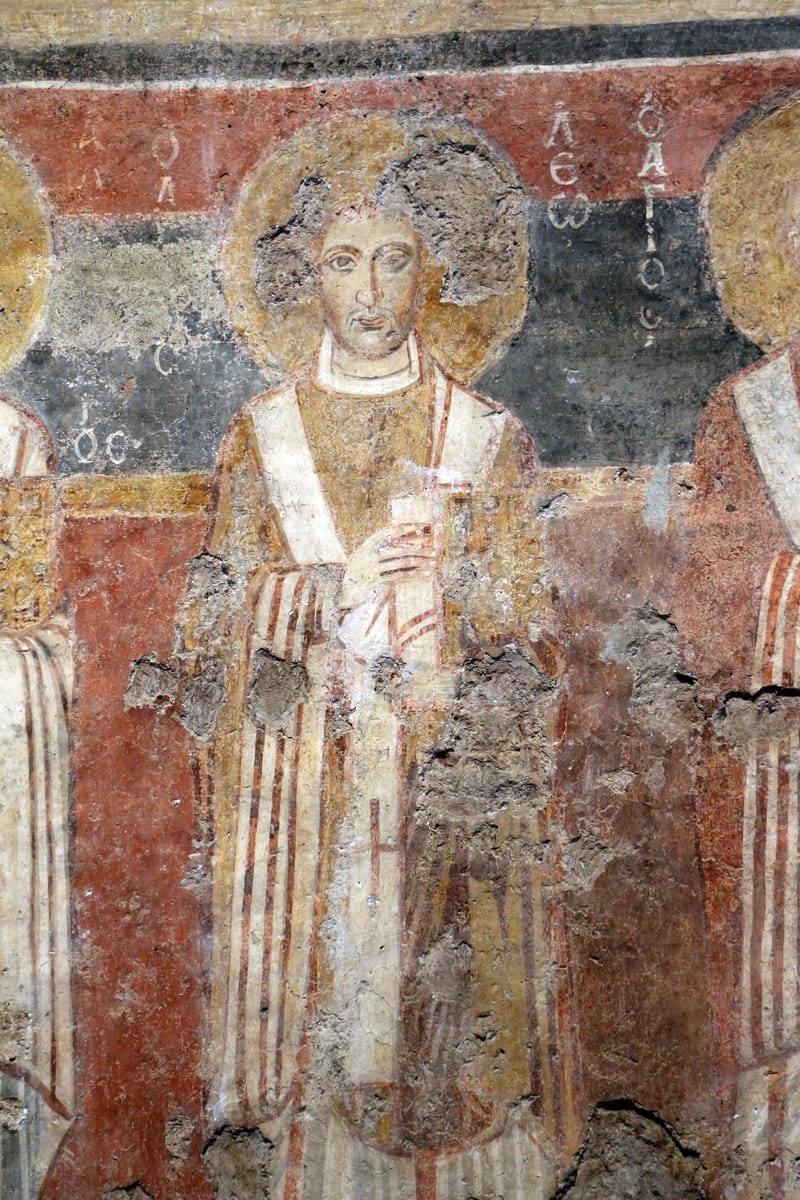
St. Leo the Great among the saints of the Roman Church beside Christ enthroned, fresco in Santa Maria Antiqua, Anonymous Roman painter, 757-767 AD Anonymous Roman painter, Rome; photograph by Sailko, CC BY 3.0 In 440 AD St. Leo the Great, then a deacon of Rome, was sent to Gaul. His task was to reconcile the general Aëtius and the magistrate Albinus. Pope Sixtus III died on August 19, 440 AD, while the deacon was still there.
The Roman Church went without a bishop for more than forty days, waiting for him. Rome sent official envoys to Gaul to bring him home. He was ordained priest and bishop on Sunday, September 29, 440 AD.
“Laudem Domini loquatur os meum, et nomen sanctum ejus anima mea ac spiritus, caro et lingua benedicat. (Let my mouth speak the praise of the Lord, and my breath and spirit, my flesh and tongue bless His holy Name.)”
St. Leo the Great to his church in Rome, in his first sermon, on the day of his ordination -
448–449 AD
A letter on who Christ is
A dispute in Constantinople drew from the Pope the fuller letter on Christ he had promised its bishop.
In 448 AD Eutyches, head of a famous monastery at Constantinople, wrote to Pope St. Leo the Great. He warned that the heresy of Nestorius was reviving, and the Pope thanked him on June 1. But Eutyches taught that Christ had received no part of his being from his mother, the Virgin Mary.
In November 448 AD Eusebius of Dorylaeum accused Eutyches before a synod under St. Flavian, bishop of Constantinople. On June 13, 449 AD, Pope St. Leo the Great sent St. Flavian the letter called the Tome. It taught that Christ is one Person in two natures, true God and true man.
“catholica Ecclesia hac fide vivit, hac proficit, ut in Christo Jesu nec sine vera Divinitate humanitas, nec sine vera credatur humanitate Divinitas. (The Catholic Church lives by this faith, and is nourished by it, that in Jesus Christ neither is the humanity believed without the true Divinity, nor the divinity without true humanity)”
St. Leo the Great to Flavian, Bishop of Constantinople, in the Tome (Letter 28, ch. 5) -
449–450 AD
The council he called a meeting of robbers
A council at Ephesus acquitted Eutyches and condemned St. Flavian over the protests of Pope St. Leo the Great's envoys.
A council opened at Ephesus on August 8, 449 AD, with the Pope's representatives present. Dioscorus, the bishop of Alexandria, claimed the first place for himself, cleared Eutyches and condemned St. Flavian. The deacon sent by Pope St. Leo the Great got away from Ephesus only with great difficulty, so no one could force him to sign its decisions.
On August 11, before any news of Ephesus reached Rome, Pope St. Leo the Great wrote scolding St. Flavian for not answering his letters. In October he asked Emperor Theodosius II for a new council in Italy. In the spring of 450 AD Dioscorus and ten other bishops excommunicated Pope St. Leo the Great, cutting him off from their communion.
“multum est explicare; nec opus est epistolari pagina comprehendi quidquid in illo Ephesino non judicio, sed latrocinio potuit perpetrari (it is a long story to explain, nor is the need to put down in the pages of a letter all that was allowed to be perpetrated in that meeting, not of judges but of robbers, at Ephesus)”
St. Leo the Great to the Empress Pulcheria, in a letter -
451 AD
A council reads his letter aloud
Hundreds of bishops at Chalcedon heard the Tome read and made it their own.
Marcian, the new emperor, called a council of bishops at Chalcedon, near Constantinople. Pope St. Leo the Great did not go, and sent legates to preside in his place.
On October 10, 451 AD, an imperial secretary read the Tome to the bishops, who received it with acclaim. On October 17 the council adopted it. Pope John XXIII named the council as the chief reason for St. Leo the Great's fame.
“Peter has spoken through the mouth of Leo”
The bishops of the Council of Chalcedon, at the reading of the Tome, second session of Chalcedon -
452 AD
Out to meet Attila
With the Huns already in Italy, the Pope went to their king, and the army turned back.
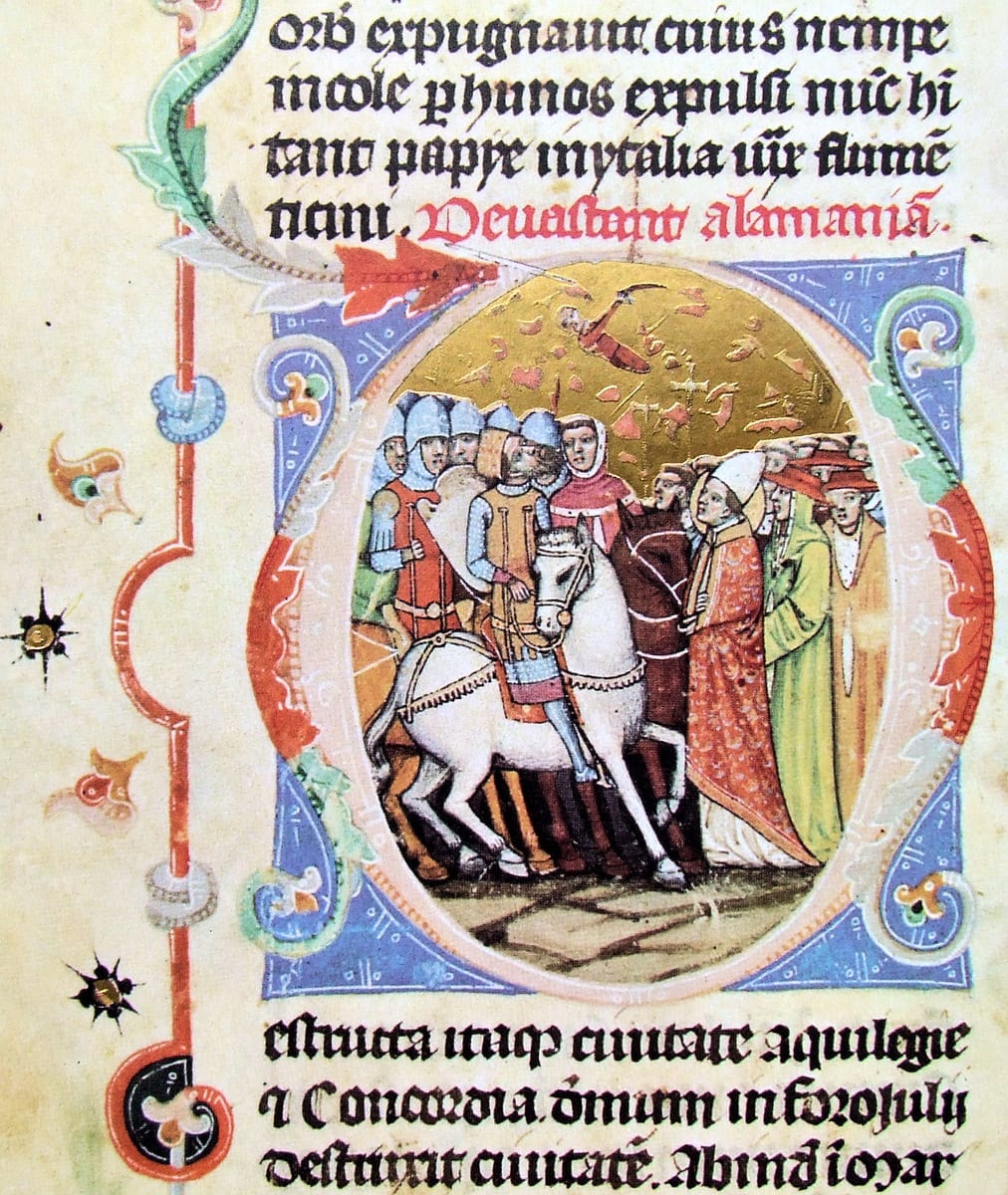
Attila and Pope St. Leo the Great, an initial in the Chronicon Pictum (the Illuminated Chronicle), Anonymous Hungarian illuminator, 1358 AD Anonymous Hungarian illuminator; photograph by Csanády In 452 AD Attila and his Huns entered Italy and burned the city of Aquileia. Pope St. Leo the Great went to meet the king with Avienus, a former consul, and Trygetius, a former prefect. St. Prosper of Aquitaine wrote that the Pope went trusting in God's help.
They met at a ford of the river Mincio, near Mantua. Attila received them courteously, ordered an end to the war and withdrew beyond the Danube. According to longstanding Catholic Tradition, Sts. Peter and Paul appeared beside Pope St. Leo the Great with drawn swords.
-
455 AD
At the gates of Rome
He could not keep the Vandals out of Rome, but he won its people their lives.
In 455 AD the Vandal king Genseric reached Rome and found it undefended. Pope St. Leo the Great went out beyond the gates to meet him, at the head of his clergy. His pleading won a promise that the city would not be burned and its people would not be killed.
Even so, the Vandals plundered Rome for fourteen days and carried off its wealth. Pope Benedict XVI noted that the Basilicas of St. Peter, St. Paul and St. John were spared.
-
458–461 AD
Last letters and a grave at St. Peter's
In 458 AD Pope St. Leo the Great answered Bishop Nicetas of Aquileia on captives and baptism by heretics, and on August 18, 460 AD he wrote his last letter on the nature of Christ to the new Patriarch of Alexandria.
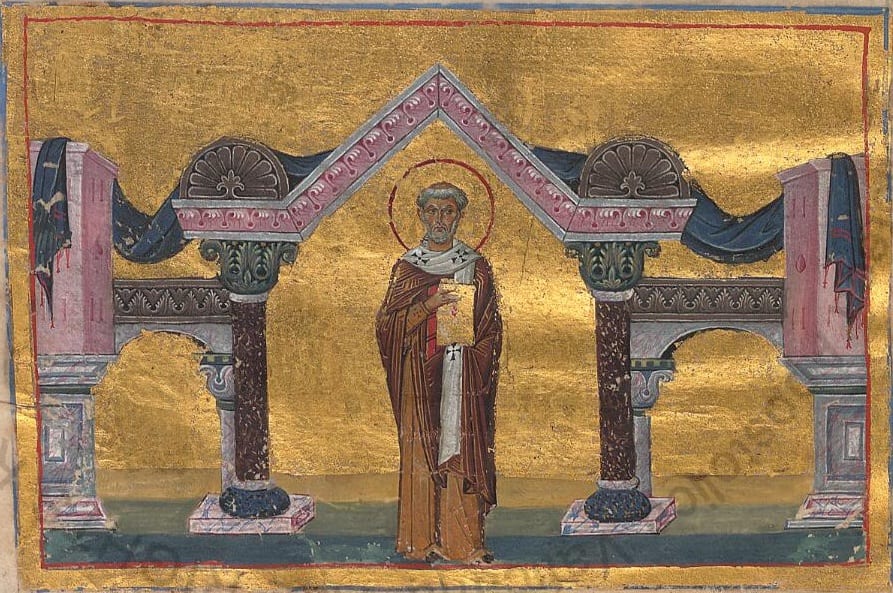
St. Leo the Great, miniature in the Menologion of Basil II, Byzantine illuminators, c. 985 AD Byzantine illuminators, Vatican Library In March 458 AD Pope St. Leo the Great answered questions from Nicetas, bishop of Aquileia, a city the Huns had burned. One concerned husbands taken captive in the invasion who came home to find their wives remarried. On August 18, 460 AD, Pope St. Leo the Great sent the new bishop of Alexandria his last letter about the nature of Christ.
Pope St. Leo the Great died in Rome on November 10, 461 AD, after twenty-one years as Pope. He was buried at St. Peter's on the Vatican.


Pray with the Church
A prayer St. Leo the Great asked of the people of Rome
From one of his sermons to the people of Rome, in his Latin, with Feltoe's English translation.
Ut ergo haec pietas, dilectissimi, quam erga humilitatem meam unanimiter exhibetis, fructum sui studii consequatur, (In order therefore, dearly beloved, that this loyalty which you unanimously display towards my humbleness may obtain the fruit of its zeal,)misericordissimam Dei nostri clementiam supplices obsecrate, (on bended knee entreat the merciful goodness of our God)ut in diebus nostris expugnet impugnantes nos, (that in our days He will drive out those who assail us,)muniat fidem nostram, augeat dilectionem, augeat pacem, (strengthen faith, increase love, increase peace)meque servulum suum, quem ad ostendendas divitias gratiae suae gubernaculis Ecclesiae voluit praesidere, (and deign to render me His poor slave, whom to show the riches of His grace He has willed to stand at the helm of the Church,)sufficientem tanto operi, et utilem vestrae aedificationi dignetur efficere, (sufficient for so great a work and useful in building you up,)et ad hoc tempora nostrae servitutis extendere, ut proficiat devotioni, quod fuerit largitus aetati, per Christum Dominum nostrum. Amen. (and to this end to lengthen our time for service that the years He may grant us may be used to His glory through Christ our Lord. Amen.)
All 3 reports on Saint Leo the Great

Pope St. Leo the Great, who faced Attila and Genseric, dies

About this picture
AI-generated image, in the manner of the early-medieval Roman frescoes of Santa Maria Antiqua, from the paper's reference portrait based on St. Leo the Great among the saints of the Roman Church beside Christ enthroned (Anonymous Roman painter, 757-767 AD, Santa Maria Antiqua, Rome; photograph by Sailko, CC BY 3.0) View source artwork.
Attila calls off his war after meeting Pope St. Leo the Great

About this picture
AI-generated image, in the manner of the early-medieval Roman frescoes of Santa Maria Antiqua, Rome (757-767 AD) View source artwork.