
Saints Canossian Daughter of Charity, born in Darfur · c. 1869–1947 AD
Saint Josephine Bakhita
Feast 8 February · Born 1869 AD, Darfur, Sudan · Died 1947 AD, Schio, Vicenza, Italy
Kidnapped as a child in Darfur and sold again and again, she was declared free in Venice, became a Canossian sister and served the house at Schio until her death in 1947 AD.
Begin the life
In brief
Saint Josephine Bakhita, also called Giuseppina Bakhita, was born about 1869 AD in Darfur, Sudan, and kidnapped as a child by slave traders. Declared free in Venice, she was baptised by the Patriarch of Venice in 1890 AD and lived mostly at Schio until she died in 1947 AD. Pope St. John Paul II canonised St. Bakhita in 2000 AD, the first saint from Sudan.
-
c. 1869–1877 AD
Taken from the fields of Darfur
Born about 1869 AD in western Sudan, she was kidnapped as a child and given the name Bakhita.
Bakhita, the future St. Josephine Bakhita, was born about 1869 AD in a small village of Darfur, in western Sudan. When St. Bakhita was five, slave raiders carried off her older sister.
Later, two men stopped St. Bakhita in the fields, held a knife to her side and carried her off. The terror made her forget her own name and her parents' names. Her captors named her Bakhita, which means fortunate.
“Vedendo il sole, la luna e le stelle, dicevo tra me: Chi è mai il Padrone di queste belle cose? E provavo una voglia grande di vederlo, di conoscerlo e di prestargli omaggio. (Seeing the sun, the moon and the stars, I said to myself: Who could be the Master of these beautiful things? And I felt a great desire to see him, to know Him and to pay Him homage)”
St. Josephine Bakhita, recalling how she sensed God as a child, before she knew him -
1877–1882 AD
Sold in the markets of Sudan
She was chained, sold five times and scarred in a general's household.
St. Bakhita fled into a forest and was caught, and she was then made to wear heavy chains. She was sold five times in the markets of El Obeid and Khartoum, and each time into a worse situation.
Her last owners were the mother and the wife of a general. In their house St. Bakhita was whipped until she bled, every day. Her skin was cut in patterns, and salt rubbed into the cuts kept the scars raised.
-
1882–1888 AD
A consul's house, and a voyage to Italy
Bought for the Italian consul in 1882 AD, she followed him to Italy and became nanny to a family's daughter.
In Khartoum in 1882 AD, an Italian merchant bought St. Bakhita for the Italian consul, Callisto Legnani. In his house, for the first time since her capture, no one used the whip to give her orders. When the Mahdist rising advanced, Legnani had to go home, and she asked to go with him.
At Genoa, Legnani agreed that St. Bakhita should stay with the family of his friend Augusto Michieli. At their house in Zianigo, in the Veneto, she became nanny to their daughter Alice, called Mimmina. The family's steward, Illuminato Checchini, gave her her first crucifix.
-
1888–1889 AD
Declared free in Venice
Left with the Canossian Sisters, she learned the faith and refused to return to Africa; a hearing in 1889 AD ruled her free.
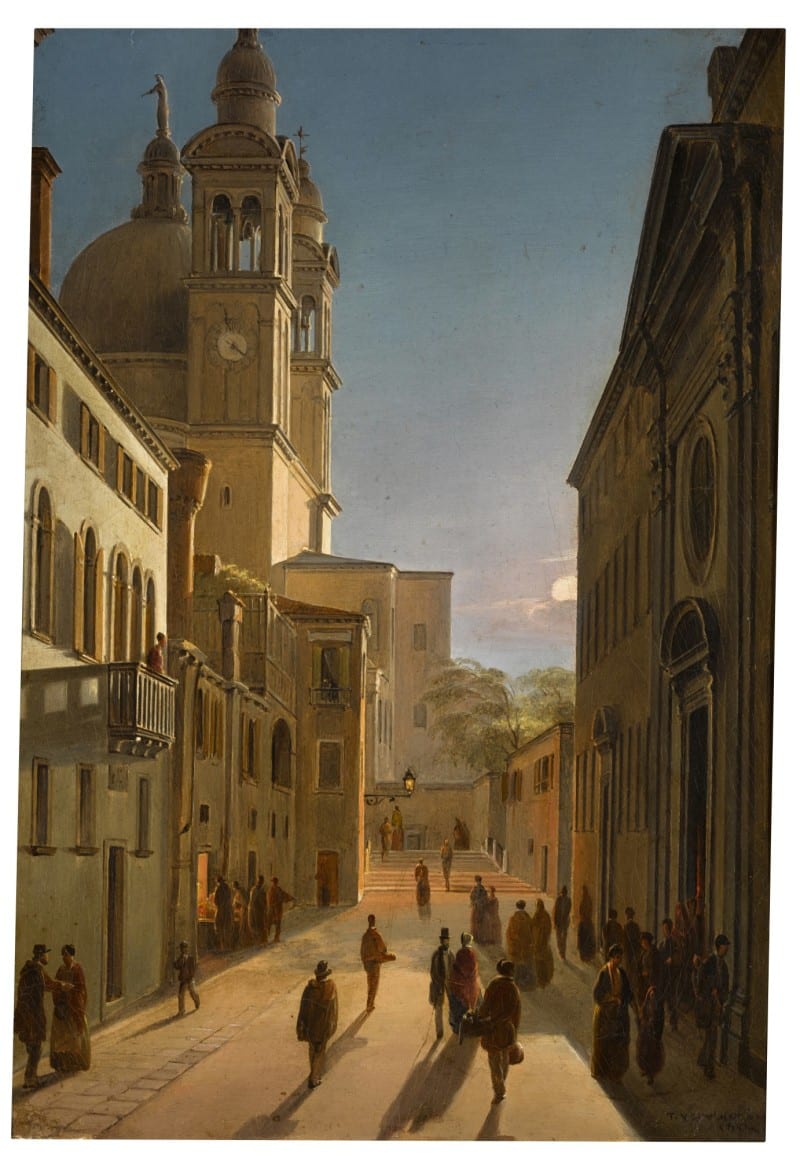
Venice, the Rio Terrà Catecumeni, with Santa Maria della Salute in the Distance, Frans Vervloet, 18[5?]4 (signed and dated; Commons reads 1854 AD) Frans Vervloet, Private collection (Sotheby's, European & British Art, 2020 AD); Wikimedia Commons In 1888 AD the Michielis left for Suakin, on the Red Sea, to run a hotel. On Checchini's advice, St. Bakhita and Mimmina were left with the Canossian Sisters in Venice. At their Institute of the Catechumens, the sisters taught her the faith.
A year later Signora Michieli came back to take them both to Africa. This time St. Bakhita refused to go; she said she would stay with the sisters and serve God. On November 29, 1889 AD, a hearing at the Catechumens declared her free, and the King's attorney held that she was free to choose because slavery no longer existed in Italy.
-
1890–1896 AD
Baptism and vows
Baptised in Venice in 1890 AD, she joined the Canossian Daughters of Charity and took vows at Verona in 1896 AD.
On January 9, 1890 AD, the Patriarch of Venice baptised and confirmed St. Bakhita and gave her First Communion. At her baptism, St. Josephine Bakhita took the names Giuseppina, Margherita and Fortunata.
St. Josephine Bakhita entered the Canossian novitiate in 1893 AD. On December 8, 1896 AD, she professed her vows at the order's mother house in Verona. That day she composed a prayer for her own people in Africa.
“Qui sono diventata figlia di Dio! (Here, I became a daughter of God!)”
St. Josephine Bakhita, kissing the baptismal font where she had been baptised -
1902–1919 AD
Doorkeeper at Schio, nurse in wartime
From 1902 AD she served the Canossian house at Schio, and stayed to cook and nurse when it became a military hospital.
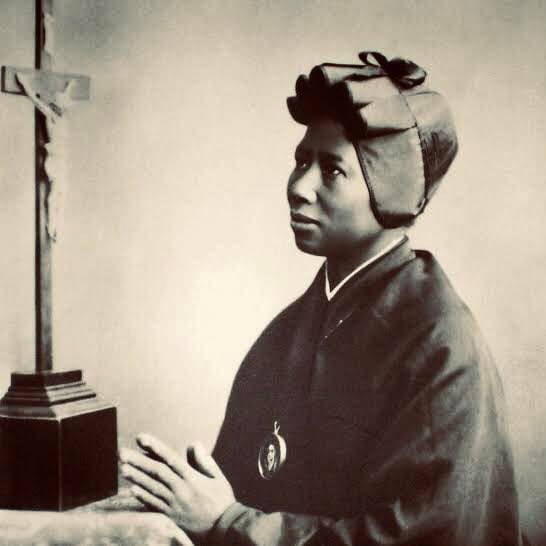
Photograph of Saint Josephine Bakhita (c. 1910 AD), Unknown photographer Unknown photographer, Wikimedia Commons (uploaded March 18, 2026 AD by 'Beloved female saints'; source of the scan not stated) In 1902 AD St. Bakhita was sent to the Canossian house at Schio, in the province of Vicenza. She worked there as cook, sacristan, doorkeeper, mender and gardener. The town called her Madre Moretta (*the little Black Mother*).
From May 8, 1915 AD, the house served as a military hospital. St. Bakhita stayed on to run the kitchen and nurse the wounded. Under shellfire she sent her kitchen helpers to the shelter and stayed at her post.
“Siate buoni, amate il Signore, pregate per quelli che non lo conoscono. Sapeste che grande grazia è conoscere Dio! (Be good, love the Lord, pray for those who do not know Him. What a great grace it is to know God!)”
St. Josephine Bakhita, a saying recorded among her words -
1931–1945 AD
Telling her story
A book in 1931 AD made her known, and she travelled Italy telling her life and showing her scars.
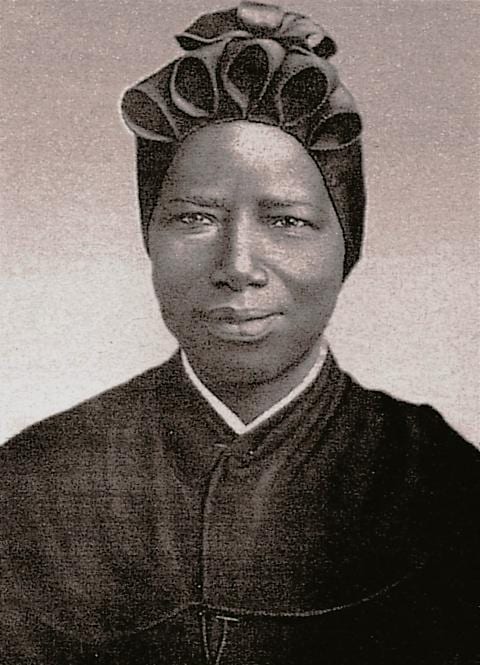
Photo - Portrait der Josefine Bakhita (the 'Bruner' portrait), Bruner (so named by the Schio Canossians; 'Brunel' in the Italian Wikipedia upload), after 1931 AD (schio-ancora-ci-parla-2018 AD); '1933 AD, Venezia' per the it.wikipedia upload, unconfirmed Bruner (so named by the Schio Canossians; 'Brunel' in the Italian Wikipedia upload), Wikimedia Commons, copied from the Diocese of Augsburg's saint-of-the-day page (bistum-augsburg.de) In 1931 AD Ida Zanolini published Storia meravigliosa (*Tale of Wonder*), the life St. Bakhita had told her. Bruner, the Vatican's official photographer, came to photograph her. Through the 1930s AD she travelled northern Italy to speak for the missions.
At Ancona in June 1935 AD, crowds pressed round St. Bakhita with questions. At Montodine in 1939 AD, she stood on a step to talk to the nursery children. She told them her life and showed them the marks of slavery on her hands.
“Se incontrassi quei negrieri che mi hanno rapita, e anche quelli che mi hanno torturata, mi inginocchierei a baciare le loro mani, perché se non fosse accaduto ciò, non sarei ora cristiana e religiosa (If I were to meet the slave-merchants who kidnapped me and even those who tortured me, I would kneel and kiss their hands. If what happened to me had never taken place, how could I become a christian and a religious?)”
St. Josephine Bakhita, something she used to say of the slave-traders and her torturers -
1947–2000 AD
Death at Schio
She died at Schio on February 8, 1947 AD, and Pope St. John Paul II canonised her in 2000 AD.
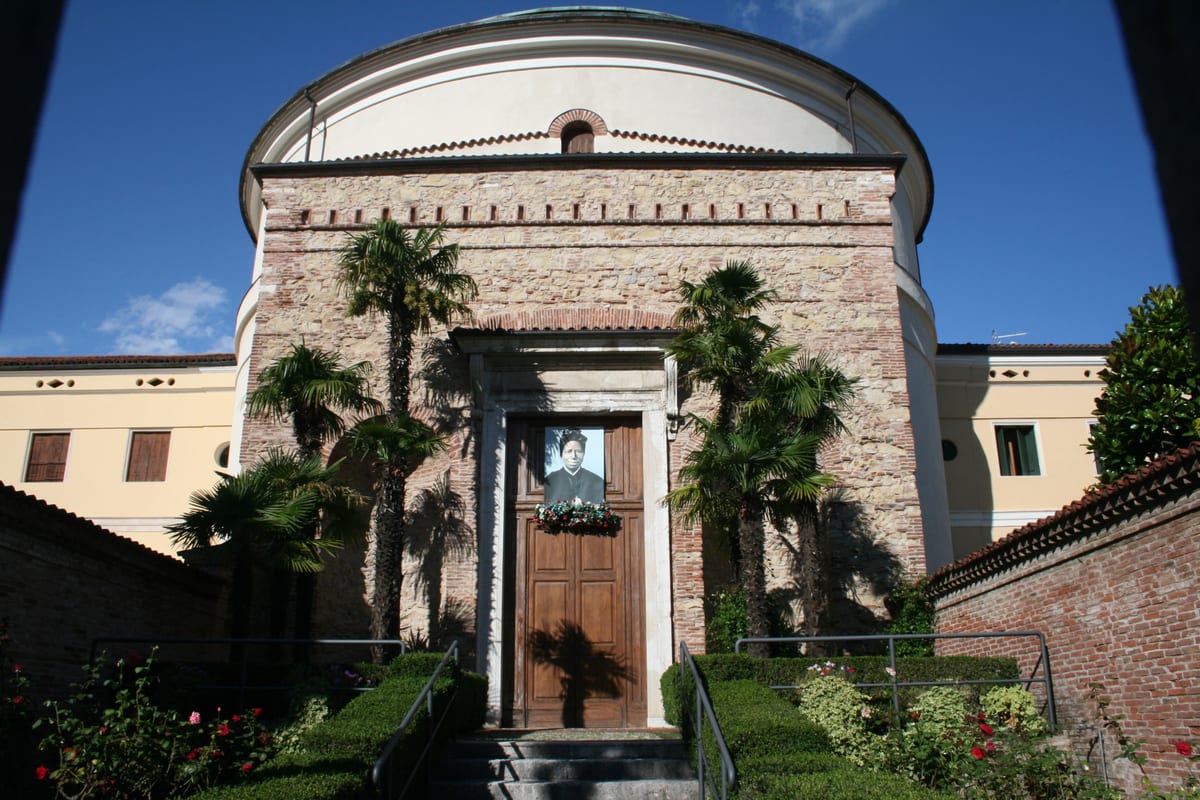
Chiesa della Sacra Famiglia a Schio, Belllissimo (Wikimedia Commons user), August 16, 2014 AD Belllissimo (Wikimedia Commons user), Wikimedia Commons (own work) St. Josephine Bakhita died of pneumonia at Schio on February 8, 1947 AD, aged 78. Her community stood round her, weeping and praying. In her last agony she relived her days of slavery, and she died smiling.
Crowds filled the house to see their Madre Moretta one last time. St. Bakhita's remains rest in the church of the Holy Family at Schio. Pope St. John Paul II canonised her in St. Peter's Square on October 1, 2000 AD.
“Mi allarghi le catene...pesano! (Please, loosen the chains... they are heavy!)”
St. Josephine Bakhita to the infirmarian nursing her, in her last agony at Schio, February 1947 AD


.jpg)


Pray with the Church
Prayer of St. Josephine Bakhita on the day of her vows
Composed by St. Josephine Bakhita on December 8, 1896 AD, the day she professed her vows at Verona. Printed in her Italian, with the English published by the Pontifical Urbaniana University.
O Signore, potessi io volare laggiù, presso la mia gente e predicare a tutti a gran voce la Tua bontà: Oh, quante anime potrei conquistarti! (O Lord, I wish I could fly southward to my people, to preach to all, loudly, your goodness. Oh! How many souls I could win for you!)Fra i primi, la mia mamma, il mio papà, i miei fratelli, la sorella mia, ancora schiava... tutti, tutti i poveri negri dell’Africa, fà o Gesù, che anche loro ti conoscano e ti amino! (First among all, my mother, and my father, my brothers and my sister, as yet a slave... I wish I could reach all, all the poor negroes of Africa. Grant, O Lord, that they, too, may know and love you!)