
Saints Ruthenian monk, Archbishop of Polotsk and martyr · Feast November 12
Saint Josaphat Kuntsevych
Feast 12 November · Born 1580 AD, Volodymyr, Volhynia (now Volodymyr-Volynskyi, Ukraine) · Died November 12, 1623 AD, Vitebsk (now Belarus)
A merchant's apprentice from Volhynia became a monk and Archbishop of Polotsk, spent his life on his Church's union with Rome, and was killed by a crowd at Vitebsk in 1623 AD.
Begin the life
In brief
Saint Josaphat Kuntsevych was a Ruthenian monk under the Rule of St. Basil who became Archbishop of Polotsk. He worked for the union of the Ruthenian Church with Rome, and a crowd killed him at Vitebsk on November 12, 1623 AD. The Church keeps his memorial on November 12, the day of his death.
-
Volodymyr · 1580s AD
A councillor's son in Volhynia
A councillor's son whose mother carries him to church learns the Church's daily prayers by heart.
Ivan Kuntsevych, the future St. Josaphat, was born at Volodymyr in Volhynia. His father, Gabriel Kuntsevych, was a merchant whom the town elected a councillor. His mother, Marina, was a councillor's daughter and liked to carry her small son into their parish church.
According to longstanding Catholic Tradition, while his mother was telling the small boy about Christ's Passion, a dart came from the side of an image of the crucified Jesus and wounded his heart. He learned almost all of the Divine Office, the Church's daily cycle of prayer, by heart and chanted it every day.
-
Vilnius · 1590s–1604 AD
The apprentice who would rather read
Sent to learn trade in the capital, he spends his hours in a church the city has deserted.
His parents had little money, so they apprenticed their son to Hyacinth Popowicz, a rich merchant of Vilnius. Popowicz hit him with his fist for reading and told him he was kept there to do business. In time the merchant came to esteem him and offered him his whole fortune and his daughter's hand.
In 1596 AD the Ruthenian bishops, meeting at Brest, brought their Church back into union with Rome. Opponents of the Union drew the people of Vilnius away from Holy Trinity, the Union's main church in the city. The young apprentice still came to every service in the empty church, as chanter and reader, and rang its bells when needed.
-
Holy Trinity, Vilnius · 1604–1614 AD
A new name, and a blow across the face
He becomes a monk at Holy Trinity, and his own superior strikes him for refusing to leave the Union.
The apprentice asked Popowicz to release him from his service so that he could become a monk. He became a monk at Holy Trinity in 1604 AD, receiving the habit from Metropolitan Hypatius Pociey and making his vows that same day. The metropolitan gave him the name Josaphat in place of his baptismal name, Ivan, which is John in English.
In May 1608 AD Samuel Sienczylo, the monastery's archimandrite, or superior, tried to draw St. Josaphat away from the Union. When St. Josaphat refused, Samuel struck him violently across the face. St. Josaphat was ordained priest in 1609 AD, and in 1614 AD he was made archimandrite of Holy Trinity.
-
Vilnius and Polotsk · 1617–1618 AD
Bishop against his will
Consecrated by his old friend, he kneels at the city gate before he enters his see, and one of its towns shuts its gates on him.
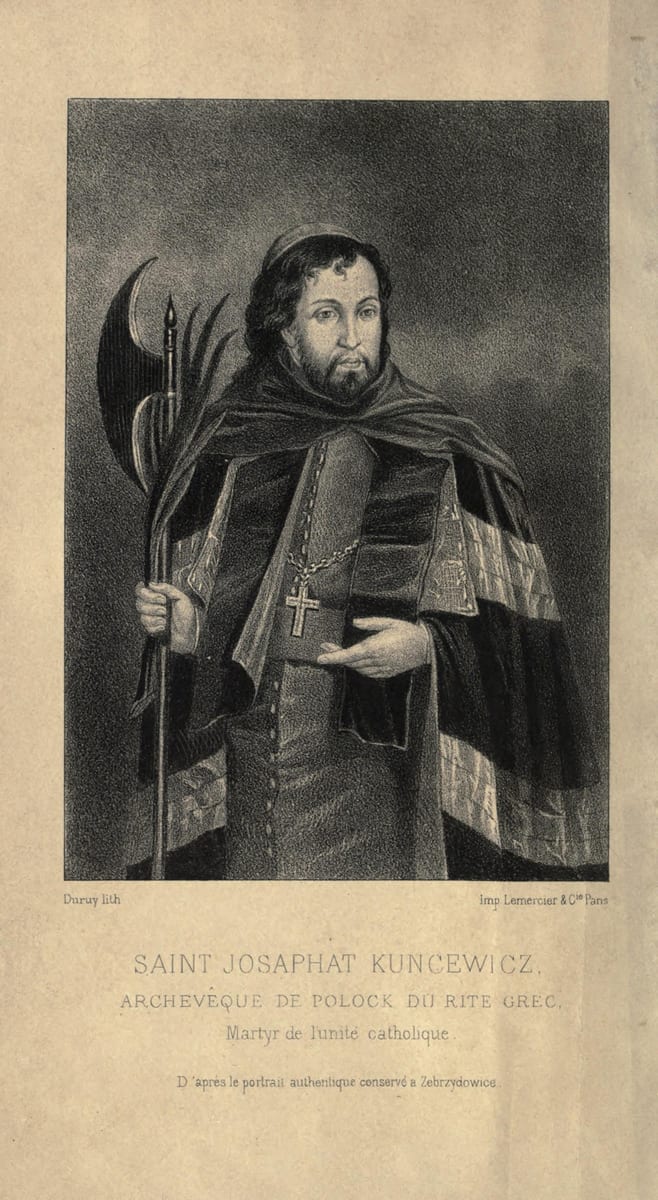
Saint Josaphat Kuncewicz, archbishop of Polotsk, Duruy, lithograph after the 17th-century portrait kept at Zebrzydowice, 1897 AD Duruy, lithograph after the 17th-century portrait kept at Zebrzydowice, frontispiece of Guépin, Un apôtre de l'union des Églises, vol. I; Internet Archive On November 12, 1617 AD his friend Metropolitan Joseph Velamin Rutsky consecrated him bishop at Vilnius. His title was Bishop of Vitebsk, and he was chosen to follow the elderly Gideon as Archbishop of Polotsk. Before leaving for his see, he stayed shut in his cell for fifteen days.
He entered Polotsk on January 9, 1618 AD, kneeling first at an altar built by the city gate. From the cathedral St. Josaphat went straight to Gideon and promised, before the clergy and nobles, to show the old archbishop a son's respect and care. That year the town of Mogilev manned its walls with cannon and shut its gates against him.
-
Kyiv, Polotsk and Vitebsk · 1620–1622 AD
Two archbishops for one see
At Pentecost, the garrison commander blocks his procession on a bridge and threatens to throw him into the river.
On August 15, 1620 AD Patriarch Theophanes of Jerusalem consecrated new bishops at Kyiv for the Ruthenians who rejected the Union. One of them, Meletius Smotrytsky, was given St. Josaphat's own see of Polotsk. Riots began at Vitebsk in 1621 AD, as word spread that Smotrytsky was urging disobedience to St. Josaphat.
Lew Sapieha, chancellor of Lithuania, wrote on March 12, 1622 AD accusing the archbishop of closing and sealing his opponents' churches. St. Josaphat wrote back from Polotsk on April 22, defending his conduct. At Pentecost the garrison commander of Vitebsk blocked his procession on a bridge and threatened to throw him into the river.
-
Polotsk and Vitebsk · October–November 1623 AD
He went to Vitebsk anyway
St. Josaphat spends his last two weeks at Vitebsk, where men led by Naum Volk and Simeon Niesza are plotting to kill him.
In late October warnings came that anger against him was growing at Vitebsk, and he announced at once that he would go there. Before leaving Polotsk he had a grave dug for himself beside the altar of his cathedral. On October 26, the feast of St. Demetrius, he preached at Vitebsk and spoke directly to the men plotting his death.
Four days before he died, St. Josaphat tried to end a feud between the town councillor Naum Volk and one of Volk's enemies. Volk led the plot with Simeon Niesza, and the plotters met at the town hall to fix the killing for Sunday, November 12. On Saturday, November 11, a town councillor warned St. Josaphat that the plotters meant to kill him in a riot the next morning.
“Domine, da mihi ut sanguinem pro unitate et oboedientia Sedis Apostolicae profundere valeam. (Lord, grant me the grace to shed my blood for the unity of the church and in behalf of obedience to the Holy See.)”
St. Josaphat Kuntsevych to God, a few days before his death, when he was warned of the plot against him, 1623 AD -
Vitebsk · November 12, 1623 AD
The Sunday morning at Vitebsk
The town bells ring the signal, the crowd breaks in, and the archbishop walks out to meet it.
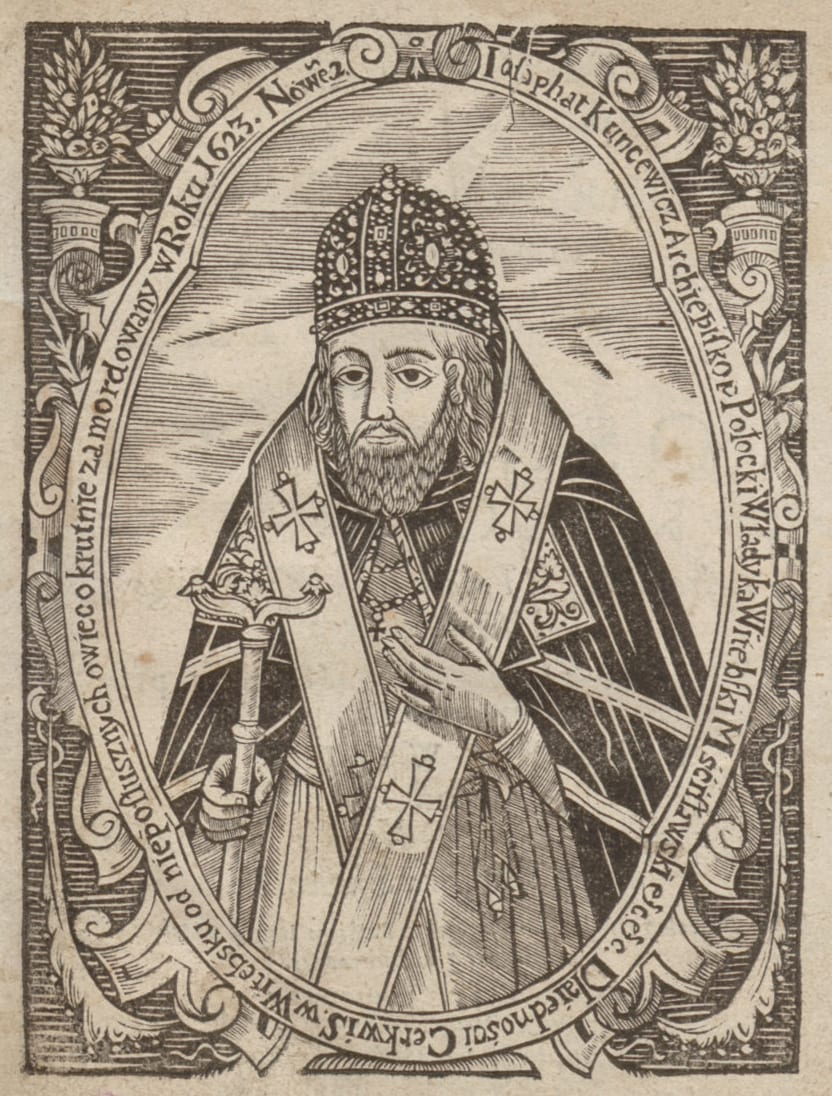
Iosaphat Kuncewicz, Archbishop of Polotsk, Unknown woodcutter, 1625 AD Unknown woodcutter, frontispiece of Wawrzyniec Leon Kreuza-Rzewuski's funeral sermon on him (Vilnius, 1625 AD); Wikimedia Commons Before dawn he was in church reciting matins when the bells of the town hall and every church rang the agreed signal. After matins he walked home through the ranks of the plotters. At sunrise the crowd broke through his fence with axes and beat down his steward and his archdeacon.
St. Josaphat broke off his prayer, opened his door and went out to the attackers. Pope Pius XI wrote that he went to them cheerfully and asked them not to harm his household. One man split his head with an axe, and another shot him through the head with a musket.
“Filioli, quare familiares meos caeditis? Si quid contra me habetis, ecce adsum. (My little children, why do ye slay them of my household? If ye have aught against me, behold, I am here.)”
St. Josaphat Kuntsevych to the mob attacking his household at Vitebsk, November 12, 1623 AD -
Vitebsk, Rome · 1623–1963 AD
From the river to St. Peter's
His killers sink his body in the Dvina. Popes later declare him blessed, then a saint, and his body now lies in St. Peter's.
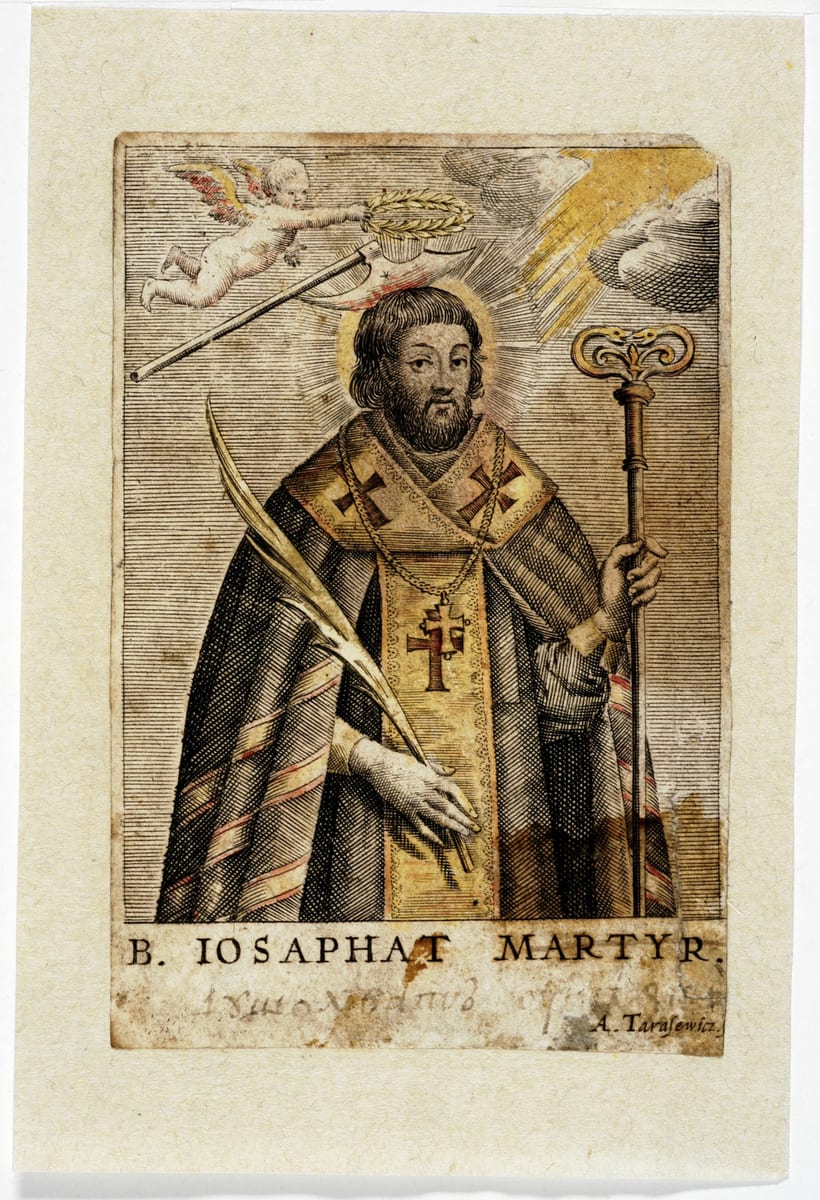
B. Iosaphat Martyr, Aleksander Tarasewicz, late 17th century Aleksander Tarasewicz, National Library of Poland (Polona) The killers dragged his body through the streets and sank it in the Dvina, weighted with stones. It was drawn from the river nearly six days later. Pope Pius XI wrote that many people soon returned to the Church's unity, his murderers among them.
In January 1624 AD a royal commission sat at Vitebsk and condemned the leaders of the crowd, Naum Volk and Simeon Niesza among them, to death. The town lost its royal privileges and its town hall, and the bells that had been rung against him were taken from its churches.
Pope Urban VIII beatified him in 1643 AD, twenty years after his death. Pope Pius IX canonised him in St. Peter's Basilica on June 29, 1867 AD. Since 1963 AD his body has lain under the altar of St. Basil the Great in St. Peter's, near the tomb of St. Peter.


Pray with the Church
Prayer of Pope Pius IX to St. Josaphat
A prayer of Pope Pius IX to St. Josaphat, which Pope Pius XI prayed again in the same words to close his encyclical *Ecclesiam Dei* (*The Church of God*) on November 12, 1923 AD.
May God grant that thy blood, O St. Josaphat, which thou didst shed for the Church of Christ, be the pledge of union with this Apostolic See, a union for which thou always didst long, and which thou didst fervently implore day and night from the God of all Goodness and all Power.In order that this may one day come to be, We earnestly desire to have thee as an unfailing advocate before God and the Heavenly Court.
All 4 reports on Saint Josaphat Kuntsevych

About this picture
AI-generated image, in the manner of a seventeenth-century copperplate engraving, from the paper's reference portrait based on Iosaphat Kuncewicz, Archbishop of Polotsk (unknown woodcutter, 1625, frontispiece of Wawrzyniec Leon Kreuza-Rzewuski's funeral sermon on him, Vilnius; Wikimedia Commons) View source artwork.
St. Josaphat opens his door to the mob beating his servants

About this picture
AI-generated image, in the manner of a seventeenth-century copperplate engraving, from the paper's reference portrait based on Iosaphat Kuncewicz, Archbishop of Polotsk (unknown woodcutter, 1625, frontispiece of Wawrzyniec Leon Kreuza-Rzewuski's funeral sermon on him, Vilnius; Wikimedia Commons) View source artwork.
St. Josaphat, warned of a plot, speaks at supper of dying for Christ

About this picture
AI-generated image, in the manner of a seventeenth-century copperplate engraving, from the paper's reference portrait based on Iosaphat Kuncewicz, Archbishop of Polotsk (unknown woodcutter, 1625, frontispiece of Wawrzyniec Leon Kreuza-Rzewuski's funeral sermon on him, Vilnius; Wikimedia Commons) View source artwork.
St. Josaphat orders his grave dug, then preaches to Vitebsk's plotters

About this picture
AI-generated image, in the manner of a seventeenth-century copperplate engraving, from the paper's reference portrait based on Saint Josaphat Kuncewicz, archbishop of Polotsk (Duruy, lithograph after the 17th-century portrait kept at Zebrzydowice, 1897, frontispiece of Guépin, Un apôtre de l'union des Églises, vol. I; Internet Archive) View source artwork.