
Saints Jesuit martyrs of New France and patrons of Canada · 1642–1649 AD
Saints John de Brébeuf and Isaac Jogues
Feast 19 October · Born 1593 AD, Condé-sur-Vire, Normandy, France · Died 1649 AD, Saint-Ignace, Huronia, Ontario, Canada
Two French Jesuit missionaries: St. Isaac Jogues went back to the Mohawk after a year as their captive, St. John de Brébeuf stayed with the Huron (Wendat) as their towns fell, and both were killed, with six companions, between 1642 AD and 1649 AD.
Begin the life
In brief
St. John de Brébeuf and St. Isaac Jogues, known with their six companions as the North American Martyrs or the Canadian Martyrs, were French Jesuit missionaries killed in the Huron and Mohawk countries between 1642 AD and 1649 AD. St. Brébeuf lived among the Huron people for most of the years from 1626 AD until his death. St. Jogues was held captive for a year by the Mohawk, a nation of the Iroquois (Haudenosaunee) Confederacy, and later went back to them as an envoy of peace.
-
1625–1629 AD
A sick priest reaches the Huron country
St. Brébeuf lands at Quebec, winters in the woods and makes his first canoe journey to the Huron country.
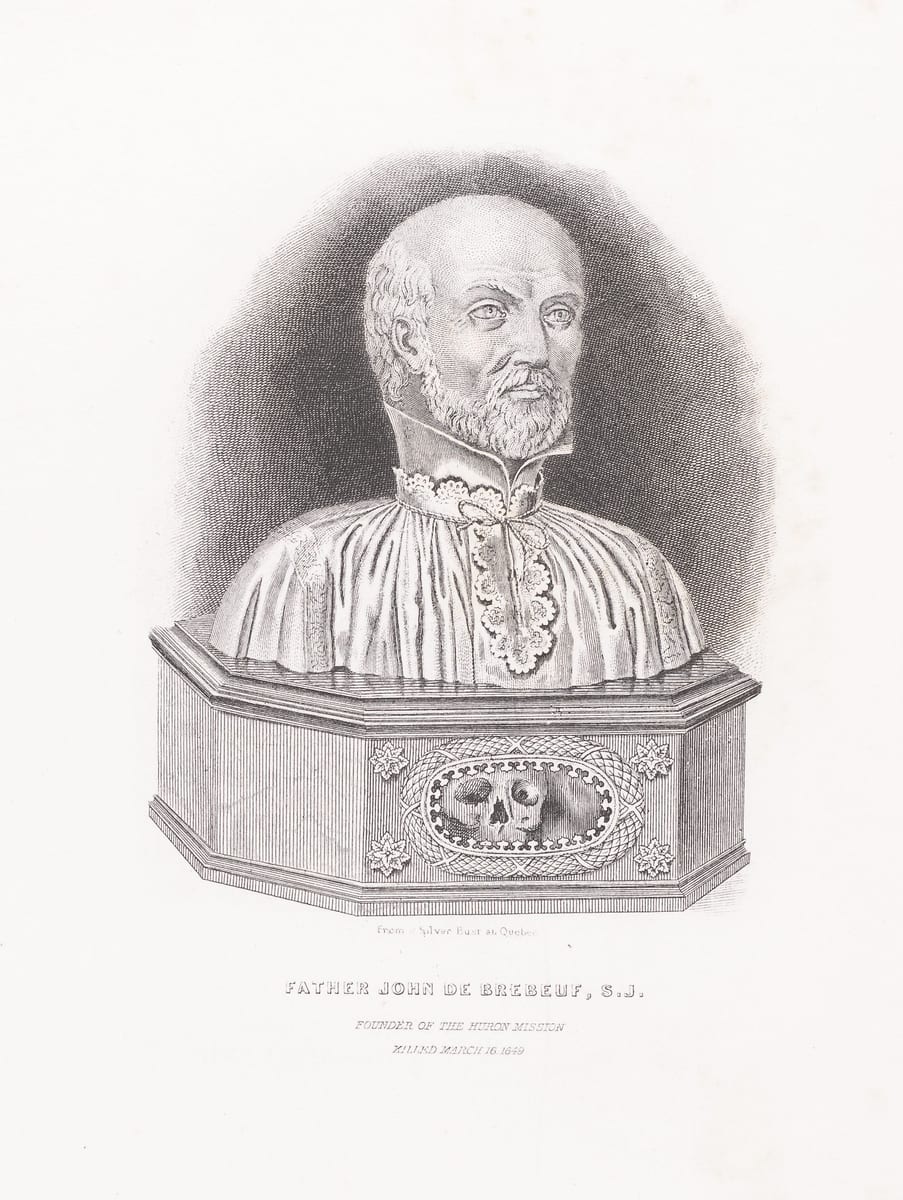
Father John de Brebeuf, S.J., Founder of the Huron Mission, killed March 16. 1649 AD — 'From Silver Bust at Quebec', Anonymous steel engraver after the silver reliquary bust of 1664–1665 AD (anonymous Paris silversmith); heliogravure plate in Alfred Hamy's Galerie illustrée de la Compagnie de Jésus, Bust 1664–65 AD; engraving 19th century; heliogravure album c. 1893 AD Anonymous steel engraver after the silver reliquary bust of 1664–1665 AD (anonymous Paris silversmith); heliogravure plate in Alfred Hamy's Galerie illustrée de la Compagnie de Jésus, KU Leuven Libraries (Galerie illustrée de la Compagnie de Jésus, source ID lbsn9983848980101471); the bust itself: Monastère des Augustines de l'Hôtel-Dieu de Québec St. Brébeuf landed at Quebec on June 19, 1625 AD, after sailing from Dieppe in April. He was thirty-two and still in poor health, which had broken down completely when he was twenty-eight. The ship's Calvinist captain threatened to carry him back to France, but St. Brébeuf stayed in the colony.
That winter St. Brébeuf lived for five months in the cold and snow with a roving band of Montagnais. In July 1626 AD he made his first 800-mile canoe journey to the Huron country and settled at Toanché, among the Bear tribe of the Huron. In 1629 AD he baptised his first Huron before leaving the country, and that July he was at Quebec when the English took it and sent him back to France.
-
1634–1639 AD
St. John de Brébeuf among the Wendat
St. Brébeuf returns to the Huron country, writes his reports on the mission, is condemned by a Huron council and writes a vow of martyrdom.
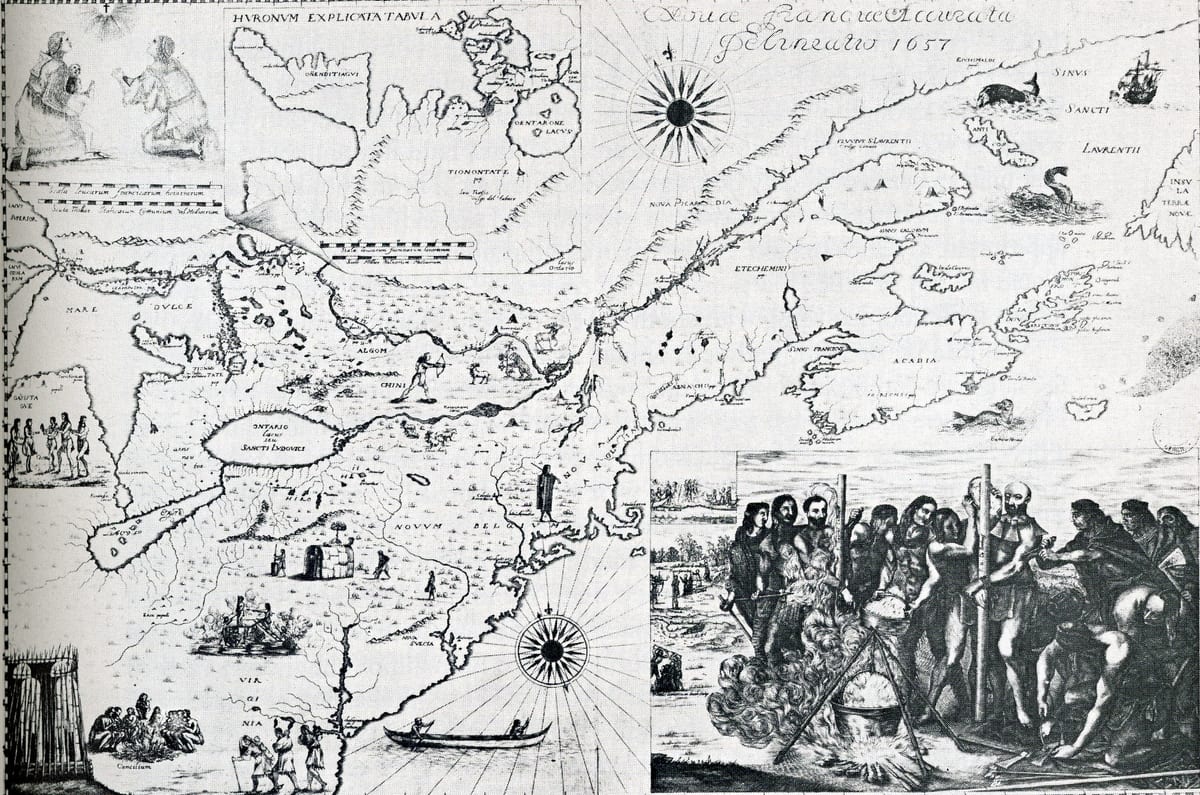
Novae Franciae accurata delineatio, Francesco Giuseppe Bressani SJ (1612–1672 AD), 1657 AD Francesco Giuseppe Bressani SJ (1612–1672 AD), Bibliothèque nationale de France (Gallica); Commons copy via emse.fr On August 5, 1634 AD, St. Brébeuf returned to the Huron country after thirty days on the canoe route from Three Rivers. The Wendat called him Échon, and at Candlemas 1636 AD, with the Christian children of Ihonatiria gathered for the blessing of candles, he said a prayer in their language. That July he signed his report on the mission, which gave advice to any missionary God might call to New France.
As the epidemics spread in 1637 AD, the Huron accused the Jesuits of sorcery. A council of twenty-eight villages brought the charge, and late in October the grand council told the priests it had decided they should die. St. Brébeuf wrote a farewell letter that every Jesuit with him signed, but the eclipse of the moon on December 31, which the missionaries had predicted, restored their standing. By 1639 AD St. Brébeuf had written out a vow never to refuse the grace of martyrdom if God offered it to him.
“Quand vous arriuerez aux Hurons vous trouuerez a la verite des coeurs pleins de charite, nous vous receurons a bras ouuerts comme vn Ange de Paradis, nous aurons toutes les bonnes volontez du monde de vous faire du bien, mais nous fommes quafi dans l'impoffible de le faire (When you reach the Hurons, you will indeed find hearts full of charity; we will receive you with open arms as an Angel of Paradise, we shall have all the inclination in the world to do you good; but we are so situated that we can do very little.)”
St. John de Brébeuf and Isaac Jogues to future missionaries, in his 'Important Advice', 1636 AD -
1636–1642 AD
St. Isaac Jogues comes to New France
A young priest from Orléans lands at Quebec, joins the Huron mission, preaches to the Ojibwa and is sent down to Quebec for supplies.
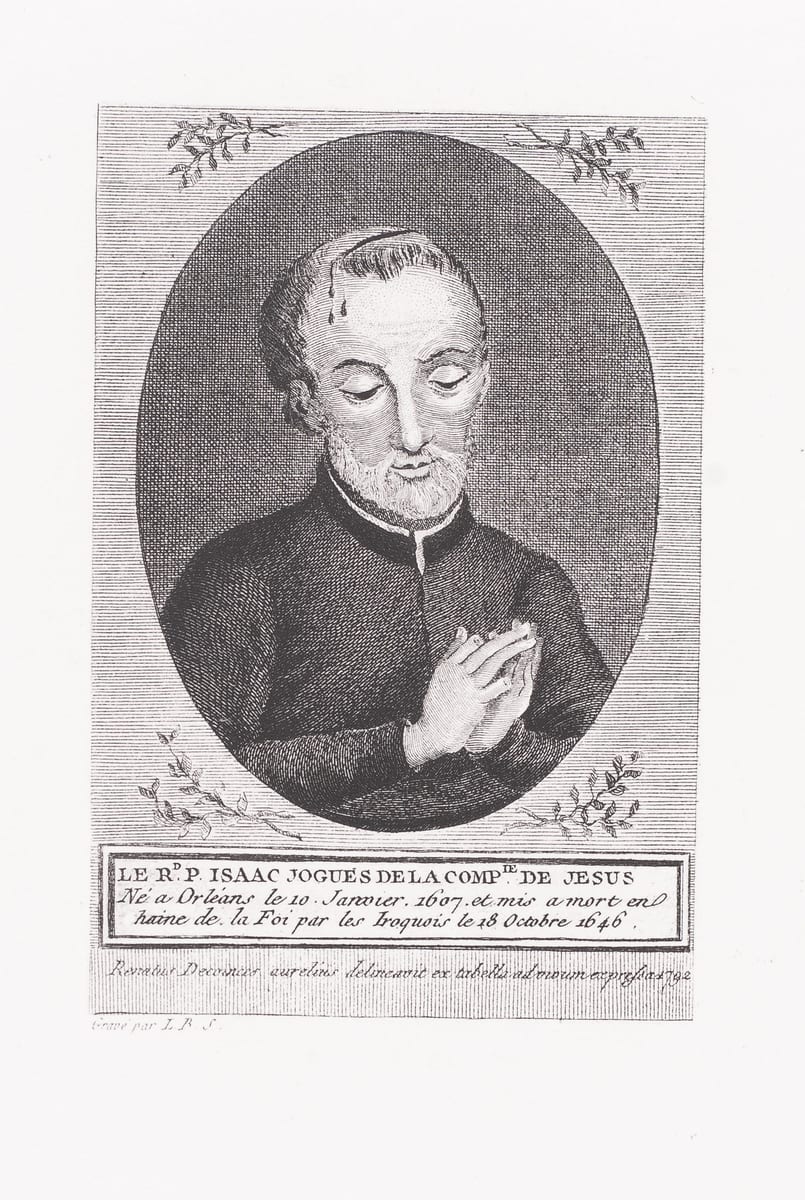
LE RD. P. ISAAC JOGUES DE LA COMPIE. DE JESUS (born Orléans January 10, 1607 AD, killed by the Iroquois October 18, 1646 AD), Engraved by 'L.B.S.' after a drawing by Renatus [Decoinces?] of Orléans, 'delineavit ex tabella ad vivum expressa 1792 AD'; heliogravure plate in Alfred Hamy's Galerie illustrée de la Compagnie de Jésus, Painted portrait from life, 17th century (lost or unlocated); drawing 1792 AD; etching 18th century; heliogravure album c. 1893 AD Engraved by 'L.B.S.' after a drawing by Renatus [Decoinces?] of Orléans, 'delineavit ex tabella ad vivum expressa 1792 AD'; heliogravure plate in Alfred Hamy's Galerie illustrée de la Compagnie de Jésus, KU Leuven Libraries (Galerie illustrée de la Compagnie de Jésus, source ID lbsn9983861640101471) St. Jogues, born at Orléans in 1607 AD, was ordained early in 1636 AD and sailed from Dieppe that April. He landed at Quebec on July 2, the feast of the Visitation, and said his first Mass in New France that day. He reached Ihonatiria on September 11, and the Hurons named him Ondessonk, bird of prey.
That month St. Jogues was the first missionary to fall ill with the epidemic fever, and St. Brébeuf bled him with his own hand. In September 1641 AD St. Jogues travelled west to the falls of Sault Sainte-Marie and preached to some two thousand Ojibwa and other Algonquins. In June 1642 AD the mission's superior sent St. Jogues down to Quebec in four canoes to bring back supplies.
“I do not know what it is to enter Paradise; but this I know, that it is difficult to experience in this world a joy more excessive and more overflowing than that I felt on my setting foot in New France, and celebrating my first Mass here on the day of the Visitation.”
St. John de Brébeuf and Isaac Jogues to his mother, letter after landing in New France, July 2, 1636 AD -
1642 AD
Taken on the St. Lawrence
St. Jogues gives himself up to stay with the captured St. René Goupil.
For the journey back, St. Jogues asked to take St. René Goupil, a surgeon serving the missionaries as a layman, because the Huron badly needed a surgeon. On August 2, 1642 AD, seventy Mohawk warriors in twelve canoes ambushed their party of about forty near Lake Saint-Pierre on the St. Lawrence. Most of the Huron fled, but St. Goupil was taken, and St. Jogues gave himself up rather than leave him and the captives who were not yet baptised.
The captors beat them and tore out their nails on the shore, and at Ossernenon an old man forced a captive Christian woman to cut off St. Isaac Jogues's left thumb. On September 29, 1642 AD, at Ossernenon, a young warrior killed St. Goupil with a hatchet for making the sign of the cross over a child. St. Jogues knelt and offered his own head to the hatchet. He gave St. Goupil absolution, and two more blows killed St. Goupil.
“O mon pere, dieu soit beny, il l'a permis, il l'a voulu, sa Sainte volonté soit faicte. Je l'aime, je la veux, je la chéris et je l'embrasse de toute l'estendue de mon coeur. (Father! blessed be God, He has permitted it; He has wished it; His holy will be done! I love it, I wish it, I cherish it, I embrace it with all my heart.)”
St. René Goupil to St. John de Brébeuf and Isaac Jogues, at the moment of their capture, August 2, 1642 AD -
1642–1644 AD
A captive, then free
St. Jogues serves his captors, escapes with Dutch help, reaches France maimed and sails back to New France.
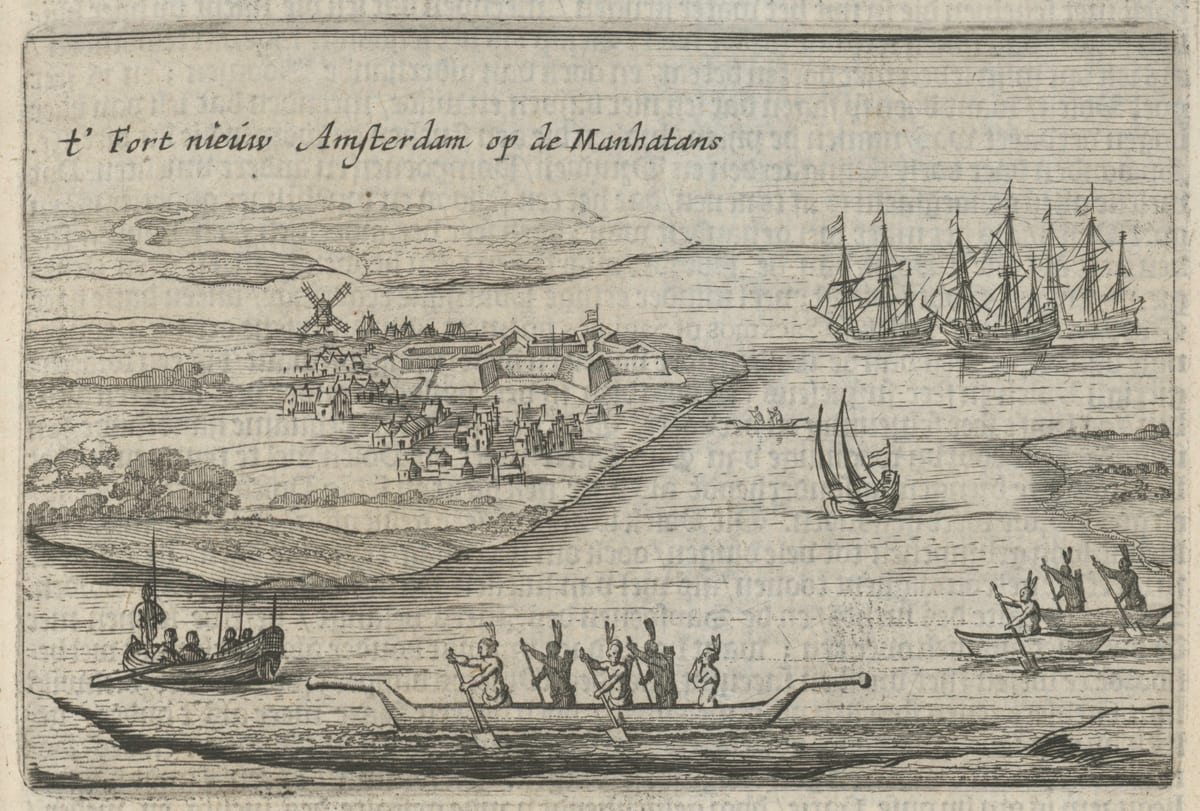
t' Fort Nieuw Amsterdam op de Manhatans (the 'Hartgers View'), After Kryn Fredericks, engineer of Fort Amsterdam; published by Joost Hartgers, Amsterdam, View c. 1626–28 AD; published 1651 AD After Kryn Fredericks, engineer of Fort Amsterdam; published by Joost Hartgers, Amsterdam, New York Public Library, Print Collection, Miriam and Ira D. Wallach Division of Art, Prints and Photographs That autumn St. Jogues was given to Mohawk hunters as a servant and marched thirty leagues on their deer hunt. Back in the villages he baptised infants and taught the Huron captives, and he refused to escape so as not to leave them. In the summer of 1643 AD, near Fort Orange, a Dutch farm labourer helped him reach a Dutch ship, and the Dutch hid him until they had paid off his captors.
The Dutch governor clothed St. Jogues at Manhattan, and he landed in Brittany on Christmas Day, 1643 AD, in time to hear Mass. Church law barred a priest with mutilated fingers from saying Mass, so St. Jogues asked Rome, and Pope Urban VIII gave him permission. St. Jogues sailed from La Rochelle in the spring of 1644 AD and was back at Quebec that summer.
“Indignum esset Christi martyrem Christi non bibere sanguinem (It would be unjust that a martyr for Christ should not drink the Blood of Christ.)”
Pope Urban VIII, granting St. Isaac Jogues leave to say Mass with his mutilated hands, 1644 AD -
1646 AD
An envoy of peace to the Mohawk village where he had been held captive
St. Jogues goes back to the village of his captivity twice, the second time with St. Jean de Lalande.
In May 1646 AD St. Jogues went to the Mohawk as the governor's envoy of peace, with the governor's engineer, Jean Bourdon. He reached Ossernenon, the village of his captivity, on June 5 and was back at Quebec on July 3. In late September St. Jogues set out again with St. Jean de Lalande, a young lay helper from Dieppe who knew the danger and had promised to follow him.
A Mohawk war party took them, and at Ossernenon the two envoys of peace were treated as enemies. On the evening of October 18, members of the Mohawk Bear clan, acting on their own authority, called St. Jogues to supper and struck him with a hatchet as he entered the lodge. St. Lalande was killed the same way early the next morning, and both bodies were thrown into the river.
“Helas! mon tres-cher Pere, quand commenceray-ie a feruir, & aymer celuy qui n'a iamais commencé a nous aymer (Alas, my dear Father, when shall I begin to love and serve Him whose love for us had no beginning?)”
St. John de Brébeuf and Isaac Jogues to a Jesuit in France, letter written, September 1646 AD -
1648–1649 AD
The Huron missions fall
Iroquois raids take the mission towns; St. Brébeuf dies at Saint-Ignace, and four more Jesuits are killed.
On July 4, 1648 AD, the Iroquois overran Teanaostaiaé as St. Antoine Daniel finished Mass, and he walked out to meet them so his people could escape. On the morning of March 16, 1649 AD, they took Saint-Louis, where St. Brébeuf and St. Gabriel Lalemant had refused to leave their people. They stripped the two priests, tore out their nails and took them to Saint-Ignace, which they had stormed at dawn.
There they scalded and burned St. Brébeuf, and he kept urging the captive Christians to look to heaven until they cut away his lips and tongue. St. Brébeuf died at about four that afternoon, and St. Lalemant died at about nine the next morning after a night of torture. On December 7, 1649 AD, St. Charles Garnier was shot and killed with a hatchet at Saint-Jean, and the next day St. Noël Chabanel was killed by a Huron who later confessed that he hated the faith.
“Mes enfans, leur dit-il, leuons les yeux au Ciel dans le plus fort de nos douleurs, fouuenons nous que Dieu eft le tefmoin de nos fouffrances, & en fera bien-toft noftre trop grande recompenfe. Mourons dans cette foy, & efperons de fa bonté l'accompliffement de fes promeffes. I'ay pitié plus de vous que de moy; mais fouftenez auec courage le peu qui refte de tourmens; ils finiront auec nos vies; la gloire qui les fuit n'aura iamais de fin. (My children, let us lift our eyes to Heaven at the height of our afflictions; let us remember that God is the witness of our sufferings, and will soon be our exceeding great reward. Let us die in this faith; and let us hope from his goodness the fulfillment of his promises. I have more pity for you than for myself; but sustain with courage the few remaining torments. They will end with our lives; the glory which follows them will never have an end.)”
St. John de Brébeuf and Isaac Jogues to the Christian Hurons captive with him, March 16, 1649 AD -
1649–1984 AD
Saints and patrons of Canada
Burial at Sainte-Marie, pilgrimages to Auriesville, canonisation, patronage of Canada and a papal visit to the Midland shrine.
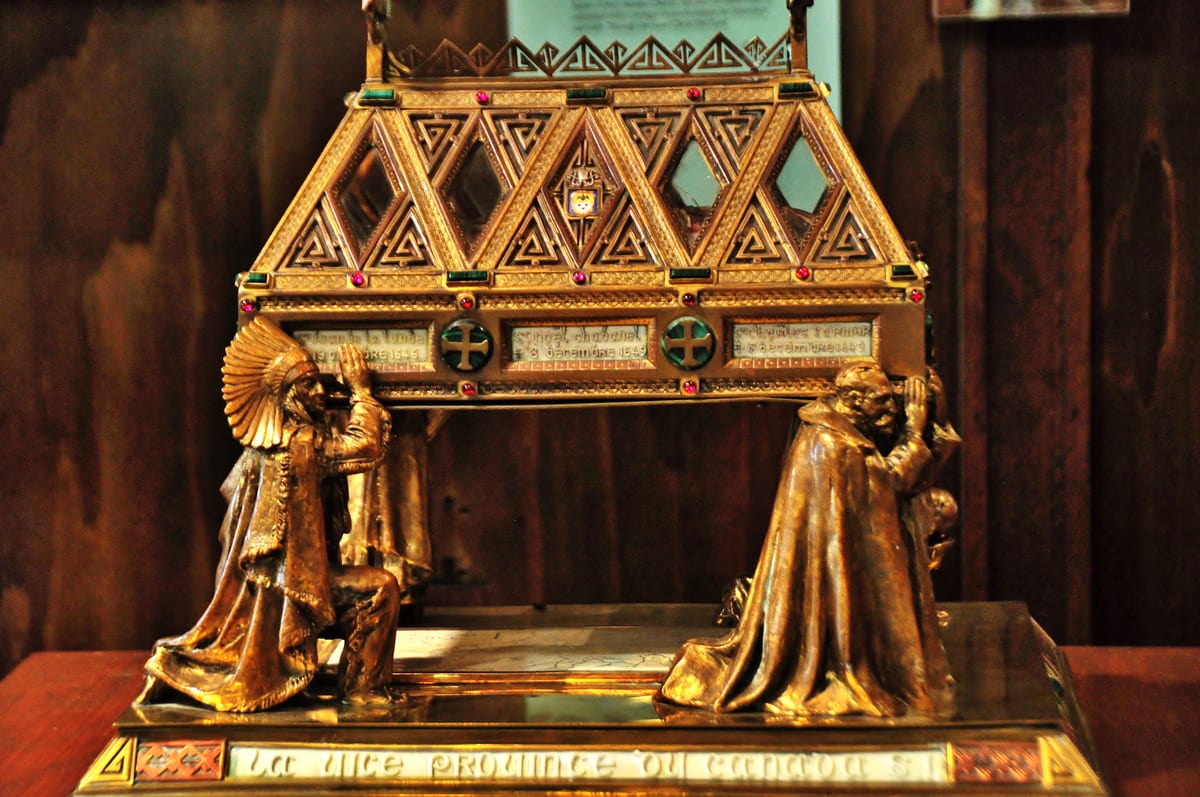
Reliquary in Martyrs' Shrine in Midland, Ontario, Photograph by Mykola Swarnyk, Photograph 16 July 2014 AD Photograph by Mykola Swarnyk, Martyrs' Shrine, Midland, Ontario St. Brébeuf and St. Lalemant were buried in March 1649 AD at Sainte-Marie, the Jesuits' central mission house in the Huron country. Large summer pilgrimages began in 1884 AD to Auriesville, New York, the site of Ossernenon, where St. Jogues, St. Goupil and St. Lalande were killed.
Pope Pius XI canonised St. Brébeuf, St. Jogues and their six companions together on June 29, 1930 AD. On October 16, 1940 AD, Pope Pius XII named the same eight martyrs patron saints of Canada. In 1984 AD Pope St. John Paul II, at the Martyrs' Shrine in Midland, recalled that Pope Urban VIII had made Sainte-Marie a place of pilgrimage in 1644 AD, the first of its kind in North America.


![Engraved by 'L.B.S.' after a drawing by Renatus [Decoinces?] of Orléans, 'delineavit ex tabella ad vivum expressa 1792 AD'; heliogravure plate in Alfred Hamy's Galerie illustrée de la Compagnie de Jésus, KU Leuven Libraries (Galerie illustrée de la Compagnie de Jésus, source ID lbsn9983861640101471)](https://commons.wikimedia.org/wiki/File:Isaac_Jogues,_8B6292083.jpg)
_print_c1626.jpg)

Pray with the Church
St. John de Brébeuf's promise to Christ
A promise St. John de Brébeuf wrote in Latin and signed in his own blood during a retreat in France, after his final vows and before his return to New France; in the English of the Jesuit historian Wynne, The Jesuit Martyrs of North America (1925 AD).
Lord Jesus, my Redeemer! You have redeemed me by Your blood and Your most precious death.This is why I promise to serve You all my life in the Society of Jesus, and never to serve any other than Thee.I sign this promise in my blood, ready to sacrifice it all for Thee as willingly as this drop.