
Saints Monk, priest and Doctor of the Church · Feast December 4
Saint John Damascene
Feast 4 December · Born 676 AD, Damascus, Syria · Died 754 AD, Monastery of Mar Saba (St. Sabas), Judaean Desert, near Jerusalem
A Christian of Damascus left the caliphs' service for a monastery near Jerusalem, wrote hymns there until his death, and was honoured by the Church for defending the holy images against an emperor.
Begin the life
In brief
Saint John Damascene, also called St. John of Damascus, grew up in a Christian family that served the caliphs at Damascus. When Emperor Leo III moved against the veneration of holy images, St. John Damascene wrote in their defence. He could answer the emperor because he lived under the caliphs, beyond the emperor's reach.
-
Late 7th century AD
A Christian house in the caliphs' city
Catholic Tradition holds that St. John Damascene was taught at Damascus by a captive monk his father had ransomed.
St. John Damascene was born at Damascus into a wealthy Christian family. His father served the caliph Abd al-Malik as chief financial officer.
According to longstanding Catholic Tradition, his father ransomed a captive monk named Cosmas to teach him and an orphan the family had adopted, the future bishop of Maiuma. The two boys excelled in arithmetic, geometry and above all theology. At an early age St. John Damascene became Treasurer of the Caliphate.
-
726 AD
The emperor moves against the holy images
When Emperor Leo III issued his edict, St. John Damascene opposed it in writing from lands under Saracen rule, out of the emperor's reach.
In 726 AD Emperor Leo III issued his first edict against the veneration of images. It tried to stop Christians from kneeling and bowing down before them. Living under the caliphs in Syria, St. John Damascene answered with the first of three discourses in defence of the holy images.
He wrote it to circulate throughout the empire. His argument rested on the Incarnation: God, invisible before, had become visible in Christ's flesh and blood, so his likeness could be drawn. Pope Benedict XVI said he was among the first to distinguish the worship owed to God from the veneration of images.
“Πάλαι μὲν ὁ Θεὸς, ὁ ἀσώματός τε καὶ ἀσχημάτιστος, οὐδαμῶς εἰκονίζετο. Νῦν δὲ σαρκὶ ὀφθέντος Θεοῦ, καὶ τοῖς ἀνθρώποις συναναστραφέντος, εἰκονίζω Θεοῦ τὸ ὁρώμενον. Οὐ προσκυνῶ τῇ ὕλῃ, προσκυνῶ δὲ τὸν τῆς ὕλης δημιουργὸν, τὸν ὕλην δι᾽ ἐμὲ γενόμενον, καὶ ἐν ὕλῃ κατοικῆσαι καταδεξάμενον, καὶ δι᾽ ὕλης τὴν σωτηρίαν μου ἐργασάμενον, καὶ σέβων οὐ παύσομαι τὴν ὕλην, δι᾽ ἧς ἡ σωτηρία μου εἴργασται· σέβω δὲ οὐχ ὡς Θεόν· ἄπαγε· (In other ages God had not been represented in images, being incorporate and faceless. But since God has now been seen in the flesh, and lived among men, I represent that part of God which is visible. I do not venerate matter, but the Creator of matter, who became matter for my sake and deigned to live in matter and bring about my salvation through matter. I will not cease therefore to venerate that matter through which my salvation was achieved. But I do not venerate it in absolute terms as God!)”
St. John Damascene, in his first discourse in defence of the holy images -
730 AD
A patriarch resigns, and St. John Damascene writes again
When a second edict banned images from churches and the patriarch resigned, St. John Damascene wrote a second, stronger discourse.
In 730 AD a second edict declared images unlawful in churches. St. Germanus, the ninety-five-year-old Patriarch of Constantinople, resigned rather than obey. But St. John Damascene lived under the caliphs, beyond the emperor's reach, and he wrote again.
His second discourse used much stronger language than the first. Even so, it did not yet anathematise Leo, and in it St. John Damascene prayed that such a step might be averted. St. John Damascene and the bishops of the East placed Emperor Leo III under anathema, a solemn curse.
“Οὐ βασιλέων ἐστὶ νομοθετεῖν τῇ Ἐκκλησίᾳ. (Kings have no call to make laws in the Church.)”
St. John Damascene to Emperor Leo III and his supporters, in his discourse in defence of the holy images -
After 726 AD
A forged letter and a severed hand
In Catholic Tradition, a forged letter cost St. John Damascene his right hand, and the Blessed Virgin Mary restored it.
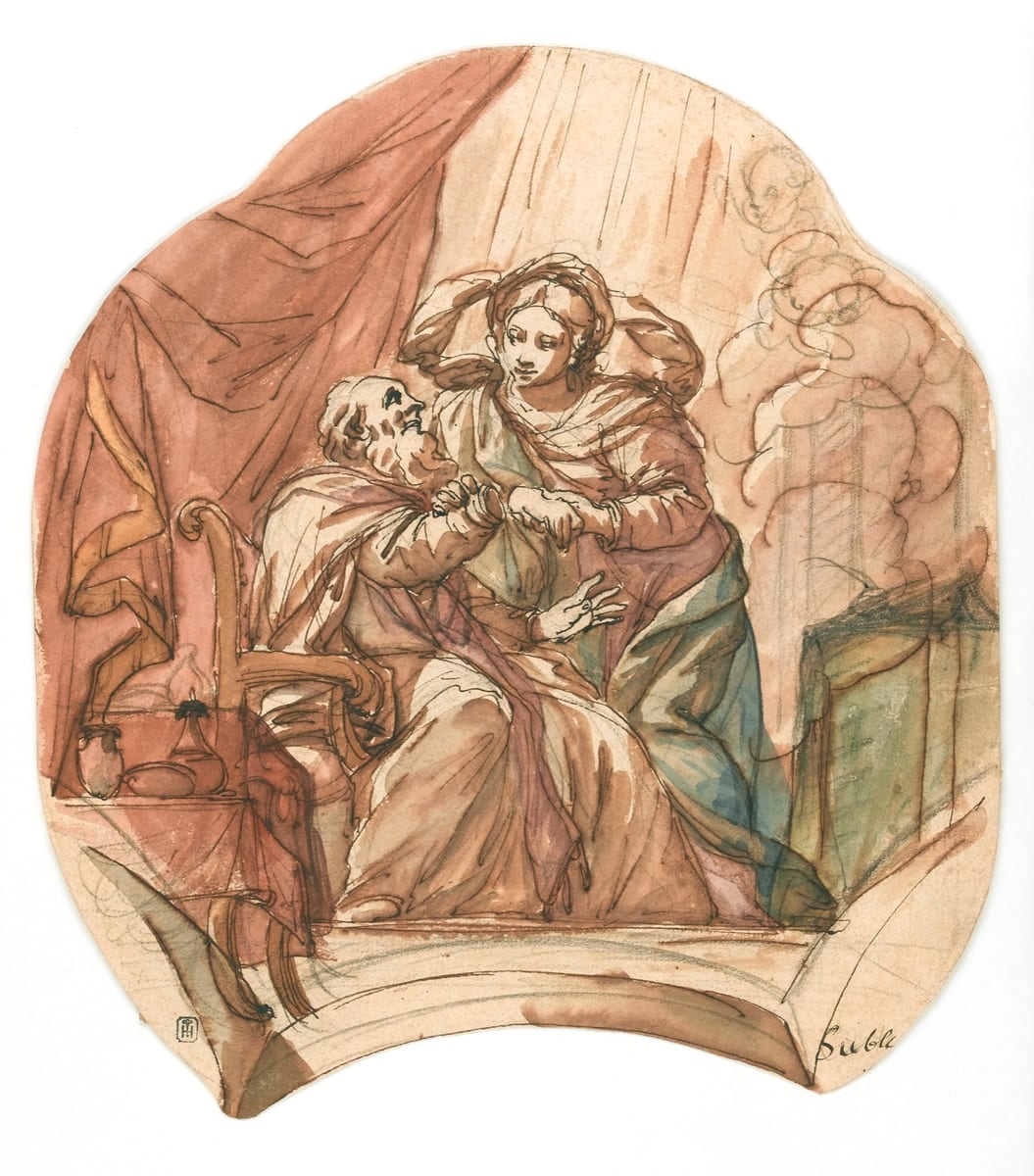
The dream of St. John Damascene: the Blessed Virgin restores his severed right hand, Unknown, 17th century AD Unknown, Wellcome Collection, London (CC BY 4.0) In Catholic Tradition, Leo III had scribes copy the handwriting of St. John Damascene and forge a letter offering to betray Damascus to the emperor. The letter reached the caliph, and St. John Damascene agreed the writing looked like his but denied he had ever written it. The caliph believed the forgery, and the right hand was cut off at the wrist and hung up in the marketplace.
That evening St. John Damascene sent to ask for the hand back, held it against his arm and commended himself to an image of the Blessed Virgin Mary. He fell asleep and saw her look at him with merciful eyes and tell him his hand was healed. He woke to find it whole, with only a faint line where it had been cut.
-
8th century AD
From the caliph's council to a desert monastery
In the account Catholic Tradition keeps, St. John Damascene turned down his old office, gave away his goods and became a monk of St. Sabas, near Jerusalem.
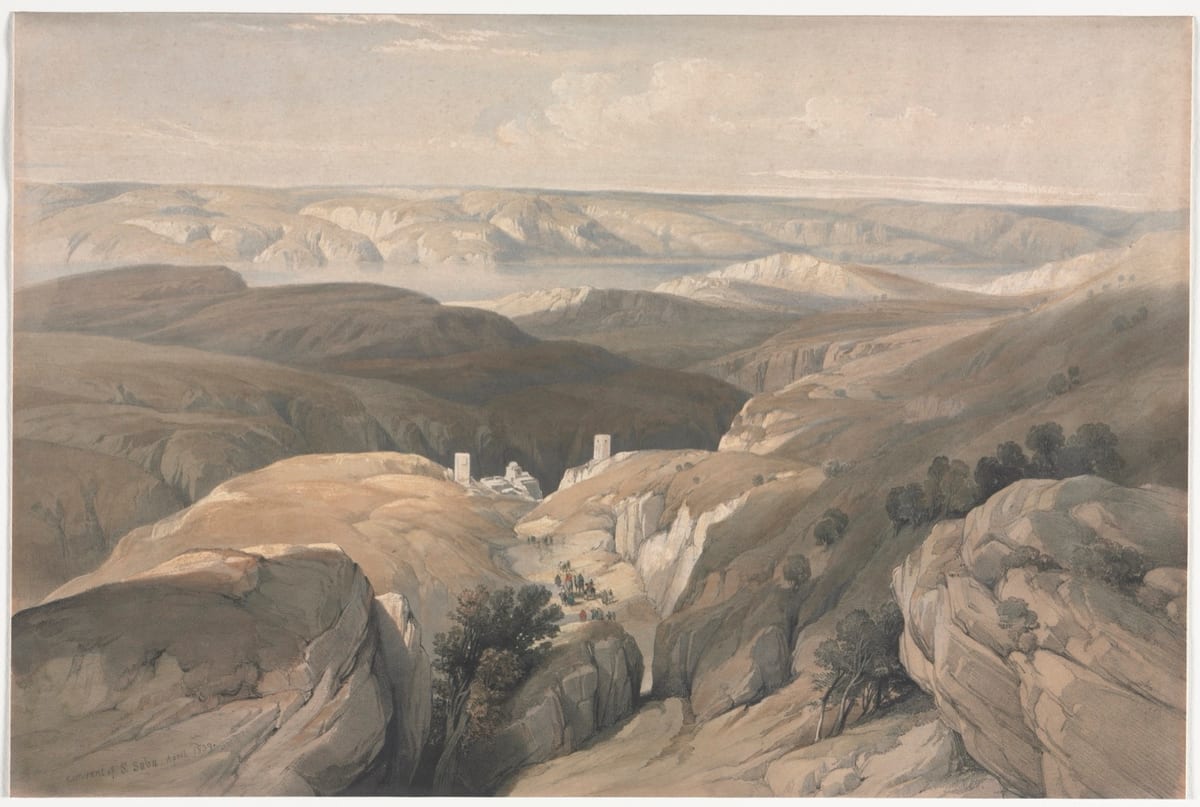
The Convent of St. Saba, David Roberts, 1839 AD David Roberts, Cleveland Museum of Art (CC0) As Catholic Tradition tells it, the caliph saw the healed hand and offered St. John Damascene his old office back. He lay face down for a long time and begged to go to a monastery instead. He gave his goods to feed the poor and freed his slaves.
He became a monk of St. Sabas, also called Mar Saba, some eighteen miles south-east of Jerusalem. His foster-brother, St. Cosmas, went with him.
-
8th century AD
Baskets in Damascus, a hymn in the desert
In Catholic Tradition, an aged monk humbled St. John Damascene with hard tests, then let him write after a dream of the Blessed Virgin Mary.
Catholic Tradition holds that an aged elder at St. Sabas took charge of the famous novice. The elder sent him to sell baskets in Damascus at a high price he could not lower. In the city where he had held high office, the crowd jeered at him.
He broke his elder's rule of silence to write a funeral hymn for a grieving monk, and was thrown out. He was taken back only after cleaning the monastery's latrines with his own hands. Then the Blessed Virgin Mary appeared to the elder in a dream and told him to let St. John Damascene write.
-
Mid-8th century AD
Hymns and books until the end
St. John Damascene was ordained a priest, completed his great summary of doctrine and wrote hymns at St. Sabas until he died.
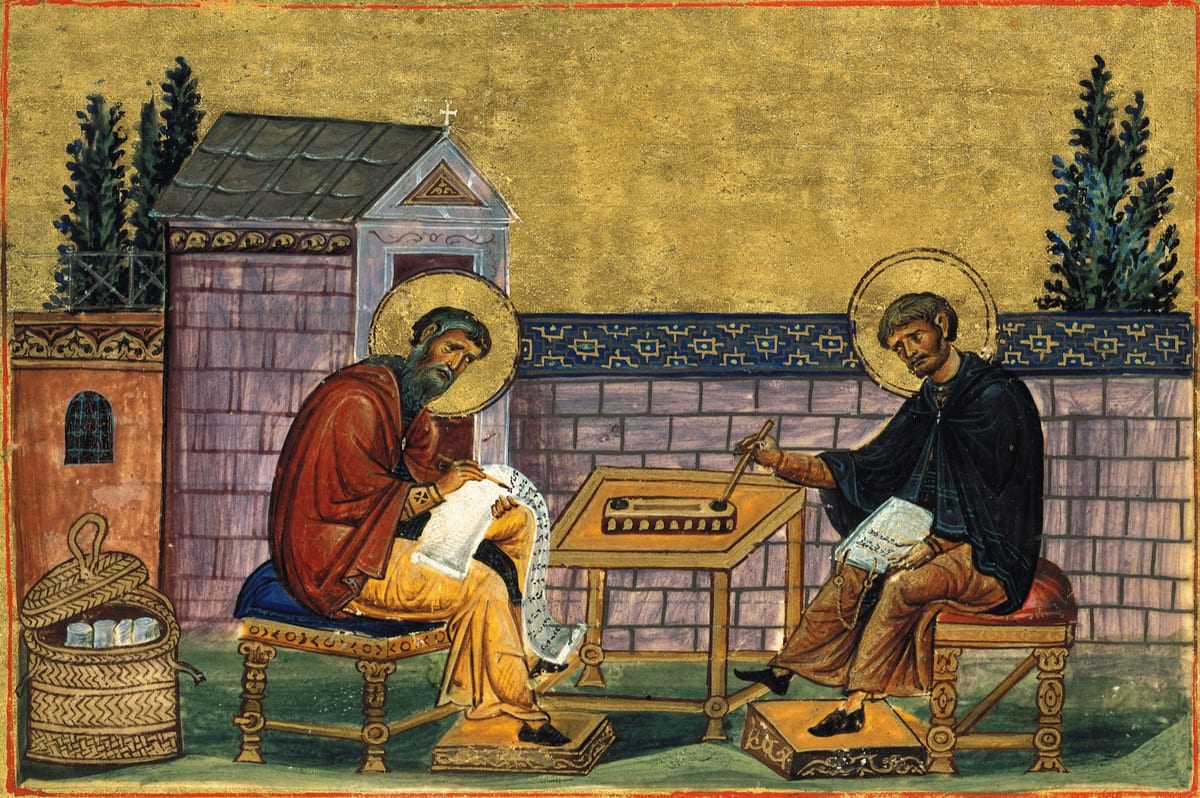
St. John of Damascus and St. Cosmas, from the Menologion of Basil II, Illuminators of the Menologion of Basil II, c. 985 AD Illuminators of the Menologion of Basil II, Biblioteca Apostolica Vaticana, Vatican City St. John Damascene was ordained a priest by the Patriarch of Jerusalem. In 743 AD St. Cosmas was made bishop of Maiuma, near Gaza. St. John Damascene dedicated to him the *Fount of Knowledge*, a three-part summary of Christian doctrine.
The Roman Martyrology records that he wrote sacred hymns at Mar Saba until his death. The Catholic Encyclopedia calls his canon for Easter Day, sung in a series of odes, the most famous of his canons. St. John Damascene died in his cell at St. Sabas, and the Breviary lessons for his feast say he fell asleep in the peace of Christ, full of days and good works.
“Ἀναστάσεως ἡμέρα, λαμπρυνθῶμεν λαοί· πάσχα κυρίου, πάσχα· ἐκ γὰρ θανάτου πρὸς ζωὴν καὶ ἐκ γῆς πρὸς οὐρανὸν Χριστὸς ὁ θεὸς ἡμᾶς διεβίβασεν, ἐπινίκιον ἄδοντας. (The day of Resurrection: let us be radiant, O peoples. The Passover of the Lord, the Passover: for from death to life, and from earth to heaven, Christ our God has brought us over, as we sing the song of victory.)”
St. John Damascene, the first ode of his Canon for Easter Day -
754–1890 AD
Cursed at Hieria, honoured at Nicaea
A council against the images condemned St. John Damascene by name in 754 AD; the Second Council of Nicaea reversed it, and Pope Leo XIII named him a Doctor of the Church.
In 754 AD a council called by Emperor Constantine V at Hieria condemned the holy images. It condemned St. John Damascene and St. Germanus by name. At the emperor's order, St. John Damascene's family name, Mansur, was written Manzer, meaning a bastard.
In 787 AD the Second Council of Nicaea cancelled Hieria's rulings and proclaimed that he should be remembered for ever. In 1150 AD Burgundio of Pisa put St. John Damascene's *Exact Exposition of the Orthodox Faith* into Latin, and St. Thomas Aquinas used it. On August 19, 1890 AD, Pope Leo XIII declared St. John Damascene a Doctor of the Church.
“Ἰωάννης δὲ, ὃς παρ᾽ αὐτῶν ὑδριστικῶς Μανσοὺρ προσηγόρευται, ἀφεὶς πάντα, Ματθαῖον τὰν εὐαγγελιστὰν ζηλώσας, Χριστῷ ἠχολούθησε (But John, whom they insultingly call Mansur, left everything and, following the example of Matthew the evangelist, followed Christ.)”
The deacon Epiphanius at the Second Council of Nicaea to the fathers of the Second Council of Nicaea


Pray with the Church
Collect for the feast of St. John Damascene
The Collect of his feast in the Roman Breviary, from the office granted when Pope Leo XIII declared him a Doctor of the Church in 1890 AD.
O Almighty and everlasting God, Who didst fill Thy blessed servant John with heavenly teaching, and wondrous strength of spirit to maintain the honouring of holy images.Grant unto us at his prayers and after his example to take pattern by their holy lives whose images we honour, and ever to feel the power of their help.
All 1 report on Saint John Damascene

About this picture
AI-generated image, in the manner of Byzantine fresco, from the paper's reference portrait based on St. John of Damascus and St. Cosmas, from the Menologion of Basil II (Illuminators of the Menologion of Basil II, c. 985 AD, Biblioteca Apostolica Vaticana, Vatican City) View source artwork.