
Saints Nun and mystic of Helfta · feast November 16
Saint Gertrude the Great
Feast 16 November · Born January 6, 1256 AD · Died November 17, 1301 AD, Helfta, near Eisleben, Saxony
Given to the nuns of Helfta at five, St. Gertrude outpaced her fellow pupils, turned to Christ at twenty-five in a vision she called her conversion, wrote down the graces that followed, and died in the same cloister some forty years after she entered it.
Begin the life
In brief
Saint Gertrude the Great, also called Gertrude of Helfta, lived in the monastery of Helfta, near Eisleben in Saxony, from the age of five until her death. She was never its abbess and lived there as an ordinary nun. The Roman Martyrology remembers her as a virgin of the Order of St. Benedict, renowned for the revelations she received.
-
1256–1280 AD
A child of Helfta
Born on the Epiphany, St. Gertrude came to the nuns at five and grew into their best student.
St. Gertrude was born on January 6, 1256 AD, the feast of the Epiphany. Her home, she said, was a long way from Eisleben. In 1261 AD, aged five, she entered the monastery of Helfta, near Eisleben, to be raised and taught by the nuns.
The Abbess Gertrude of Hackeborn, who made her nuns study the liberal arts and above all Holy Scripture, gave her own sister, St. Mechtild of Hackeborn, charge of the school and the choir. St. Gertrude grew up in St. Mechtild's care and outpaced her companions through the whole course, from grammar to philosophy. Pope Benedict XVI said that literature, music, song and miniature painting captivated her.
-
January 27, 1281 AD
A youth in the dormitory
At twenty-five, after a restless Advent, St. Gertrude saw Christ in the nuns' dormitory and turned from her books to Scripture.
In Advent 1280 AD, St. Gertrude began to find her studies and the pleasures of youth empty. On January 27, 1281 AD, in her twenty-sixth year, she was in the nuns' dormitory at dusk after Compline. She bowed to an older nun, and as she raised her head she saw Christ as a youth of about sixteen.
He told her that her salvation was near and asked why she was so consumed with grief. He took her by the hand, and on that hand she saw the marks of his wounds. After the vision she gave up her love of secular books for Scripture, the Fathers and theology.
“Salvabo te et liberabo te, noli timere. (I will save thee, I will deliver thee; fear not.)”
Christ to St. Gertrude, in the vision of Christ as a youth that she counted as her conversion, January 27, 1281 AD -
1282–1288 AD
Wounds in her heart
A prayer found in a book of devotions led to the marks of Christ's Wounds in St. Gertrude's heart, and seven years later another prayer, said daily for her before a crucifix, came before the wound of love.
In the first or second winter after her conversion, St. Gertrude found a prayer to the Five Wounds of Christ in a book of devotions and began to pray it. One evening after Vespers she sat in the refectory beside a nun she had confided in. There she became aware, in her spirit, that the marks of Christ's Wounds were printed on her heart.
Seven years later, a little before Advent, she asked another nun to pray every day before a crucifix that her heart be pierced with divine love. She wrote that on a Wednesday in Advent, after Mass, Christ made a wound in her heart. She later named these two graces, the marks of the Wounds and the wound of love, as the ones she prized above the rest.
“Domine, fateor quod secundum merita mea non sum digna accipere minimum donorum tuorum; sed tamen meritis et desiderio omnium adstantium supplico pietati tuae, ut transfigas cor meum tui amoris sagitta. (Lord, I am not worthy to receive the least of Thy gifts; but I beseech Thee, by the merits and prayers of all here present, to pierce my heart with the arrow of Thy love.)”
St. Gertrude the Great to Christ, after Communion on the Third Sunday of Advent -
1289 AD
A book she did not want to write
St. Gertrude held back before setting down her graces in the book later called the Herald of Divine Love.
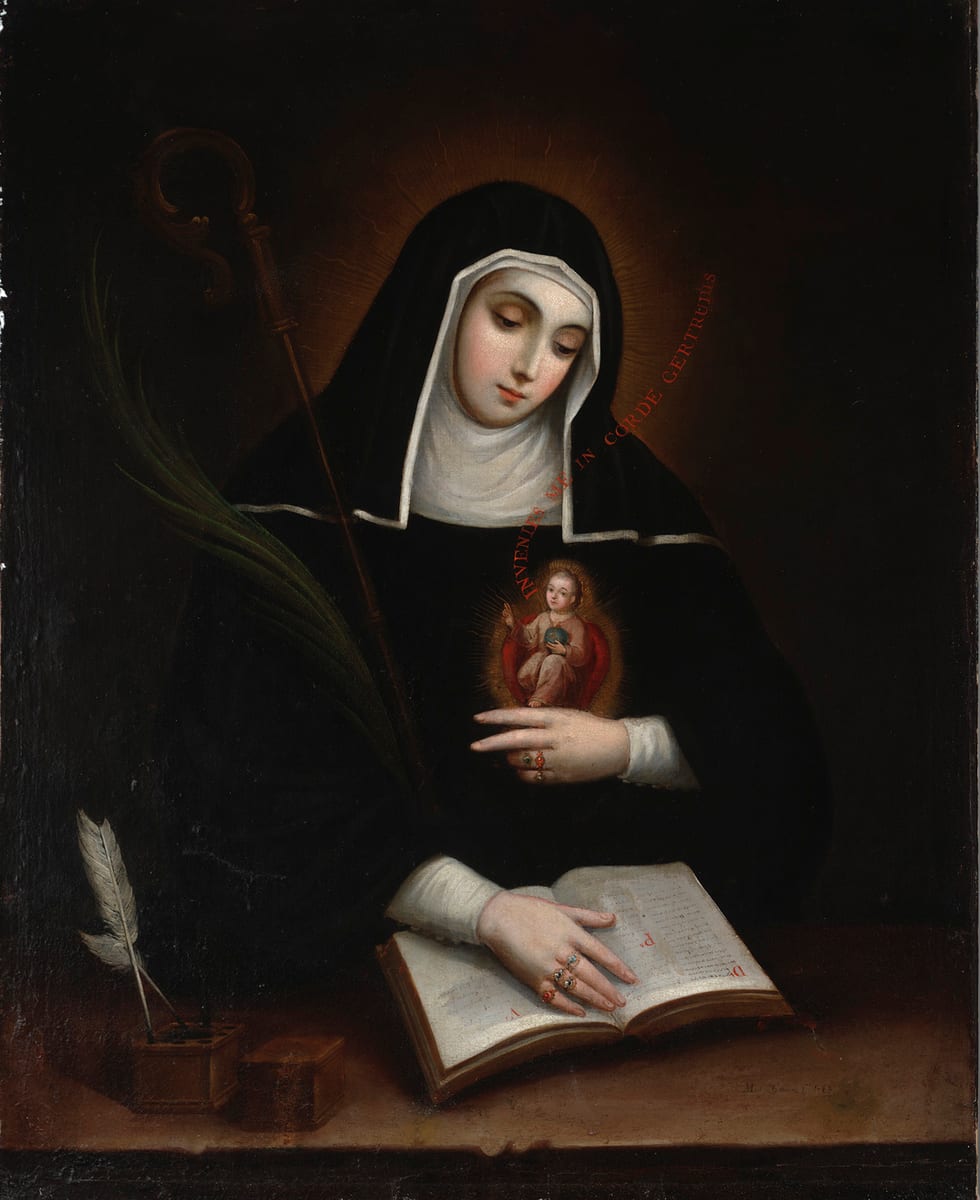
Santa Gertrudis, Miguel Cabrera (1695–1768 AD), 1763 AD Miguel Cabrera (1695–1768 AD), Dallas Museum of Art, Dallas, Texas (2006.37), gift of Laura and Daniel D. Boeckman in honor of Dr. William Rudolph St. Gertrude thought it unfitting to make her graces known, and she put off writing them down until the feast of the Exaltation of the Cross. She told herself she had already used them for the good of others in what she said, if not in writing. On that feast Christ told her she would not leave this life until she had written her graces down.
For the next four mornings, at a set hour, the words she was to write came to her plainly. Her account became the second of the five books of the Herald of Divine Love, the only one of them she wrote herself. She was also the chief author of the book recording the graces of St. Mechtild of Hackeborn.
“Absque contradictione certum divinae pietatis meae testimonium volo habere in scriptis tuis, his novissimis temporibus, in quibus dispono benefacere multis. (I desire your writings to be an indisputable evidence of My Divine goodness in these latter times, in which I purpose to do good to many.)”
Christ to St. Gertrude, commanding her to write -
1290s AD
The counsellor of Helfta
In 1292 AD, St. Gertrude told her abbess that the electors had chosen Adolf of Nassau as king, against general expectation that Albert, Rudolf's son, would win.
As her name spread, people of every class came to Helfta to see St. Gertrude, and she often withdrew from them. Her biographer wrote that dealing with the outside world was a hardship for her. The nuns of the house were encouraged to go to her for spiritual advice.
In May 1292 AD, with the imperial throne empty, she told her abbess, against general expectation, that the electors had passed over Albert of Habsburg, the late king's son, and chosen Adolf of Nassau. She added that Adolf would die by his rival's hand. In 1298 AD the two armies met at Göllheim, and Albert killed Adolf there.
“Noli timere, filia, sed confide, quod hoc speciali privilegio praefero te, quod quicumque super quibuscumque causis humiliter et fideliter requisierit te, tu in luce divinae veritatis meae discernens causam illam sicut ego eam judico. (Fear nothing, My daughter, but rather be filled with a holy confidence; for I will give you this special grace, that when any one shall have recourse to you with faith and humility, in order to consult you on any subject whatsoever, the light of My truth shall discover to you the most hidden obscurities in the matter.)”
Christ to St. Gertrude, when she feared she had reproved someone too severely -
1290s AD
No Mass at Helfta
Clergy who had seized a bishop's powers shut the monastery off from Mass, and St. Gertrude prayed for those who were robbing it.
Clergy who had taken over the powers of the Bishop of Halberstadt, in whose diocese Helfta lay, placed the monastery under an interdict. The interdict stopped Mass from being said there, and the last Mass before it was the Marian Mass *Salve, Sancta Parens* (*Hail, holy Mother*). Christ told St. Gertrude his love would grow in her while the interdict lasted.
St. Gertrude complained to Christ that people trying to take the convent's goods were threatening the nuns with excommunication. She prayed for people who had robbed the convent before and were robbing it again. Those who had used violence against the monastery were publicly excommunicated.
“Sine eos, quia de hoc ego tractabo cum ipsis. (Do not trouble about that; I will settle the matter with them.)”
Christ to St. Gertrude, on those who had laid the interdict -
1298 AD–1301 AD or 1302 AD
Death at Helfta
St. Gertrude spent her last years ill, mourning her teacher and preparing every week for death.
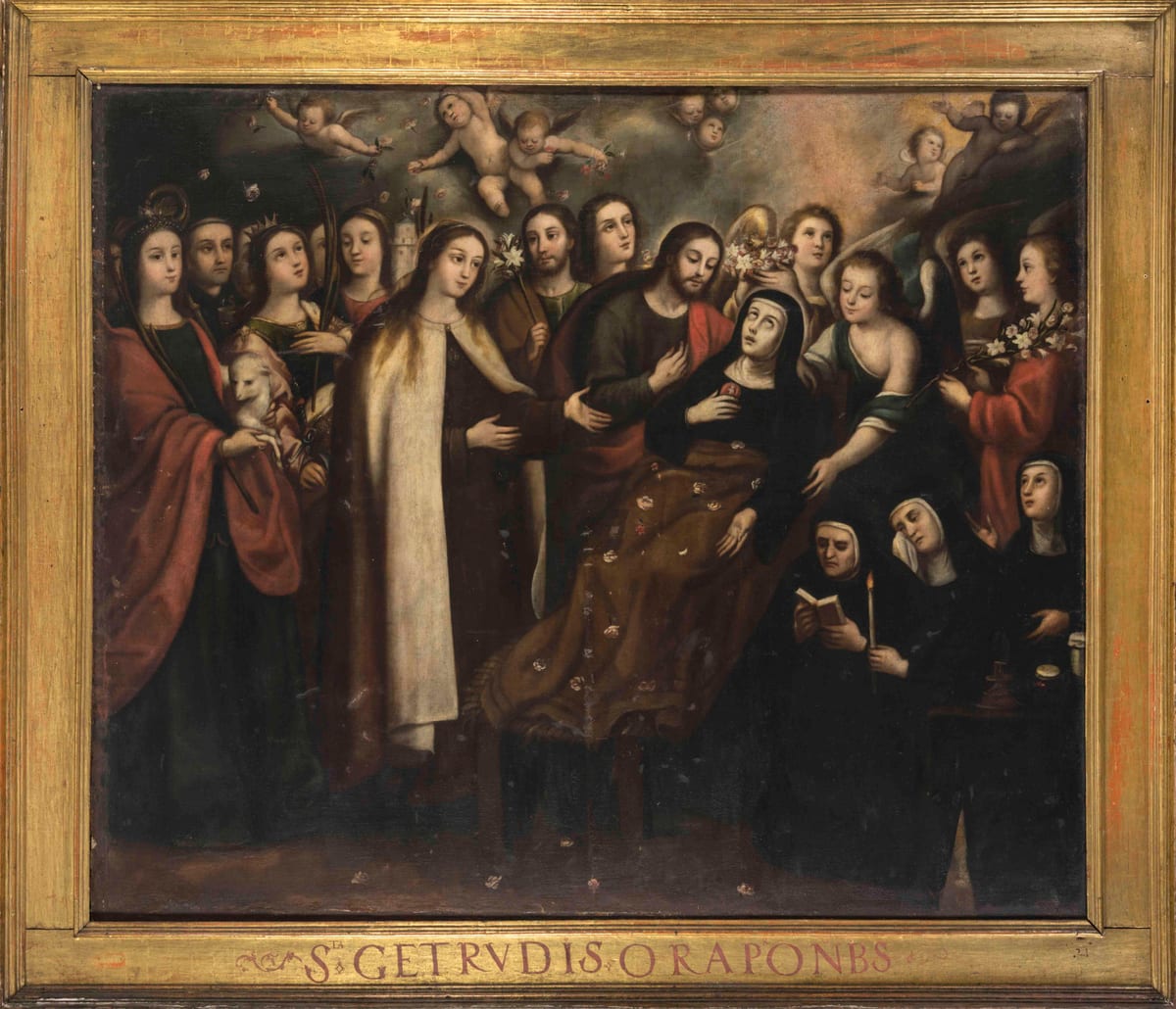
Muerte de Santa Gertrudis (The Death of St. Gertrude), Baltasar Vargas de Figueroa (attributed), 17th century AD Baltasar Vargas de Figueroa (attributed), Museo Colonial (Museo de Arte Colonial), Bogotá St. Gertrude died at Helfta on November 17, in 1301 AD or 1302 AD, aged about forty-six. Her teacher since childhood, St. Mechtild of Hackeborn, had died there on November 19, 1298 AD, and St. Gertrude mourned her. Toward the end of her own life a serious illness kept her in the infirmary.
When Christ offered her the choice between dying at once and a long illness, she left it to him. Every Friday, at the Office of None, she withdrew to prepare for death and to pray the prayers for the dying. In one of those hours Christ showed her how she would die, as a young girl resting in his arms.
“Fiat domine mi voluntas tua. (Lord, do Thou Thy holy will.)”
St. Gertrude the Great to Christ, leaving whether she should die at once or bear a long illness -
1677–1739 AD
Called the Great
Never formally canonized, St. Gertrude entered the Roman Martyrology because Rome's own books already called her the Great.
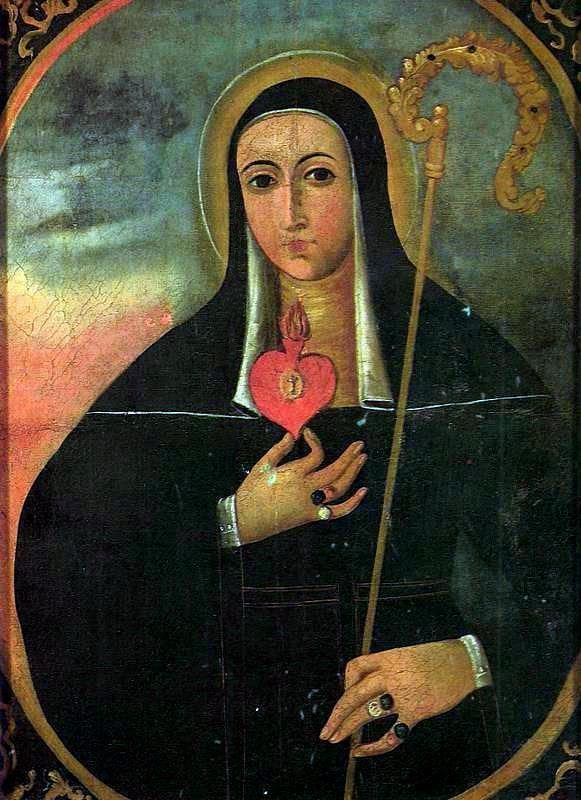
Santa Gertrudes Magna, Cuzco School, unidentified painter; scan from Maia, Pedro Moacir, Museu de Arte Sacra/UFBA (São Paulo: Banco Safra, 1987 AD), 17th century AD Cuzco School, unidentified painter; scan from Maia, Pedro Moacir, Museu de Arte Sacra/UFBA (São Paulo: Banco Safra, 1987 AD), Museu de Arte Sacra da Universidade Federal da Bahia, Salvador In 1677 AD St. Gertrude's name was proposed for the Roman Martyrology. The Promoter of the Faith objected that no document warranted her canonization or beatification. Officials in Rome answered that their own books already called her the Great, and held that this earned her a place.
The Martyrology records her death under November 17 and keeps her feast on the day before. On March 9, 1739 AD, Pope Clement XII authorized an Office of St. Gertrude for everyone bound to pray the Hours. At the petition of the King of Spain she was declared Patroness of the West Indies.


Pray with the Church
Collect for the feast of St. Gertrude
The prayer of the Roman Breviary for her feast on November 16, in its English translation.
O God, Who didst make unto thyself a pleasant dwelling-place in the heart of thy blessed hand-maiden Gertrude,be Thou entreated for the same thy servant's sake, and by her prayers,to purge away in thy mercy all defilement from our hearts,and to grant us one day to rejoice with her in thy presence.
All 2 reports on Saint Gertrude the Great

About this picture
AI-generated image, in the manner of an eighteenth-century New Spanish oil painting, from the paper's reference portrait based on Santa Gertrudis (Miguel Cabrera, 1763 AD, Dallas Museum of Art, Dallas, Texas) View source artwork.
St. Mechtild of Hackeborn offers Christ her heart and dies at Helfta

About this picture
AI-generated image, in the manner of eighteenth-century New Spanish devotional oil painting, from the paper's reference portrait based on Santa Gertrudis (Miguel Cabrera, 1763 AD, Dallas Museum of Art, Dallas, Texas) View source artwork.