
Saints Patroness of Migrants
Saint Frances Xavier Cabrini
Feast 22 December · Born 1850 AD, Sant'Angelo Lodigiano, Lombardy, Italy · Died 1917 AD, Columbus Hospital, Chicago, Illinois, United States
Two religious orders turned her away as too frail; she founded her own at thirty and crossed the ocean twenty-four times for the Italians of the Americas.
Begin the life
In brief
Saint Frances Xavier Cabrini, commonly known as Mother Cabrini, was born on July 15, 1850 AD at Sant'Angelo Lodigiano on the Lombard plain, the last of thirteen children. She founded the Missionary Sisters of the Sacred Heart of Jesus at Codogno in 1880 AD and died at Chicago on December 22, 1917 AD. Pope Pius XII declared her a saint in 1946 AD, the first citizen of the United States to be canonised, and in 1950 AD named her heavenly patroness of all emigrants.
-
1850–1859 AD
A last child on the Lombard plain
She was born two months early into a family where most of the children died young, and she learned about the missions from her father's reading.
St. Frances Xavier Cabrini was born two months before term and was frail all her life. Of her parents' thirteen children, only four grew up. Her mother gave her her first education, and her elder sister Rosa taught her to read.
Her father read the children stories of the missions, and reading the Annals of the Propagation of the Faith made her want to go to China. She dressed her dolls as nuns and floated paper boats loaded with violets down the river as her missionaries. At seven she fell into the same river and was nearly swept away, and ever after she trembled at the sight of running water.
-
1870–1873 AD
The refusals
Orphaned at twenty, she taught in a village school, nursed the sick through smallpox, and was turned down twice for religious life.
Her father, Agostino Cabrini, died on February 22, 1870 AD. St. Frances Xavier Cabrini was twenty when her mother, Stella Oldini, died ten months later. The parish priest, who opposed her wish to enter religious life, sent her instead to the village of Vidardo to stand in for a sick schoolmistress, and she taught there for two years.
When smallpox broke out she nursed the sick and caught the disease. At twenty-three, two religious orders refused her for her poor health: the Daughters of the Sacred Heart, who had been her teachers, and the Canossian sisters of Crema. Her confessor told her there were no women missionaries she could join, so she decided to found an order of them.
-
1874–1880 AD
Codogno
Six hard years in a failing orphanage ended with a bishop telling her to begin an order of her own.
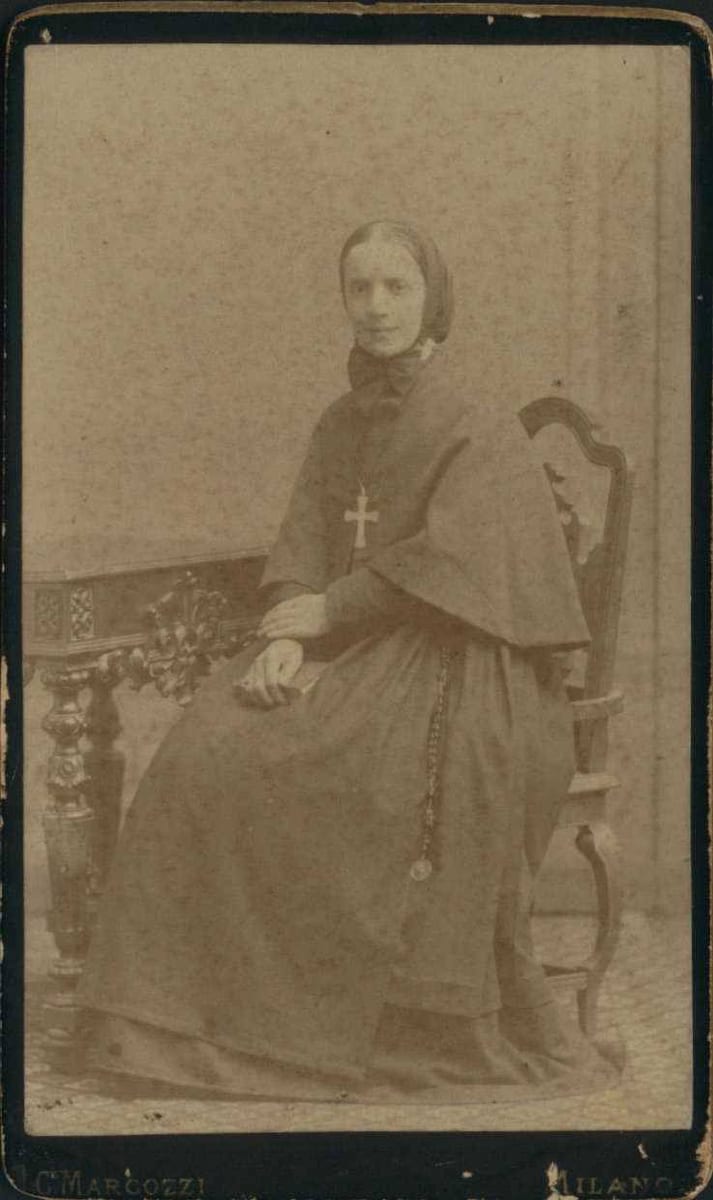
05_Frances Xavier Cabrini at Age Thirty, Carlo Marcozzi, Milan, 1880 AD Carlo Marcozzi, Milan, St. Frances Cabrini Collection, Holy Spirit Library, Cabrini University; Missionary Sisters of the Sacred Heart of Jesus In August 1874 AD Antonio Serrati, the parish priest of Codogno, who had known her as a teacher at Vidardo, called her to the House of Providence, a struggling orphanage for poor girls in his town. She took the habit and made her vows there, adding Saverio to her name for Saint Francis Xavier, patron of the missions. The Bishop of Lodi, Domenico Gelmini, made her superior of the house, and she soon took the place of its foundress, Antonia Tondini.
Pope Pius XII said later that she found the house disorganised, divided and without charity, and that the community treated her as an intruder. After six years, and grave trouble caused by some of the sisters, Bishop Gelmini dissolved the community, asked her whether she wanted to be a missionary, and told her it was time to found an order. She answered that she would look for a house, and at dawn on November 14, 1880 AD she and seven young women moved into an abandoned Franciscan house in Codogno.
“I will look for a house.”
Mother Cabrini to Bishop Domenico Gelmini of Lodi, her reply when told to found the Order, November 1880 AD -
1887–1889 AD
Rome, and the West
She carried her Rule to Rome for approval and came away sent in the opposite direction from the one she had asked for.
On September 22, 1887 AD she went to Rome to ask the Holy See to approve the Rule she had written for her sisters and to let her open a house in the city. On September 25 she knelt at the altar of St. Francis Xavier in the Church of the Gesù and vowed to go to the missions of the East with six sisters as soon as the Holy See approved her order. Four days after she arrived, Cardinal Lucido Maria Parocchi, the Vicar of Rome, told her to go back to Codogno: her community was only seven years old, Rome already had many like it, and he asked whether she had 150,000 lire to build a house.
Within days Cardinal Parocchi reversed himself and told her to open two houses in Rome instead of one, and on March 12, 1888 AD the Holy See approved her Rule with a Decree of Praise. When Pope Leo XIII received her in audience, he was troubled by the plight of the Italians pouring into New York and the Americas, and he told her to go not east but west. She answered that she would go, knelt for his blessing, made the sign of the cross and left.
“Not to the East, but to the West!”
Pope Leo XIII to St. Frances Xavier Cabrini, in audience, when she asked leave for the missions of Asia, 1889 AD -
1889–1892 AD
Little Italy
She landed in New York with six sisters, was told to go home, and stayed to open an orphanage, a school and a hospital.
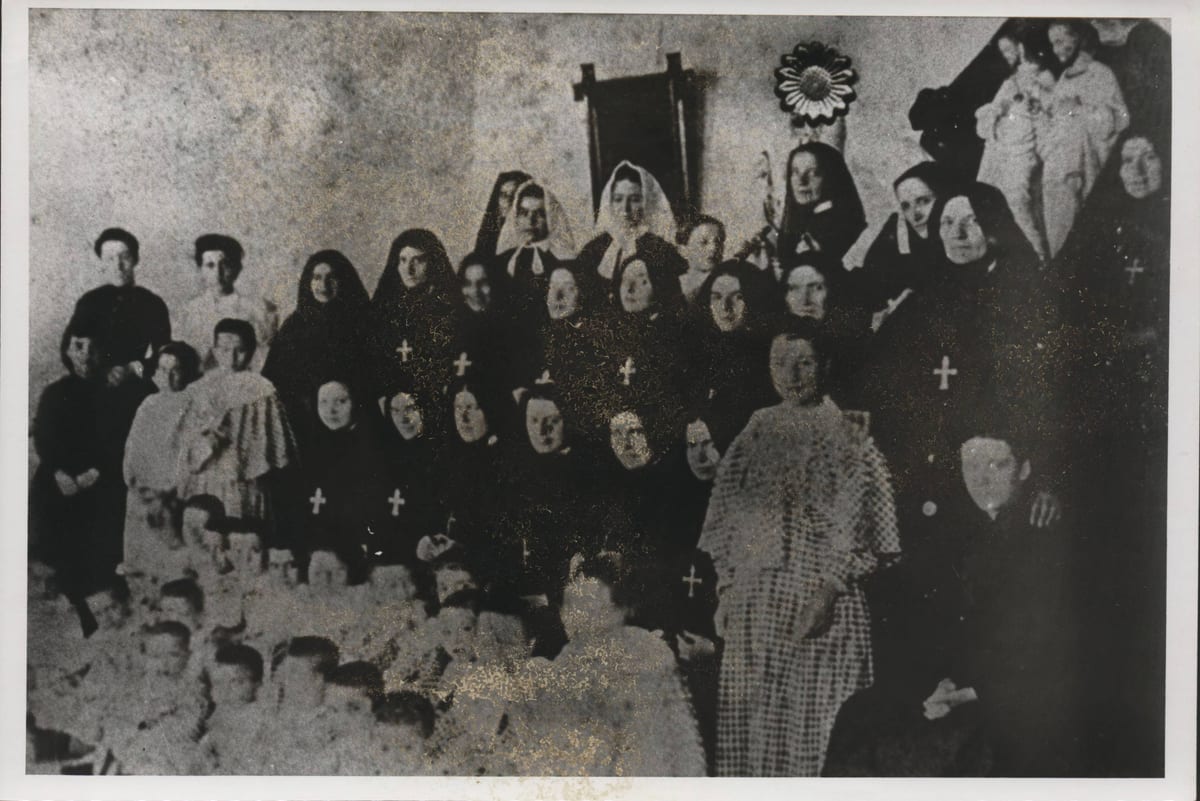
01_ Missionary Sisters of the Sacred Heart of Jesus and Orphans, New York, Circa 1890 AD, Unknown, New York Unknown, New York, St. Frances Cabrini Collection, Holy Spirit Library, Cabrini University; Missionary Sisters of the Sacred Heart of Jesus She sailed for New York with six sisters in March 1889 AD and landed on March 31. It was her first ocean voyage, and she had feared the sea since her fall into the river as a child. The Archbishop of New York told the sisters to go back to Italy after setbacks in setting up the school and orphanage they had come for, and she refused, because Pope Leo XIII had sent her to America and she had told him she would go.
In the Italian quarter, Little Italy, large families lived in a single room, and children begged or shined shoes for a few cents. The sisters opened their first house three weeks after landing, and that year she founded an orphanage and the first school for the children of Italian emigrants. Columbus Hospital opened on September 17, 1892 AD with ten sisters and ten patients. Sick Italian immigrants had been forced to go to the hospital for the poor, where no one spoke their language.
-
1891–1895 AD
Nicaragua, and the Andes
Her sisters were thrown out of Nicaragua; the next year she crossed the Andes by mule to begin her work in Argentina.
On December 3, 1891 AD she opened a college at Granada in Nicaragua at the personal request of the country's president. In 1893 AD an anticlerical liberal became president, and in August 1894 AD her sisters were expelled, accused of meddling in politics and of pressuring their pupils to leave their families. Her appeals for compensation and for the sisters' return, sent through the Italian foreign ministry, were long ignored; Nicaragua acknowledged its debt only in 1921 AD, after her death, and let the sisters return the following year.
She went down the Pacific coast through Peru and Chile, and in 1895 AD she crossed the Andes on muleback to reach Buenos Aires. When snow buried the path she followed two muleteers along the edge of deep precipices, and when her mule went too near the edge she shouted at it in Spanish, to no purpose. She came over the mountains to Buenos Aires, and on May 8, 1895 AD she opened the college of Santa Rosa there, a school for the daughters of well-to-do families.
“Forward, still forward — I am made for the infinite.”
Mother Cabrini, looking from the Andes towards the Pampas, 1895 AD -
1902–1912 AD
An American citizen
Her missions ran west to Denver and Seattle, and in Seattle she became an American citizen.
Her missions ran west, to Denver in 1902 AD, where two hundred children came to the new school on its first day, and to Seattle in 1903 AD. On October 13, 1909 AD she became a citizen of the United States at Seattle. In 1910 AD she tried to step down as head of her order, but her sisters asked with one voice that she stay, and on July 16 the Holy See made her Superior General for life.
In March 1912 AD she left Rome on the twenty-fourth and last ocean voyage of her life, meaning to rebuild Columbus Hospital in New York. That year she paid her last visit to Colorado, to the land she had bought in the foothills at Golden as a summer camp for the girls of her Queen of Heaven Orphanage in Denver. According to the Tradition kept at the shrine in Golden, when the sisters at the camp told her in September 1912 AD that they had no water, she told them to lift a rock and dig, and they found a spring.
-
1917–1946 AD
The last day
She spent the eve of her death wrapping Christmas sweets for schoolchildren and died the next day in the hospital she had opened.
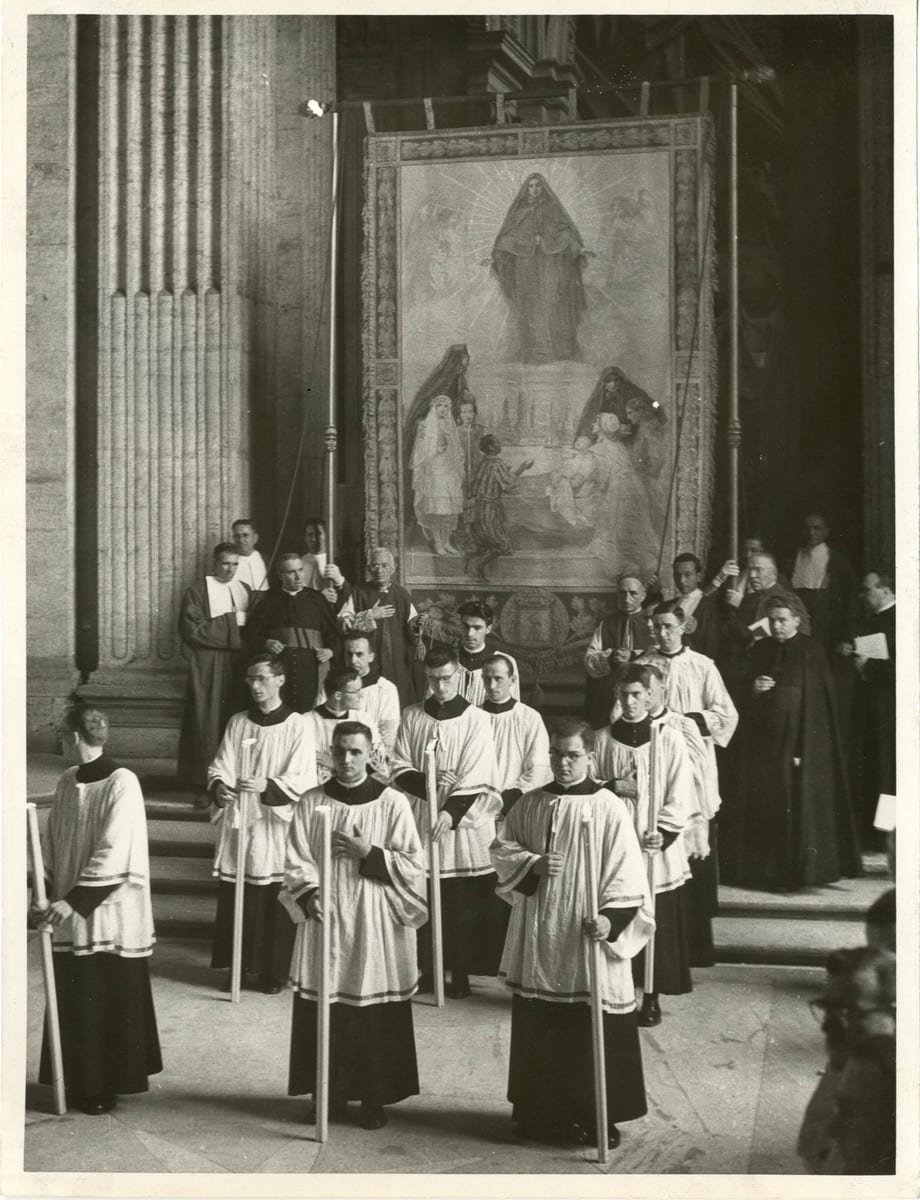
01P_Canonization Tapestry, Unknown, Rome, July 7, 1946 AD Unknown, Rome, St. Frances Cabrini Collection, Holy Spirit Library, Cabrini University; Missionary Sisters of the Sacred Heart of Jesus On Friday, December 21, 1917 AD she rose early, went to Mass and stayed for the whole hour of adoration before the Blessed Sacrament. That day she wrapped Christmas sweets for the children at her school, part of a Christmas gift for five hundred children. She died of an aneurysm the next day, in a private room of the Columbus Hospital she had opened in Chicago, while she was still preparing that gift.
She left sixty-seven houses and about thirteen hundred sisters. When Pope Pius XII canonised her in 1946 AD, he fixed her feast on December 22, the day of her death.
“Be peaceful in difficulties, fear nothing, that the good Jesus thinks of everything and will defend us in everything.”
Mother Cabrini, written from Chicago eleven days before her death, December 11, 1917 AD


Pray with the Church
Collect for the Memorial of Saint Frances Xavier Cabrini
The Collect of the Mass for her memorial on the calendar of the United States, kept on November 13.
God our Father, who called Saint Frances Xavier Cabrini from Italy to serve the immigrants of America,by her example, teach us to have concern for the stranger, the sick, and all those in need,and by her prayers help us to see Christ in all the men and women we meet.Through our Lord Jesus Christ, your Son, who lives and reigns with you in the unity of the Holy Spirit, God, for ever and ever.
All 3 reports on Saint Frances Xavier Cabrini

Told to go home, St. Frances Xavier Cabrini gets two schools in Rome

St. Frances Xavier Cabrini vows in Rome to take her sisters East
