
Saints Poland, 1905–1938 AD
Saint Faustina Kowalska
Feast 5 October · Born 1905 AD, Głogowiec, Poland · Died 1938 AD, Kraków-Łagiewniki, Poland
A farmer's daughter who kept house for strangers, entered a convent at nineteen with no dowry, and died of tuberculosis at thirty-three in the infirmary at Kraków-Łagiewniki.
Begin the life
In brief
Saint Faustina Kowalska, commonly known as Sister Faustina, was the third of ten children of a farming family near Łódź. She spent thirteen years in the Congregation of the Sisters of Our Lady of Mercy as a cook, gardener and portress, and wrote down in a notebook the revelations of Divine Mercy she received from February 1931 AD. Pope John Paul II canonized her in St Peter's Square on April 30, 2000 AD, and Pope Francis entered her memorial in the General Roman Calendar on May 18, 2020 AD, to be kept on October 5.
-
1905–1923 AD
A farmer's daughter goes into service
Born at Głogowiec with nine brothers and sisters, she had three years of schooling and left home at sixteen to keep house for strangers.
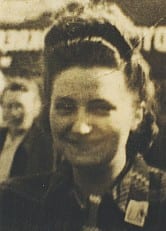
Sw faustyna helena kowalska 'Faustyna Kowalska w wieku 18 lat' (Helena Kowalska at the age of eighteen), unknown photographer, 1920s; the Congregation dates the only known pre-convent photograph of her to Lodz, 1923 AD or 1924 AD unknown photographer, Wikimedia Commons; reproduced from faustyna.pl, the site of the Congregation of the Sisters of Our Lady of Mercy St. Faustina was born on August 25, 1905 AD at Głogowiec, near Łódź, to Marianna and Stanisław Kowalski. Her mother could not read, and it was she who taught the children the faith and prepared them for their First Holy Communion. St. Faustina made hers at nine, in the parish church at Świnice Warckie.
She began school at twelve, when the Russian occupation ended and a primary school opened, and left after three years to make room for the younger children. At sixteen she said goodbye to her parents and went into domestic service at Aleksandrów Łódzki, to help keep the family. She came home the next year to say she wanted to enter a convent, and her parents refused, giving as their reason that they could not afford a dowry.
“I'm not alone, I'm walking with Jesus.”
St. Faustina Kowalska to a friend, on the road home after her First Holy Communion, asked why she walked alone, 1914 AD -
1924–1925 AD
The dance at Wenecja Park
She left a dance in Łódź for the cathedral, went to Warsaw with nothing arranged, and earned the money for her habit in service at Ostrówek.
At a dance in Wenecja Park in Łódź she saw Jesus beside her, crushed with suffering, stripped of His apparel and covered with wounds. She left the dance for the cathedral of St. Stanisław Kostka, lay prostrate before the Blessed Sacrament, and was told to go at once to Warsaw and enter a convent.
She left for the capital in July 1924 AD with nothing arranged beforehand. Mother Michaela Moraczewska accepted her provisionally at the Sisters of Our Lady of Mercy, on condition that she first earn what her habit would cost. She took a post with Aldona Lipszyc at Ostrówek, made a vow of perpetual chastity there during Vespers, and crossed the convent threshold on Żytnia Street on August 1, 1925 AD.
“As I started to dance, I suddenly saw Jesus next to me, Jesus crushed with suffering, stripped of His apparel and all covered with wounds, Who said these words to me, 'How long am I to put up with you, and how long are you going to keep Me waiting'?”
St. Faustina Kowalska, written in her Diary, of the dance in Wenecja Park at Łódź, 1924 AD -
1926–1930 AD
The habit and the name
She took the habit at Kraków, lost all consolation in prayer for a stretch of her novitiate, and was moved from house to house as cook, gardener and shop assistant.
At the clothing at Kraków on April 30, 1926 AD she received the habit and the name Sister Maria Faustyna, and fainted twice during the rite. Towards the end of her first year in the novitiate her prayer went dark, and she found no consolation in it. Bishop Stanisław Rospond received her first vows at Łagiewniki on April 30, 1928 AD, with her parents there to watch.
She was moved often between the Congregation's houses and worked as cook, gardener and portress. At Płock her main occupation was serving customers in the bakery shop.
“See, Father, the One to whom I have made my vows is my husband and therefore your son-in-law.”
St. Faustina Kowalska to her father, Stanisław Kowalski, April 30, 1928 AD -
1931 AD
The command at Płock
In her cell she was told to have an image painted and a feast kept, and she could not draw.
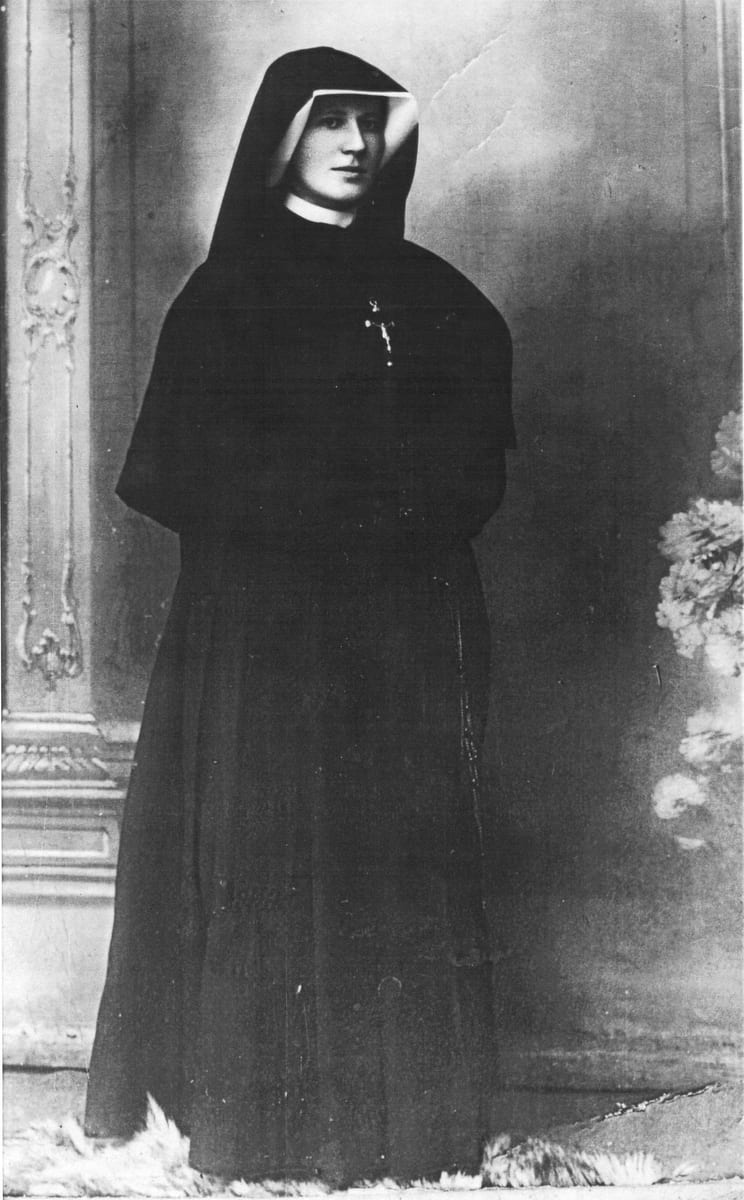
Siostra Faustyna Kowalska - Plock (1931 AD), unknown 20th-century photographer unknown 20th-century photographer, Wikimedia Commons; from the archive of the Congregation of the Sisters of Our Lady of Mercy, reproduced via gosc.pl On the evening of Sunday, February 22, 1931 AD, in her cell at Płock, St. Faustina saw the Lord Jesus in a white robe, with two rays coming from His breast. She was asked for an image painted after the pattern she saw, and for a Feast of Divine Mercy on the first Sunday after Easter.
She could not draw at all. Her confessor took the command to mean an image painted in her soul, and a sister she asked for help offered her a choice of holy pictures instead. In the house her silence under questioning annoyed the more curious sisters.
“Make Me a picture of this image in the form that you see, with the inscription Jesus, I trust in You. I want this picture venerated first in your chapel, and in the whole world. I promise that the soul that venerates this picture shall not perish. I also promise it victory over its enemies, already here on Earth, and especially in the hour of death. I Myself shall protect it as My glory.”
Christ to St. Faustina, in her cell at Płock, in the vision of the Lord in a white robe, February 22, 1931 AD -
1933–1935 AD
The painter in Vilnius
A confessor who believed her found an artist, and the picture she had directed hung at last in the Gate of Dawn.
She made her perpetual vows at Kraków on May 1, 1933 AD and was sent to Vilnius at the end of that month. In June she met Father Michał Sopoćko, who lectured in pastoral theology at Stefan Batory University and became her confessor. He ordered her to write down what she received, and looked for an artist who could paint what she described.
Eugeniusz Kazimirowski began the painting in January 1934 AD, with Father Sopoćko posing for the figure of Jesus, and she came to the studio once or twice a week to direct him. When it was finished in June she wept, because the Jesus of the picture was not as beautiful as the one she had seen. From April 26 to 28, 1935 AD the image hung in the Gate of Dawn for the close of the Jubilee Year of the Redemption, decorated with greenery and flowers by her own hands.
“Who's going to paint You as beautiful as You are?”
St. Faustina Kowalska to Jesus, weeping before the finished painting at Vilnius, June 1934 AD -
1936–1937 AD
The decision left to her
She believed she was to found a new congregation, and her Mother General handed her the choice of going or staying.
On September 13, 1935 AD, in her cell at Vilnius, she saw an angel sent by God to punish the earth, and the Chaplet of the Divine Mercy was given her then. She left Vilnius on March 21, 1936 AD, already ill, believing that she was to found a contemplative order. Father Józef Andrasz, who became her confessor at Kraków in May, held that a congregation to preach and obtain God's mercy was necessary for the Church, while Father Sopoćko advised her by letter and was more cautious.
On May 4, 1937 AD Mother General Michaela Moraczewska told her that she had always held her back, but that the decision to go or to stay was now entirely her own. A great darkness came over her the next day, and she put off what she had decided to do. In June she wrote down the final shape of the work, one work in three hues, and she stayed in her own Congregation.
“No one would be able to understand all the suffering and anguish I'm going through; neither am I able to describe it, nor can there be any greater suffering. The suffering martyrs go through is no greater, for at such times death would bring me relief; there is nothing I can compare this suffering with, this endless dying of the soul.”
St. Faustina Kowalska, written in her Diary after her last attempt to leave the Congregation, 1937 AD -
1938 AD
The infirmary at Łagiewniki
Tuberculosis took her lungs and her stomach, and she kept the visiting sisters at arm's length so that they should not catch it.
Tuberculosis, undiagnosed until her years in Vilnius, had attacked both her lungs and her alimentary canal, and she spent over eight months in the hospital at Prądnik. Her superiors sent her back there after Easter in 1938 AD, and she made her last entries in the notebook at the end of June. She came back to the convent infirmary on September 17, 1938 AD and asked pardon of the sisters for her unintentional failings.
She did not let the sisters who visited come too close, because she did not want them infected, and she asked her family not to travel because of the cost. On the afternoon of October 5, 1938 AD Father Andrasz gave her absolution and the Sacrament of the Sick. She died at a quarter to eleven that night, aged thirty-three, with Sister Amelia Socha and Sister Eufemia Traczyńska beside her.
“My one occupation is to live in the presence of my Heavenly Father.”
St. Faustina Kowalska to Blessed Michał Sopoćko, at her last meeting with her director from Vilnius, September 1938 AD -
1938–2020 AD
The grave, the ban and the feast
Pilgrims came to the grave in the convent garden; Rome forbade the devotion for nineteen years, then lifted the ban.
The sisters carried her coffin to the cemetery at the end of the garden on October 7, 1938 AD, and no one from her family was there, because she had not wanted to put them to the cost of the journey. Pilgrims came to the grave to pray for her intercession, and on March 7, 1943 AD Father Andrasz blessed Adolf Hyła's painting of the Merciful Jesus and began public devotions at Łagiewniki. On March 6, 1959 AD the Holy See banned the spread of the devotion in the forms she had conveyed, and the prohibition stood for nineteen years.
Cardinal Karol Wojtyła, who as a young labourer at the Solvay quarry beside the convent had prayed before the image, opened her cause at Kraków in 1965 AD, and the bans were lifted on April 15, 1978 AD. As Pope John Paul II he beatified her in 1993 AD, canonized her on April 30, 2000 AD, and gave the Second Sunday of Easter the name Divine Mercy Sunday for the whole Church. Pope Francis entered her memorial in the General Roman Calendar on May 18, 2020 AD, to be kept on October 5.
“I clearly sense that my mission will not end upon my death, but will only begin then.”
St. Faustina Kowalska, written in her Diary


.jpg)
Pray with the Church
Collect for the Memorial of Saint Faustina Kowalska
The Collect of the Roman Missal for her memorial on October 5, in the English translation confirmed by the Dicastery for Divine Worship and the Discipline of the Sacraments on October 2, 2023 AD.
O God, who entrusted Saint Faustinawith spreading the immense riches of your infinite mercy,grant, at her intercession,that after her example we may fully trust in your goodnessand generously perform works of charity.Through our Lord Jesus Christ, your Son,who lives and reigns with you in the unity of the Holy Spirit,God, for ever and ever.
All 3 reports on Saint Faustina Kowalska

A sister woken by mistake sees St. Faustina smile and die at Łagiewniki

St. Faustina's confessor visits her at Łagiewniki, and she does not talk
