
Saints Jesuit priest and martyr · 1540–1581 AD
Saint Edmund Campion
Feast 1 December · Born January 25, 1540 AD, London, England · Died December 1, 1581 AD, Tyburn, London, England
A London bookseller's son who became Oxford's finest speaker swore the Queen's oath, then broke with her Church to become a Catholic priest and a Jesuit, and came home on a secret mission that ended on the gallows at Tyburn in 1581 AD.
Begin the life
In brief
Saint Edmund Campion, also called Edmund Campian, was a London bookseller's son who became the most admired speaker at Oxford and then a Jesuit priest. He landed at Dover in 1580 AD as one of the first two Jesuits sent to England, and he was hanged, drawn and quartered at Tyburn on December 1, 1581 AD. Pope St. Paul VI canonized him on October 25, 1970 AD among the Forty Martyrs of England and Wales.
-
1540–1557 AD
The best speaker at Oxford
A bookseller's son wins a free schooling, a place at Oxford and a following of his own.
St. Edmund Campion was born in London on January 25, 1540 AD, the son of a bookseller of the same name. The Grocers' Company, a London guild, paid for his schooling after one of its members noticed how quick he was. At thirteen he gave the address of welcome when Queen Mary's entry procession halted at St. Paul's on August 3, 1553 AD.
Sir Thomas White, who founded St. John's College, Oxford, took him as one of its first scholars and made him a junior fellow at seventeen. He was soon thought the best speaker of his time, and a circle of admirers known as Campionists gathered around him.
-
1564–1568 AD
The Queen's oath
He swears the Queen's oath and takes orders in her Church while his career rises.
In 1564 AD his college's rules required him to start reading the Fathers of the Church, the early Christian writers. That same year, on taking his degree, he swore the oath of supremacy, which acknowledged the Queen as spiritual head of the Church in England. Tobie Mathew, who was at Oxford with him, said he swore it against his own conscience.
His friend Richard Cheney, Bishop of Gloucester, who detested the new doctrines in private but conformed outwardly, persuaded him to be ordained a deacon in the Church of England. During Queen Elizabeth's visit to Oxford in 1566 AD he disputed before her and Robert Dudley, the university's chancellor, and both were won over by him. In 1568 AD the university made him Proctor, its chief office after the head of the university.
-
1569–1571 AD
Escape from Ireland
He goes to Dublin, is hunted there as a Catholic, and slips away disguised as a servant.
St. Edmund Campion left Oxford on August 1, 1569 AD, when his term as Proctor ended, and later went to Dublin, where there was a plan to revive the city's old university. The plan came to nothing, and he lodged with James Stanihurst, the father of one of his Oxford pupils. He lived openly as a Catholic, though he had not yet been reconciled to the Church, and the Lord Chancellor of Ireland resolved to arrest him.
Warned at midnight, he went into hiding and wrote a History of Ireland in the friendly houses that sheltered him. He sailed from Drogheda dressed as a servant called Mr. Patrick, and the officers who searched the ship for him seized his manuscript instead. He had come to love Ireland, and he took its chief saint, St. Patrick, as his patron.
-
1571–1578 AD
Priest of the Society of Jesus
He leaves England for a Catholic seminary, walks to Rome and is ordained a Jesuit priest at Prague.
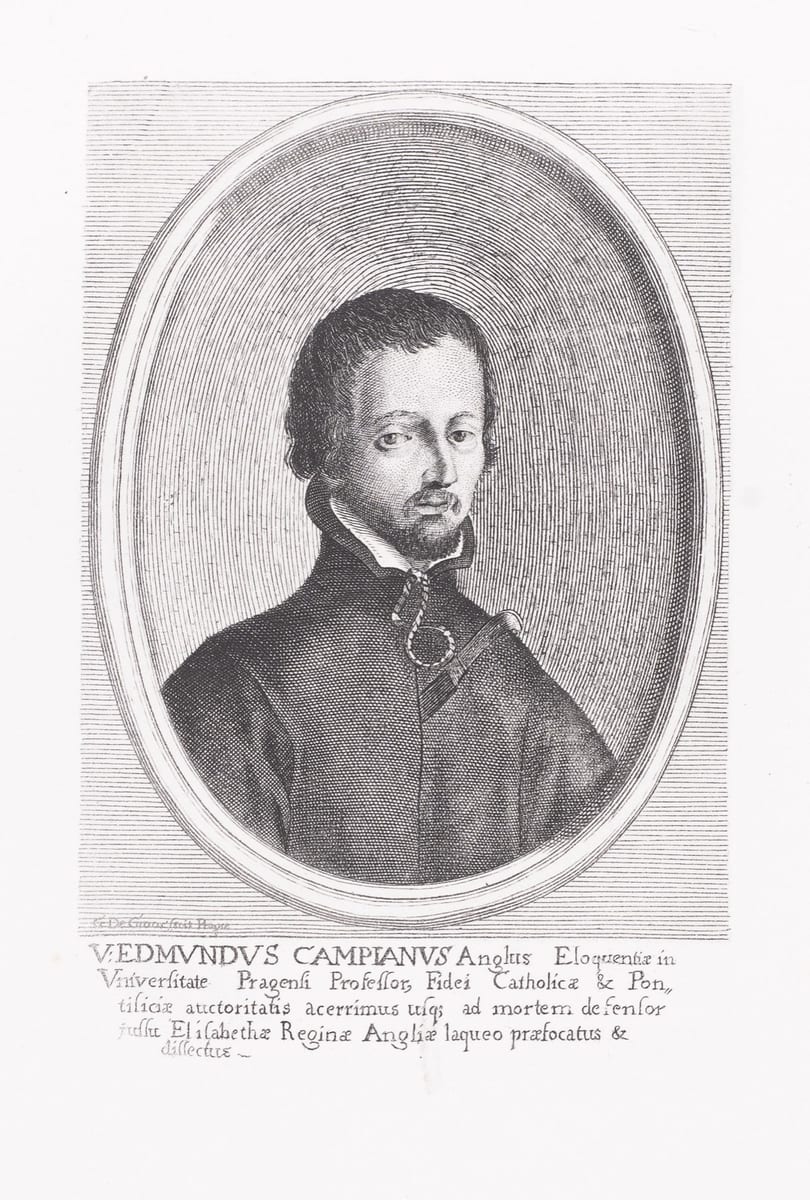
Edmundus Campianus, professor of eloquence at Prague, Gerard de Groos, engraved at Prague, late 17th century Gerard de Groos, engraved at Prague, KU Leuven Libraries Back in England, St. Edmund Campion resolved to leave for good, because he saw that Catholics could no longer live securely there without compromising their conscience. He went to the seminary Dr. William Allen had recently founded for English priests at Douai, in the Spanish Netherlands, and studied Catholic theology there. From there he walked to Rome as a barefoot pilgrim.
He entered the Society of Jesus in April 1573 AD, the first novice admitted after Everard Mercurian was elected its head. William Allen wrote that St. Edmund Campion chose the order to wipe away, by penance, the fault of having taken orders in the Church of England. The order sent him to teach at its college in Prague, and the Archbishop of Prague ordained him a priest there in 1578 AD.
-
1580–1581 AD
Sent home to England
He crosses in disguise into a country that is watching for him, preaches in secret and writes to the Queen's council.
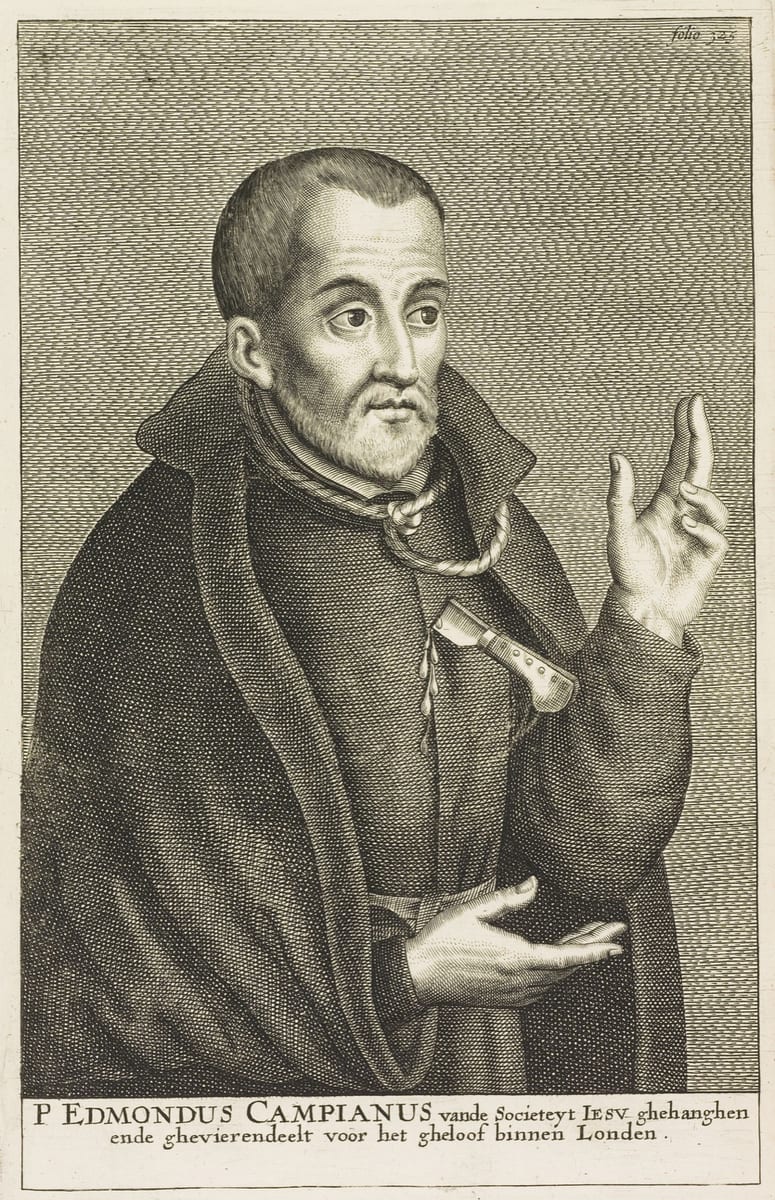
P. Edmondus Campianus, from Cornelius Hazart's Kerckelycke historie (Antwerp), anonymous Antwerp engraver, after the portrait painted for the Gesù in Rome, 1669 AD anonymous Antwerp engraver, after the portrait painted for the Gesù in Rome, KU Leuven Libraries Called back from Prague, St. Edmund Campion left Rome in April 1580 AD with Fr. Robert Persons, the first two Jesuits sent on a mission to England. At Dover the mayor had orders to watch for St. Edmund Campion and his lay-brother companion, Ralph Emerson. He crossed in disguise in late June, and the mayor held him on suspicion and then let him go.
In London on June 29, 1580 AD, he preached to Catholics in a hired hall near Smithfield while gentlemen stood guard dressed as porters. In case he was caught, he wrote a declaration to the Queen's Privy Council setting out why he had come and asking to defend his faith in public debate. A friend he trusted with it passed it around, and he spent the next months riding from one Catholic house to the next, as far north as Yorkshire.
“And touching our Societie be it known to you that we have made a league--all the Jesuits in the world, whose succession and multitude must overreach all the practices of England--cheerfully to carry the cross you shall lay upon us, and never to despair your recovery, while we have a man left to enjoy your Tyburn, or to be racked with your torments, or consumed with your prisons. The expense is reckoned, the enterprise is begun; it is of God, it cannot be withstood. So the faith was planted: so it must be restored.”
St. Edmund Campion to The Lords of Her Majesty's Privy Council, eighth article of his declaration, 1580 AD -
1581 AD
A book at Oxford, a Mass at Lyford
His book turns up on the benches of St. Mary's Church in Oxford.
In January 1581 AD a royal proclamation denounced everyone who sheltered or helped priests and Jesuits. In Lancashire St. Edmund Campion wrote the Ten Reasons, a Latin book for the scholars of Oxford that defended his challenge to debate the most learned Protestants. It was printed on a secret press at Stonor, near Henley, and four hundred copies were found covering the benches of St. Mary's Church, Oxford, during the university's chief ceremony of the year.
On Sunday, July 16, he said Mass at Lyford Grange in Berkshire and gave blessed bread and holy water to everyone there, including an informer, George Eliot. Eliot came back with armed men, and the next morning they broke into a hiding place in the wall and found St. Edmund Campion lying there with two other priests. At dinner on the road to London, Eliot complained that St. Edmund Campion looked cheerfully at everyone except him.
“God forgive thee, Eliot, for so judging of me. I forgive thee, and in token thereof I drink to thee, and if thou wilt repent and come to confession I will absolve thee, but large penance thou must have.”
St. Edmund Campion to George Eliot, at dinner on the road to London, answering the man who betrayed him, July 1581 AD -
July–November 1581 AD
The rack and the bar
Racked in the Tower and given the debate he had asked for there, he is tried as a traitor and sentenced to death.
St. Edmund Campion was led bound through London to the Tower on July 22, with a placard on his hat naming him a seditious Jesuit. At the door of the rack chamber he knelt and made the sign of the cross before he was racked on the Privy Council's orders, and during his imprisonment he was questioned on whether he had sent money to rebels in Ireland. Weakened by the rack, he was given the public debate he had asked for, against the deans of St. Paul's and Windsor in the Tower chapel on August 31.
On November 14 he was charged in Westminster Hall with coming to England to raise a rebellion. His arms were so numb from the rack that he could not raise his hand to plead, and a fellow prisoner lifted it for him. At the trial that followed the jury found him guilty, and when he was sentenced to be hanged, drawn and quartered, he broke into the Te Deum, the hymn that opens by praising God and acknowledging him as Lord.
“I protest before God and his Angels, before heaven and earth, before the world and this bar whereat I stand, which is but a small resemblance of the terrible judgement of the next life, that I am not guilty thereof, nor of any part of treason contained in the indictment, or of any other treason whatsoever.”
St. Edmund Campion to the court of King's Bench, November 14, 1581 AD -
December 1, 1581 AD
Tyburn
Dragged through London on a hurdle, he dies on the gallows professing the Catholic faith.
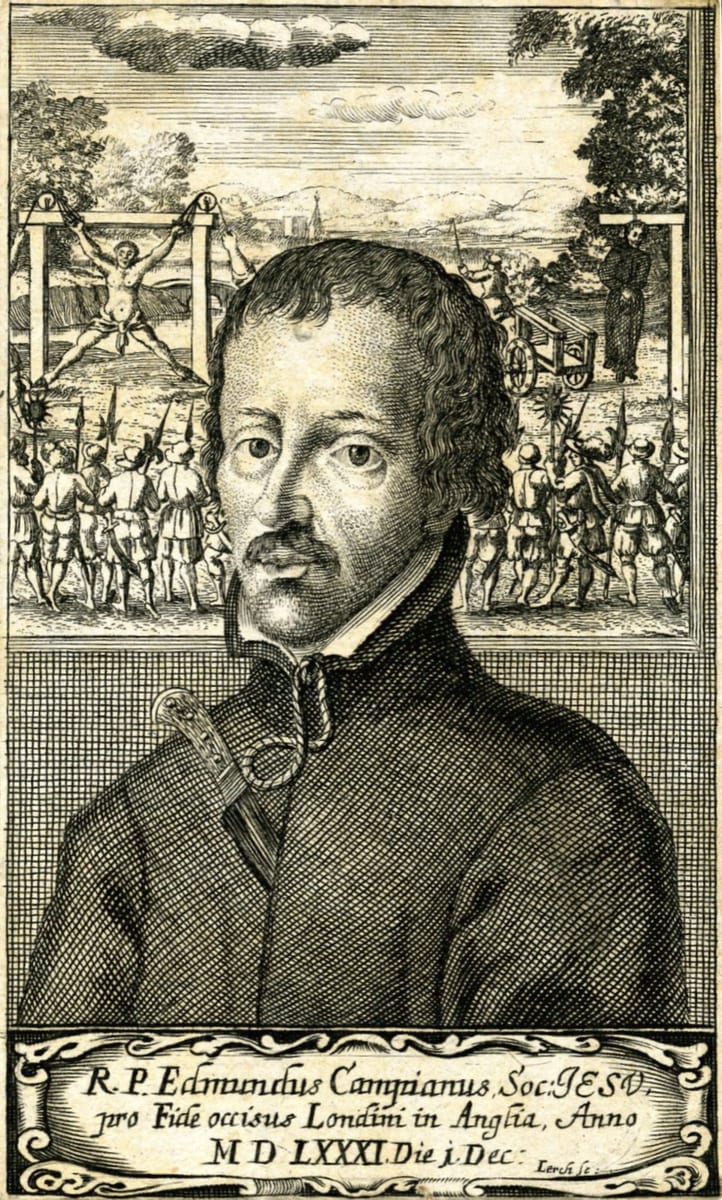
R. P. Edmundus Campianus, plate for Mathias Tanner's Jesuit martyrology, Johann Martin Lerch, c. 1671–1680 AD Johann Martin Lerch, British Museum On the rainy morning of December 1, 1581 AD, St. Edmund Campion was brought out in the gown of Irish frieze he had worn at his trial and strapped to a hurdle. St. Ralph Sherwin and St. Alexander Briant, the two priests who were to die with him, were bound together on a second, and both hurdles were dragged through the city to Tyburn. Passing under Newgate, he raised himself to salute the image of Our Lady above the arch.
At Tyburn he was put first into the cart under the gallows, and while he prayed a schoolmaster read out the government's declaration that the men were dying for treason, not for religion. Lord Charles Howard asked him which Queen he was praying for, and he answered that he prayed for Elizabeth, Howard's Queen and his own. Then the cart was drawn away, and amid the tears of the crowd he died, declaring himself a perfect Catholic.
“Well my Lord, I am a Catholic man & a Priest, in that faith have I lived hitherto, and in that faith I do intend to die, and if you esteem my religion Treason, then of force I must grant unto you, as for any other treason, I never committed, God is my judge.”
St. Edmund Campion to a lord of the Council at the gallows, December 1, 1581 AD


Pray with the Church
Te Deum
The opening words of the Te Deum (We praise you, O God; we acknowledge you to be the Lord), which St. Edmund Campion cried aloud in Westminster Hall when he was sentenced to death in November 1581 AD.
Te Deum laudamus,Te Dominum confitemur.
All 4 reports on Saint Edmund Campion

About this picture
AI-generated image, in the manner of a copperplate line engraving of the Catholic martyr-prints of 1584-1675, from the paper's reference portrait based on P. Edmondus Campianus, from Cornelius Hazart's Kerckelycke historie (anonymous Antwerp engraver, after the portrait painted for the Gesù in Rome, 1669, KU Leuven Libraries) View source artwork.
Sentenced to die, St. Edmund Campion answers the court with the Te Deum

About this picture
AI-generated image, in the manner of a copperplate line engraving of the Catholic martyr-prints of 1584-1675, from the paper's reference portrait based on P. Edmondus Campianus, from Cornelius Hazart's Kerckelycke historie (anonymous Antwerp engraver, after the portrait painted for the Gesù in Rome, 1669, KU Leuven Libraries) View source artwork.
A fellow prisoner kisses St. Edmund Campion's racked hand in Westminster Hall

About this picture
AI-generated image, in the manner of a copperplate line engraving of the Catholic martyr-prints of 1584-1675, from the paper's reference portrait based on P. Edmondus Campianus, from Cornelius Hazart's Kerckelycke historie (anonymous Antwerp engraver, after the portrait painted for the Gesù in Rome, 1669, KU Leuven Libraries) View source artwork.
Bishop of Gloucester keeps St. Edmund Campion's warning as his chief treasure

About this picture
AI-generated image, in the manner of a copperplate line engraving of the Catholic martyr-prints of 1584-1675, from the paper's reference portrait based on P. Edmondus Campianus, from Cornelius Hazart's Kerckelycke historie (anonymous Antwerp engraver, after the portrait painted for the Gesù in Rome, 1669, KU Leuven Libraries) View source artwork.