Saints Piedmont, 1842–1857 AD
Saint Dominic Savio
Feast 9 March · Born 1842 AD, Riva di Chieri, Piedmont, Italy · Died 1857 AD, Mondonio, Castelnuovo d'Asti, Piedmont, Italy
A blacksmith's son who was let to the altar rail at seven, worked on the other boys in a Turin playground, and died at fourteen.
Begin the life
In brief
Saint Dominic Savio, also called Domenico, was a Piedmontese blacksmith's son who at twelve became a pupil of Saint John Bosco at the Oratory of St Francis de Sales at Valdocco. He died at Mondonio on March 9, 1857 AD, aged fourteen. Pope Pius XII canonized him in 1954 AD, a schoolboy and not a religious or a cleric.
-
1842–1849 AD
The blacksmith's son
One of ten children in a blacksmith's house, he was admitted to First Communion at seven.
St. Dominic Savio was born at Riva di Chieri on April 2, 1842 AD. He was one of ten children of a blacksmith and a seamstress. The family moved to Murialdo, near Castelnuovo d'Asti, when he was two.
Children in Piedmont then waited until eleven or twelve for First Communion. The parish priest examined him, consulted the neighbouring priests, and admitted him at seven in 1849 AD. He asked his mother's pardon the night before.
“Tomorrow is my First Communion Day, so please forgive me all the wrong I have done you, and I promise to behave myself much better in the future. I will do better at school and be more respectful and more obedient.”
St. Dominic Savio to His mother, Brigid Savio, at home on the eve of his First Communion, 1849 AD -
1852–1853 AD
The charge he did not answer
He walked to school and back each day, and when a school offence was laid on him he hung his head and said nothing.
He started at the municipal school of Castelnuovo d'Asti on June 21, 1852 AD, not yet ten years old. The school was some distance from home and he walked there and back. His health began to fail, so in November 1852 AD the family moved to Mondonio.
In 1853 AD a school offence came to light that carried immediate expulsion. The culprit and his friends laid it on St. Dominic Savio, who hung his head and said nothing. The real culprits were found the next day, and the headmaster asked him why he had not cleared himself.
“I knew that the guilty boy was already under threat of expulsion for other things, but I hoped to be forgiven, since it was the first act of misconduct ever imputed to me at school. I also remembered that Our Lord had been unjustly accused.”
St. Dominic Savio to The priest at Mondonio, 1853 AD -
October–December 1854 AD
Valdocco
At twelve he asked a Turin priest to take him in, and was a boarder by the end of October.
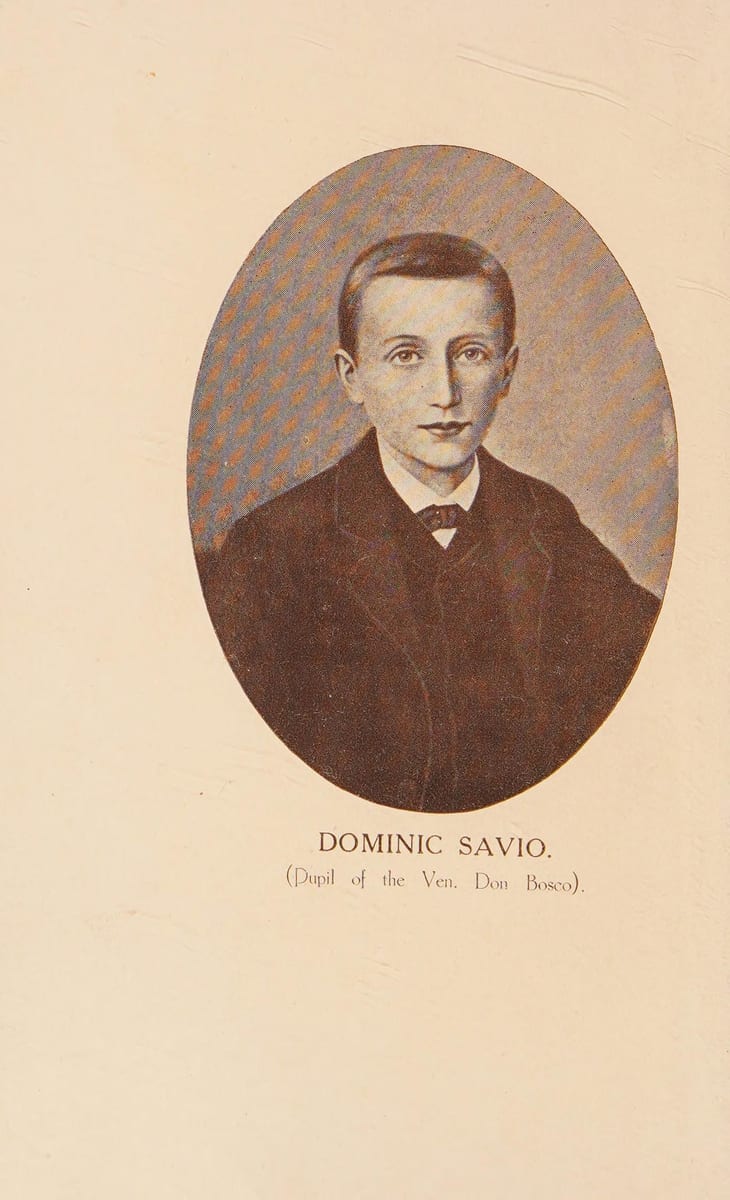
Dominic Savio (Pupil of the Ven. Don Bosco) — frontispiece plate to 'The Life of Dominic Savio' by St John Bosco, Salesian Press English edition, Unknown engraver, after the likeness first published by St John Bosco at Turin in 1859 AD in a plate signed C. Tomatis, 1915 AD (plate); the likeness descends from the engraving of 1858-1859 AD Unknown engraver, after the likeness first published by St John Bosco at Turin in 1859 AD in a plate signed C. Tomatis, Internet Archive (scan of the Salesian Press edition); the same plate is on Wikimedia Commons In October 1854 AD he walked with his father to Murialdo to meet Saint John Bosco. Handed a book and told to learn page nine, he came back and recited it within eight minutes. On October 29, 1854 AD he entered the Oratory of St Francis de Sales at Valdocco, outside Turin, as a boarder.
On December 8, 1854 AD Pope Pius IX defined the dogma of the Immaculate Conception at Rome. That evening St. Dominic Savio knelt at Our Lady's altar and renewed the promises of his First Communion. Pope Pius XII, canonizing him a century later, said that day saw him raised in an ecstasy of love towards the Virgin Mary.
“Then I must be the material and you are to fashion it; take me with you therefore.”
St. Dominic Savio to St. John Bosco, at Murialdo, at the first meeting, October 1854 AD -
1855–1856 AD
Penances forbidden
Offered a present, he asked to be made holy; his superiors took his penances away from him.
Six months into his time at Valdocco he heard a sermon on an easy way to the perfection of the saints. He began pressing for penances and for hours at a time in prayer.
He put sharp pieces of iron and wood in his bed and kept only summer coverings through January. Each device was found out and stopped, because his superiors judged them unsuitable for his years and his health. St. John Bosco told him instead that the penance God wanted from him was obedience.
“I do not desire anything else, but to become perfect; if I do not obtain that I shall be fit for nothing.”
St. Dominic Savio to St. John Bosco, at the Oratory, offered a present and choosing instead to be made holy, 1855 AD -
1856 AD
The stone fight
Two boys meant to settle a quarrel with stones, so he knelt down between them.
Two boys at the Oratory agreed to fight with stones and would not be talked out of it. St. Dominic Savio made them promise one condition first, without telling them what it was.
At the ground fixed for the fight he knelt between them and held up a crucifix. Neither boy would throw at him, and the quarrel ended there. Both of them went to Confession afterwards.
“Throw your stone at me; let me have the first blow.”
St. Dominic Savio to One of the quarrelling boys, kneeling between the two boys, 1856 AD -
1856 AD
The Company of the Immaculate Conception
He gathered his friends into a company under Our Lady's name and wrote its rule himself.
In 1856 AD he gathered companions into the Company of the Immaculate Conception and drew up its rule. The rules were read out before Our Lady's altar on June 8, 1856 AD, nine months before he died.
Pope Pius XII said he urged his companions to the sacraments, to the Rosary and to flight from temptation. Pope Pius XII added that bad receptions and insolent replies did not stop him.
“I would like to do something to honour Our Lady and I must do it soon or I shall be too late.”
St. Dominic Savio, at the Oratory, before founding the Company of the Immaculate Conception, 1856 AD -
1856 AD–March 1857 AD
Sent home
His strength gave way, the doctors sent him back to his parents, and he died nine days later.
The first signs of the illness that killed him appeared in the summer of 1856 AD. A doctor put the decline down to a delicate constitution and the constant strain of his mind. He left the Oratory for his father's house at Mondonio on March 1, 1857 AD.
The doctor there put him to bed and bled him ten times in four days. He asked his father to call the priest, and received the Last Sacraments. On March 9, 1857 AD he was given the Papal Blessing, and that evening he died, aged fourteen.
“Goodbye, father, goodbye; the priest wanted to tell me something else, but I cannot remember it now . . . . Oh! what a beautiful sight I behold”
St. Dominic Savio to His father, Charles Savio, March 9, 1857 AD -
1857–1954 AD
The little saint of Mondonio
The villagers kept his grave as a shrine, and Rome raised him to the altars a century after his death.
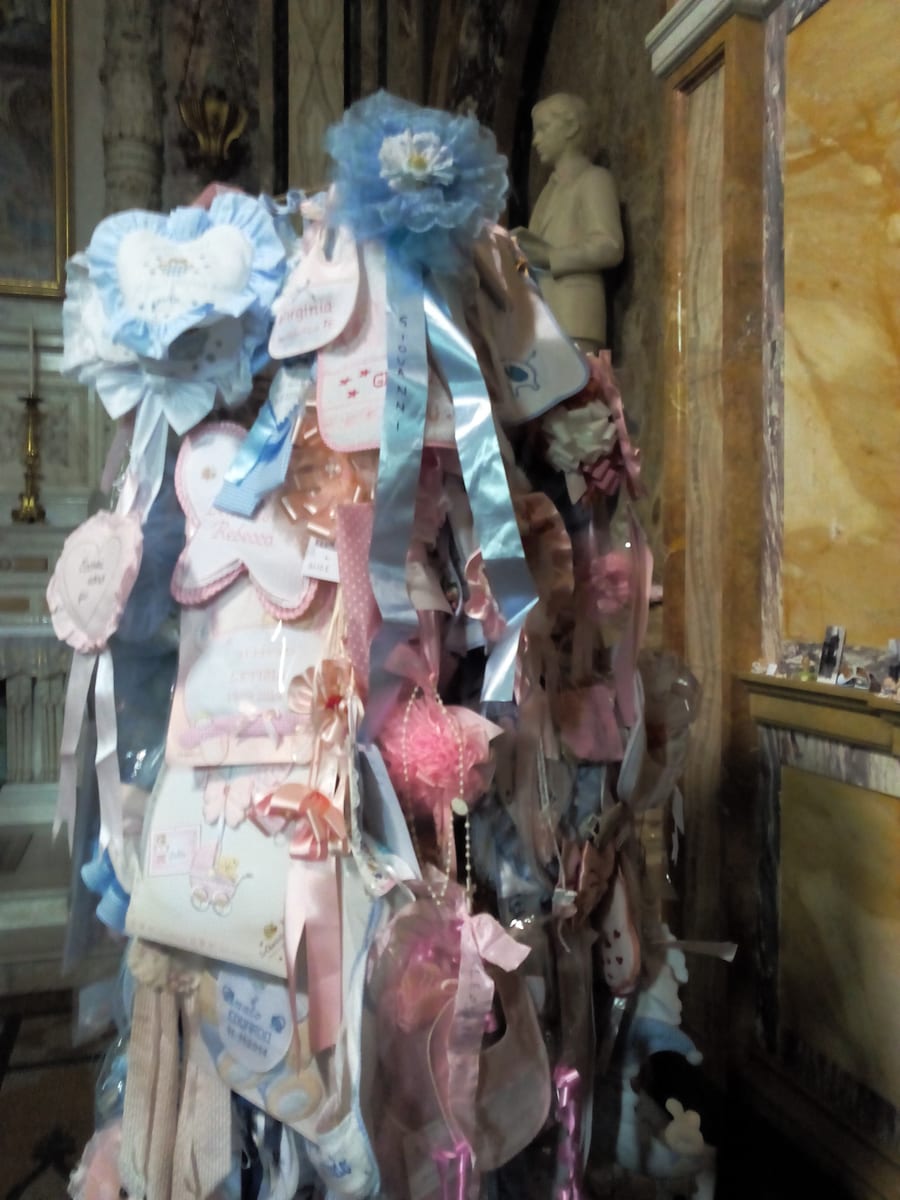
Cappella di San Domenico Savio, Basilica di Maria Ausiliatrice, Torino — ribbons hung in thanksgiving for a safe delivery, Betty&Giò (photographer), October 13, 2015 AD Betty&Giò (photographer), Wikimedia Commons They buried him in an ordinary grave in the little graveyard of Mondonio. The country people of the district called him their *piccolo santo* (*little saint*). In 1914 AD his remains were raised at nightfall, the villagers being hostile to their removal, and taken to the Basilica of Mary Help of Christians at Turin.
Pope Pius XII beatified him on March 5, 1950 AD, with crowds of young people filling St Peter's. Pope Pius XII canonized him in St Peter's Square on June 12, 1954 AD. The Church keeps his feast on March 9, the day he died.


Pray with the Church
The prayer St. Dominic Savio made before his anointing
His own words at Mondonio in March 1857 AD, spoken aloud before he received Extreme Unction, and set down by St. John Bosco in the life he wrote of his pupil.
Pardon my sins, O God, for I love Thee, and wish to love Thee for ever!May this Sacrament which Thou permitted me to receive in Thy infinite mercy, blot out all the sins I have committed by my hearing, sight, tongue, hands and feet;may my body and soul be sanctified through the merits of Thy passion. Amen.
All 3 reports on Saint Dominic Savio

About this picture
AI-generated image, in the manner of a monochrome relief engraving of the Turin devotional press of the 1850s, from the paper's reference portrait based on Dominic Savio (Pupil of the Ven. Don Bosco), frontispiece plate to 'The Life of Dominic Savio' by St. John Bosco (unknown engraver, after the likeness published by St. John Bosco in 1859 AD; 1915 AD, Internet Archive) View source artwork.
St. Dominic Savio learns a page by heart in eight minutes

About this picture
AI-generated image, in the manner of a monochrome relief engraving of the Turin devotional press of the 1850s, from the paper's reference portrait based on Dominic Savio (Pupil of the Ven. Don Bosco), the frontispiece plate to 'The Life of Dominic Savio' by John Bosco (unknown engraver, Salesian Press, 1915 AD, Internet Archive) View source artwork.
St. John Bosco tells how St. Dominic Savio found a dying man

About this picture
AI-generated image, in the manner of a monochrome relief engraving of the Turin devotional press of the 1850s, from the paper's reference portrait based on Dominic Savio (Pupil of the Ven. Don Bosco) — frontispiece plate to 'The Life of Dominic Savio' by St John Bosco, Salesian Press English edition (unknown engraver, after the likeness first published by St John Bosco at Turin in 1859 AD in a plate signed C. Tomatis, 1915 AD, Internet Archive) View source artwork.