Saints Priest of Turin and founder of the Salesians · 1815–1888 AD
Saint John Bosco
Feast 31 January · Born 1815 AD, The Becchi, Murialdo, Castelnuovo d'Asti (now Castelnuovo Don Bosco), Piedmont, Italy · Died 1888 AD, Oratory of St. Francis de Sales, Valdocco, Turin, Italy
A peasant boy from Piedmont lost his father before he was two, worked his way to the priesthood, gave the poor boys of Turin a home, schools and trades, founded the Salesians and died among them at Valdocco in 1888 AD.
Begin the life
In brief
Saint John Bosco, commonly known as Don Bosco, was born to peasant farmers at the Becchi, a hamlet in Piedmont, in 1815 AD. As a young priest in Turin he worked in the city's prisons, where he saw boys who had been released come back again. He spent the rest of his life giving Turin's poor boys, some of them homeless, a home, evening schools and workshops at Valdocco.
-
1815–1824 AD
A father lost, a dream at nine
A farm boy loses his father before he is two and, at about nine, has a dream he never forgets.
St. John Bosco was not yet two when his father, Francesco, died in May 1817 AD. His first memory was wanting to stay in the room with the body after everyone else had left. That year a drought ruined the crops, and the family had nothing else to live on.
When he was about nine, he dreamt of a courtyard full of swearing boys, and when he hit them a man told him to win them over with gentleness and charity instead. A woman then showed him wild animals that had turned into lambs. The next morning he told his mother, his brothers and his grandmother, and each of them gave the dream a different meaning.
“A suo tempo tutto comprenderai. (In good time you will understand everything.)”
The woman in his dream at about nine, to the boy Giovanni Bosco, at the close of his first dream, 1824 AD -
1826–1828 AD
The acrobat who led the prayers
He copies the fairground performers to draw the village boys to prayer, finds an old priest to teach him and is sent out to work on a farm.
At eleven St. John Bosco could juggle, somersault and dance on a rope like a fairground acrobat. He put on shows for the village boys in a meadow so that he could teach them the faith, and he ended them with prayer.
In April 1826 AD the old chaplain of Murialdo, Don Calosso, met him on the road home from a parish mission and began to teach him. Because his half-brother, Antonio, thought time spent on books was wasted, his mother sent him away in February 1828 AD, at twelve, to work as a farmhand at the Moglia farm. He later called his time there the most beautiful of his life.
“Per avvicinarmi, parlare, istruire nella religione tanti miei compagni, che non sono cattivi, ma diventano tali, perché niuno di loro ha cura. (I'd like to attract my companions, talk to them, and teach them our religion. They're not bad, but they become bad because they have no one to guide them.)”
St. John Bosco to Don Calosso, asked why he wanted to become a cleric, April 1826 AD -
1829–1841 AD
Odd jobs, a friary turned down, a priest
He pays his own way through school, nearly becomes a Franciscan and is ordained a priest in Turin.
In December 1829 AD his uncle, Michele Occhiena, found him at the farm and arranged for him to come home and study. Later, at school in Chieri, St. John Bosco paid his way as a tailor, waiter, stableman, carpenter, shoemaker and blacksmith. In 1834 AD the Franciscans accepted him, but days before he was due to enter their friary he dreamt of friars in worn habits running off in opposite directions.
Then the uncle of his friend Luigi Comollo, the parish priest of Cinzano, wrote that he should put off the friary, become a cleric and learn God's will while he studied. He entered the seminary of Chieri on October 30, 1835 AD. He was ordained a priest in the Archbishop's chapel in Turin on June 5, 1841 AD.
“Tu cerchi la pace e qui pace non troverai. Vedi l’atteggiamento de’ tuoi fratelli. Altro luogo, altra messe Dio ti prepara. (You're looking for peace, but you won't find it here. See what goes on! God's preparing another place, another harvest for you.)”
A friar in his dream of 1834, to Giovanni Bosco, a dream days before he was due at the Franciscan friary, 1834 AD -
1841–1846 AD
The boy in the sacristy
A boy thrown out of a church becomes his first pupil, and the gathering that grows around the young priest is turned out of one place after another.
On December 8, 1841 AD, as Don Bosco vested for Mass in the church of St. Francis of Assisi in Turin, a sacristan beat a boy and drove him out. Don Bosco took the side of the boy, Bartolomeo Garelli, and made him his first catechism pupil. By February 2, 1842 AD, about twenty boys were coming to him, and he called the gathering an Oratory because every lesson began and ended with prayer.
In July 1845 AD the Marchioness Barolo, at whose house at Valdocco he was assistant chaplain, took back the rooms she had set aside for the Oratory, and the boys carried their benches to the church of San Martino. After more moves, the other tenants of Casa Moretta complained of the noise, and in March 1846 AD Don Bosco gave up its rooms and rented a meadow. On Easter Sunday, April 12, 1846 AD, the Oratory moved into a shed at Valdocco, which became its permanent home.
“mio Dio, perché non mi fate palese il luogo in cui volete che io raccolga questi fanciulli? (My God, why don't you show me where you want me to gather these children?)”
St. John Bosco to God, walking alone on the evening of the last Sunday in the meadow, March 15, 1846 AD -
1846–1854 AD
A mother at Valdocco, a knife at the gate
His mother leaves the farm to keep house for the boys, and in 1854 AD a man with a knife attacks him at the Oratory gate.
In July 1846 AD, worn out, Don Bosco fell seriously ill with an inflammation of the lungs and went home to the Becchi to recover. On November 3, 1846 AD, at his request, his mother, Margherita, walked with him from the Becchi to Valdocco to keep house for the boys. The boys called her Mamma Margherita (*Mother Margherita*).
In January 1854 AD two men called on Don Bosco to make him stop publishing his popular Catholic booklets, and he refused. That August a man with a long knife attacked him at the Oratory gate as his boys stood around him. The police arrested the man at half past nine that night.
“Io non ho mai potuto sapere il vero motivo di tali vessazioni, ma sembra che ogni cosa fosse sempre ordita ad attentarmi la vita per farmi desistere, essi dicevano, dal calunniare i protestanti. (I never could discover the real reason for this persecution, but it seems that all these attempts on my life were intended to make me stop, they would say, calumniating the Protestants.)”
St. John Bosco, on the attempts on his life, 1854 AD -
1858–1875 AD
A Society of his own, a ship for Argentina
The Pope backs his plan for a religious society, its Rules are approved and his first missionaries sail for Argentina.
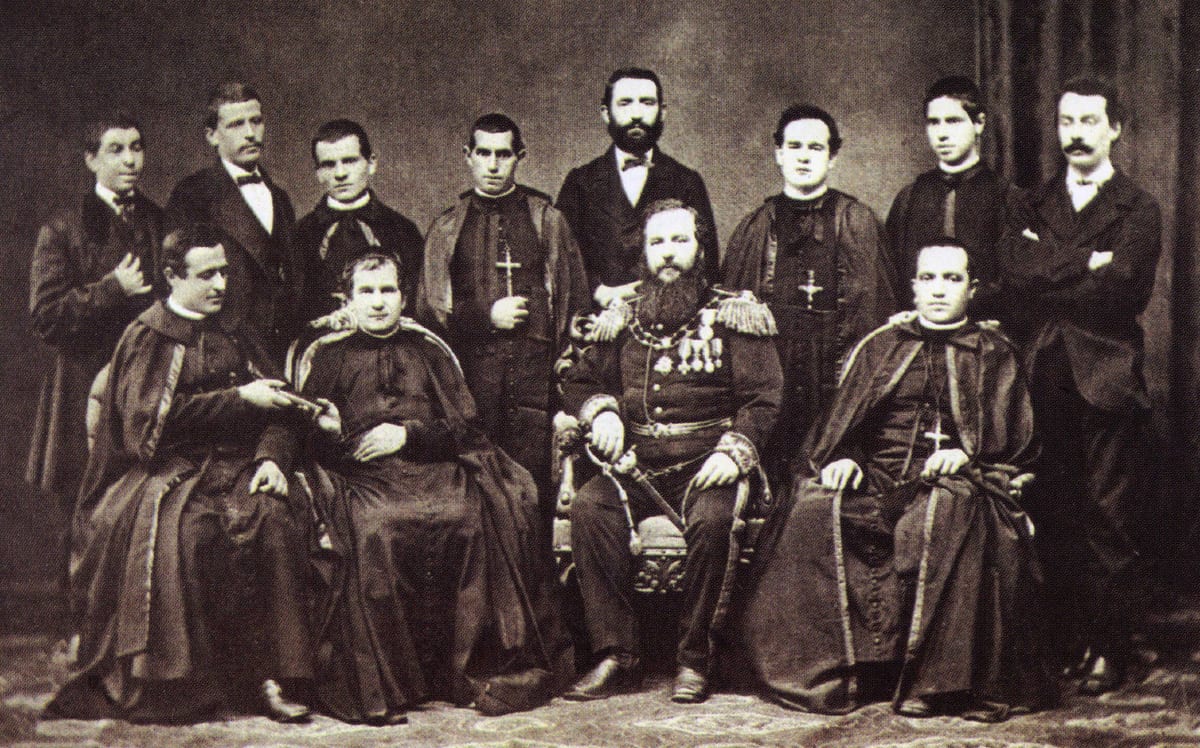
Giovanni Bosco, Giovanni Battista Gazzolo, Giovanni Cagliero (1875 AD) — the departure of the first Salesians for Argentina, Michele Schemboche (1828–1908 AD) Michele Schemboche (1828–1908 AD), Archivo Central Salesiano – Sede Inspectorial, Buenos Aires (via Wikimedia Commons) In 1858 AD Don Bosco took his plan for a religious society to Pope Pius IX in Rome. Pope Pius IX told him a society bound by simple vows seemed necessary in such troubled times. By then a group of priests, clerics and laymen was already living together at Valdocco under the rules of the society he planned.
In 1872 AD he founded the Daughters of Mary Help of Christians to educate girls. He took letters of support from twenty-four bishops to Rome, and in 1874 AD the Society's Rules were approved. On November 11, 1875 AD, his first missionaries sailed under Don Giovanni Cagliero, and they landed at Buenos Aires, Argentina, on December 14.
“da mihi animas, caetera tolle. (Give me souls; take away everything else!)”
The motto on the card in Don Bosco's room, read by Dominic Savio on his arrival, 1854 AD -
1887–1888 AD
Tears at an altar, a joke on the deathbed
In Rome he weeps through a Mass at the memory of his childhood dream, and months later he dies at Valdocco.
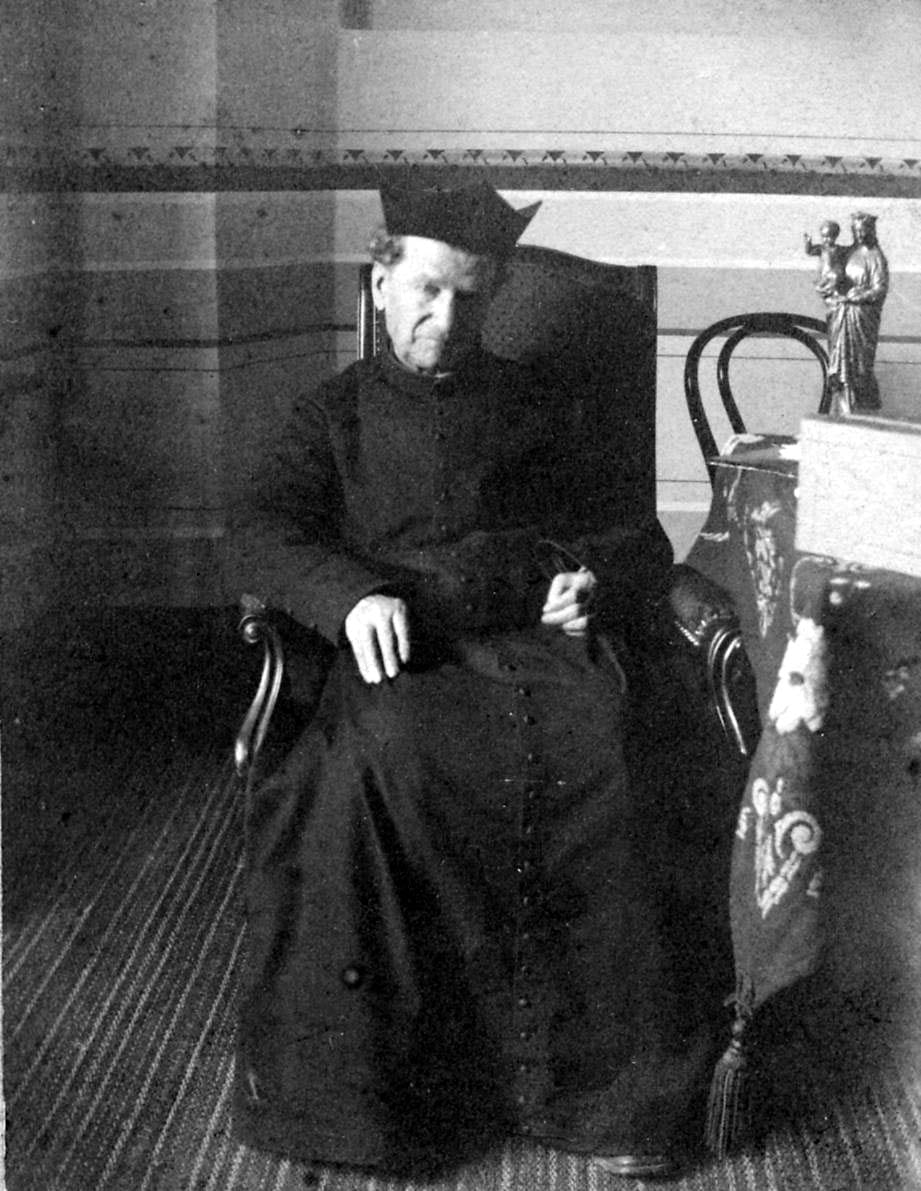
Bosco in his old age, Unknown, c. 1880s (Commons) Unknown, Wikimedia Commons (source: infoans.org, 'RMG – Conocer a Don Bosco: las imágenes más realistas y veraces') In May 1887 AD Don Bosco said Mass in the Sacred Heart church he had built in Rome. He stopped at least fifteen times, overcome and weeping. Afterwards he told his secretary, Don Viglietti, that he had seen again, as if alive, his childhood dream and his mother and brothers arguing over what it meant.
Late in 1887 AD he fell gravely ill, and the illness lasted forty days. On January 15, 1888 AD, short of breath, he joked that he needed someone to mend his bellows. He died at Valdocco at a quarter to five on the morning of January 31, 1888 AD, aged seventy-two.
“O miei cari figlioli, si avvicina il tempo nel quale dovrò distaccarmi da voi e partire per la mia eternità (Oh, my beloved children, the time is drawing near when I shall have to leave you for eternity.)”
St. John Bosco to the boys and Salesians of Valdocco, closing the Letter from Rome, May 10, 1884 AD -
1888–1934 AD
A city in mourning, a saint at Easter
Many of Turin's shops close for his death, crowds line his funeral route and Pope Pius XI declares him first Blessed, then a saint.
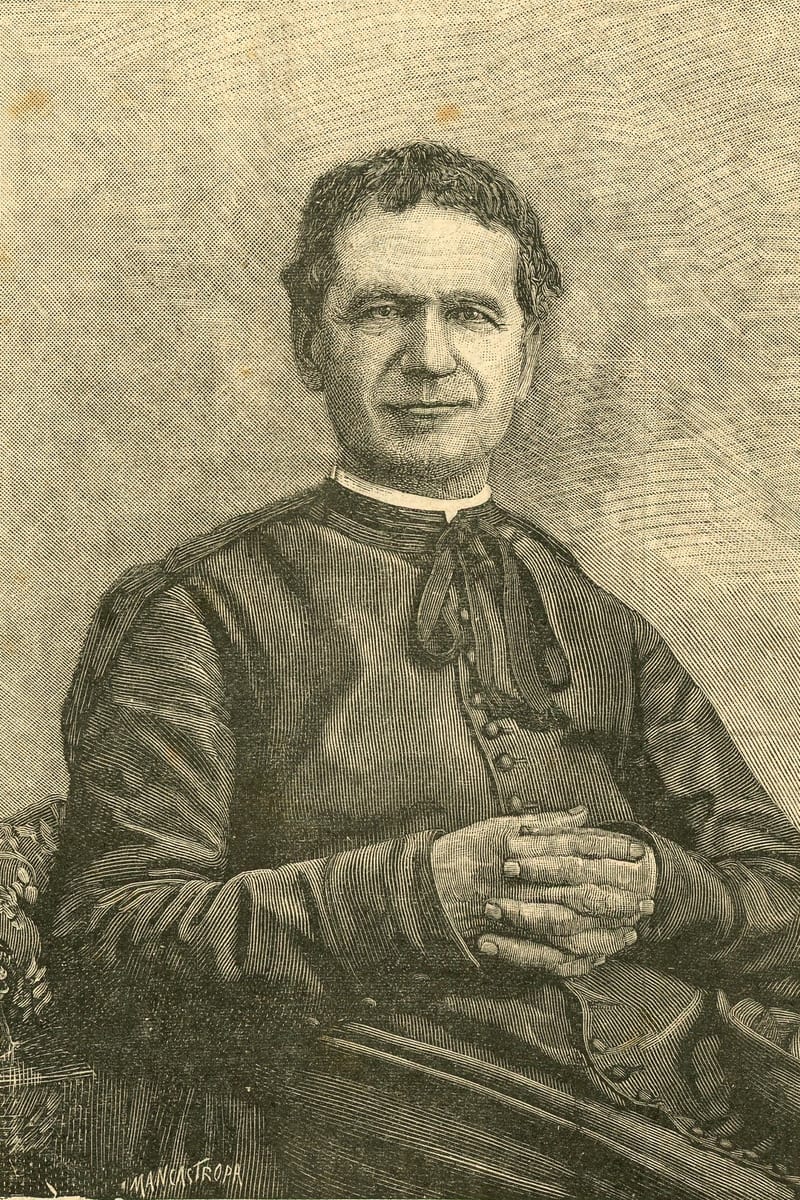
Don Bosco, engraving for the "Galleria dei contemporanei", 1888 AD, Ernesto Mancastroppa Ernesto Mancastroppa, L'illustrazione popolare, Fratelli Treves Editori, Milan, 1888 AD (via Wikimedia Commons) As news of the death spread, many of Turin's shops closed and the newspapers sold out. On February 2, 1888 AD, about six thousand people walked behind his coffin. More than a hundred thousand watched along the route.
Pope Pius XI beatified him in St. Peter's Basilica on June 2, 1929 AD. The same Pope canonized him there on Easter Sunday, April 1, 1934 AD. Pope Pius XI called him *educator princeps* (*the first among educators*).


.jpg)

.jpg)
Pray with the Church
His prayer on the day he became a cleric
St. John Bosco prayed these words when he was clothed as a cleric. He wrote them down in his Memorie dell'Oratorio (*Memoirs of the Oratory*). In them he asks God to make him a new man who begins a new life, and asks Mary to be his salvation.
Si, o mio Dio, fate che in questo momento io vesta un uomo nuovo, (Yes, O my God, grant that at this moment I may put on a new nature.)cioè che da questo momento io incominci una vita nuova, tutta secondo i divini voleri, (May I henceforth lead a new life in complete conformity with your holy will.)e che la giustizia e la santità siano l'oggetto costante de' miei pensieri, delle mie parole e delle mie opere. (May justice and holiness be the constant objects of my thoughts, words, and actions.)Così sia. (Amen.)O Maria, siate voi la salvezza mia. (O Mary, be my salvation.)
All 2 reports on Saint John Bosco

About this picture
AI-generated image, in the manner of a monochrome relief engraving of the Turin devotional press of the 1850s, from the paper's reference portrait based on Dominic Savio (Pupil of the Ven. Don Bosco), frontispiece plate to 'The Life of Dominic Savio' by St. John Bosco (unknown engraver, after the likeness published by St. John Bosco in 1859 AD; 1915 AD, Internet Archive) View source artwork.
St. Dominic Savio learns a page by heart in eight minutes
