
Saints Irish abbot, founder of Luxeuil and Bobbio · died 615 AD
Saint Columban
Feast 23 November · Born 543 AD, Leinster, Ireland · Died November 23, 615 AD, Bobbio, Italy
An Irish monk left Bangor as a pilgrim for Christ, built monasteries in Burgundy until a queen and a king drove him out, and died in Lombard Italy at Bobbio, the last house he founded.
Begin the life
In brief
Saint Columban was an Irish monk who left Bangor with twelve companions as a pilgrim for Christ. In Burgundy he founded the monasteries of Annegray and Luxeuil, until the royal court expelled him in 610 AD. He founded his last monastery at Bobbio in Lombard Italy and died there in November 615 AD.
-
Sixth century AD · Leinster
A young man asks a hermit what to do
Troubled by temptation, the young St. Columban goes to a holy woman living alone, and she tells him to leave home.
St. Columban grew up in Leinster, one of the four principal provinces of Ireland. Irish custom was to send a child to be raised by others, but his mother would not hand him even to her nearest relatives. As a young man he was handsome, and women of his country tempted him.
Unable to decide what to do, he went for advice to a holy woman who lived in fasting and prayer in a small hermitage some distance from his home. She reminded him that Samson, David and Solomon had all been led astray by the love of women. She had left her father's house to fight temptation, and she urged him to leave his own country and flee.
“evade ruinam, per quam multos conperis corruisse, declina viam, quae inferi ducit ad valvas (...which you see so many hopelessly entangled! Turn aside from the path that leads to the gates of Hell!)”
A holy woman recluse to St. Columban, ending her counsel to him -
Leinster and Lough Erne
His mother lies across the door
St. Columban's mother throws herself on the threshold to keep him home; he answers her from the Gospel and goes to study Scripture.
When St. Columban decided to leave home for the religious life, his mother tried to stop him. She threw herself down across the threshold of the door. Wailing on the floor, she said she would not let him go.
St. Columban answered her with the Gospel saying that whoever loves father or mother more than Christ is not worthy of him, and he left. His first master was St. Sinell, abbot of Cleenish on Lough Erne, under whom he studied Sacred Scripture. There, still very young, he wrote a commentary on the Psalms.
“Non audisti: Qui amat patrem aut matrem plus quam me, non est me dignus? (Have you not heard the words of the Saviour: 'He that loveth father or mother more than Me, is not worthy of Me'?)”
St. Columban to his mother, leaving home as she lay across the threshold to stop him -
Bangor, County Down
Long years at Bangor, then the call to leave
St. Columban becomes a monk and priest under St. Comgall, and after many years asks to go abroad as a pilgrim for Christ.
At about twenty, St. Columban entered the monastery of Bangor in the north-east of Ireland. Its abbot, St. Comgall, was known for his virtue and the severity of his discipline. St. Columban lived there for many years in prayer, fasting and study, and was ordained a priest.
In time he told St. Comgall of a burning desire to leave Ireland on the *peregrinatio pro Christo* (*pilgrimage for Christ*), the ascetic ideal of the Irish monasteries. St. Comgall did not want to lose him and refused at first, but in the end he agreed. Twelve monks went with St. Columban, among them St. Gall, who had been placed in his care as a boy.
“ieiuniis vacare coepit et iugum Christi, quod ferentibus leve est, super se ferre semetipsumque sibi abnegando ac crucem suam tollendo Christum sequere (He gave himself up entirely to fasting and prayer, to abnegation of self, and to the faithful carrying of the sweet yoke of Christ; for his only aim was to follow Christ by taking up His Cross and becoming like unto Him.)”
Jonas of Bobbio, describing his years as a monk at Bangor -
Burgundy
Monasteries in the forests of the Vosges
The Irish monks cross to Gaul, and St. Columban founds Annegray, Luxeuil and Fontaine in the kingdom of Burgundy.
The small group passed through Britain and landed on the coast of Brittany. They made their way into the kingdom of Burgundy and the forests of the Vosges. There St. Columban founded his first monastery, at Annegray.
King Childebert II of Burgundy gave him the site of the once-famous baths of Luxovium, where the monastery of Luxeuil rose. A third house followed at Fontaine, and his name spread through Gaul and Germany. The rule St. Columban wrote had each monk confess his small faults as well as his grave sins, before meals or before going to bed.
“de omnibus non solum capitalibus criminibus sed etiam de minoribus neglegentiis … quia confessio et paenitentia de morte liberant. Ergo nec ipsa parva a confessione sunt neglegenda peccata, quia ut scriptum est, Qui parva neglegit paulatim defluit (We must accuse ourselves not merely of our grievous sins but also of our lesser faults, because confession and penance save the soul from death, and the Scripture tells us: 'He that contemneth small things, shall fall by little and little')”
St. Columban to his monks, on daily confession, in his Rule -
Luxeuil, from about 600 AD
A quarrel over the date of Easter
St. Columban's monks keep Easter by the Irish reckoning; he argues it with Pope St. Gregory the Great and will not go before the bishops of Burgundy.
St. Columban's monasteries kept Easter by the Irish reckoning, which put their Easter on a different day from the rest of Gaul's. Around 600 AD he wrote to Pope St. Gregory the Great to argue the question. Pope Benedict XVI noted in 2008 AD that this letter is the first text to use the words *totius Europae* (*of all Europe*) of the Church across the continent.
In 602 AD his monks kept Easter a week before everyone else in Gaul. The bishops of Burgundy summoned him to a synod at Chalon-sur-Saône to explain how his monasteries kept Easter and did penance. He did not go, and wrote asking only to be left to live in silence in the forests, near the graves of seventeen of his monks.
“huius diversitatis auctor non sim ac pro Christo salvatore, communi domino ac Deo nostro, in has terras peregrinus processerim (I am not the author of this divergence. I came as a poor stranger into these parts for the cause of Christ, Our Saviour.)”
St. Columban to the Frankish bishops in synod, in his letter to the synod on the Easter reckoning, 603 AD -
610 AD
Driven out of Luxeuil
St. Columban refuses to bless the king's sons by his concubines, a decree exiles every Irish monk, and the ship meant to take him home runs aground.
Queen Brunhild, grandmother of King Theuderic II, kept the king from marrying because she feared a queen would cut down her own power. She brought the king's sons by his concubines to St. Columban for a blessing, and he refused: he told her the boys would never be kings, since they were born outside marriage. In 610 AD Queen Brunhild and King Theuderic II banished him and every monk of Irish origin from Luxeuil for good.
Guards took the exiles to Nantes, where a ship paid for by the court waited to carry them to Ireland. Not far from shore the ship ran aground. The captain took it as a sign from Heaven, gave up the voyage and put the monks back on land.
“Nequaquam, inquid, istos regalia sceptra suscepturus scias, quia de lupanaribus emerserunt. (Know this, that these boys shall never hold the kingly sceptre, for they are the offspring of incontinence and crime.)”
St. Columban to Queen Brunhild, refusing to bless King Theuderic II's sons -
From 611 AD
He will not pray against his enemy
St. Columban finds a new royal patron, refuses to pray against the king who exiled him, parts from St. Gall and crosses into Lombard Italy.
After the ship turned back, St. Columban went in 611 AD to the court of King Theudebert II of Austrasia, brother of the king who had exiled him, and King Theudebert became his patron. When war broke out between the two brothers, his disciple Chagnoald urged him to pray for King Theudebert's victory. St. Columban refused, because the Lord had commanded his followers to pray for their enemies.
King Theudebert was overthrown at Zülpich in 612 AD, and St. Columban set out for Italy. St. Gall, pleading illness, asked to stay behind at Bregenz on Lake Constance; St. Columban told St. Gall that St. Gall did not want to share the hardships of the pilgrimage, and forbade St. Gall to say Mass while St. Columban lived. In Lombard Italy, King Agilulf welcomed him at Milan and gave him land at Bobbio in the Trebbia valley, where he founded his last monastery.
“Stultum ac religione alienum consilium administras. Non enim ita Dominus voluit, qui nos pro inimicis nostris orare rogavit; in arbitrio esse iam iusti iudicis, quid de eis fieri velit. (The advice you give is foolish and foreign to religion. For the Lord did not will it so, who asked us to pray for our enemies; it is now for the just Judge to decide what he wills to be done with them.)”
St. Columban to Chagnoald, his disciple, when Chagnoald urged him to pray against King Theuderic II, 612 AD -
November 615 AD
Death at Bobbio, and a staff for St. Gall
St. Columban dies at Bobbio about a year after founding it; Catholic Tradition remembers his parting gift to St. Gall.
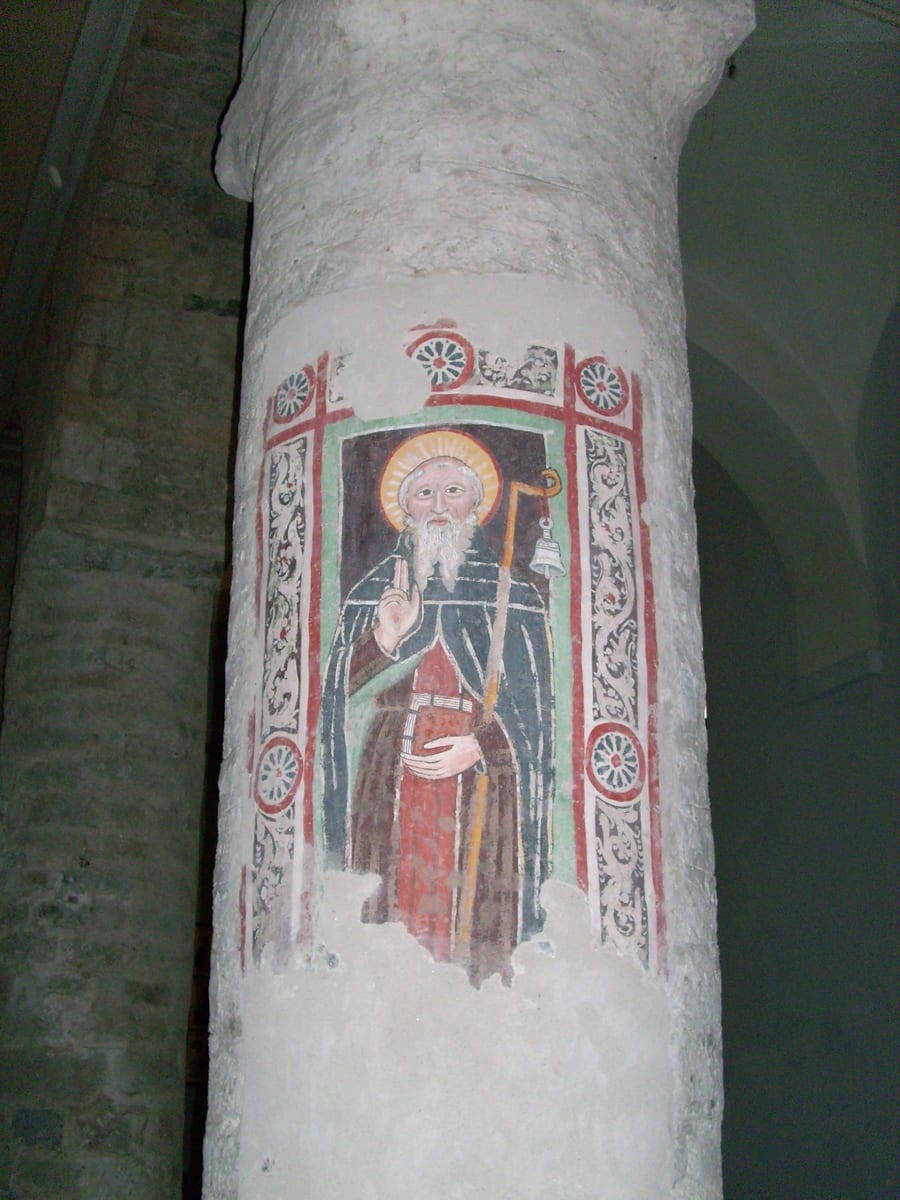
San Colombano benedicente (St. Columban blessing), fresco on a column of the cathedral of Brugnato, Unknown Italian painter (SIGEC: 'ambito italiano'); photograph by Davide Papalini, 2007 AD, 14th century (SIGEC: 1300–1399 AD; Torriti 14th or 15th c.; Tomaini early 15th c.) Unknown Italian painter (SIGEC: 'ambito italiano'); photograph by Davide Papalini, 2007 AD, Concattedrale dei Santi Pietro, Lorenzo e Colombano, Brugnato (La Spezia), Italy; catalogued in the Italian state catalogue SIGEC as ICCD 07/00030282 (https://sigecweb.beniculturali.it/sigec/item/print/ICCD4245950) St. Columban was old and ill in his last years. He governed Bobbio for about a year and died there in November 615 AD. Pope Benedict XVI said in 2008 AD that the Roman rite still commemorates him on November 23, the day of his death.
According to longstanding Catholic Tradition, St. Gall learned in a vision after the night's vigils that his master had died, and had the altar made ready to offer Mass for him. The monks of Bobbio then sent St. Gall his master's staff as a sign of forgiveness, as St. Columban had asked before he died.
“Porro beatus Columbanus, expleto anni circulo, in antedictu caenubio Ebobiensi vita beata functus, animam membris solutam caelo reddidit VIIII. Kl. Decembris. (The blessed Columban, having spent a year in the cloister of Bobbio, ended his godly life and rendered his soul to Heaven on the twenty-third of November.)”
Jonas of Bobbio, recording St. Columban's death in his Life of St. Columban


Pray with the Church
The favourite prayer of St. Columban
The prayer St. Columban is recorded as saying in his hermitage near Annegray, in the English printed by George Metlake, The Life and Writings of Saint Columban (1914 AD), p. 123–124.
O Lord God, eradicate, extirpate from my soul whatever the adversary has planted therein;take away from my heart and from my lips all iniquity;enlighten my mind and strengthen my will that I may serve Thee alone in deed and in truth.Give me, O Lord, memory, charity, chastity, faith;give me whatever Thou knowest to be profitable to my soul.
All 4 reports on Saint Columban

St. Columban dies at Bobbio, sending St. Gall his staff in forgiveness

Reluctant abbot sends Saint Columban to sea with twelve hand-picked monks

About this picture
AI-generated image, in the manner of a fourteenth-century North Italian fresco, from the paper's reference portrait based on San Colombano benedicente (unknown Italian painter, 14th century, Concattedrale dei Santi Pietro, Lorenzo e Colombano, Brugnato, Italy; photograph by Davide Papalini, CC BY-SA 3.0) View source artwork.
At about twenty, St. Columban enters Bangor and stays thirty years

About this picture
AI-generated image, in the manner of a fourteenth-century North Italian fresco, from the paper's reference portrait based on San Colombano benedicente (unknown Italian painter, 14th century, Concattedrale dei Santi Pietro, Lorenzo e Colombano, Brugnato, Italy; photograph by Davide Papalini, CC BY-SA 3.0) View source artwork.