
Saints Cardinal and Archbishop of Milan · 1538–1584 AD
Saint Charles Borromeo
Feast 4 November · Born October 2, 1538 AD, Rocca (castle) of Arona, Lake Maggiore, Duchy of Milan · Died November 3, 1584 AD, Archbishop's palace, Milan
Made a cardinal at twenty-one by his uncle the Pope, St. Charles Borromeo refused to marry, went to live among his people in Milan, survived an assassin's shot, stayed with them through the plague and died there at forty-six.
Begin the life
In brief
Saint Charles Borromeo, a count's son and a nephew of Pope Pius IV, was the Archbishop of Milan who put the reforms of the Council of Trent into force in his diocese. St. Charles Borromeo entered Milan in 1565 AD and lived there from 1566 AD until his death in 1584 AD, holding councils of his clergy and visiting parishes up into the Alpine valleys. Pope Paul V canonised him on November 1, 1610 AD, and fixed his feast for November 4.
-
1538–1559 AD
A boy of the castle at Arona
St. Charles Borromeo was born on Lake Maggiore to a count, took the tonsure at twelve and earned a law doctorate at Pavia.
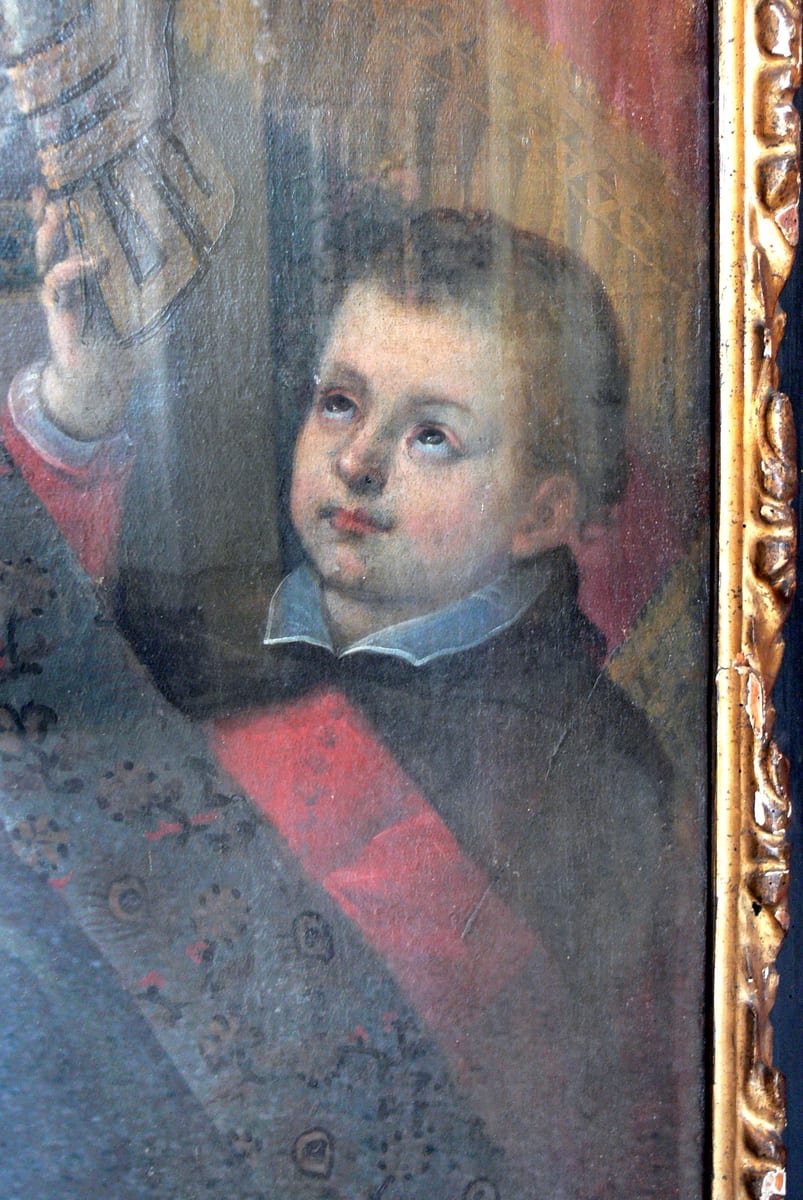
Painting of the young St. Charles Borromeo, Unknown painter, undated Unknown painter, Palazzo Borromeo, Isola Bella, Lake Maggiore; photograph by Wolfgang Sauber, CC BY-SA 3.0 St. Charles Borromeo was born before dawn on October 2, 1538 AD, in the castle of Arona on Lake Maggiore. His mother, Margherita de' Medici, was a sister of the cardinal who later became Pope Pius IV. According to longstanding Catholic Tradition, the soldiers on guard saw a bright band of light over the room where he was born.
As a boy he built and decorated little altars and chapels and sang the divine office. When he was twelve, his father let him receive the tonsure, the rite that made him a cleric. He studied civil and church law at Pavia and took his doctorate there in 1559 AD.
-
1559–1563 AD
Cardinal at twenty-one
St. Charles Borromeo's uncle became Pope and called him to Rome, where he was made a cardinal and Archbishop of Milan.
In December 1559 AD the cardinals elected his mother's brother Pope Pius IV, and the new Pope called his nephew to Rome. On January 31, 1560 AD, at twenty-one, St. Charles Borromeo was made a cardinal. On February 8 the Pope made him Archbishop of Milan, but he stayed in Rome and ran the diocese through deputies he sent there.
He also ran the government of the papal states for his uncle. From Rome he handled much of the Pope's correspondence with the Council of Trent, the meeting of bishops that resumed in January 1562 AD after years of suspension and closed in December 1563 AD. Francesco Pena, dean of the Rota, later wrote that the council was brought to its close through St. Charles Borromeo's own work.
“piacesse a Dio, che l'avessimo adesso ancora, perciocché non permetterebbe che si mandasse il grano altrove, come altri fanno dandoci occasione di carestia con tanto danno de' poverelli. (Would to God that we had him now. He would not allow grain to be exported as is done now, while the poor suffer.)”
An old man of the Romagna to Giussano -
1562–1563 AD
A brother's death and a refusal to marry
When St. Charles Borromeo's only brother died, he was pressed to marry and became a priest instead.
On November 28, 1562 AD, his elder and only brother, Count Federico Borromeo, died suddenly of a fever. Federico had been the head of the family, and its hopes of an heir now rested on St. Charles Borromeo. Many people whose word carried weight with him urged him to leave the clergy and marry so the family line would go on.
Instead he moved quickly to be ordained a priest. Cardinal Federigo Cesa ordained him in Santa Maria Maggiore on September 4, 1563 AD. His uncle, Pope Pius IV, complained to him that he had taken holy orders instead of marrying as planned.
“Padre santo, ella non si quereli di me, perciocché ho presa la sposa lungo tempo fa molto da me desiderata. (Do not be displeased with me, Holy Father. I am now wedded to the spouse whom I have so long desired.)”
St. Charles Borromeo to Pope Pius IV, 1563 AD -
1565–1570 AD
The archbishop comes to Milan
St. Charles Borromeo came to live in Milan, was hailed as a second St. Ambrose and soon clashed with the King of Spain's officials.
St. Charles Borromeo left Rome to live in his diocese and entered Milan on Sunday, September 23, 1565 AD, aged twenty-six. The crowds hailed him as a second St. Ambrose, the patron of Milan. The next Sunday he preached in the cathedral on Luke 22:15, the verse about desiring with desire to eat this pasch.
In 1567 AD he had laymen living in open adultery jailed, and the King of Spain's officials in Milan said he had no right to do it. On August 30, 1569 AD, the canons of the royal church of Santa Maria della Scala refused to let him inspect it, and when he came in his vestments their armed men, shouting the name of Spain, pushed him outside and shut the door. After praying before the Blessed Sacrament he excommunicated the canons, and when they later asked his pardon he absolved them before the cathedral doors on February 5, 1570 AD.
“ben posso dire, desiderio desideravi, hoc pascha manducare vobiscum. (With desire I have desired to eat this pasch with you)”
St. Charles Borromeo to the people of Milan, his first sermon in the Duomo after his entry into Milan -
1568–1571 AD
Shot in the back at prayer
A friar of the religious order St. Charles Borromeo was reforming fired at him as he knelt at evening prayer.
In 1568 AD he set out to reform the Humiliati, a religious order of which he was the protector, and the reform met fierce resistance inside the order. On October 26, 1569 AD, a Humiliati friar called Farina fired an arquebus at him from four or five yards as he knelt at evening prayer in his chapel. The ball struck the middle of his back but did not go through his clothes, and that evening he found no wound, only a small bruise.
That night the governor of Milan visited him and published an edict saying he had come through unharmed by the grace and miracle of God. Farina and three other conspirators, all clergy, were stripped of their orders, handed to the civil power and executed in July 1570 AD. Pope St. Pius V suppressed the Humiliati on February 7, 1571 AD.
-
1576–1577 AD
Staying with the sick in the plague
When plague came and Milan's governor and nobles fled, St. Charles Borromeo made his will and went among the sick.
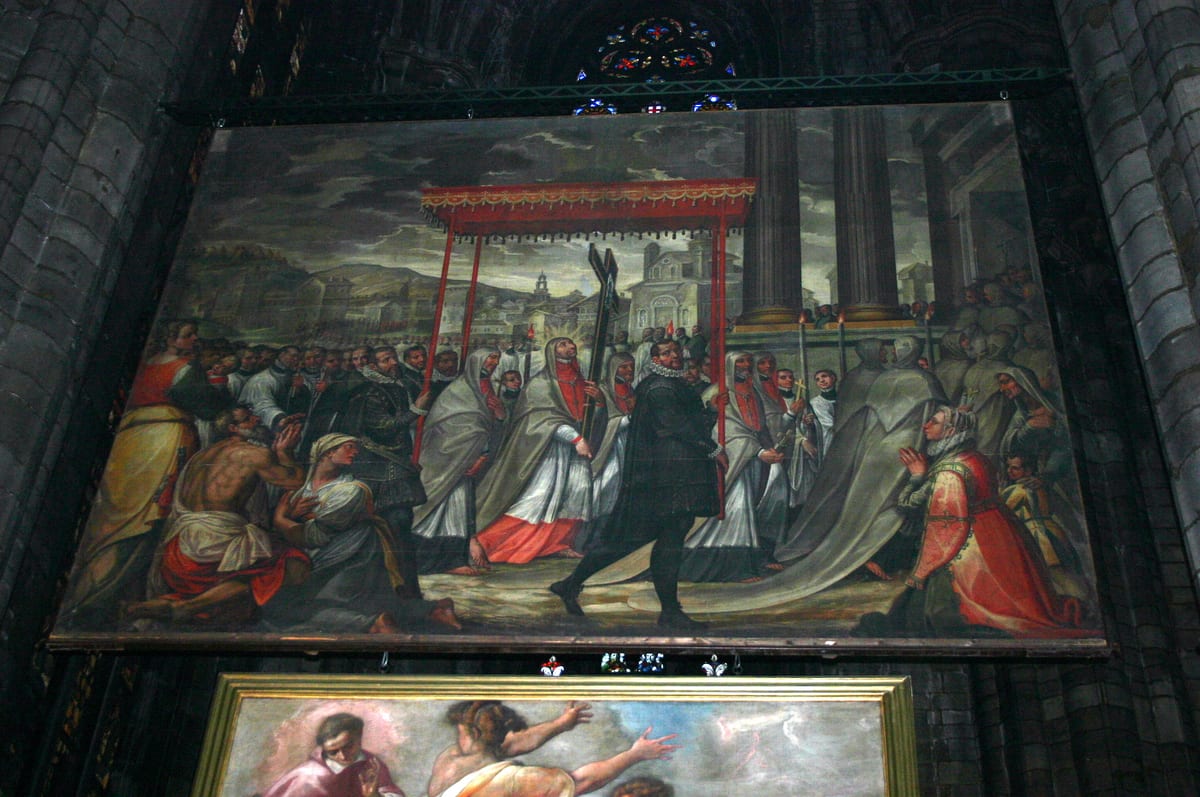
St. Charles Borromeo carries the Holy Nail in procession (Quadroni di San Carlo), Il Fiammenghino (Giovanni Mauro della Rovere), 1602 AD Il Fiammenghino (Giovanni Mauro della Rovere), Milan Cathedral; photograph by Giovanni Dall'Orto Plague reached Milan in 1576 AD while he was at Lodi, and the governor and the nobility fled the city. St. Charles Borromeo hurried back, made his will on September 9 and went to care for the sick himself. He called the superiors of the religious houses to his palace and urged them to serve the sick, and twenty-eight of them offered themselves.
He often visited the plague hospital of San Gregorio and people shut in by the quarantine, holding only a sponge soaked in vinegar against infection. By December 1576 AD his letters counted about thirteen thousand dead in the city. Early in 1577 AD he walked barefoot through the snow, dressed as a penitent, in the jubilee processions.
“avete considerata la misera condizione di quei poverelli, i quali non solo restano afflitti dal male e tormentati dal dolore di ritrovarsi in quell' infelice stato, ma ancora si veggono privi di ogni necessario aiuto, non tanto del corpo, quanto, che molto più importa, dell' anima, e non si trova pure un sacerdote che avendo compassione a tanta calamità, si muova per aiutarli? Da me vien forse la causa di questo male, perchè non sono il primo a mettermi alla prova di soccorrerli per far animo e dare in questo modo buon esempio agli altri. Però se Iddio non provvede per altra via, so quando mi converrà fare. (Have you fully realised the depth of wretchedness of these poor people, not plague-stricken alone, but forsaken of men, and what is far more deplorable, destitute of spiritual succour, not a single priest being found to take compassion upon them ? It is I who am the cause in not having been the first to set the example of aiding them. Still, if God does not send them help in other ways, I know my duty.)”
St. Charles Borromeo to members of his household, at home, after seeing the lazaretto of San Gregorio, 1576 AD -
1578–1583 AD
Priests, a boy saint and a torn black gown
St. Charles Borromeo founded a congregation of priests, gave a future saint his First Communion and carried his visits into the Swiss valleys.
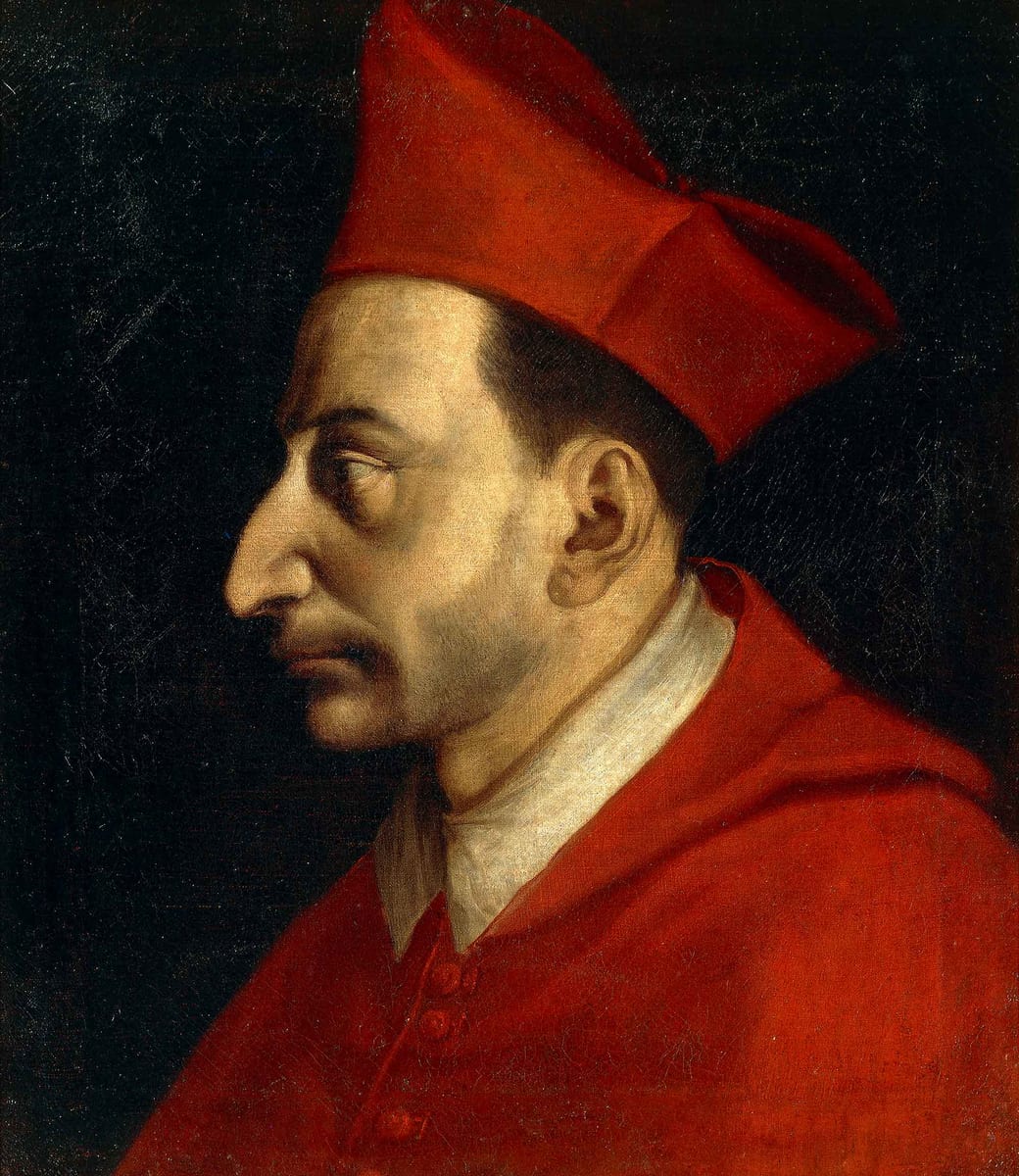
Portrait of St. Charles Borromeo, Giovanni Ambrogio Figino, between 1575 AD and 1599 AD Giovanni Ambrogio Figino, Pinacoteca Ambrosiana, Milan On August 16, 1578 AD, St. Charles Borromeo founded the Oblates of St. Ambrose, a congregation of secular priests. In 1579 AD he founded the Swiss College in Milan to train young men from the Swiss and Grisons valleys as priests who could answer the Protestants in their homelands. In July 1580 AD, at Castiglione delle Stiviere, he gave twelve-year-old St. Aloysius Gonzaga his First Communion.
In July 1583 AD he gave all the money he had to the plague-struck town of Brissago and had to borrow what he needed to get back to Milan. That November he set out to visit the Swiss cantons and the Grisons, beginning in the Val Mesolcina, where more than one hundred and fifty people formally abjured together, then confessed and received Communion from him. One cold night there the Franciscan preacher Francesco Panigarola found him studying in a single torn black gown and urged him to put on something warmer.
“E quale, se io né altra ne ho, né altra voglio averne? Le altre della dignità sono vesti, e non son mie; ma quanto a me, di verno e di state di questa sola veste son contento, né altra voglio averne in vita mia. (What will you say if I have no other? The robes which I am obliged to wear in the day belong to the dignity of cardinal: but this garment is my own, and I will have no other either for winter or summer.)”
St. Charles Borromeo to Francesco Panigarola, 1583 AD -
October–November 1584 AD
The last journey home
St. Charles Borromeo fell ill with fever on retreat, said his last Mass where he was born and died in Milan days later.
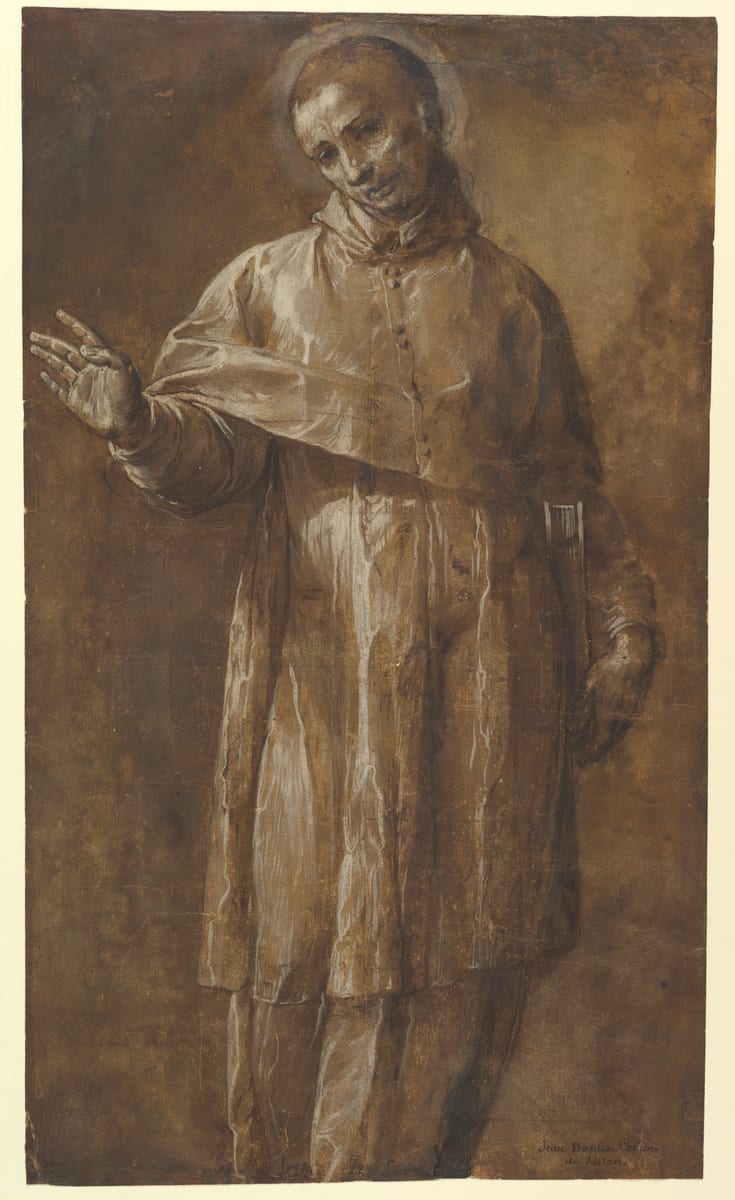
St. Charles Borromeo, Giovanni Battista Crespi, il Cerano, late 16th or early 17th century Giovanni Battista Crespi, il Cerano, The Metropolitan Museum of Art, New York (Rogers Fund), CC0 In October 1584 AD, on his yearly retreat at the Sacro Monte of Varallo, St. Charles Borromeo fell ill with a fever and hid it. He said his last Mass at Arona, where he was born, on All Saints' Day, and the next day boats carried him to Milan. On November 3 he received Communion and the last anointing with his eyes on a picture of Christ being laid in the tomb.
As he lay dying, the people of Milan went in procession singing the litany of the saints for him. When he was told his illness was hopeless, he said *Ecce venio* (*Behold, I come*), the last words anyone heard from him. He died in the archbishop's palace that night, aged forty-six, and his eyes were closed by Father Carlo Bascapè, who had followed him into the plague hospital in 1576 AD.
“Ecce venio (Behold I come)”
St. Charles Borromeo, his last words, on his deathbed in Milan


Pray with the Church
Editae saepe, Pope St. Pius X's encyclical on St. Charles Borromeo
A passage from Pope St. Pius X's encyclical Editae saepe, May 26, 1910 AD, on St. Charles Borromeo, issued for the third centenary of his canonisation by Pope Paul V in 1610 AD.
The Lord gave him to us as a star shining in the darkness of these sins which are Our affliction.Let us beseech the Divine Goodness both in word and deed to let Charles now assist by his patronage the Church he loved so ardently and aided so greatly by his merits and example, thus making peace for us in the day of wrath, through Christ Our Lord.
All 5 reports on Saint Charles Borromeo

About this picture
AI-generated image, in the manner of Lombard oil painting of 1575–1630, from the paper's reference portrait based on Portrait of St. Charles Borromeo (Giovanni Ambrogio Figino, between 1575 and 1599, Pinacoteca Ambrosiana, Milan) View source artwork.
St. Charles Borromeo dies in Milan at forty-six, saying "Behold, I come"

At his coronation, Pope John XXIII puts the shepherd above the diplomat

About this picture
AI-generated image, in the manner of Lombard oil painting of 1575–1630, from the paper's reference portrait based on Portrait of St. Charles Borromeo (Giovanni Ambrogio Figino, between 1575 and 1599, Pinacoteca Ambrosiana, Milan) View source artwork.
St. Charles Borromeo founds a college in plague-struck Ascona through a fever

About this picture
AI-generated image, in the manner of Lombard oil painting of 1575–1630, from the paper's reference portrait based on Il digiuno di San Carlo Borromeo (Daniele Crespi, between 1610 and 1630, Santa Maria della Passione, Milan; photograph by Giovanni Dall'Orto) View source artwork.

Friar shoots kneeling St. Charles Borromeo; ball fails to pierce his clothes

About this picture
AI-generated image, in the manner of Lombard oil painting of 1575–1630, from the paper's reference portrait based on Il digiuno di San Carlo Borromeo (Daniele Crespi, 17th century, Santa Maria della Passione, Milan; photograph by Giovanni Dall'Orto) View source artwork.