
Saints Virgin and martyr of Rome
Saint Cecilia
Feast 22 November · Born 200 AD, Rome, Roman Empire (modern Italy) · Died 230 AD, Rome, Roman Empire (modern Italy)
A senatorial house in Trastevere, a marriage she did not want, a prefect she argued with, and a grave the Church has opened twice.
Begin the life
In brief
Saint Cecilia was a Roman virgin and martyr, one of the four principal virgin martyrs of the Western Church, and her name stands in the Roman Canon of the Mass. She was buried on the Via Appia in the cemetery of Callistus, beside the crypt of the third-century Roman bishops, and her feast was kept in the Roman Church by the fourth century AD. The tradition carried by the fifth-century Passio sanctae Caeciliae and read at Matins of her feast in the Roman Breviary places her death on November 22, in the reign of the emperor Alexander Severus. Longstanding Catholic tradition holds that Pope Urban consecrated her house in Trastevere as a church in her name, and the basilica of Santa Cecilia in Trastevere stands on that site, with her body venerated in its crypt. She is patron of music and musicians, of luthiers and of other makers of musical instruments.
-
Early third century AD
A daughter of the Caecilii
A senatorial family at Rome, a cemetery on the Via Appia that had been their own ground, and a girl raised Christian from the cradle.
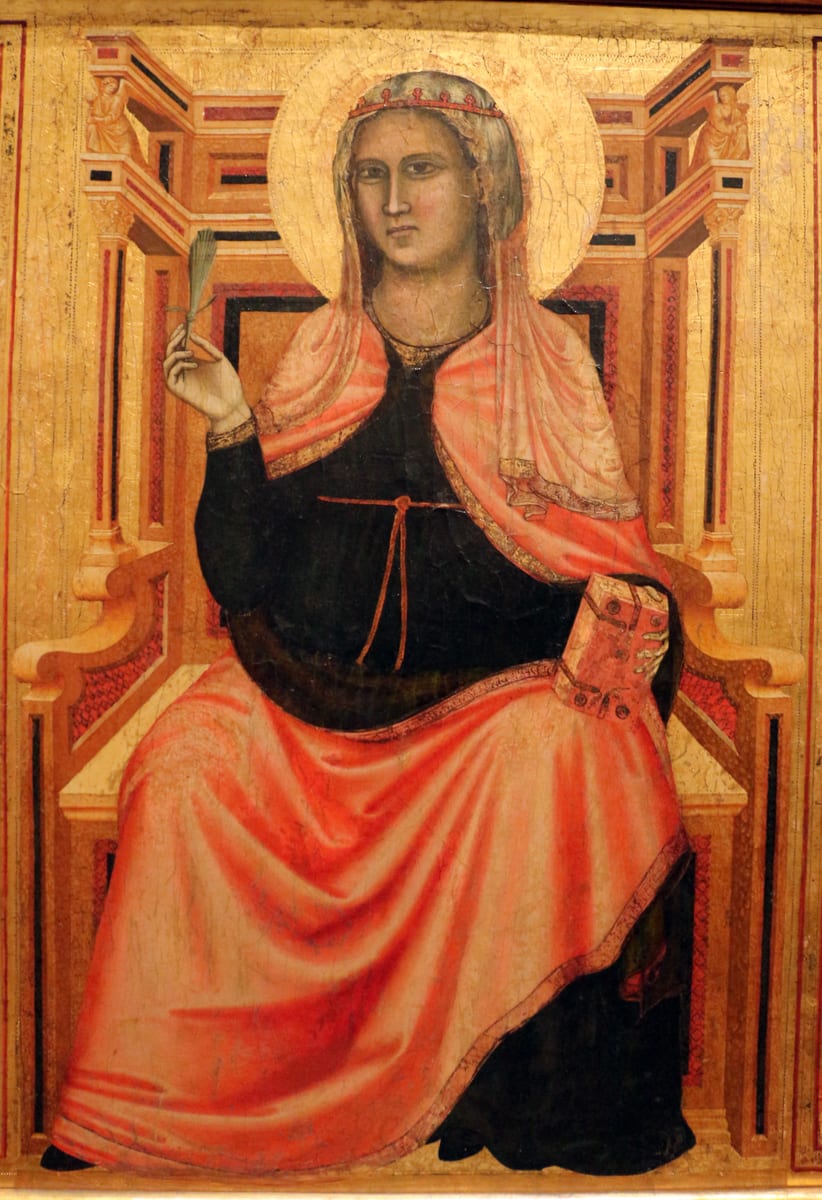
Saint Cecilia and stories from her life - central panel, St. Cecilia enthroned, Master of the Saint Cecilia Altarpiece (traditionally Cimabue; the Uffizi proposes Gaddo Gaddi); photograph by Francesco Bini (Sailko), c. 1305-1310 AD Master of the Saint Cecilia Altarpiece (traditionally Cimabue; the Uffizi proposes Gaddo Gaddi); photograph by Francesco Bini (Sailko), Galleria degli Uffizi, Florence (inv. 1890 no. 449) The Governorate of Vatican City State places the birth of St. Cecilia in a noble Roman family at the beginning of the third century AD. Her family was of senatorial rank, and the ground under which the oldest part of the Catacomb of Callistus was dug belonged to the gens Caecilia before it passed by donation to the Roman Church. A dozen epitaphs of Caecilii of high rank have come out of the Crypt of Lucina and the first areas of that cemetery, and the burial vault of the family's freedmen and slaves was found in the same neighbourhood in 1820 AD.
Longstanding Catholic tradition, read in the lessons of her feast, holds that she was trained from her earliest years in the teaching of the Christian faith and consecrated her virginity to God by vow while still very young. The Golden Legend, which carried that tradition to Western readers, says that from the time she lay in her cradle she was nourished in the faith of Christ and ceased from prayer neither by day nor by night. The same tradition holds that she wore haircloth next to her skin under her outer dress and kept fasts of two and three days together, and the Church keeps that detail in the antiphons of November 22.
“The glorious maiden carried the Gospel of Christ always in her breast, and meditated therein day and night, talking with God and praying.”
The Church -
c. 230 AD
The wedding, and the road to the third milestone
Married against her will to a pagan of her own class, she sent her husband down the Appian Way to a bishop in hiding.
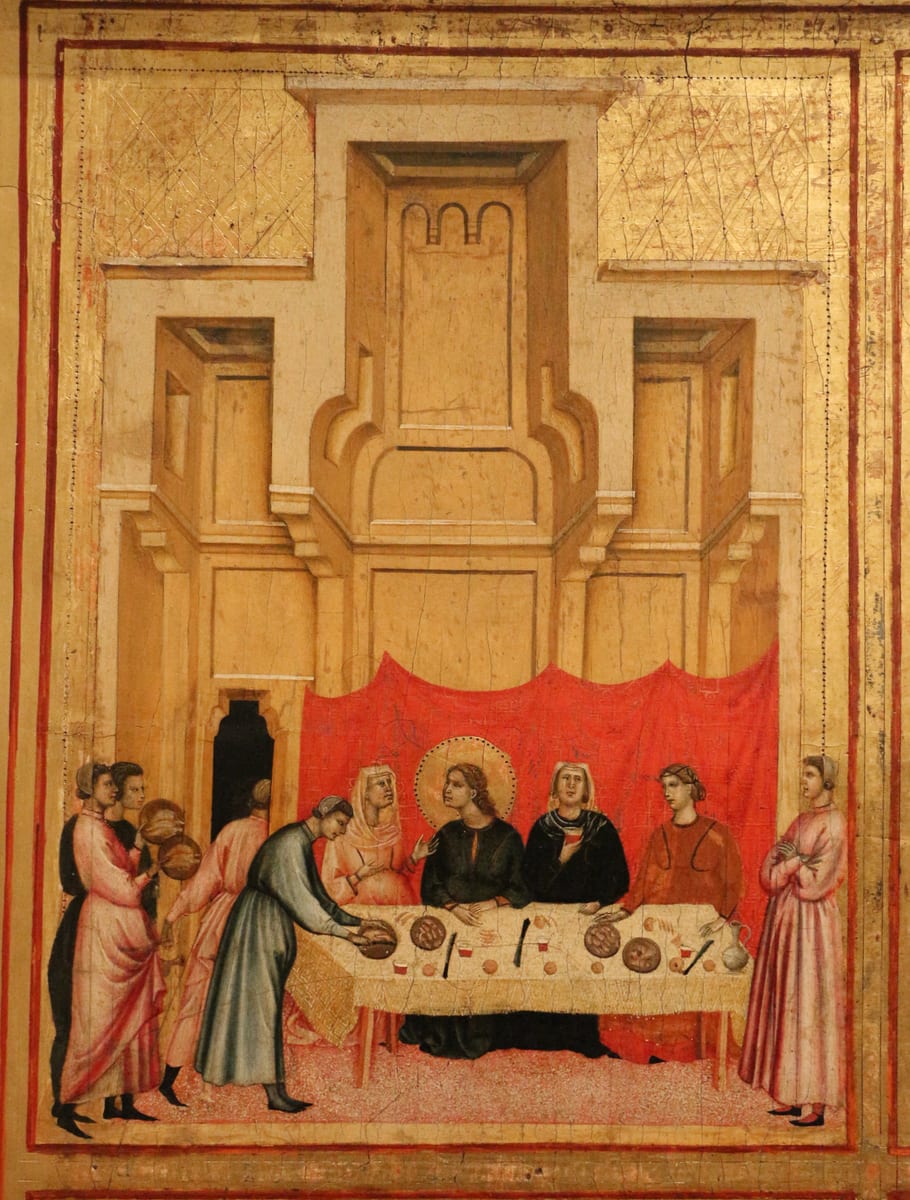
Saint Cecilia and stories from her life - the marriage banquet of Cecilia and Valerian, Master of the Saint Cecilia Altarpiece; photograph by Francesco Bini (Sailko), c. 1305-1310 AD Master of the Saint Cecilia Altarpiece; photograph by Francesco Bini (Sailko), Galleria degli Uffizi, Florence (inv. 1890 no. 449) According to longstanding Catholic tradition, her parents gave her in marriage, against her will, to a young Roman of noble family, St. Valerian, who was not a Christian. The Golden Legend says that on the wedding day she was clothed in cloth of gold over the haircloth, and that while the instruments played she sang in her heart to God alone. The Church took that moment for the first antiphon of her feast.
Tradition places the turn of her story in the bridal chamber that night, where she told St. Valerian of an angel of God who guarded her body. The lesson read at Matins of her feast carries the same tradition: he was moved, did not dare to touch her, and answered that he would believe in Christ if he could see the angel. Tradition holds that she sent him three miles out along the Via Appia, where Pope Urban was hiding among the sepulchres of the martyrs because of the persecution, and that Pope St. Urban baptised him there.
In the same tradition St. Valerian came home from his baptism to find her at prayer with the angel standing beside her, holding two crowns of roses and lilies brought from Paradise, one for each of them. The Golden Legend says that when he was asked what he desired he asked for his brother, and that the angel answered that both would come to God by the palm of martyrdom. Pope Paschal I had that scene worked in gold cloth on an altar covering for her basilica six centuries later.
“The musicians played, and Cecilia sang unto the Lord, saying: Let my heart be undefiled, that I be not ashamed.”
The Church -
c. 230 AD
Four martyrs on the Appian Way
St. Valerian's brother came in, the two of them buried the Christian dead, and the prefect of the city took notice.
Tradition holds that St. Valerian's brother St. Tiburtius came into the chamber, smelled roses and lilies he could not see, and received the faith from St. Cecilia and St. Valerian. The same tradition has him baptised by Pope Urban and granted the sight of the angel his brother had seen. It holds too that the two brothers gave rich alms and buried the bodies of the confessors who had died for Christ, and the Golden Legend says it was this that brought them before the prefect.
Tradition names the prefect of the city Turcius Almachius, who ordered the brothers to sacrifice to the image of Jupiter or be beheaded. Tradition holds that St. Maximus, the officer sent to carry out the sentence, was converted by the two prisoners and baptised with his whole household, and the Roman Martyrology names him the prefect's chamberlain, moved by their constancy.
The Roman Martyrology keeps April 14 as the birthday of the holy martyrs Tiburtius, Valerian and Maximus, who suffered under the emperor Alexander and the prefect Almachius. Tradition holds that the first two were beaten with rods and beheaded for the true faith, and that St. Maximus was scourged with leaded whips until he died, as that same entry records. The three were buried in the Catacomb of Praetextatus on the Via Appia, where the ancient pilgrim itineraries mark their tombs and where the Martyrologium Hieronymianum places them under April 14.
“Today I call thee my brother, for the love of God hath made thee to cast away idols.”
St. Cecilia -
c. 230 AD
Before the prefect
According to the tradition preserved in the Acts of Saint Cecilia, her preaching brought four hundred and more to Pope Urban for baptism, the goods of St. Tiburtius and St. Valerian had all been given to the poor, and she was brought before the prefect to answer for both.
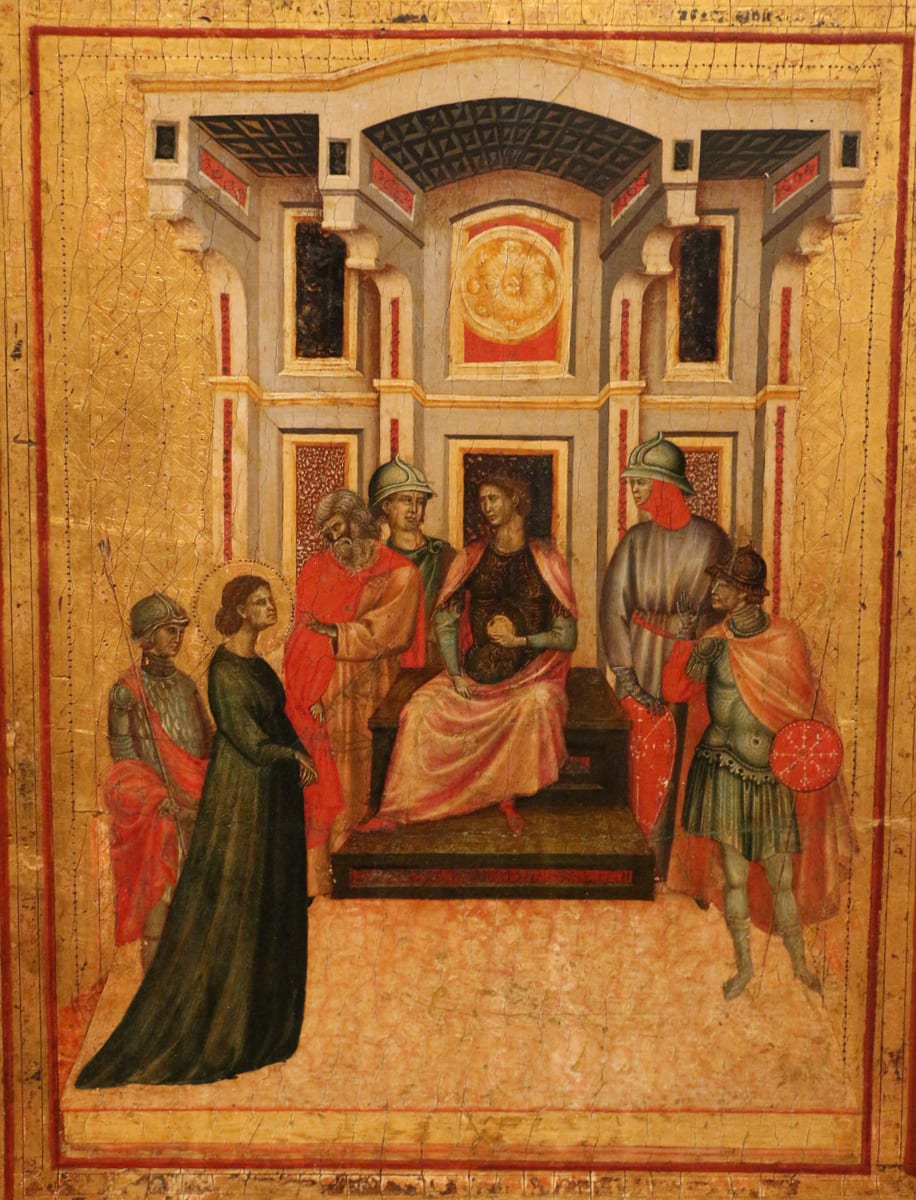
Saint Cecilia and stories from her life - Cecilia before the prefect Almachius, Master of the Saint Cecilia Altarpiece; photograph by Francesco Bini (Sailko), c. 1305-1310 AD Master of the Saint Cecilia Altarpiece; photograph by Francesco Bini (Sailko), Galleria degli Uffizi, Florence (inv. 1890 no. 449) The Golden Legend says that between the deaths of the brothers and her own arrest St. Cecilia went on preaching, that the men sent to fetch her wept and changed sides, and that Pope Urban baptised four hundred and more. Tradition holds that before she was taken she arranged that her house should be kept as a place of worship for the Roman Church.
The tradition carried in the lessons of her feast holds that Almachius had her seized and asked her first of all where the property of St. Tiburtius and St. Valerian had gone, and that she answered that all their goods had been given to the poor. The Governorate of Vatican City State gives the same tradition, adding that she was first confined to her own house and reported a second time before being brought to the prefect and ordered to sacrifice to the idols.
The longest passage of that tradition is the exchange at the tribunal, where she disputed the prefect's questioning, the power he claimed and the gods he served, and refused to sacrifice. The Church's office for November 22 says that the maiden Saint Cecilia overcame Almachius the judge and called St. Tiburtius and St. Valerian to their crowns.
“The Maiden Cecilia overcame Almachius, and called Tiburtius and Valerian to crowns.”
The Church -
November 230 AD
The bath, and three days on the pavement
The furnace did not kill her, the executioner could not finish, and she used what was left to her to dispose of her house and her poor.
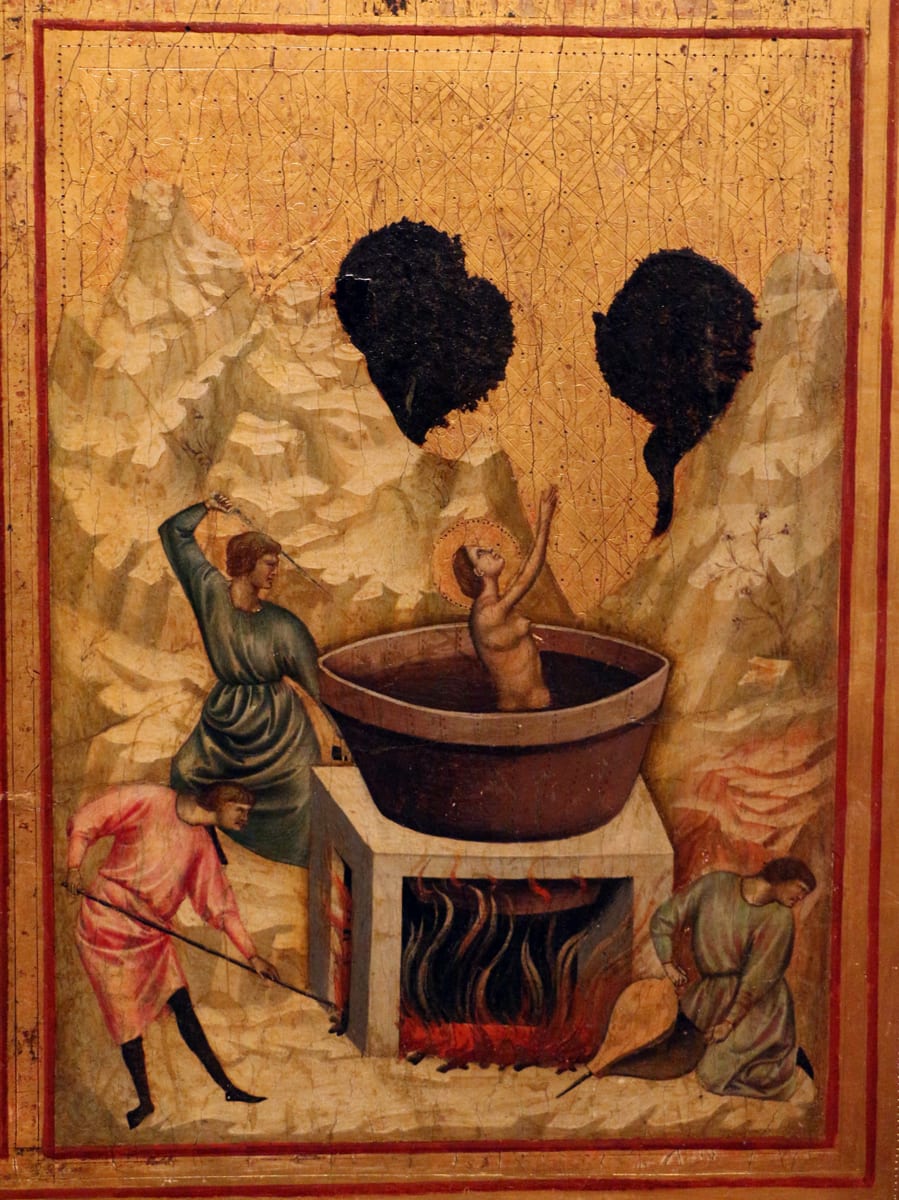
Saint Cecilia and stories from her life - the martyrdom of Cecilia, Master of the Saint Cecilia Altarpiece; photograph by Francesco Bini (Sailko), c. 1305-1310 AD Master of the Saint Cecilia Altarpiece; photograph by Francesco Bini (Sailko), Galleria degli Uffizi, Florence (inv. 1890 no. 449) Tradition holds that Almachius condemned her to be suffocated in the bath of her own house, and that the furnace was heated seven times more than it was wont to be heated. She stayed there a day and a night, and the Roman Martyrology, which keeps that tradition, records that she came out of the fire uninjured. The remains of that bath have long been shown in a side chapel of the basilica in Trastevere.
Tradition holds that the prefect then sent an executioner to behead her where she stood, that the sword struck three times at her neck without severing her head, and that Roman law allowed no fourth stroke. The same tradition has the faithful of her house coming in to dip handkerchiefs and linen in her blood, and those cloths were still at her feet when the coffin was opened in 821 AD.
The Golden Legend says she lived three days after the strokes, gave all she had to the poor, went on preaching, and sent everyone she converted to Pope Urban for baptism. In the same tradition Pope Urban came to her on the third morning, she committed to him the poor she had always fed, and she gave him her house to be made a church for ever. The Roman Breviary, keeping that tradition, places her death on November 22, in the reign of the emperor Alexander Severus, glorified with the two palms of virginity and martyrdom. She was buried on the Via Appia in the cemetery of Callistus, beside the crypt of the third-century Roman bishops, where the medieval pilgrim guides later pointed out her grave. Tradition holds that Pope Urban, who buried her, also consecrated a church in her name in her own house.
“I have asked the Lord for three days, that I may consecrate my house as a Church.”
St. Cecilia -
Fourth to sixth centuries AD
Rome keeps her day
A church in Trastevere, five Masses, a name in the Canon, and one fifth-century text that scholars have argued over ever since.
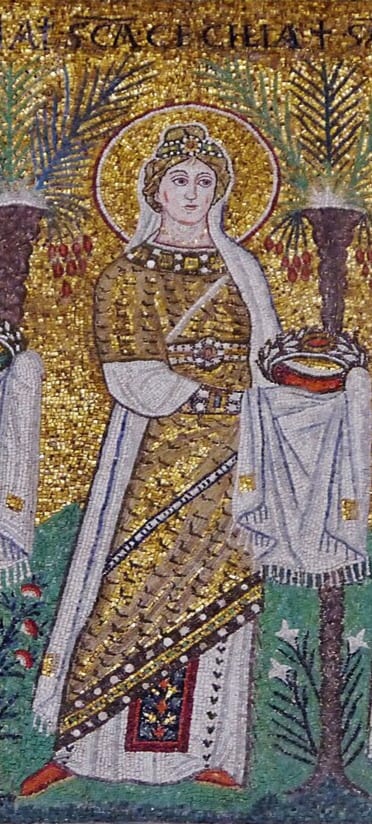
SCA CECILIA, from the procession of virgin martyrs, Basilica of Sant'Apollinare Nuovo, Ravennate mosaicists; photograph by Zairon, 6th century AD Ravennate mosaicists; photograph by Zairon, Basilica of Sant'Apollinare Nuovo, Ravenna Her feast was kept in the Roman Church in the fourth century AD on the witness of the Martyrologium Hieronymianum, which names her alone under September 16 on the Appian Way and again under November 22. Her name is not in the fourth-century Roman list of feasts, the Depositio martyrum. The titular church in Trastevere was built as early as the fourth century AD, and its name appears in the signatures of a Roman council about 500 AD as the titulus of Saint Cecilia. A Roman collection of Masses completed about the end of the fifth century AD carries five different Masses in her honour, and by 496 AD the Church of Rome venerated her as virgin and martyr.
The Latin account of her passion, from which everything told of her life descends, was written at Rome about the middle of the fifth century AD, and Antonio Bosio printed it from the oldest manuscripts of the city's libraries in 1600 AD. Writing in the Catholic Encyclopedia in 1908 AD, Johann Peter Kirsch called that account in its present shape a pious romance without historical value, and said in the same breath that the existence of the martyrs is a historical fact. Giovanni Battista de Rossi and his English editors, who admitted the text corrupt and interpolated, held it true in its chief features and in details only a contemporary could have collected.
A sixth-century mosaic at Sant'Apollinare Nuovo in Ravenna shows her holding the crown of martyrdom. Pictures of the sixth and seventh centuries in her own crypt show her in the attitude of prayer, richly attired, with large roses springing from the ground at her feet and a bishop inscribed as St. Urban beside her. Before the fifteenth century AD she is seldom shown with a musical instrument, and generally carries the martyr's palm and a crown of red or white roses.
“The time when Cecilia suffered martyrdom is not known.”
Johann Peter Kirsch, 1908 AD -
755–821 AD
The pope who went looking for her
Lombard raiders, a search abandoned on a false report, a vision at Saint Peter's, and a new basilica over her house.
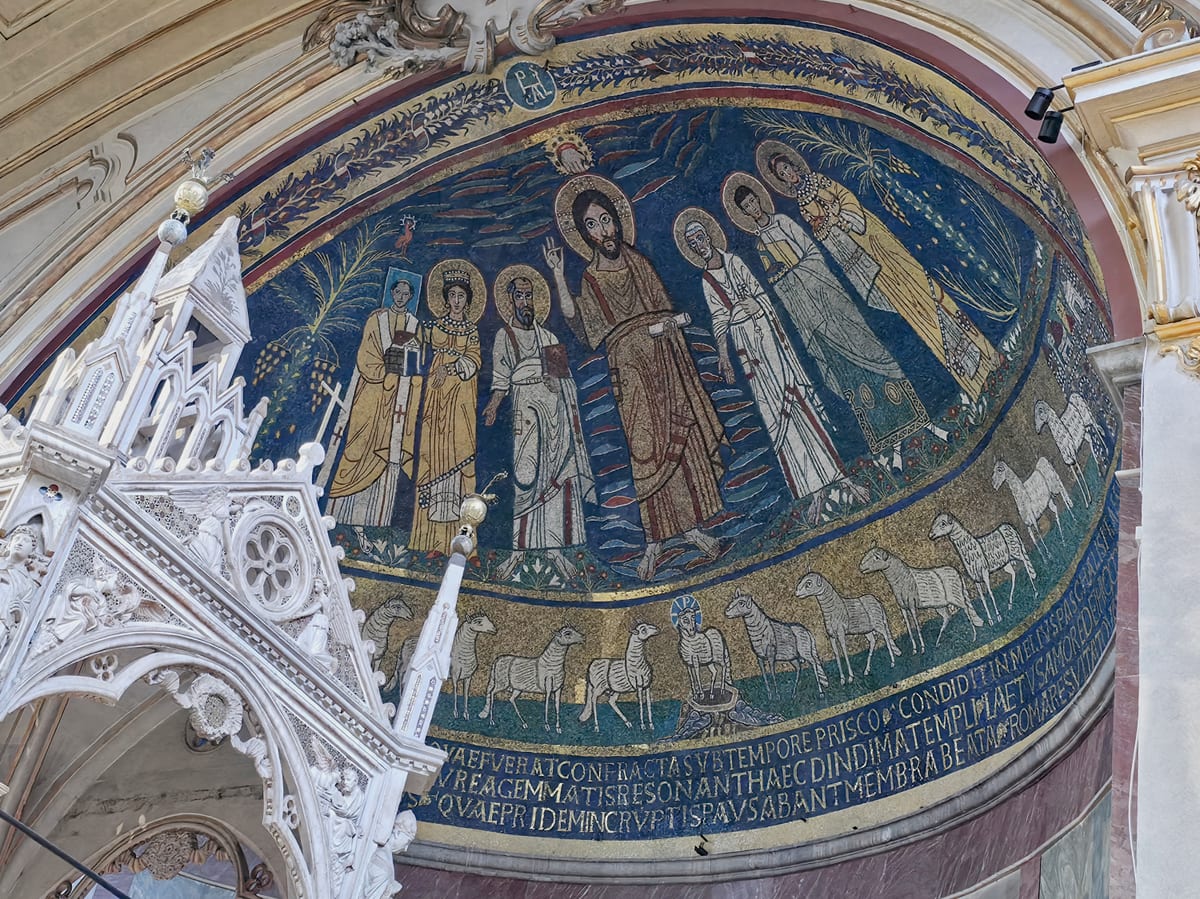
Apse mosaic, Santa Cecilia in Trastevere: Christ in majesty with Saints Paul, Cecilia, Pope Paschal I, Peter, Valerian and Agatha, Roman mosaicists under Pope Paschal I; photograph by NateBergin, 821 AD Roman mosaicists under Pope Paschal I; photograph by NateBergin, Basilica of Santa Cecilia in Trastevere, Rome When the Lombards under King Aistulf besieged Rome in 755 AD they carried off many bodies from the cemeteries of the city, and hers was believed to be among them. Pope Paschal I, chosen pope on January 24, 817 AD, translated into the city that July the relics of 2,300 martyrs from the suburban cemeteries, then lying in ruin. Finding the walls of her old church shaken with age and ready to fall from their foundations, he began a new one on the same site.
The Liber Pontificalis records that as he kept vigil at Saint Peter's and sang Lauds at the dawn of a Sunday, sleep overcame him and he saw a girl of virginal aspect in angelic dress standing beside him, who gave him her name. She told him that the Lombards had searched for her eagerly and, by the help of Christ and of the Blessed Virgin Mary, could neither find her nor carry her away, and that it had pleased God that he should find her and lay her in the church he had newly built.
He found the body clothed in garments of gold, with the body of her husband St. Valerian, and the linen cloths of her martyrdom rolled up at her feet and full of her blood. The Liber Pontificalis names the cemetery of Praetextatus, outside the Porta Appia, as the place of that finding. He lined the cypress coffin with fringed silk, laid the body in a white marble sarcophagus in the attitude in which he had found it, and in 821 AD placed it under the high altar with Saints Valerian, Tiburtius and Maximus and the pontiffs St. Urban and St. Lucius. He consecrated the new basilica that year, founded a monastery beside it in honour of the virgin martyrs Saint Agatha and St. Cecilia whose monks were to sing the praises of God there by day and by night, and set her in the apse mosaic, which survives.
“Si nomen inquiris, Caecilia famula Christi vocor.”
St. Cecilia, in the vision of Pope Paschal I, 821 AD -
1584–2025 AD
The coffin opened, and the marble made
An academy of music took her name, a cardinal dug under the altar, and a sculptor cut what he had seen.
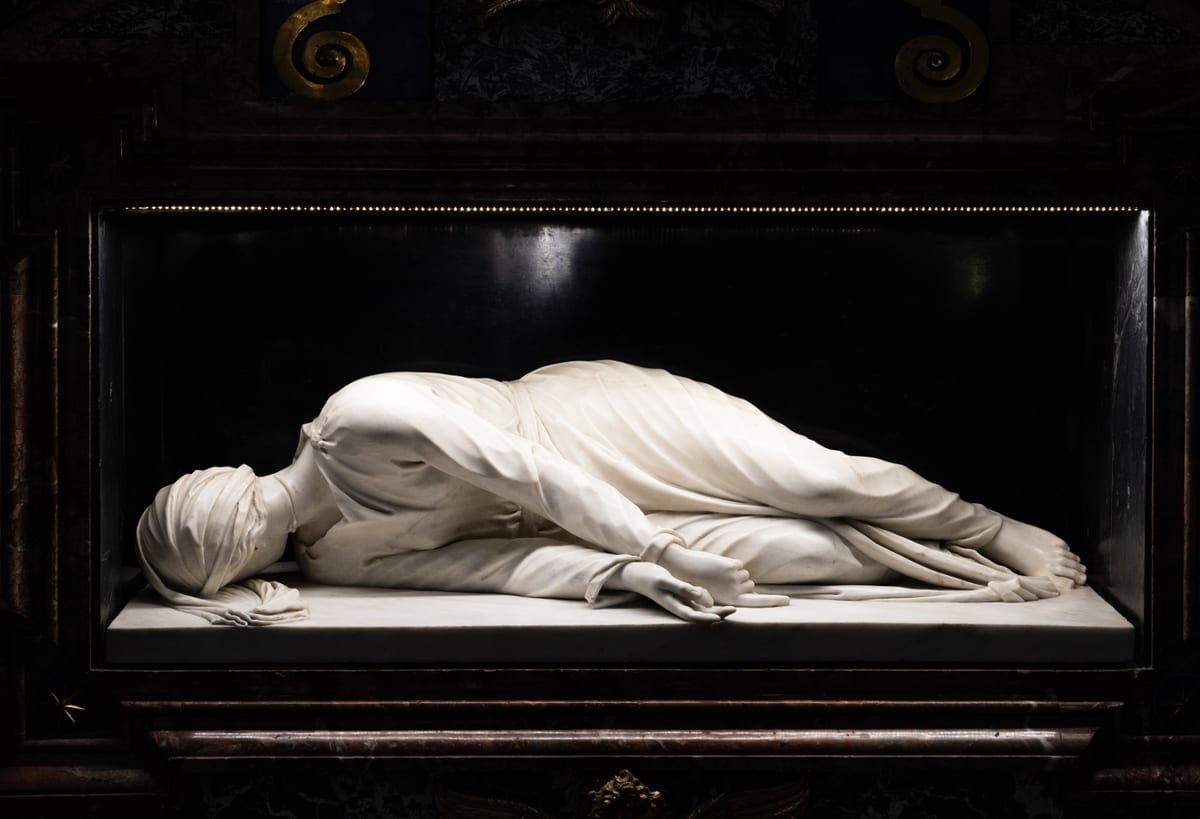
The Martyrdom of Saint Cecilia, marble statue beneath the high altar, Stefano Maderno; photograph by Jacek Durski, 1600 AD Stefano Maderno; photograph by Jacek Durski, Basilica of Santa Cecilia in Trastevere, Rome The Catholic Encyclopedia traces her patronage of music to the phrase of the fifth-century account about the instruments played at her wedding, and holds that the Latin words were wrongly read of St. Cecilia herself as the organist. Raphael painted her with the organ about 1513 AD in the picture now in the gallery at Bologna, and when the Academy of Music was founded at Rome in 1584 AD she was made patroness of the institute.
Cardinal Paolo Emilio Sfondrati, cardinal of her title, dug beneath the high altar in 1599 AD while repairing the church and came on a wide vault holding two marble sarcophagi. One was opened before witnesses on October 20, 1599 AD, and held a coffin of cypress wood under the silk Pope Paschal had spread eight centuries before, faded in colour but entire. The body lay on its right side, arms extended in front, the head turned round towards the bottom of the coffin and the knees slightly bent, in robes of golden tissue with the linen cloths at her feet. Pope Clement VIII, then sick at Frascati, sent Cardinal Cesare Baronius to examine the remains, and the second sarcophagus was found to hold three bodies, two manifestly beheaded and a third whose skull was broken and whose hair was matted with blood.
Antonio Bosio, who was present throughout, reports that the body stayed in the sight of the people for a whole month and that many were freed from grave diseases in that time. On November 22, 1599 AD, her feast day, Clement VIII sang the Mass and laid the body back untouched in the same place before the whole watching people. Sfondrati raised the high altar that stands over the tomb and set beneath it a marble statue by Stefano Maderno, who had seen the body and cut it in the same posture. Giovanni Battista de Rossi cleared her empty crypt in the Cemetery of Callistus in 1854 AD, a chamber beside the papal crypt where a recess for a large sarcophagus stands scarcely an inch of rock from one of the popes' graves. Pope Saint Pius X promulgated his Motu Proprio on sacred music on her feast in 1903 AD, and at a concert for its centenary Pope John Paul II said that popular piety presents St. Cecilia as patroness of music. In 2025 AD the Dicastery for Evangelization placed the basilica on the Jubilee pilgrimage itinerary of the patronesses of Europe and doctors of the Church, where her body is venerated in the crypt.
“Behold the image of the most holy Virgin Cecilia, whom I myself saw lying incorrupt in her tomb. I have in this marble expressed for thee the same Saint in the very same posture of body.”
Stefano Maderno, 1600 AD


Pray with the Church
Collect for the Feast of Saint Cecilia
The collect of her feast in the Roman Breviary, prayed by the Church on November 22.
O God, Who year by year dost gladden thy people by the solemn feast of thy blessed Virgin and Martyr Cecilia, grant unto us, we beseech thee, not only devoutly to observe the same, but also to follow after the pattern of her godly conversation.
All 2 reports on Saint Cecilia

About this picture
AI-generated image, in the manner of a gold-ground egg-tempera panel painting, from the paper's reference portrait based on Saint Cecilia and stories from her life - Cecilia before the prefect Almachius (Master of the Saint Cecilia Altarpiece, c. 1305-1310 AD, Galleria degli Uffizi, Florence) View source artwork.
St. Cecilia calls the prefect's power a bladder full of wind
