
Saints Abbess of Kildare and Patroness of Ireland · Feast February 1
Saint Brigid of Kildare
Feast 1 February · Born Faughart (Fothart), County Louth, Ireland · Died Kildare, County Kildare, Ireland
Saint Brigid of Kildare died on February 1.
Begin the life
In brief
Saint Brigid of Kildare was the abbess who founded the monastery of Kildare in Leinster. She is the Patroness of Ireland, and the Church keeps her feast on February 1, the day she died. According to longstanding Catholic Tradition, she was a bondwoman's daughter who gave away so much of her father's goods that he tried to sell her.
-
Died February 1
The abbess of Kildare
St. Brigid died on February 1, and Ireland keeps her as a patron with St. Patrick and St. Columba.
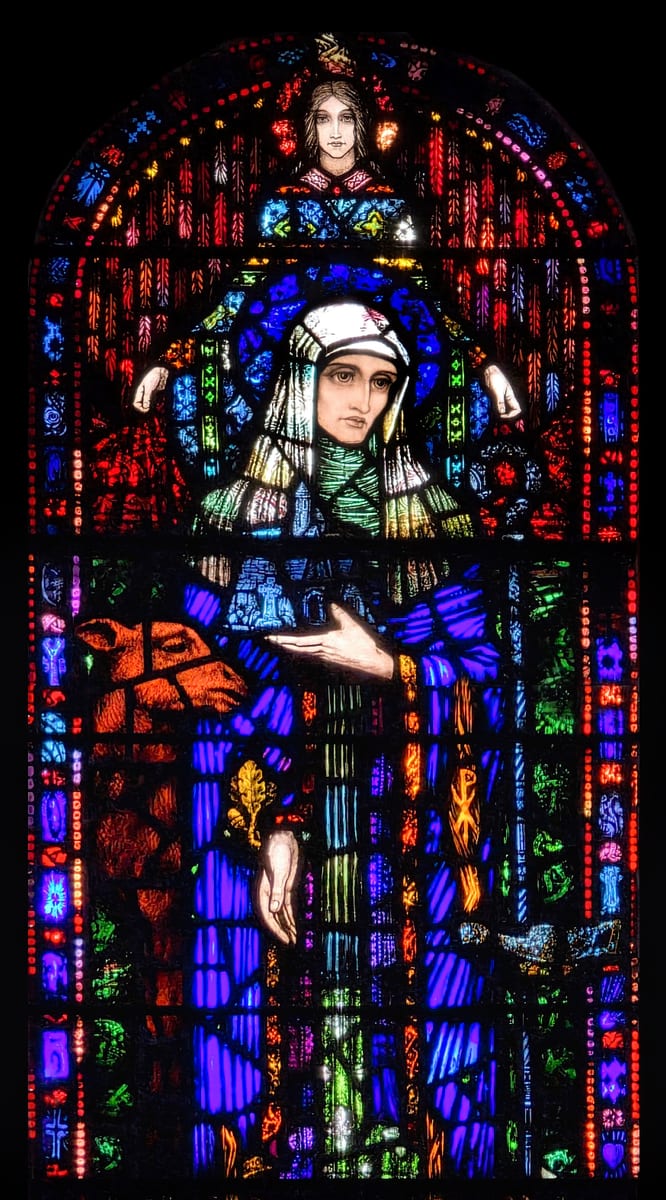
St. Brigid (detail), Honan Chapel window, Harry Clarke, 1915 AD Harry Clarke, Honan Chapel, University College Cork; photograph by NateBergin, 2025 AD, CC BY 4.0 St. Brigid's monastery at Kildare, about twenty miles from Dublin, became the parent house of many convents, which took her as their mother and foundress. She died on February 1.
She is one of Ireland's three patron saints, with St. Patrick and St. Columba. St. Brigid and St. Patrick were friends.
“inter sanctum Patricium Brigitanque Hibernesium columpnas amicitia caritatis inerat tanta, ut unum cor consiliumque haberent unum. Christus per illum illamque virtutes multas peregit. (Between St. Patrick and St. Brigid, the columns of the Irish, there was so great a friendship of charity that they had but one heart and one mind. Through him and through her Christ performed many miracles.)”
The Book of Armagh, on the friendship of St. Patrick and St. Brigid -
Mid-fifth century AD
Born on a druid's threshold
In Catholic Tradition, St. Brigid's mother was a bondwoman sold while pregnant, and the child was born on the threshold of a druid's house.
Catholic Tradition holds that her father, Dubthach, was a Leinster nobleman, and her mother, Broicsech, was a bondwoman he had bought and loved. When Broicsech was pregnant, Dubthach's jealous wife made him sell her to a druid, though two bishops told him not to sell the unborn child.
The baby was born as her mother stepped over the druid's threshold, neither inside the house nor outside it. Maidservants washed her in the warm milk her mother was carrying. The druid dreamed that three clerics in white baptised the baby, and one of them named her Brigid.
-
Girlhood
A sword for a beggar
Catholic Tradition holds that Dubthach drove his daughter to the king of Leinster to sell her, and while he was inside she gave his sword to a poor man.
In Catholic Tradition the girl gave the butter she churned to the poor, and part of the meat she was cooking to a hungry dog. Because she secretly gave the poor anything she could find, her father, Dubthach, drove her in his chariot to Dúnlang mac Énda, king of Leinster, meaning to sell her to grind the king's grain at the quern. While Dubthach was inside with the king, she gave his sword, the king's own gift, to a poor man.
When her father asked what had become of it, she told him she had given it to Christ. The king asked her why, and she answered that if her God asked for the king and her father, she would give them both to him, with all they had, if she could. The king told Dubthach that his daughter was too great for the king to buy and greater still for her father to sell.
“Ni bu Sanct Brigid suanach Ni bu huarach im sheire Dé, Sech ni chiuir ni cossens Ind nóeb dibad bethath che. (Saint Brigid was not given to sleep, Nor was she intermittent about God's love; Not merely that she did not buy, she did not seek for The wealth of this world below, the holy one.)”
St. Broccán's hymn 'Ní car Brigit', a stanza of the metrical life of St. Brigid -
Youth and the founding of Kildare
The veil and the oak
Catholic Tradition holds that St. Brigid refused marriage and took the veil from St. Mel.
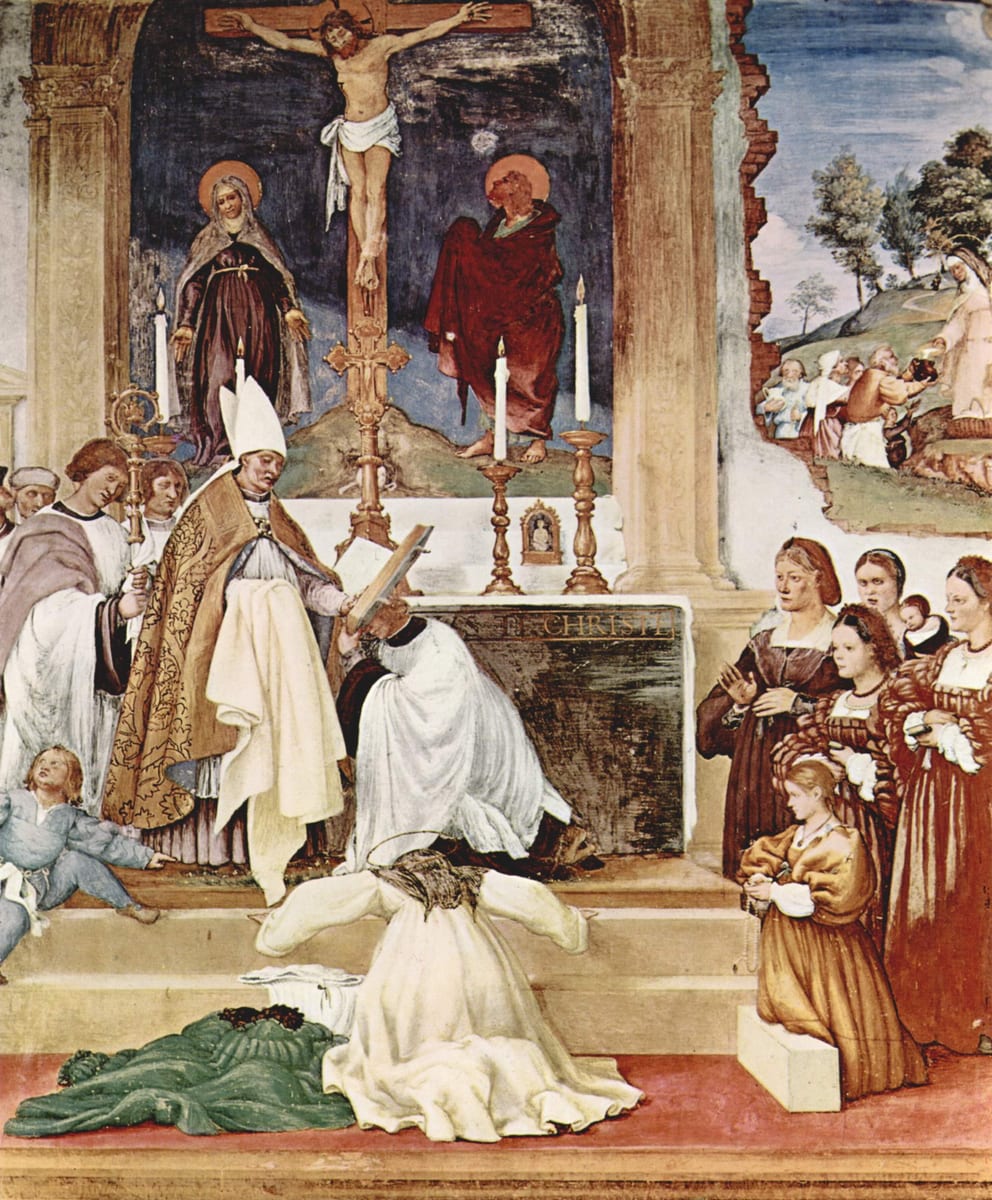
St. Brigid takes the veil, from the frescoes of the Legend of St. Brigid, Lorenzo Lotto, 1524 AD Lorenzo Lotto, Oratorio (Cappella) Suardi, Trescore Balneario Catholic Tradition holds that when her family wanted her married, St. Brigid refused, saying she had offered her virginity to God. To keep from being married against her will, she thrust her finger into her own eye; her father then let her take the veil, and her eye was healed when she received it. She went to St. Mel, a disciple of St. Patrick, and as she held the wooden foot of the altar during the prayers, the wood turned green and stayed green from that hour.
Later she built her convent under a large oak on the plain of the Liffey, and the place took the name Cill Dara (*church of the oak*), Kildare. Her first church there was built of wattles, and the house began poor, living on alms, until it was crowded with women asking to join. She founded two houses, one for men and one for women, with St. Conláed, also called St. Conleth, as their pastor and Bishop of Kildare.
“In Scotia S. Brigidæ Virginis, quæ cum lignum altaris tetigisset, in testimonium Virginitatis suæ statim viride factum est. (In Scotia, of St. Brigid, virgin: when she touched the wood of the altar, it at once turned green, in testimony of her virginity.)”
The Roman Martyrology, the entry for 1 February -
The Kildare years
A cloak on a sunbeam
In Catholic Tradition, St. Brigid hung a wet garment on a sunbeam and turned bath water to ale for lepers.
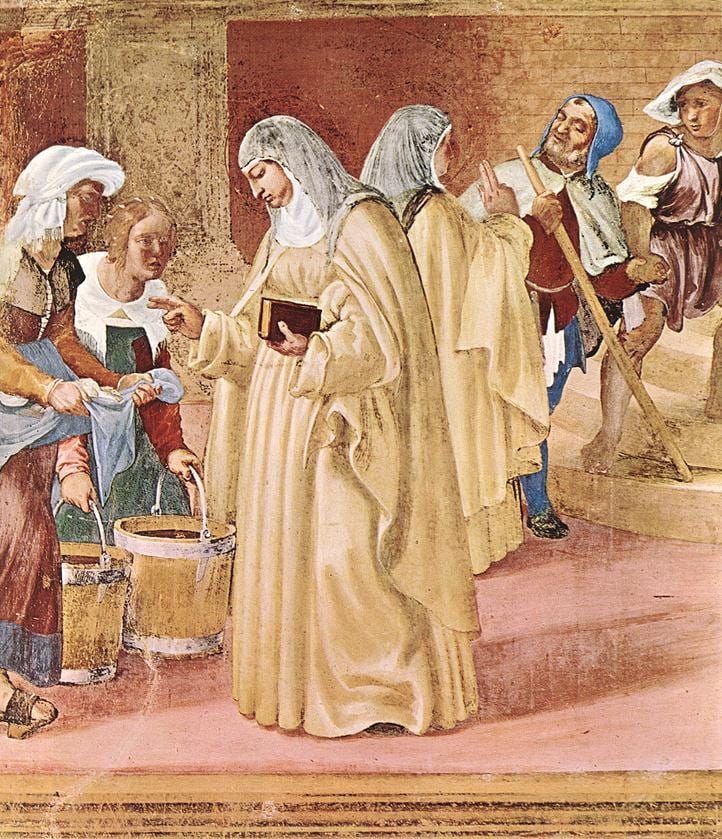
The blessings of St. Brigid, from the frescoes of the Legend of St. Brigid, Lorenzo Lotto, 1524 AD Lorenzo Lotto, Oratorio Suardi, Trescore Balneario As Catholic Tradition tells it, St. Brigid came home on a rainy day, and a sunbeam came into her house through the wall. She hung her wet garment on the beam, taking it for a rope. The beam held the garment until midnight.
Catholic Tradition also tells of lepers who asked her for ale when she had none. She blessed water meant for a bath, and it turned into excellent ale.
“Christus in nostra insula / Que vocatur Hivernia / Ostensus est hominibus / Maximis mirabilibus / Que perfecit per felicem / Celestis vite virginem / Precellentem pro merito / Magno in numdi circulo. (In our island of Hibernia Christ was made known to man by the very great miracles which he performed through the happy virgin of celestial life, famous for her merits through the whole world.)”
The hymn 'Christus in nostra insula', ascribed to St. Ultan, a hymn in honour of St. Brigid -
After her death
Kildare after her
St. Brigid's tomb beside the altar, her bones found at Down, and the fire her nuns kept burning at Kildare.
Cogitosus described the church of Kildare as it stood in his own day: lofty, hung with painted panels, with three oratories inside. St. Brigid and St. Conláed lay on either side of its altar, in tombs adorned with gold, silver and gems, with crowns of gold and silver hanging above. When Norse raiders struck Kildare, her relics were carried to Down for safety.
In 1185 AD her bones were found at Down, in one vault with those of St. Patrick and St. Columba. Gerald of Wales, who travelled in Ireland, saw the nuns of Kildare tending St. Brigid's fire inside a circular hedge that no man was allowed to enter. He was told that nineteen sisters kept the fire one night each, left it to St. Brigid on the twentieth, and found it still burning in the morning.
“Hi tres in Duno tumulo tumulantur in uno, Brigida, Patricius, atque Columba pius. (These three lie buried in Down in one tomb: Brigid, Patrick, and holy Columba.)”
Hector Boece, a couplet on the burial of the three saints at Down -
February 1
Her feast
St. Broccán's hymn sets St. Brigid beside the Blessed Virgin Mary as one of two nuns in heaven.
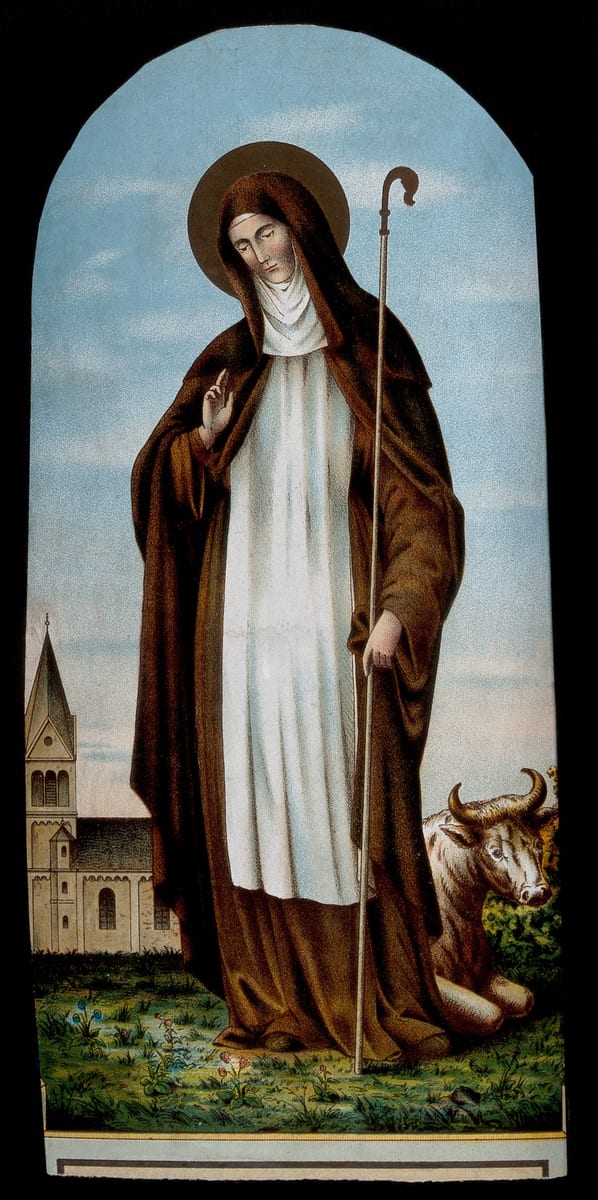
St. Brigid of Ireland, colour lithograph, Lithographer unknown, nineteenth century Lithographer unknown, Wellcome Collection, London (ICV No 32242); licence CC BY 4.0 The Church keeps St. Brigid's feast on February 1, the day of her death. The Roman Martyrology names her on that day, a virgin, in Ireland. In the dioceses of Kildare and Leighlin her feast was kept for eight days, from February 1 to 8.
Two Irish hymns in her praise are ascribed, one to St. Ultan of Ardbreccan or, in another tradition, to St. Columba, and the other to St. Ultan's pupil, St. Broccán. St. Broccán's hymn calls the Blessed Virgin Mary and St. Brigid the two nuns in heaven and asks for the protection of both. On March 19, 2010 AD, Pope Benedict XVI ended his letter to the Catholics of Ireland with a prayer that names St. Patrick and St. Brigid.
“ni fuar a sset acht Maire • admunemar mo Brigi (I have not found her like, save Mary: we honour my Brigid.)”
St. Broccán's hymn 'Ní car Brigit'


Pray with the Church
St. Brigid, ever-good woman
The opening stanza of an Old Irish hymn in praise of St. Brigid, which the preface in the Irish Liber Hymnorum gives to St. Ultan of Ardbreccan and the Book of Lismore gives to St. Columba, in the English of J. H. Bernard and R. Atkinson, The Irish Liber Hymnorum (1898 AD).
Brigid, ever-good woman,flame golden, sparkling,may she bear us to the eternal kingdom,(she), the sun fiery, radiant !