
Saints Bishop of Sebaste and martyr · Feast February 3
Saint Blaise of Sebaste
Feast 3 February · Died Outside the walls of Sebaste, Roman Armenia (modern Sivas, Turkey)
A fourth-century bishop of Sebaste in Armenia died a martyr, and the Church still blesses throats in his name with two crossed candles.
Begin the life
In brief
Saint Blaise, also called St. Blase, was bishop of Sebaste in Armenia in the fourth century AD and died a martyr. The Church venerates him as patron of those who suffer from diseases of the throat. According to longstanding Catholic Tradition, he healed a boy choking on a fish bone as soldiers led him to his trial.
-
Fourth to sixth century AD
A name in the Martyrology and a doctor's remedy
The Church keeps his memory on February 3, and a physician of the sixth century AD told doctors to call on him for a choking patient.
The Roman Martyrology commemorates St. Blaise on February 3 as bishop and martyr. Its 2004 AD edition records that he was martyred at Sebaste, the city now called Sivas, under the Emperor Licinius. The Eastern Churches keep his feast on February 11.
Aëtius of Amida, a physician of the sixth century AD, told doctors to call on St. Blaise when something stuck in a patient's throat. He gave a form of words for the doctor to say while holding the patient's throat. The Bollandists later cited the passage to show how old the devotion to St. Blaise was.
“Egredere os, si tamen os, aut quidquid tandem existis: quemadmodum Iesus Christus ex sepulchro Lazarum eduxit, & quemadmodum Ionam ex ceto. … Blasius Martyr & seruus Christi dicit, Aut descende, aut ascende. (Come forth, bone, if indeed you are a bone, or whatever you may be: just as Jesus Christ brought forth Lazarus from the tomb, and as He brought Jonah from the whale... Blasius, Martyr and servant of Christ, says: Either go down or come up.)”
Aëtius of Amida, the words he gave doctors to say over a bone stuck in the throat -
Fourth century AD
The bishop in the cave
As Catholic Tradition tells it, he hid from persecution in a mountain cave among wild animals until the governor's hunters found him.
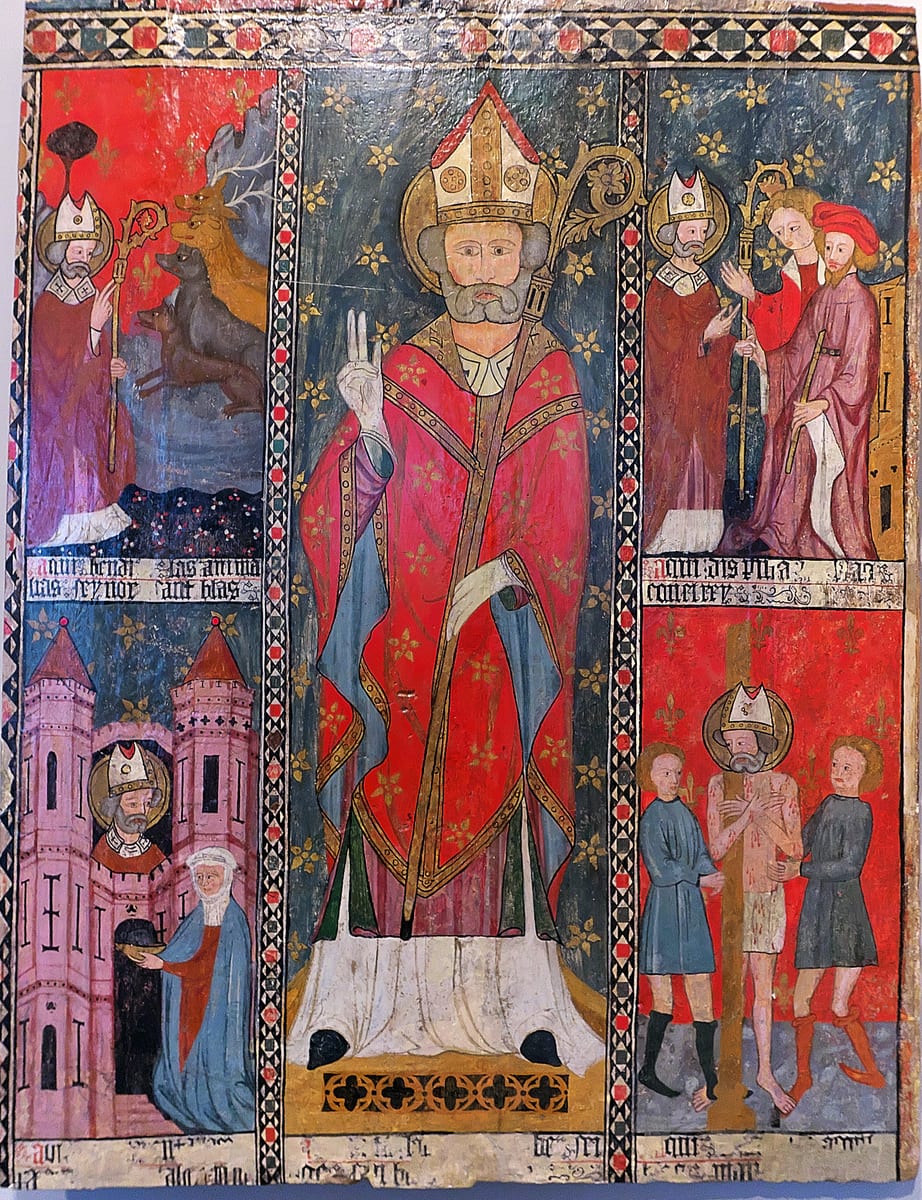
Retable of St. Blaise, c. 1400–1410 AD Museo de Navarra, Pamplona; photograph Jl FilpoC, CC BY-SA 4.0 Catholic Tradition holds, in the Acts of his martyrdom, that the Christians of Sebaste chose St. Blaise as their bishop for his blameless life. By then the Christians of the city were few, hiding from persecution in mountains and caves. St. Blaise fled too, to a cave on Mount Argaeus, where sick animals came to him and went away healed.
Agricolaus, the governor at Sebaste and a fierce enemy of the Christians, ordered wild beasts rounded up for public games. His hunters found boars, stags, goats and bears standing unafraid at the cave mouth, and St. Blaise inside at prayer. When they reported a Christian living on the mountain, Agricolaus sent soldiers to bring him in.
-
Fourth century AD
The boy with the fish bone and the widow's pig
On the road to his trial, Tradition holds, he healed a choking boy and won back a poor widow's pig from a wolf.
As Catholic Tradition tells it, soldiers were leading St. Blaise to Sebaste when a mother laid her only son at his feet. The boy was close to death from a fish bone stuck in his throat. St. Blaise laid his hand on him, signed his throat with the cross, prayed and gave him back to his mother healed.
On the same road, a wolf carried off the only pig of a poor widow, and she begged St. Blaise for help. He smiled at her, and the wolf ran back and set the pig down unharmed at her feet.
-
Fourth century AD
Prison, a candle and the sword
In Catholic Tradition, a widow fed him in prison, and before he was beheaded he prayed for everyone who would choke as the boy had.
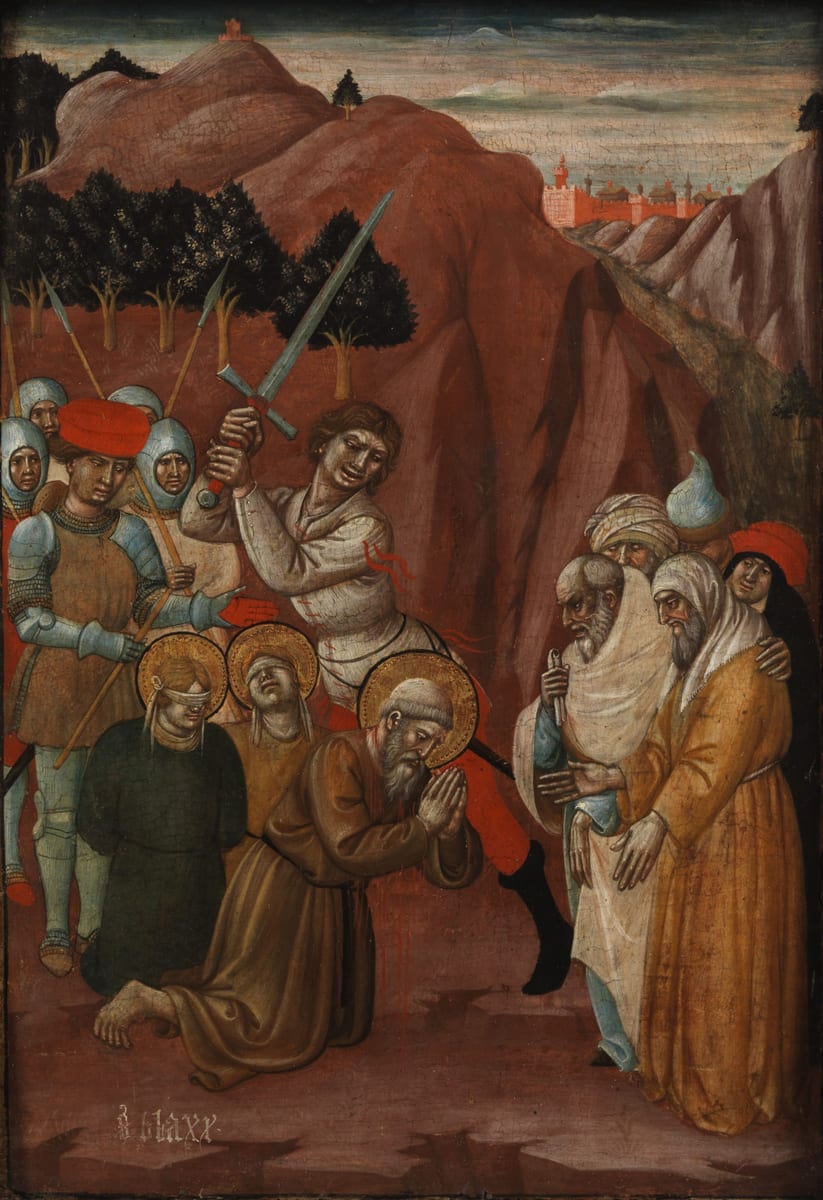
The Martyrdom of St. Blaise, Giovanni Antonio Bellinzoni da Pesaro, 15th century Giovanni Antonio Bellinzoni da Pesaro In Catholic Tradition, St. Blaise was brought before Agricolaus at Sebaste, refused to worship the gods, and was beaten with clubs and sent back to prison. The widow killed her pig to feed him, paid the guards by night and brought him its cooked head and feet, with bread and a candle. The Golden Legend tells that he asked her to offer a candle in his church every year, and she did so all her life.
When he still would not worship the gods, he was hung on a wooden frame and torn with iron combs like those used to comb out wool. Agricolaus sentenced St. Blaise to the sword together with two boys the bishop had baptized in prison, sons of one of seven women who had been seized as Christians while gathering his blood and were beheaded before him. Before the sword fell outside the walls of Sebaste, he prayed that anyone choking on a bone who called on him would be helped.
-
Middle Ages to today
The blessing of throats
The blessing of throats is ordinarily given on February 3, with two crossed candles touched to each throat.
On February 3 each person's throat is touched with two candles crossed together. The Book of Blessings asks for candles blessed the day before, on the feast of the Presentation of the Lord. In some places blessed oil takes the place of the candles, and each throat is touched with a small candle's wick dipped in it.
St. Blaise is one of the fourteen saints known as the Holy Helpers. The Roman Ritual's blessing of the candles calls him a martyr and bishop who feared no torment and gladly accepted martyrdom. The Book of Blessings says devotion to him spread through the whole Church in the Middle Ages because he was said to have cured a choking boy.
“Per intercessionem S. Blasii liberet te Deus a malo gutteris et a quovis alio malo (Through the intercession of St. Blaise may God free you from evil of the throat and from any other evil.)”
The Roman Ritual, the blessing of throats -
1190–2003 AD
Patron of Dubrovnik
Dubrovnik has celebrated his feast since at least 1190 AD, and places across Europe claimed his relics.
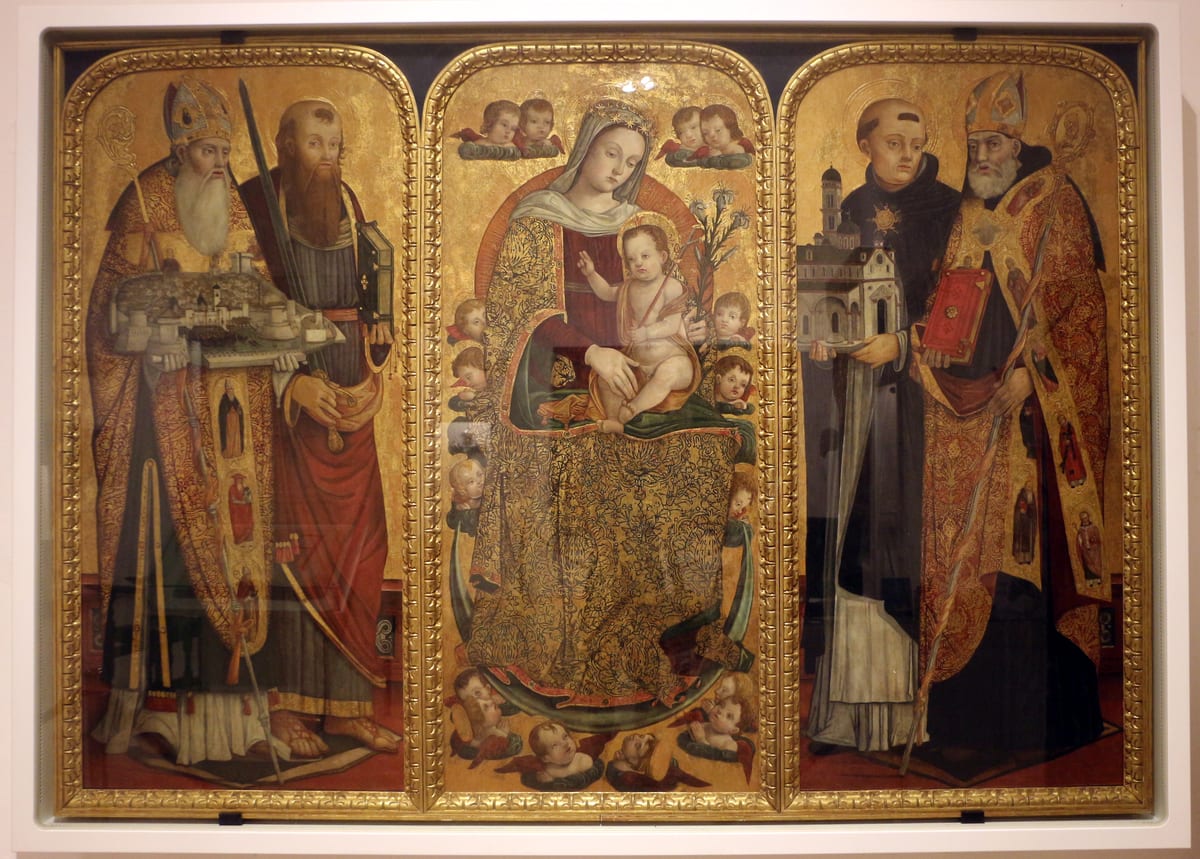
Triptych of the Virgin and Child Enthroned with Saints, with St. Blaise holding Dubrovnik, Nikola Božidarević, c. 1500–1510 AD Nikola Božidarević, Dominican Monastery Museum, Dubrovnik; photograph Sailko, CC BY 3.0 Dubrovnik has celebrated the feast of St. Blaise, in one form or another, since at least 1190 AD. On the evening before February 3, all the city's church bells ring and white doves are released. People gather that evening for a rite of healing for the throat, to guard them against illness.
St. Blaise is the principal patron of Dubrovnik, once the commonwealth of Ragusa. During the Crusades his relics were carried across the West, and Ragusa was among the many places that claimed some of them. Pope St. John Paul II celebrated Mass in the city's Harbour Square on June 6, 2003 AD, and in his homily spoke of St. Blaise as the city's patron.
“Želja mi je da baština ljudskih i kršćanskim vrijednosti, što se je nagomilala tijekom minulih stoljeća, i dalje, uz Božju pomoć i pomoć vašega Parca, svetoga Vlaha, bude najdragocjenije blago puka ove zemlje. (It is my hope that the patrimony of human and Christian values, accumulated down the centuries, will continue, with the help of God and of your Patron Saint Blase, to be the most precious treasure of the people of this country.)”
Pope St. John Paul II to the people of Dubrovnik and of Croatia, June 6, 2003 AD


Pray with the Church
The Blessing of Throats
Book of Blessings (1989 AD), Order for the Blessing of Throats on the memorial of St. Blaise: the celebrant's prayer of blessing
Through the intercession of Saint Blase, bishop and martyr, may God deliver you from every disease of the throat and from every other illness:In the name of the Father, and of the Son, and of the Holy Spirit.