Saints Missionary, Archbishop of Santiago de Cuba and royal confessor · 1807–1870 AD
Saint Anthony Mary Claret
Feast 24 October · Born 1807 AD, Sallent, province of Barcelona, Catalonia, Spain · Died 1870 AD, Fontfroide Abbey, near Narbonne, France
A Catalan weaver's son walked the roads as a missionary, founded a congregation of preachers, survived a razor attack as Archbishop of Santiago de Cuba, served as Queen Isabella II's confessor and died in exile in France.
Begin the life
In brief
Saint Anthony Mary Claret, also called Anthony Claret, was a weaver's son from Sallent in Catalonia who became a priest and a preacher on foot. He founded the Missionary Sons of the Immaculate Heart of Mary (the Claretians), served as Archbishop of Santiago de Cuba and was confessor to Queen Isabella II. He died in exile in France in 1870 AD, and Pope Pius XII canonised him on May 7, 1950 AD.
-
1807–1825 AD
The weaver's son
A Sallent boy weaves a piece and a half of cloth a week at his father's looms.
St. Anthony Mary was born at Sallent, an industrial town in Catalonia, on December 23, 1807 AD, the fifth of eleven children. His father, Juan Claret, was a cotton weaver who owned a small factory. As a boy he began studying Latin, but the lessons ended when his teacher died.
At twelve his father put him to work at the looms, although the boy had already shown signs that he wanted to be a priest. He wove a piece and a half of cloth a week, when most weavers managed one. In 1825 AD he went to Barcelona with his brother Juan to learn more of the trade, and won prizes in its drawing classes.
-
1825–1835 AD
From the sea to the altar
Saved from drowning, he enters the seminary and is ordained a priest.
In Barcelona he went back to Latin in his free hours with a blind teacher, Francisco Artigas, because he still felt drawn to the priesthood. In 1826 AD a wave carried him far out while he was bathing, and after he called on Our Lady a companion pulled him from the water. Afterwards he resolved to give himself entirely to God, and his father, though surprised, did not stand in his way.
On September 29, 1829 AD, after Mass with his family, he left Sallent for the diocesan seminary at Vic. The Bishop of Solsona ordained him a priest on June 13, 1835 AD, the feast of his patron, St. Anthony of Padua. On his first day hearing confessions, August 2, 1835 AD, he heard them for six hours without a break.
-
1839–1840 AD
On foot to Rome
He walks out of Spain to offer himself for the foreign missions, and illness sends him home.
In 1839 AD Father Claret gave up his parish to offer himself to the Church's office in Rome that sent priests to the foreign missions. He set out alone and on foot, with no money, carrying only a breviary, a Bible, a shirt, a pair of stockings, a handkerchief, a razor and a comb. From Marseille he paid for the cheapest place on deck and lived on bread and cheese for the five days to Civitavecchia.
In Rome he entered the Jesuit novitiate on November 2, 1839 AD. In February 1840 AD, after the novices began the Spiritual Exercises, a pain in one leg grew so severe that the doctors feared he would be crippled for life. The head of the Jesuits told him it was God's will that he go back to Spain, and he left Rome in mid-March 1840 AD.
“Dios le llevó a la Compañía no para que se quedase en ella, sino para que aprendiese a ganar almas para el cielo. (God brought you to the Company not that you should remain in it, but that you might learn in it how to win souls for heaven.)”
The Father General of the Society of Jesus to St. Anthony Mary Claret, in a later letter -
1840–1849 AD
Preacher of Catalonia
He preaches across Catalonia and the Canary Islands and founds a press for cheap Catholic books.
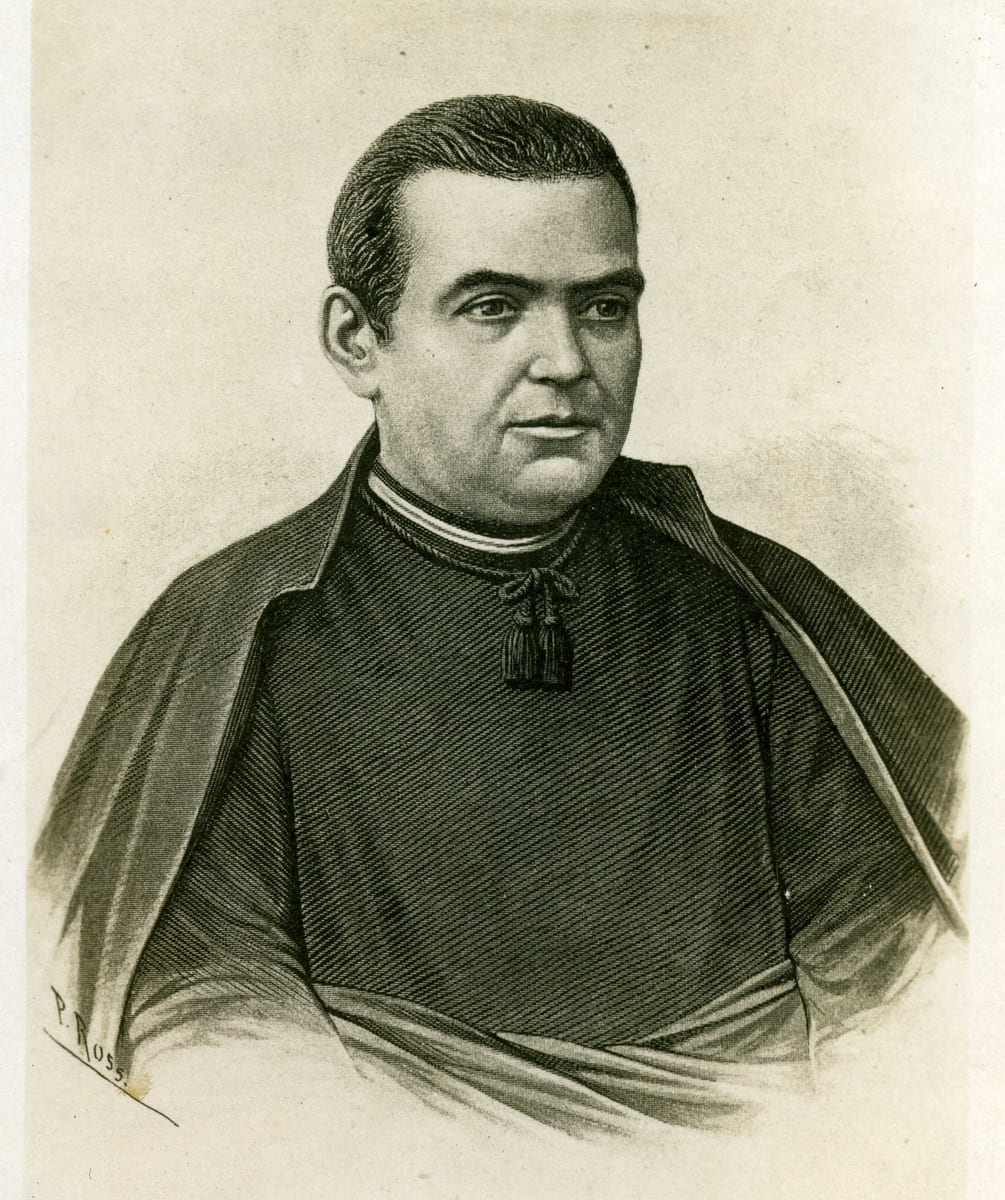
Retrato de Mossén Claret en los comienzos de su predicación misionera por Cataluña, P. Ross (engraver), 1894 AD (engraving); depicts the 1840s P. Ross (engraver), Wikimedia Commons (scan uploaded by Cesc2003) St. Anthony Mary Claret began his missions in the parish of Viladrau on August 15, 1840 AD, with a novena for the Assumption. Spain was at civil war, and he took great care never to say a word about politics. At Roda in December 1843 AD the church was packed, and his voice carried clearly to the people standing outside.
In 1848 AD he founded the Religious Library at Barcelona to print cheap Catholic books, and its first title was his own explained catechism. That year he went to the Canary Islands with their new bishop, Buenaventura Codina, and preached there for fifteen months. He came home in May 1849 AD with nothing but two rips in his cloak.
“No todos quieren ni pueden oir la palabra divina, pero todos pueden leer ú oir leer un buen libro. Algunos no pueden ir á la Iglesia, pero el libro va á su casa. El predicador no puede estar predicando siempre, pero el libro dice siempre lo mismo. (Not everyone wishes to or is able to hear the Word of God, but everyone can read or listen to the reading of a good book. Not everyone can go to church to hear God's Word, but a book can go to a person's house. The preacher can't always be preaching, but a book is always delivering the same message)”
St. Anthony Mary Claret, in his notes on the value of good books -
1849–1855 AD
Founder, then archbishop
He founds a congregation of missionaries at Vic and, weeks later, is named to the see of Santiago de Cuba.
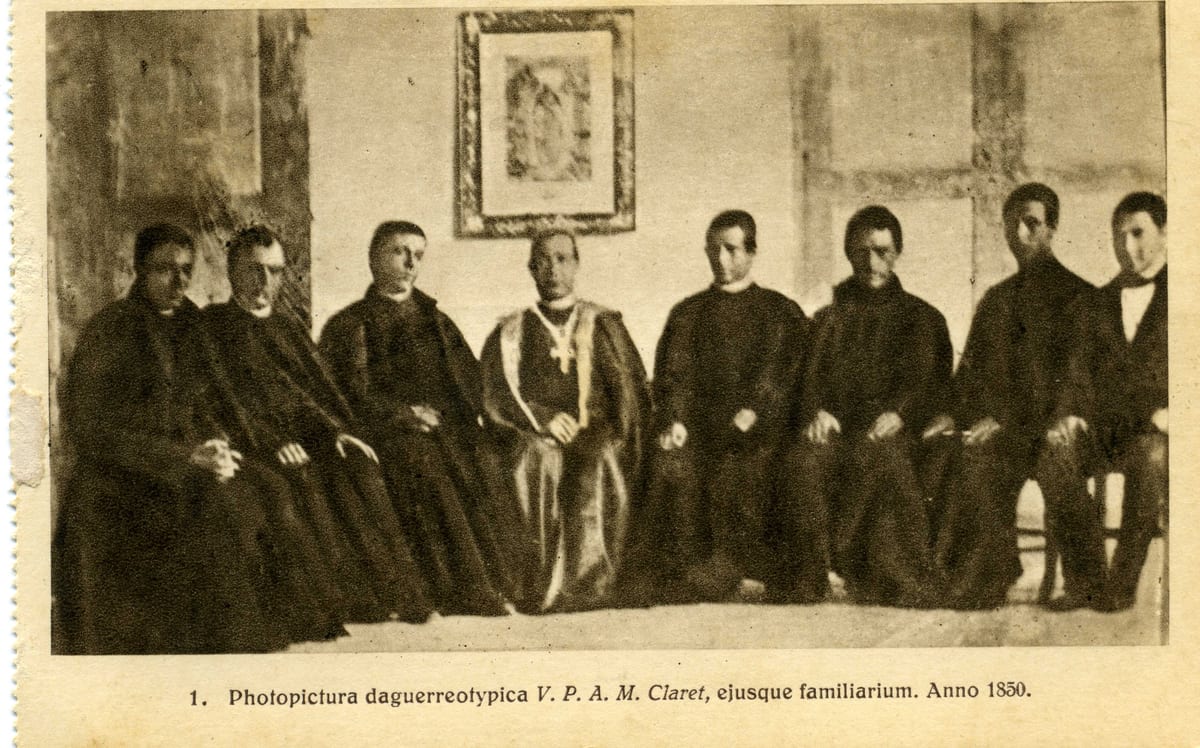
Photopictura daguerreotypica V. P. A. M. Claret, ejusque familiarium, unknown daguerreotypist, 1850 AD (caption on the printed card) or 1853 AD, Santiago de Cuba (Commons description) unknown daguerreotypist, Wikimedia Commons (scan of a Claretian postcard, uploaded by Cesc2003) On July 16, 1849 AD, in the seminary of Vic, St. Anthony Mary Claret and five young priests began a retreat together. That day they founded the Missionary Sons of the Immaculate Heart of Mary (the Claretians). Less than three weeks later Queen Isabella II named him Archbishop of Santiago de Cuba, and he accepted two months after that.
Archbishop Claret was consecrated at Vic on October 6, 1850 AD, and reached Cuba on February 16, 1851 AD. He found parish priests living in poverty and ruined churches; he wrote to the Queen about the priests in May 1851 AD and reported on the churches and clergy to the island's government in December 1851 AD. At El Cobre on June 21, 1851 AD, he cut the fees and paperwork for weddings, so that couples living together without marriage could afford to marry.
-
1856 AD
The razor at Holguín
A man slashes the archbishop's face with a razor in a Cuban street after a sermon.
On February 1, 1856 AD, on a pastoral visit to the city of Holguín, Archbishop Claret preached in the evening. At about half past eight that night, as he left the church, a man named Antonio Pérez came up as if to kiss his ring and struck at him with a razor. The blade opened his left cheek to the bone from the ear to the point of the chin and wounded his right arm.
The attacker was seized at once, and the furious crowd almost turned on him before he could be handed over to the courts. When a fistula formed in the wound, an operation was set, but the wound healed in the night before it, after he called on Our Lady. He was back in Santiago de Cuba in time to lead the Holy Week services in person.
-
1857–1868 AD
Confessor to a queen
Summoned from Cuba to be the Queen's confessor, he is mocked in caricatures and leaves the court for a time when she recognises the new Kingdom of Italy.
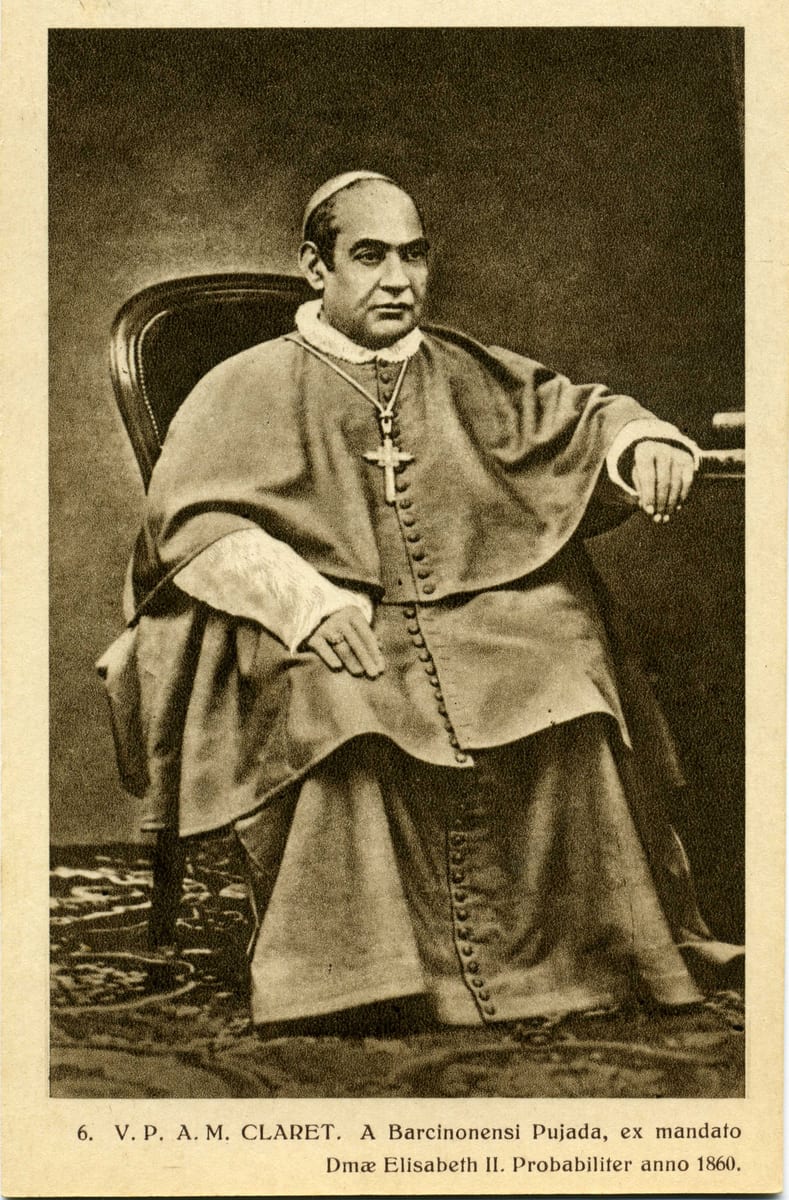
V. P. A. M. Claret. A Barcinonensi Pujada, ex mandato Dmae Elisabeth II. Probabiliter anno 1860 AD, Bernardo Pujadas (photographer), Barcelona Bernardo Pujadas (photographer), Barcelona, Wikimedia Commons (scan of a numbered Claretian postcard, no. 6, uploaded by Cesc2003 from 'own archive') On March 18, 1857 AD, coming home to his palace in Santiago de Cuba after a sermon, Archbishop Claret found an order to go to Madrid at once. In Madrid Queen Isabella II told him she wanted him to direct her soul, and on June 5 a Royal Order named him her confessor. He was mocked in many slanderous caricatures, and on March 21, 1865 AD the man who made them came to him for confession.
In July 1865 AD the Queen agreed to recognise the new Kingdom of Italy, which had taken most of the Pope's lands. Three days later he was praying in the church at La Granja when, he wrote, Jesus told him to leave; he left the court. In Rome that autumn Pope Pius IX told him to go back to Spain, and he returned to the court.
“Antonio, retírate. (Anthony, leave.)”
Christ to St. Anthony Mary Claret, July 17, 1865 AD -
1868–1870 AD
Exile and Fontfroide
A revolution drives the Queen and her confessor into France, and he dies at a French abbey.
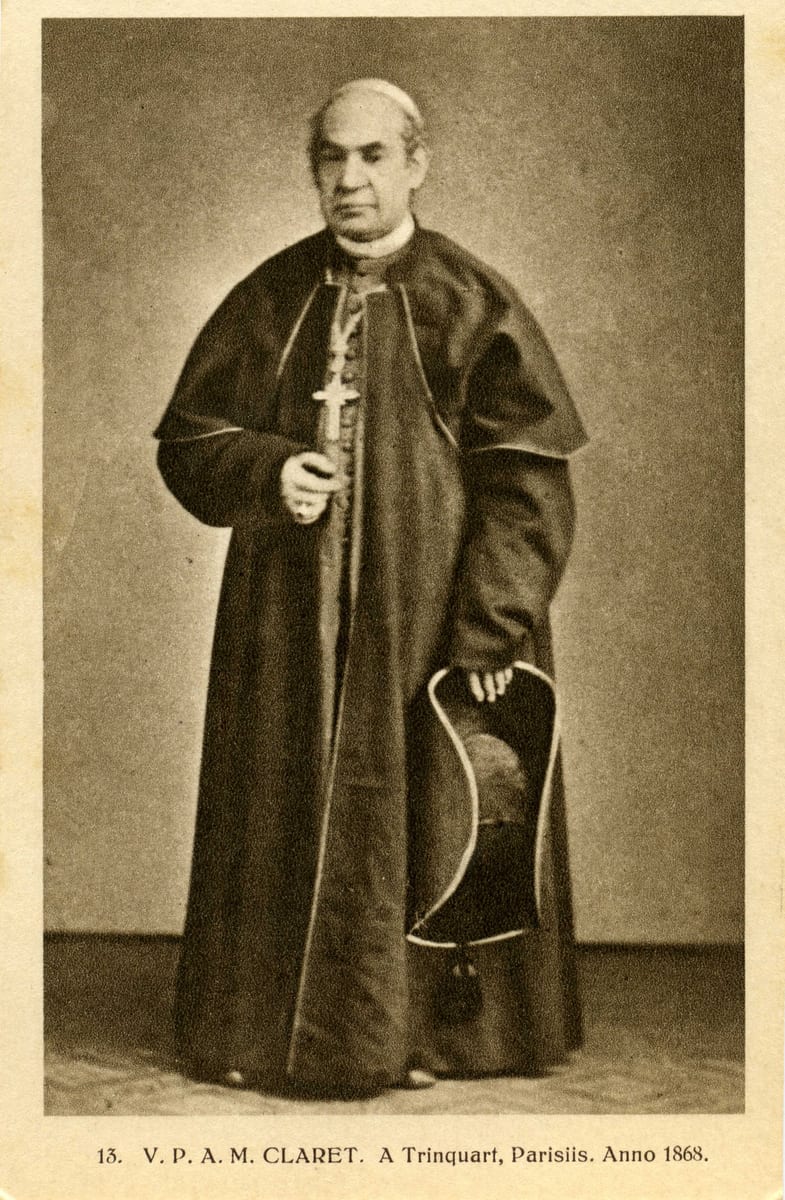
V. P. A. M. Claret. A Trinquart, Parisiis. Anno 1868 AD (San Antonio María Claret en París), A. Trinquart (photographer), Paris A. Trinquart (photographer), Paris, Wikimedia Commons (scan of a numbered Claretian postcard, no. 13, uploaded by Cesc2003) A revolution that began with the fleet off Cádiz in September 1868 AD dethroned Queen Isabella II. St. Anthony Mary Claret crossed into France with her and the royal family. On March 30, 1869 AD, he laid down his post as her confessor and left Paris for Rome and the First Vatican Council.
In August 1870 AD friends warned him to leave as soon as he could, and on August 6 he set out for the Cistercian abbey of Fontfroide, near Narbonne. He died there at a quarter to nine on the morning of October 24, 1870 AD, the day on which the Church keeps his feast. The monks wanted to bury him inside the abbey church, but the French authorities refused, and he was laid in the common grave.
“Mihimetípsi ego dico: Fílius immaculáti cordis Maríæ vir est, qui caritáte flagrat et, quacúmque transit, combúrit; qui efficáciter cupit omnibúsque ópibus curat omnes hómines igne divíni amóris accéndere. (For myself, I say this to you: The man who burns with the fire of divine love is a son of the Immaculate Heart of Mary, and wherever he goes, he enkindles that flame; he desires and works with all his strength to inflame all men with the fire of God's love.)”
St. Anthony Mary Claret, in L'Egoismo vinto (Rome, 1869), 1869 AD


Pray with the Church
Prayer of St. Anthony Mary Claret
Written by St. Anthony Mary Claret in his Autobiography, closing the chapter on why he preached. Printed in his original Spanish; the square brackets are the Spanish edition's own. In English it reads: O my God and my Father, may I know you and make you known; love you and make you loved; serve you and make you served; praise you and make all creatures praise you. Grant, my Father, that all sinners be converted, all the just persevere in grace, and all of us attain to eternal glory. Amen.
¡Oh Dios mío y Padre mío!, haced que os conozca y que [os] haga conocer;que os ame y os haga amar; que os sirva y os haga ser[vir]; que os alabe y os haga alabar de todas las criaturas.Dadme, Padre mío, que todos los pecadores se conviertan, que todos los justos perseveren en gracia y todos consigamos la eterna gloria. Amén.