
Saints Priests, bishops, catechists and lay martyrs of Vietnam · 1745–1862 AD
Saint Andrew Dũng-Lạc and the Vietnamese Martyrs
Feast 24 November · Born Bắc Ninh province, Tonkin (St. Andrew Dũng-Lạc) · Died 1839 AD, Hanoi, Vietnam (St. Andrew Dũng-Lạc, beheaded 21 December 1839)
Vietnamese priests and catechists, Spanish friars and French missionaries refused to trample the cross, and 117 of them were canonised together in 1988 AD.
Begin the life
In brief
Saint Andrew Dũng-Lạc (Andrew Dung-Lac) and his companions are the 117 martyrs of Vietnam whom Pope St. John Paul II canonised together in St. Peter's Square on June 19, 1988 AD. They died in Vietnam between 1745 AD and 1862 AD: 96 Vietnamese, 11 Spanish Dominicans and 10 French priests and bishops of the Paris Foreign Missions. The Church keeps their feast on November 24 under the name of St. Andrew Dũng-Lạc, a Vietnamese priest beheaded at Hanoi on December 21, 1839 AD.
-
1745–1798 AD
The first martyrs
Two Spanish friars, then a Vietnamese Dominican and his Spanish companion, then a newly ordained priest of West Tonkin.
The first of them were two Spanish Dominicans, St. Francisco Gil de Federich of Tortosa and St. Mateo Alonso de Leciñana of Nava del Rey, beheaded in Tonkin in 1745 AD. St. Vincent Liêm de la Paz, born at Trà Lũ in Nam Định province in 1732 AD, studied in Manila and became the first Vietnamese Dominican. He went to Cu-Duong for the feast of the Rosary and was seized there on October 1, 1773 AD.
On November 7, 1773 AD he and the Spanish Dominican St. Jacinto Castañeda were beheaded together at Hanoi. Pope St. John Paul II named St. Vincent Liêm the first of the 96 Vietnamese martyrs. In the Tây Sơn years St. John Đạt, a priest of West Tonkin, was beheaded on October 28, 1798 AD, the year of his ordination.
“Todavía tenemos que padecer! Pero ya poco tiempo queda. (We still have to suffer. But little time is left now.)”
St. Mateo Alonso de Leciñana to St. Francisco Gil de Federich and the bystanders, January 22, 1745 AD -
1833–1838 AD
The edicts of Minh Mạng
The Emperor made trampling the crucifix the test, and priests of three nations died in his persecution.
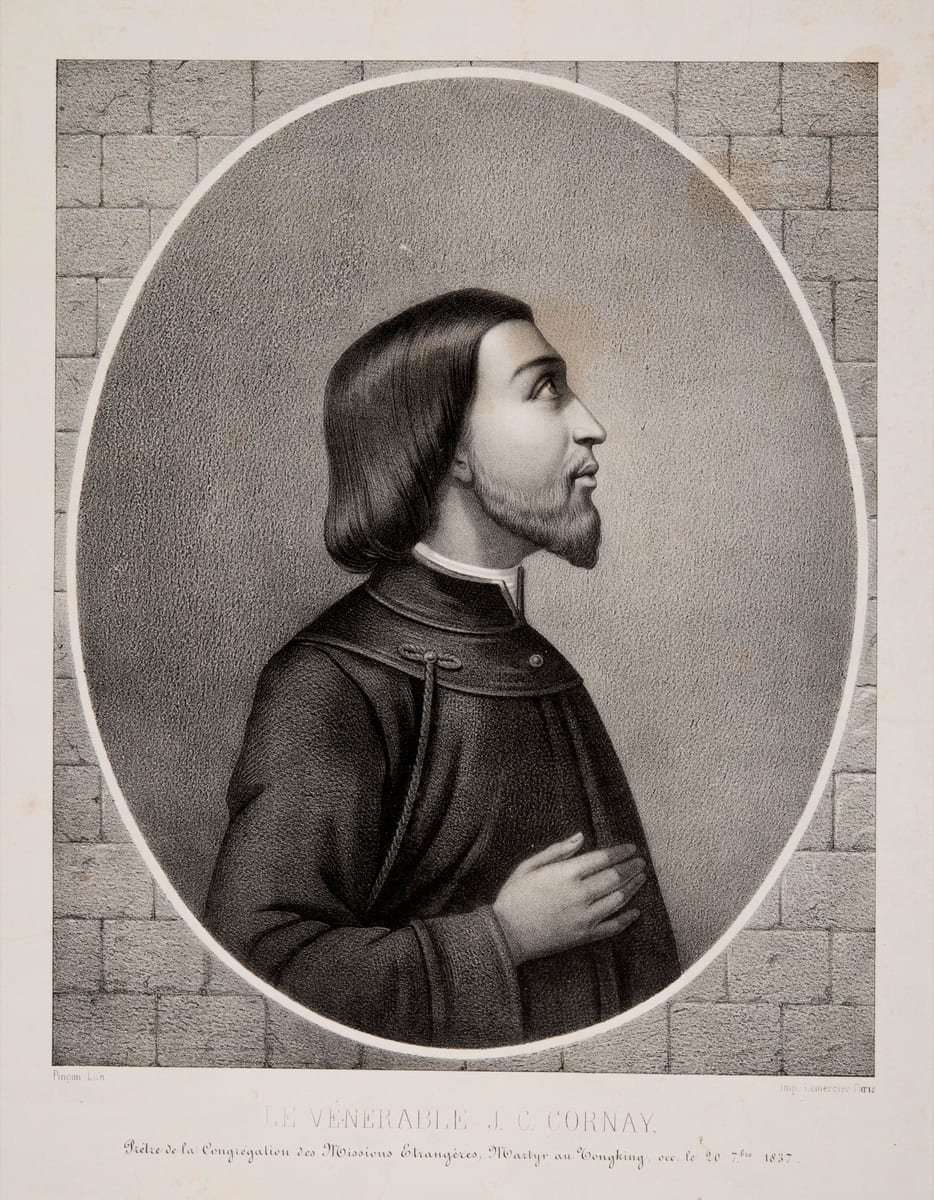
Le Vénérable J. C. Cornay, Prêtre de la Congrégation des Missions Étrangères, Martyr au Tongking AD, P. Pinçon, lithographer; printed by Lemercier, Paris P. Pinçon, lithographer; printed by Lemercier, Paris, Bibliothèque municipale de Poitiers The Emperor Minh Mạng's edicts of 1833 AD and 1836 AD ordered Christians to trample a crucifix and decreed death for European priests and anyone who hid them. St. François-Isidore Gagelin, a French priest of the Paris Foreign Missions, gave himself up to encourage the faithful and was executed at Huế on October 17, 1833 AD. St. Joseph Marchand, a missionary of the Paris Foreign Missions seized in the rebel citadel of Saigon, died near Huế on November 30, 1835 AD under the torture of the hundred wounds.
St. Jean-Charles Cornay, who had entered the Paris Foreign Missions seminary as a subdeacon, was arrested and caged at Bầu Nô in 1837 AD, kissed the cross his captors tried to drag him over in prison at Sơn Tây, and was beheaded there on September 20. In East Tonkin the Spanish Dominican bishops St. Ignacio Delgado and St. Domingo Henares were arrested in 1838 AD, and St. Domingo Henares was beheaded on June 25 with his catechist, St. Francisco Chiểu. St. Pierre Dumoulin-Borie, chosen as coadjutor bishop of West Tonkin, was beheaded near Đồng Hới on November 24, 1838 AD, with two Vietnamese priests.
“Quand vous m'en feriez donner trois cents, j'y consens; mais la seule chose que je désire de vous, c'est de ne mettre à la question aucune personne du peuple. (Even if you had me given three hundred, I agree; the only thing I ask of you is not to put any of the people to the torture.)”
St. Pierre Dumoulin-Borie to the governor, who threatened a hundred more strokes, 1838 AD -
1823–1839 AD
St. Andrew Dũng-Lạc
A poor boy taken in by a catechist became a priest, was ransomed once, and was taken again.
St. Andrew Dũng-Lạc was born in Bắc Ninh province to very poor parents who were not Christians. A catechist at Hà Nội took him in as a child, and he was ordained priest in 1823 AD. In 1835 AD he was jailed at Lý Nhân, and the Christians bought his freedom from the mandarin for four bars of silver.
On November 10, 1839 AD he was arrested again at Kẻ Song, where he had gone to confess to St. Peter Trương Văn Thi, a priest of seventy-six. Ordered to trample the cross, St. Andrew Dũng-Lạc refused. He and St. Peter Thi were beheaded at Hanoi on December 21, 1839 AD, on the spot where the catechist St. Francis Xavier Cần had died two years before.
“Ceux qui meurent pour la foi vont au ciel, nous, nous cachons sans cesse, nous dépensons de l'argent pour nous soustraire aux persécuteurs ; mieux vaudrait nous laisser arrêter et mourir. (Those who die for the faith go to heaven; we hide all the time, we spend money to escape the persecutors; it would be better to let ourselves be arrested and die.)”
St. Andrew Dũng-Lạc and the Vietnamese Martyrs, 1835 AD -
1840–1847 AD
From Minh Mạng to Thiệu Trị
A priest and two catechists held at Ninh Bình die in West Tonkin, a new emperor takes the throne, and prisoners wait in their cells.
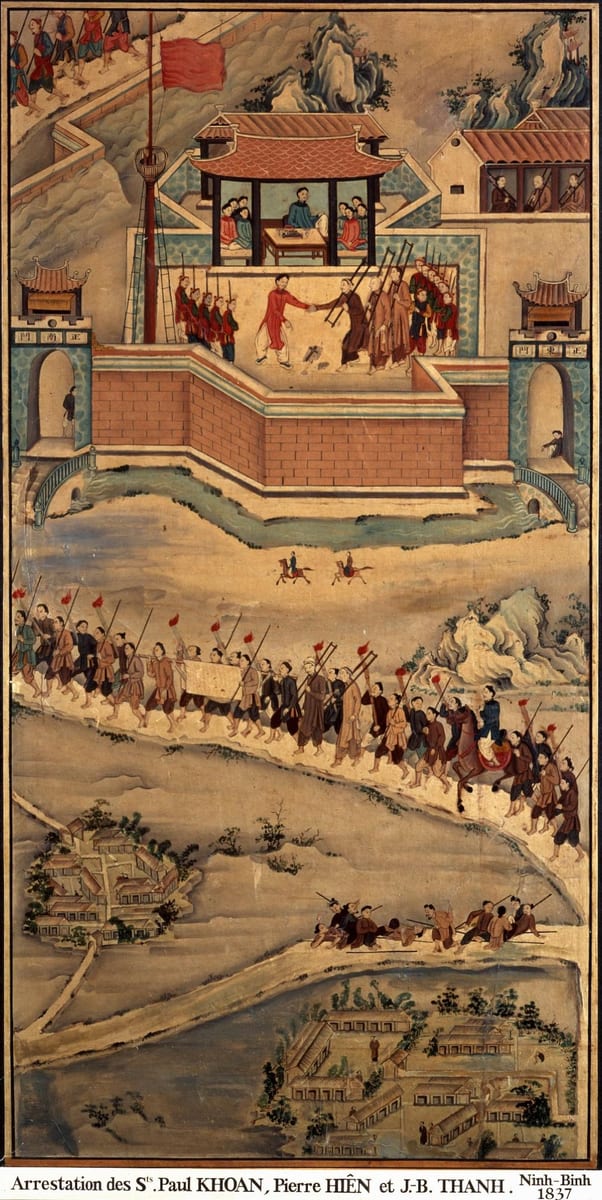
Arrestation des Vénérables Khoan, Thanh, Hiêu, Anonymous Vietnamese painter of the mission of West Tonkin, c. 1838–1840 AD Anonymous Vietnamese painter of the mission of West Tonkin, Archdiocese of Hanoi, from its series of paintings of the martyrs St. Paul Phạm Khắc Khoan, a Vietnamese priest, and his catechists St. Peter Nguyễn Văn Hiếu and St. John Baptist Thành were beheaded on April 28, 1840 AD, after nearly two years in prison at Ninh Bình. The Emperor Minh Mạng died after a fall from his horse on January 20, 1841 AD, and his eldest son, Thiệu Trị, was crowned. St. Agnes Lê Thị Thành, called Bà Đê, arrested with two priests, died in prison on July 12, 1841 AD.
She is the one woman among the 117. St. Paul Lê Bảo Tịnh, who later ran the seminary at Vĩnh Trị, was arrested in Hà Nội province on May 10, 1842 AD and condemned to death, with the sentence held back. The Church reads the letter he wrote from prison in the Office of the martyrs' feast.
“Ne vous attristez pas sur notre sort ; nous sommes innocents, nous n'avons rien entrepris ni contre le roi, ni contre les lois du royaume; le seul tort, qu'on nous reproche, est notre titre de chrétiens ; nous mourons, parce que nous refusons d'abjurer la religion de Jésus, qui est la seule véritable. (Do not be sad about our fate. We are innocent; we have done nothing against the king or the laws of the kingdom. The only fault charged against us is that we are Christians; we die because we refuse to renounce the religion of Jesus, which is the only true one.)”
St. Paul Phạm Khắc Khoan to the crowd of onlookers, on the way to execution, April 28, 1840 AD -
1847–1860 AD
The persecution of Tự Đức
A new emperor's edicts reach bishops, the head of a seminary and an army captain, as a foreign squadron reaches the coast.
The Emperor Tự Đức, who took the throne in November 1847 AD, ordered the next August that missionaries be thrown into the sea with a stone round the neck. On February 27, 1857 AD troops surrounded Vĩnh Trị and seized St. Paul Tịnh, and he was beheaded at Nam Định on April 6. On July 20, 1857 AD the Dominican Bishop St. José María Díaz Sanjurjo asked his executioners to take his head with three strokes.
His successor, Bishop St. Melchor García Sampedro, was cut to pieces at Nam Định on July 28, 1858 AD. A French and Spanish squadron seized Tourane that summer, and the emperor's officials used the attack as a reason to hunt Christians. St. Joseph Lê Đăng Thị, an army captain, was strangled at Phủ Cam, by Huế, on October 24, 1860 AD.
“Je ne sais si le bon Dieu me laissera vivre assez longtemps pour être martyr; je ne désire qu'une seule chose, c'est d'être martyr; mais peut-être le bon Dieu me refusera une si grande grâce à cause de mes péchés. (I do not know whether God will let me live long enough to be a martyr; I want only one thing, to be a martyr; but perhaps God will refuse me so great a grace because of my sins.)”
St. Joseph Lê Đăng Thị, often heard saying it in prison, 1860 AD -
1860–1862 AD
The cage at Hanoi
A French priest writes his farewells from a cage, a bishop dies in a stable, and fishermen die on the pyre.
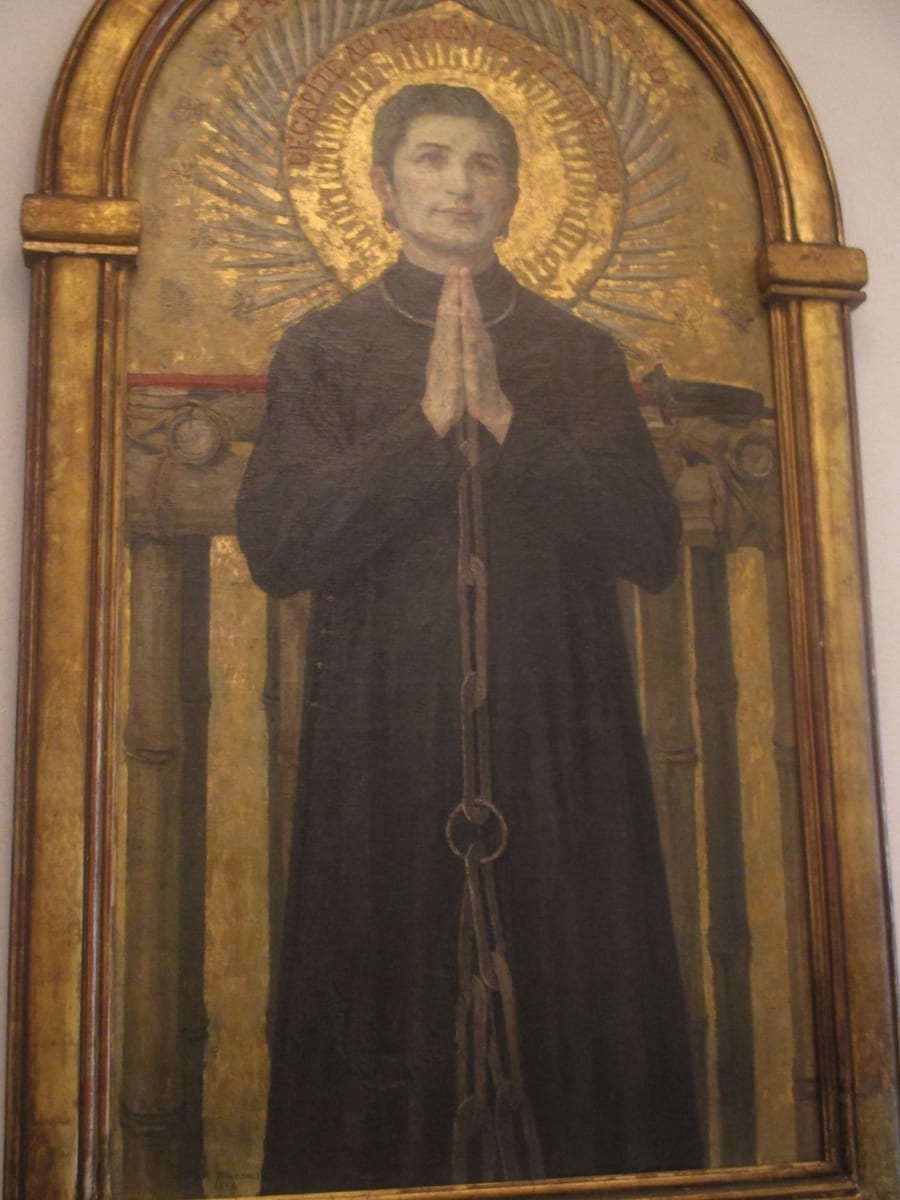
Le Bienheureux Vénard Jean Théophane, décapité pour la foi au Tonkin le 2 février 1861 AD, Unknown painter, Late 19th or early 20th century AD Unknown painter, Missions Étrangères de Paris, crypt of the chapel, rue du Bac, Paris St. Théophane Vénard, a French priest of the Paris Foreign Missions, was pulled from a double wall at Kẻ Bèo on November 30, 1860 AD and put in a cage. From the cage at Hanoi he wrote farewell letters to his father, his sister Mélanie and his brothers on January 20, 1861 AD. On February 2, 1861 AD he was led to the riverbank at Hanoi chanting psalms, and beheaded at thirty-one.
Bishop St. Étienne-Théodore Cuénot, who had given himself up, died in the war-elephant stable at Bình Định on November 14, 1861 AD, before the order to behead him arrived. On January 7, 1862 AD the farmer St. Joseph Tuân, ordered to trample the cross, knelt and adored it instead. In June two fishermen, St. Dominic Toái and St. Dominic Huyên, were burned on the pyre because they would not give up the faith.
“Un léger coup de sabre séparera ma tête, comme une fleur printanière que le maître du jardin cueille pour son plaisir. (A slight sabre-cut will separate my head from my body, like the spring flower which the Master of the garden gathers for His pleasure.)”
St. Théophane Vénard to his father, farewell letter from his cage, January 20, 1861 AD -
1900–1988 AD
Beatified and canonised
Three Popes beatified the martyrs in four groups, and a fourth canonised all 117 on one Sunday in Rome.
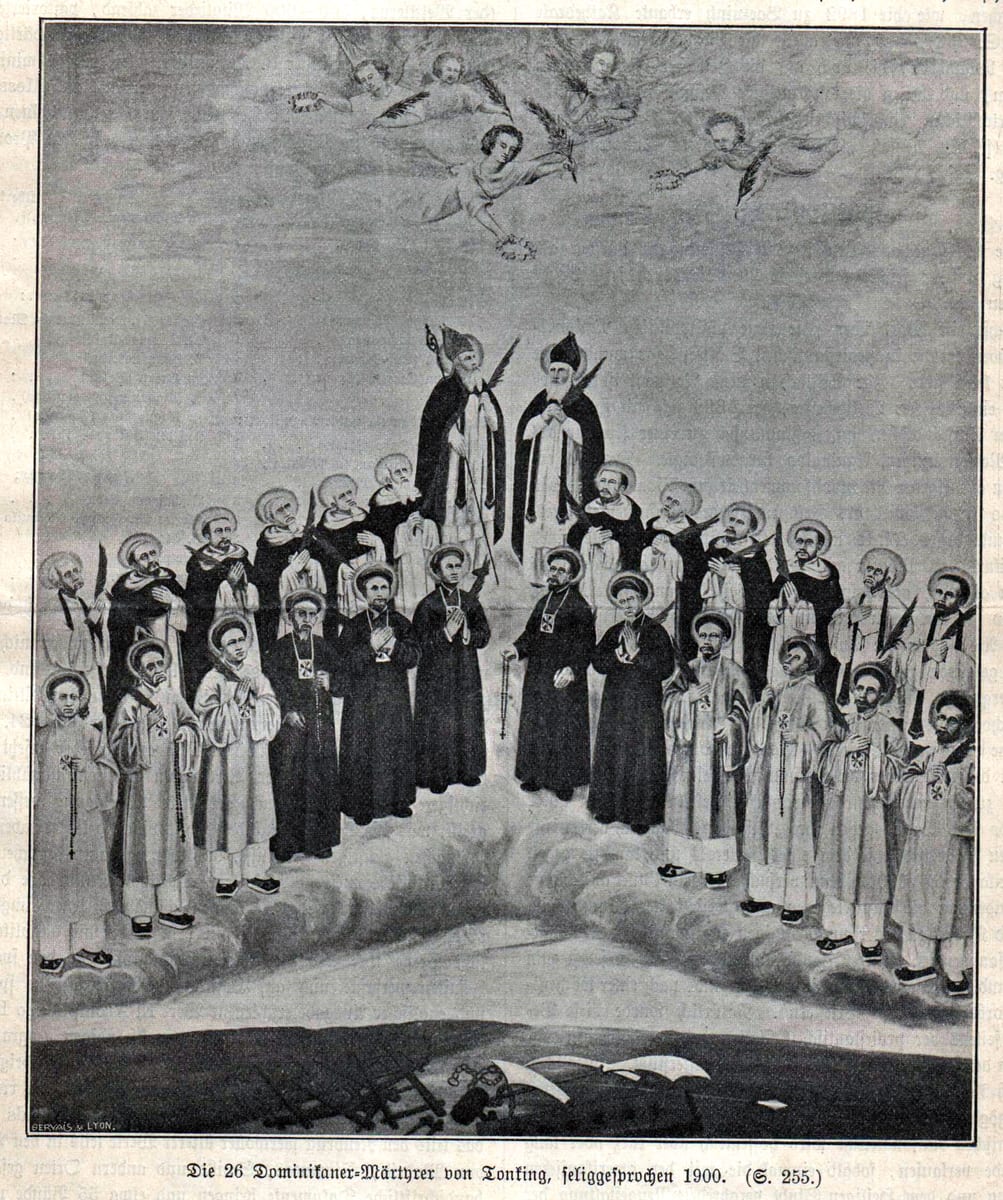
Die 26 Dominikaner-Märtyrer von Tonking, seliggesprochen 1900 AD, Plate printed by Gervais, Lyon, after a devotional painting, 1903 AD Plate printed by Gervais, Lyon, after a devotional painting, Die katholischen Missionen (Freiburg im Breisgau), 1903 AD, p. 255 Pope Leo XIII beatified St. Jean-Charles Cornay, St. Pierre Dumoulin-Borie and their companions at St. Peter's on May 27, 1900 AD. Pope St. Pius X beatified the four Dominicans of 1745 AD and 1773 AD on May 20, 1906 AD, and St. Théophane Vénard and Bishop St. Étienne-Théodore Cuénot on May 2, 1909 AD. Pope Pius XII beatified the last group of 25 on April 29, 1951 AD.
Pope St. John Paul II canonised all 117 together at Mass in St. Peter's Square on Sunday, June 19, 1988 AD. The next day Pope St. John Paul II called it the largest canonisation ever carried out.


Pray with the Church
From the last prayer of St. Philip Phan Văn Minh
The opening invocations of the last prayer of St. Philip Phan Văn Minh, a priest of the West Cochinchina mission, at the place of his execution on July 3, 1853 AD, as Adrien Launay printed it from a letter cited by Bishop Lefebvre. These are the first three of its four invocations; the fourth asks Our Lady to help him. In English: My God, have mercy on me. Give me strength and courage to suffer for your glory. My God, forgive me my sins.
Mon Dieu, ayez pitié de moi!Donnez-moi la force et le courage de souffrir pour votre gloire !Mon Dieu, pardonnez-moi mes péchés !
All 8 reports on Saint Andrew Dũng-Lạc and the Vietnamese Martyrs

About this picture
AI-generated image, in the manner of a nineteenth-century Vietnamese mission painting, based on Arrestation des Vénérables Khoan, Thanh, Hiêu (Anonymous Vietnamese painter of the mission of West Tonkin, c. 1838–1840 AD, Archdiocese of Hanoi) View source artwork.
Sentenced to die, St. Pierre Dumoulin-Borie kneels to thank the mandarin

About this picture
AI-generated image, in the manner of a nineteenth-century Vietnamese mission painting, from the paper's reference portrait based on Le Bienheureux Vénard Jean Théophane, décapité pour la foi au Tonkin le 2 février 1861 (Unknown painter, late 19th or early 20th century AD, Missions Étrangères de Paris, crypt of the chapel, rue du Bac, Paris) View source artwork.
Minding a goat at nine, St. Théophane Vénard resolves to be a martyr

About this picture
AI-generated image, in the manner of a nineteenth-century Vietnamese mission painting, from the paper's reference image based on Funérailles du Vénérable Bonnard (Anonymous Vietnamese painter of the mission of West Tonkin, c. 1852 AD, Missions Étrangères de Paris; photograph by PHGCOM, CC BY-SA 3.0) View source artwork.

Two bamboo canes carry St. Jacinto Castañeda and five others to shore

About this picture
AI-generated image, in the manner of a nineteenth-century Vietnamese mission painting, from the paper's reference image based on Arrestation des Vénérables Khoan, Thanh, Hiêu (anonymous Vietnamese painter of the mission of West Tonkin, c. 1838–1840 AD, Archdiocese of Hanoi) View source artwork.
St. Étienne-Théodore Cuénot dies in elephant stable before beheading order arrives

About this picture
AI-generated image, in the manner of a nineteenth-century Vietnamese mission painting, based on Arrestation des Vénérables Khoan, Thanh, Hiêu (Anonymous Vietnamese painter of the mission of West Tonkin, c. 1838–1840 AD, Archdiocese of Hanoi) View source artwork.
Caught twice in one day, St. Andrew Dũng-Lạc forbids another ransom

About this picture
AI-generated image, in the manner of a nineteenth-century Vietnamese mission painting, from the paper's reference image based on Arrestation des Vénérables Khoan, Thanh, Hiêu (Anonymous Vietnamese painter of the mission of West Tonkin, c. 1838–1840 AD, Archdiocese of Hanoi) View source artwork.
St. Vincent Liêm asks to share a Spanish priest's death sentence

About this picture
AI-generated image, in the manner of a nineteenth-century Vietnamese mission painting, from the paper's reference portrait based on Arrestation des Vénérables Khoan, Thanh, Hiêu (Anonymous Vietnamese painter of the mission of West Tonkin, c. 1838–1840 AD, Archdiocese of Hanoi, from its series of paintings of the martyrs) View source artwork.
St. John Đạt gives himself up to spare the village that hid him

About this picture
AI-generated image, in the manner of a nineteenth-century Vietnamese mission painting, from the paper's reference portrait based on Arrestation des Vénérables Khoan, Thanh, Hiêu (Anonymous Vietnamese painter of the mission of West Tonkin, c. 1838–1840 AD, Archdiocese of Hanoi, from its series of paintings of the martyrs) View source artwork.