
Saints Jesuit lay brother and porter of Montesión · Feast October 30
Saint Alphonsus Rodríguez
Feast 30 October · Born July 25, 1531 AD, Segovia, Castile, Spain · Died October 31, 1617 AD, College of Montesión, Palma, Majorca, Spain
A Segovia cloth merchant who buried his wife and children joined the Jesuits as a lay brother at about forty, became porter of their college on Majorca, and died there in 1617 AD.
Begin the life
In brief
Saint Alphonsus Rodríguez (Alphonsus Rodriguez) was a cloth merchant of Segovia who lost his wife and children and became a Jesuit lay brother at about forty. From about 1580 AD he kept the door of the Jesuit College of Montesión at Palma, on the island of Majorca. Pope Leo XIII canonized him on January 15, 1888 AD, together with St. Peter Claver, the young Jesuit he had urged towards the Indies.
-
1530s–1540s AD
A merchant's son in Segovia
The boy met the first Jesuits under his father's roof, then left school to learn the cloth trade.
St. Alphonsus was born at Segovia, in Castile, on July 25, the feast of St. James. His father, Diego Rodríguez, was a cloth merchant in a city known for its fine cloth. When two of the first Jesuit priests came to preach in Segovia, Diego Rodríguez gave them lodging, and one of them was St. Peter Faber.
All his life St. Alphonsus counted it a special grace to have lived under one roof with those men. His father sent him and his elder brother to study at Alcalá, then died within the year. His mother, María Gómez, called him home at about fifteen to learn the family business and help raise the younger children.
-
1552–1562 AD
The draper of Market Street
He ran the family firm, married at his mother's urging and became a father.

Vista de Segovia (general view of Segovia), Anton van den Wyngaerde (1525–1571 AD), 1562 AD Anton van den Wyngaerde (1525–1571 AD), Reproduced on Commons from M. T. Cortón de las Heras, La construcción de la Catedral de Segovia (1525–1607 AD), Segovia 1997 AD; original drawing by Wyngaerde By 1552 AD St. Alphonsus was signing the family firm's business by himself, though his mother was still its head. At his mother's urging he married María Suárez, a young woman of the same social rank as his, in 1557 AD. The couple lived in the Calle del Mercado (*Market Street*) in Segovia, and he carried on his father's trade as a draper.
A witness at his canonization process said that parents sent their children to buy wool from him, sure they would not be cheated. On Monday, January 16, 1562 AD, a son of his was baptized at Segovia and given his father's name, Alonso.
-
Early 1560s AD
A house emptied
His daughter and then his wife died, and the widower turned to confession, penance and prayer.
His little daughter died first, and her death was the first great sorrow of his life. Soon afterwards his wife died, still young, not long after the baby Alonso was born. At thirty-one St. Alphonsus was a widower with one small son, the little Alonso, and his business was failing.
He confessed every sin of his whole life to Father Juan Bautista Martínez, a Jesuit then preaching in Segovia, and wept as he did it. From then on he went to Confession and Communion every week, and he fasted, prayed and scourged himself. He took his mother and his two unmarried sisters, Juliana and Antonia, into his house.
-
1560s AD
The last child
He prayed over his small son, lost him within the month, and was turned away by the Jesuits of Segovia.
One day St. Alphonsus looked at his son, then a bright boy of about three. He prayed that God would take the child rather than let him ever offend God. Within a month the boy fell ill and died.
With no child left to raise, St. Alphonsus turned his thoughts to life in a religious order. At thirty-eight he asked to join the Jesuits at Segovia. They judged him unfit, because he was too old and had too little learning.
-
1569–1571 AD
A schoolboy at thirty-eight
He gave away his goods, sat in a Valencia classroom with boys, and was admitted as a Jesuit lay brother.
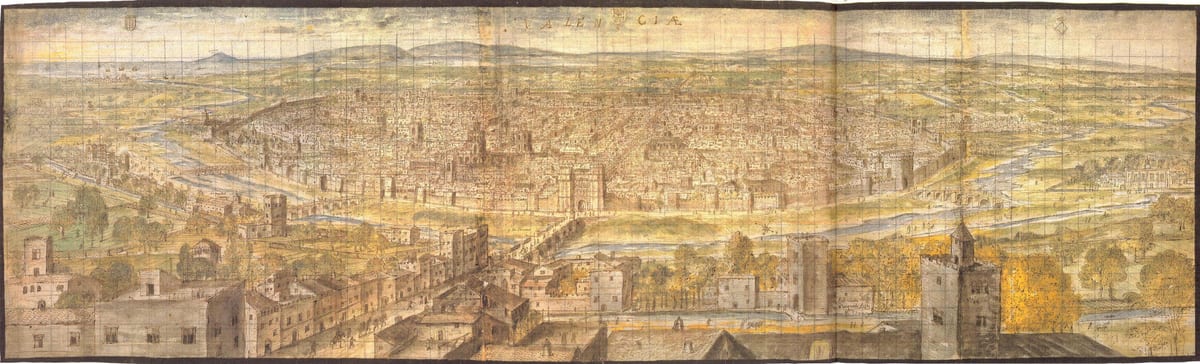
València el 1563 AD (view of Valencia from the north), Anton van den Wyngaerde (1525–1571 AD) Anton van den Wyngaerde (1525–1571 AD), Reproduced on Commons via urbanity.es; original drawing by Wyngaerde St. Alphonsus signed over everything he owned to his two sisters, keeping only enough money for the journey. Dressed as a poor man, he went to Valencia to see Father Luis de Santander, his former director at Segovia and now rector of the Jesuit college there. He spent two years there in school among the boys, learning Latin.
When Father Santander warned him about the course he was following, St. Alphonsus resolved never again, as long as he lived, to do his own will. On January 31, 1571 AD, when he was about forty, the Society of Jesus admitted him at Valencia. Because of his age and his slowness at learning, he was taken as a lay brother, not as a candidate for the priesthood.
“Mucho me temo, hijo, que no os perdáis. — ¿Pues por qué me tengo de perder? — Porque veo que queréis hacer vuestra voluntad; y haciéndola, sin duda os perderéis. (I fear greatly that you will lose your soul. / Why should I lose my soul? / Because I see you want to follow your own caprice; and if you do so, there can be no doubt that you will be lost.)”
Father Luis de Santander to St. Alphonsus, and St. Alphonsus's reply, the warning at Valencia -
1571–1603 AD
The door at Montesión
Sent to a new college on Majorca, he took his vows there and was made its porter.
In 1571 AD his superiors sent St. Alphonsus, still a novice, to the new Jesuit college on Majorca named for Our Lady of Montesión, and he landed there in August. He made his first vows there on April 5, 1573 AD, and he lived there for the rest of his life. About 1580 AD he was given the busy post of door-keeper, to keep him busy and take his mind off the inner troubles he was then suffering.
In 1600 AD Christopher Colomer, so ill that he had already received Viaticum, the Communion given to the dying, came to the porter's lodge burning with fever. Colomer begged for the drink he had been refused at home, and St. Alphonsus blessed some water and gave it to him, and Colomer was cured. In September 1603 AD St. Alphonsus kept the viceroy, the bishop and the city magistrates outside the gate before a student play, because he had strict orders not to open it before the appointed hour.
“«ya voy, Señor, y abriros hé yo Señor á Vos por amor de Vos;» (Lord, I must open the door to Thee, for love of Thee. / I am coming, my Lord.)”
St. Alphonsus Rodríguez, at the sound of the porter's bell -
1605–1610 AD
A student at the lodge
A young Jesuit came to the porter every day and later left for the Indies, urged on by him.
In November 1605 AD a young Jesuit student, St. Peter Claver, landed at Palma to study philosophy at Montesión. He got permission to speak with St. Alphonsus for a quarter of an hour every day about the state of his soul. After a vision, St. Alphonsus put all his strength into persuading St. Peter Claver to go to the Indies.
The two friends parted in November 1608 AD, when St. Peter Claver crossed with three novices to the bay of Sóller and took ship there for Tarragona. In 1610 AD the head of the Jesuits, Father Claudio Acquaviva, chose St. Peter Claver for the Kingdom of New Granada, in the Indies.
-
1617 AD
The vigil of All Saints
He died just after midnight at eighty-six, and at dawn the city came to his body.
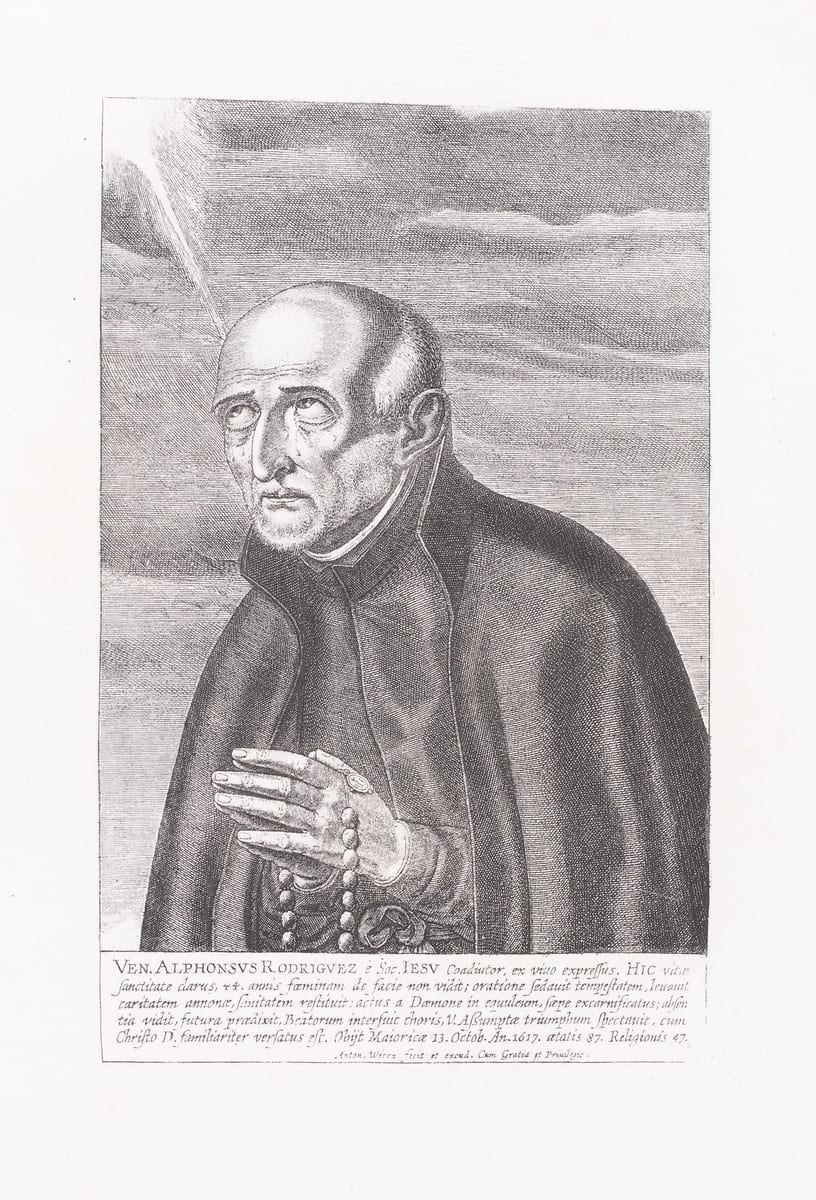
Ven. Alphonsus Rodriguez e Soc. Iesu Coadiutor, ex vivo expressus, Antonius Wierix III, 1617–1624 AD Antonius Wierix III, KU Leuven Libraries In October 1617 AD his confessor, Father Juan Mateo Marimón, anointed St. Alphonsus, who answered the prayers calmly. He then lay with his eyes closed for three days. A quarter of an hour after midnight on October 31, the vigil of All Saints, he opened his eyes, kissed the feet of the crucifix and died, aged eighty-six.
At dawn the news ran through Palma. Almost the whole city came to the college to kiss his hands and feet.


Pray with the Church
Prayer of St. Alphonsus Rodríguez
The prayer St. Alphonsus said he had learned from Christ Himself, which he repeated in his last illness, in the English of Foley's Life of the saint (1873 AD).
O Jesus and Mary, my only comfort, grant me that I may suffer and die for your love, and that I may be wholly yours and not mine own.
All 4 reports on Saint Alphonsus Rodríguez

About this picture
AI-generated image, in the manner of Spanish Golden Age oil painting.
Dying widow touched with St. Alphonsus's relic walks to church next morning

About this picture
AI-generated image, in the manner of Spanish Golden Age oil painting, from the paper's reference portrait based on Ven. Alphonsus Rodriguez e Soc. Iesu Coadiutor, ex vivo expressus (Antonius Wierix III, 1617–1624, KU Leuven Libraries) View source artwork.
Palma's crowds force a secret night burial for Saint Alphonsus Rodríguez

About this picture
AI-generated image, in the manner of Spanish Golden Age oil painting, from the paper's reference portrait based on Ven. Alphonsus Rodriguez e Soc. Iesu Coadiutor, ex vivo expressus (Antonius Wierix III, 1617–1624, KU Leuven Libraries) View source artwork.
Jesuits admit St. Alphonsus Rodríguez so as not to lose a saint

About this picture
AI-generated image, in the manner of an early nineteenth-century Spanish pen-and-wash church-interior drawing. No person appears in it.