
Saints Martyr of Rome · Feast February 14
Saint Valentine
Feast 14 February · Died Rome (buried on the Via Flaminia)
Saint Valentine, a martyr buried outside Rome on February 14, is remembered in Catholic Tradition as a priest who gave a blind girl her sight before he was beheaded, and in Geoffrey Chaucer's poem the birds choose their mates on his day.
Begin the life
In brief
Saint Valentine, also called Valentine of Rome, is a martyr buried on the Via Flaminia outside Rome, and the Church keeps him on February 14. The Roman Martyrology of 1914 AD keeps two martyrs of the name on February 14, a priest of Rome and a bishop of Terni. In Catholic Tradition, the priest gave sight to a blind girl, and the bishop healed a crippled boy.
-
February 14
What the Church knows
The Church knows St. Valentine's name and that he was buried on the Via Flaminia on February 14.
The Church's revised Roman Calendar of 1969 AD sets out what is known of St. Valentine. Apart from his name, the Calendar says, only his burial on the Via Flaminia on February 14 is known. Its commentary counts him among the ancient martyrs of Rome, known from the Mass books and other records of the Middle Ages.
Catholic Tradition, as the Roman Martyrology of 1914 AD keeps it, places the priest at Rome in the time of the emperor Claudius. The same Martyrology keeps a bishop of Interamna, the city now called Terni.
“Romæ, via Flamínia, natális sancti Valentíni, Presbýteri et Mártyris, qui, post multa sanitátum et doctrínæ insígnia, fústibus cæsus et decollátus est, sub Cláudio Cǽsare. (AT Rome, on the Flaminian road, in the time of the emperor Claudius, the birthday of blessed Valentine, priest and martyr, who after having cured and instructed many persons, was beaten with clubs and beheaded.)”
The Roman Martyrology, the entry for February 14 -
337–649 AD
Pope St. Julius I's basilica on the Via Flaminia
Pope St. Julius I built a basilica bearing St. Valentine's name outside Rome, and Pope Theodore I later built him a church by the Milvian Bridge.

St. Valentine, fresco in the row of saints and Fathers of the Church, 757–767 AD Santa Maria Antiqua, Roman Forum, Rome; photograph Sailko, CC BY 3.0 Pope St. Julius I, Bishop of Rome from 337 AD to 352 AD, built a basilica on the Via Flaminia. It stood at the second milestone from the city and was called by St. Valentine's name. Digging at the site later uncovered the floor of its nave and apse and a grave inscription dated 359 AD.
Early pilgrims' guides praised the church for its size and beauty. An underground cemetery of St. Valentine, decorated with paintings, lay on the same road. Between 642 AD and 649 AD, Pope Theodore I built a church to St. Valentine from the ground up beside the Milvian Bridge, dedicated it himself and gave it many gifts.
-
Time of the emperor Claudius
The priest in the officer's house
In Catholic Tradition, a Roman priest held in an officer's house gave sight to the officer's blind daughter and was beheaded on the Via Flaminia.
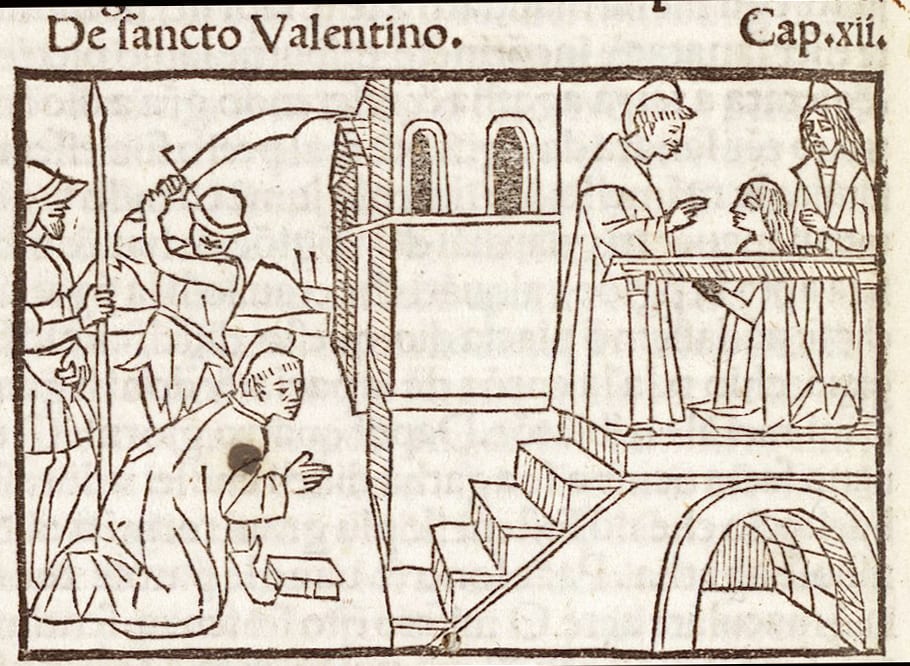
St. Valentine heals the provost's daughter and is beheaded, woodcut from the Venetian Golden Legend, 1497 AD BEIC digital library, Milan In Catholic Tradition, the emperor Claudius had St. Valentine, a priest of Rome, put in chains for helping the martyrs of his persecution. Claudius asked him why he would not accept the emperor's friendship, and St. Valentine answered with words from the Gospel of John. Claudius was moved by the answer, until the prefect Calpurnius warned him that he was being led astray; then, with sorrow, Claudius handed St. Valentine to Calpurnius, who put him in the house of his officer Asterius.
Asterius brought him an adopted daughter he had loved since the cradle, blind for about two years, and St. Valentine laid his hand on her eyes and prayed to Christ, and her eyes were opened. Asterius and his wife fell at St. Valentine's feet, and after a three-day fast their household of about forty-six was baptized. When Claudius heard of it he was angry, and he had St. Valentine beaten with clubs and beheaded on the Via Flaminia on February 14.
-
Third century AD
The bishop sent for to heal a crippled boy
In Catholic Tradition, a bishop sent for from Terni healed a teacher's crippled son in Rome and was beheaded at midnight.
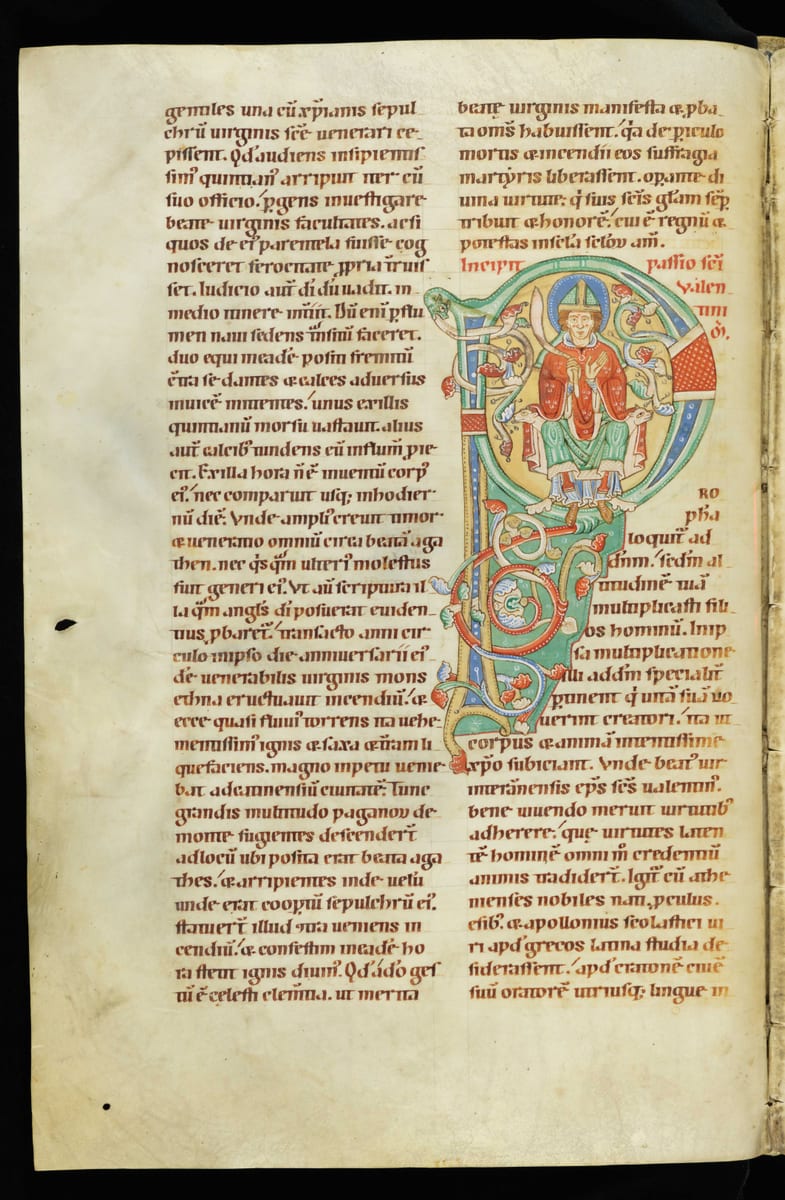
St. Valentine, bishop, in the initial of his Passion, Weissenau Passionary, Frater Rufillus and an unknown master, 1170–1200 AD Frater Rufillus and an unknown master, Fondation Martin Bodmer, Cologny As Catholic Tradition tells it, Cherimon, only son of St. Craton, a teacher of rhetoric at Rome, was bent double with his head between his knees. St. Craton sent to Interamna, the city now called Terni, for its bishop, St. Valentine of Terni, who had cured a tribune's brother of the same illness. The bishop shut himself in a room with the boy, and around midnight Cherimon got up healed and praised God aloud.
St. Craton was baptized with his household, and the bishop was then arrested, beaten and pressed to sacrifice to the gods, and he would not give way. The Roman Martyrology keeps St. Craton as a martyr too, put to death with his household a short time after his baptism. At midnight the prefect Placidus had the bishop beheaded, and Sts. Proculus, Ephebus and Apollonius, Athenian students who had turned to Christ after the healing, carried his body by night to their church at Interamna.
“Interámnæ sanctórum Próculi, Ephébi et Apollónii Mártyrum, qui, cum ad sancti Valentíni corpus vigílias ágerent, Leóntii Consuláris jussu comprehénsi sunt, et gládio cæsi. (… the holy martyrs Proculus, Ephebus and Apollonius, who, whilst watching by the body of St. Valentine, were arrested and put to the sword by the command of the ex-consul Leontius)”
The Roman Martyrology, the entry for February 14 -
Fourteenth and fifteenth centuries AD
The poets give his day to the birds
Poems written in English and French in the fourteenth and fifteenth centuries tell of choosing a mate on St. Valentine's Day.
In Geoffrey Chaucer's poem The Parlement of Foules, the birds gather before Nature to choose their mates, as they do every year on St. Valentine's Day. The poem ends with the small birds singing a song addressed to St. Valentine. In a French ballad, John Gower described all the birds coming to an assembly held by St. Valentine on his day.
Charles d'Orléans wrote in a short poem that on St. Valentine's Day everyone must choose a mate. Herbert Thurston wrote in the Catholic Encyclopedia in 1912 AD that the day's customs grew from a medieval belief that birds paired on February 14. Thurston added that people who chose each other this way seem to have called each other their Valentines.
“Now welcom somer, with thy sonne softe, That hast this wintres weders over-shake, And driven awey the longe nightes blake! Seynt Valentyn, that art ful hy on-lofte;— Thus singen smale foules for thy sake— (Now welcome, summer, with your gentle sun, who have shaken off this winter's storms and driven away the long black nights. Saint Valentine, who are high aloft — so the small birds sing for your sake —)”
The small birds of Geoffrey Chaucer's Parlement of Foules to St. Valentine -
Nineteenth century to 2004 AD
Relics in Rome, a memorial left to local calendars
Most of St. Valentine's relics were kept in Rome, his memorial was left to local calendars in 1969 AD, and the Martyrology still keeps him on February 14.
In the nineteenth century, most of St. Valentine's relics were kept in the church of St. Praxedes in Rome. The head of St. Valentine was kept in the church of St. Sebastian in Rome.
In 1969 AD, the revised Roman Calendar left St. Valentine's memorial, though ancient, for local churches to keep in their own calendars. It moved the memorial of Sts. Cyril and Methodius to February 14, the day St. Cyril died in 869 AD. The Roman Martyrology of 2004 AD keeps St. Valentine, martyr, on February 14, at Rome on the Via Flaminia near the Milvian Bridge.


Pray with the Church
St. Valentine's prayer over the blind girl
The prayer Catholic Tradition gives St. Valentine as he laid his hand on the eyes of Asterius's blind adopted daughter, from the Passion of Sts. Marius and Martha as printed in the Acta Sanctorum (January, vol. II, Paris, 1863 AD).
Domine Jesu Christe (Lord Jesus Christ,)illumina famulam tuam, quia tu es lumen verum. (give light to your handmaid, for you are the true light.)