
Saints Archbishop of Canterbury and martyr · c. 1118–1170 AD
Saint Thomas Becket
Feast 29 December · Born December 21, 1118 AD, London, England · Died December 29, 1170 AD, Canterbury Cathedral, Canterbury, England
A London clerk rose to be King Henry II's chancellor, became his archbishop and opponent, spent six years in exile, and died under four knights' swords in his own cathedral.
Begin the life
In brief
Saint Thomas Becket, also called St. Thomas of Canterbury, was a London citizen's son who rose to be King Henry II's chancellor. As Archbishop of Canterbury he resisted the king over the rights of the Church and spent six years in exile in France. Four of the king's knights killed him in Canterbury Cathedral on December 29, 1170 AD.
-
c. 1118–1154 AD
From London to the archbishop's household
Born to a London citizen, St. Thomas Becket lost his mother at twenty-one and rose to be the Archbishop of Canterbury's most trusted clerk.
St. Thomas Becket was born in London on December 21, the feast of St. Thomas the Apostle. His father, Gilbert, had once been sheriff of London, and his mother, Matilda, made sure he was taught to read, which he learned from the canons of Merton. He used to say that he had learned the fear of the Lord from her.
Repeated fires in the city had worn down his father's means, and when his mother died, he was twenty-one and nearly destitute. He kept the accounts of a rich relative in London, then joined the household of Theobald, Archbishop of Canterbury, arriving with one squire. He became Theobald's most trusted clerk, and in 1154 AD the archbishop ordained him deacon and made him Archdeacon of Canterbury.
-
1154–1162 AD
The king's chancellor, then his archbishop
King Henry II made St. Thomas Becket his chancellor and, after Archbishop Theobald died, Archbishop of Canterbury.
On Theobald's recommendation, King Henry II made St. Thomas Becket Chancellor of England. In 1158 AD he went to France to negotiate a royal marriage, with a train so lavish that people talked about it as he passed.
Archbishop Theobald died on April 18, 1161 AD. St. Thomas Becket was elected in May 1162 AD, ordained priest on June 2 and consecrated archbishop the next day.
“Equidem tres tales pauperes agnosco in Anglia sacerdotes, quorum cujuslibet ad archiepiscopatum promotionem magis optarem quam meam; nam ego, si forte promoverer, ita dominum meum regem intus et in cute novi, necesse haberem aut ipsius gratiam amittere, aut Domini Dei (quod absit!) servitium postponere. (Indeed I know three poor priests in England any one of whom I would rather see raised to the archbishopric than myself; for if I were raised to it, I know my lord the king so thoroughly, inside and out, that I would have either to lose his favour or (God forbid) to put the service of the Lord God second.)”
St. Thomas Becket to Aschetinus, Prior of Leicester, 1161 AD -
1162–1164 AD
The quarrel over accused clergy
St. Thomas Becket refused to hand clergy accused of crimes to the king's judges, then gave way at Clarendon but would not seal the written text.
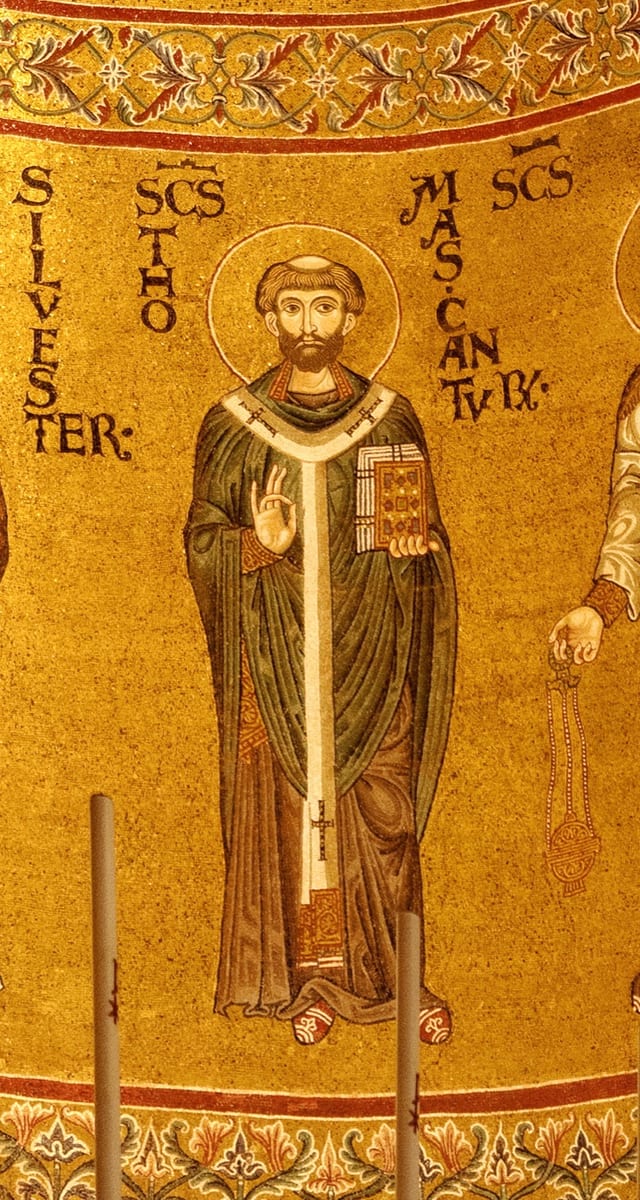
SCS THOMAS CANTUR: St. Thomas of Canterbury, apse mosaic, Monreale Cathedral (crop of 'Abside della Cattedrale di Santa Maria Nuova Monreale, Palermo, Italia 28 Aprile 2023 AD 02'), Byzantine-trained mosaicists working for King William II of Sicily; photograph by Giorgio Galeotti, c. 1178-1189 AD (mosaic); photograph April 28, 2023 AD Byzantine-trained mosaicists working for King William II of Sicily; photograph by Giorgio Galeotti, Cattedrale di Santa Maria Nuova, Monreale, Sicily; photo Giorgio Galeotti, CC BY-SA 4.0 On August 10, 1162 AD, St. Thomas Becket went barefoot to meet the envoy bringing his pallium, the Pope's sign of an archbishop's authority. His quarrel with King Henry II came over clergy accused of crimes, whom he refused to hand to the king's judges and would punish only under the laws of God and the Church. In October 1163 AD the king asked the bishops at Westminster to approve old rules he called his grandfather's customs, without yet saying what they were.
At Clarendon in January 1164 AD the king pressed St. Thomas Becket to accept the customs in public, and, moved by the clergy's tears, St. Thomas Becket promised to keep them. But he refused to set his seal to the written text. He took away a copy, not as approval but as a safeguard for the Church.
“Fateor, fratres, inexcusabilis sum ante Dominum, contra Dominum praestans sacramentum, degenere timore compulsus, et hoste maligno circumventus, vetitis adquievi. (I confess, brothers, I am without excuse before the Lord: I gave an oath against the Lord; driven by unworthy fear and caught by the evil enemy, I gave way to what was forbidden.)”
St. Thomas Becket to the bishops, at Northampton, of the oath he had taken at Clarendon, October 1164 AD -
October–November 1164 AD
Northampton and the night flight
Summoned before the king's council, St. Thomas Becket carried his cross into court, refused the barons' sentence and escaped to Flanders in disguise.
In October 1164 AD complainants had St. Thomas Becket summoned to the king's council at Northampton to answer for estates they said he had taken. There King Henry II also demanded an account of some thirty thousand pounds from his years as chancellor. St. Thomas Becket carried his own cross into the court, and when the barons came to pass sentence, he told them they had no right to judge him.
He walked out of the hall with the cross while men jeered, and on the night of October 13 he slipped out of Northampton in secret. For nearly three weeks he hid with a hermit and then in one monastery after another, travelling only by night. On November 2, All Souls' Day, two priests rowed him in disguise from Sandwich across to Flanders.
“Equidem, ista fuit amara dies. — Ultima erit amarior. (William FitzStephen: This has indeed been a bitter day. St. Thomas Becket: The last will be bitterer.)”
William FitzStephen to St. Thomas Becket, and St. Thomas Becket's reply, October 13, 1164 AD -
1164–1169 AD
Exile in France
Sheltered by Pope Alexander III and the monks of Pontigny, St. Thomas Becket held out through years of failed peace talks.
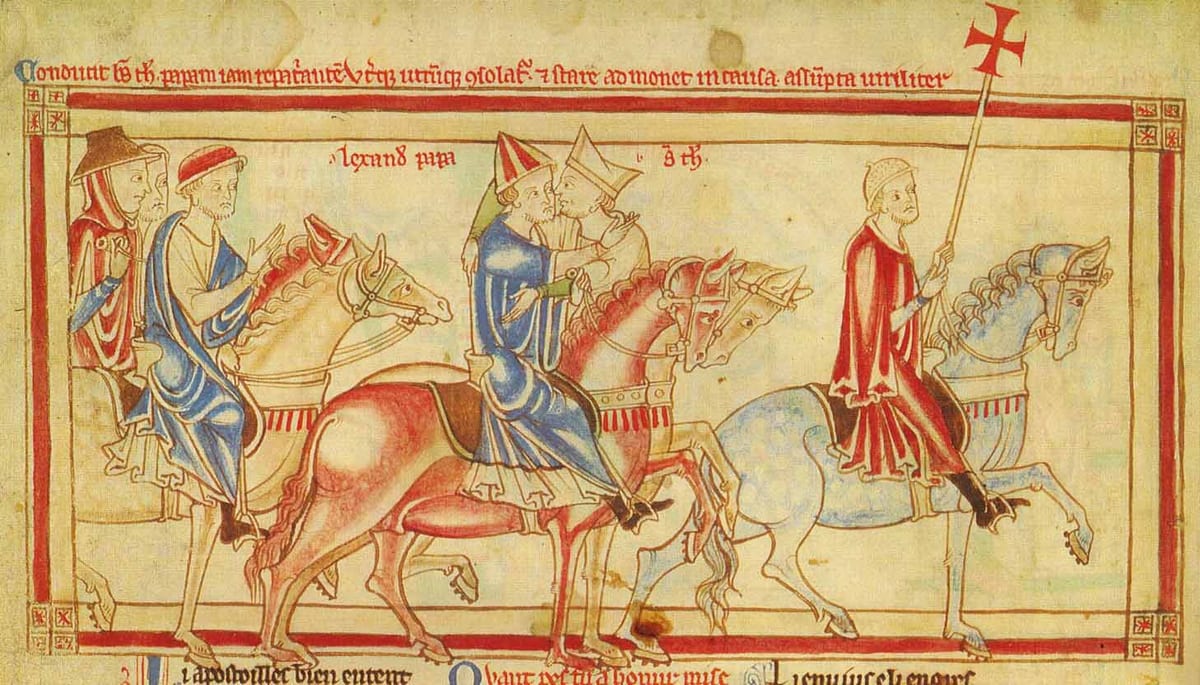
Becket bids farewell to the Pope: The Becket Leaves (La vie de Seint Thomas de Cantorbéry), f. 1v, English illuminator, possibly Matthew Paris (attribution disputed), c. 1220-1240 AD English illuminator, possibly Matthew Paris (attribution disputed), Wormsley Library (Sir Paul Getty collection), on loan to the British Library, Loan MS 88 On November 23, 1164 AD, St. Thomas Becket threw himself at the feet of Pope Alexander III at Sens. A week later he went to live with the Cistercian monks of Pontigny, where he lived austerely and kept his penances hidden. In England, on December 26, King Henry II seized everything St. Thomas Becket owned and banished all his relatives.
At Montmirail on January 6, 1169 AD, he threw himself at the king's feet before the King of France. St. Thomas Becket defended the words saving the honour of God, the king told him to be content with what his predecessors had asked, and the talks brought no peace.
“Dilecti socii, mecum omnia passi, ut quid contra me ita sentitis et loquimini? Reditus et restitutio nostra minimum quidem est; libertas ecclesiae, de qua rex non loquitur, longe pluris est. (Dear companions, who have suffered everything with me, why do you think and speak against me like this? Our return and restoration is a very small thing; the freedom of the Church, of which the king says nothing, is worth far more.)”
St. Thomas Becket to his companions in exile, after the conference of Montmirail, January 1169 AD -
July–December 1170 AD
Peace, and the road home
Reconciled with King Henry II at Fréteval, St. Thomas Becket came home to Canterbury, and four of the king's knights set out after him.
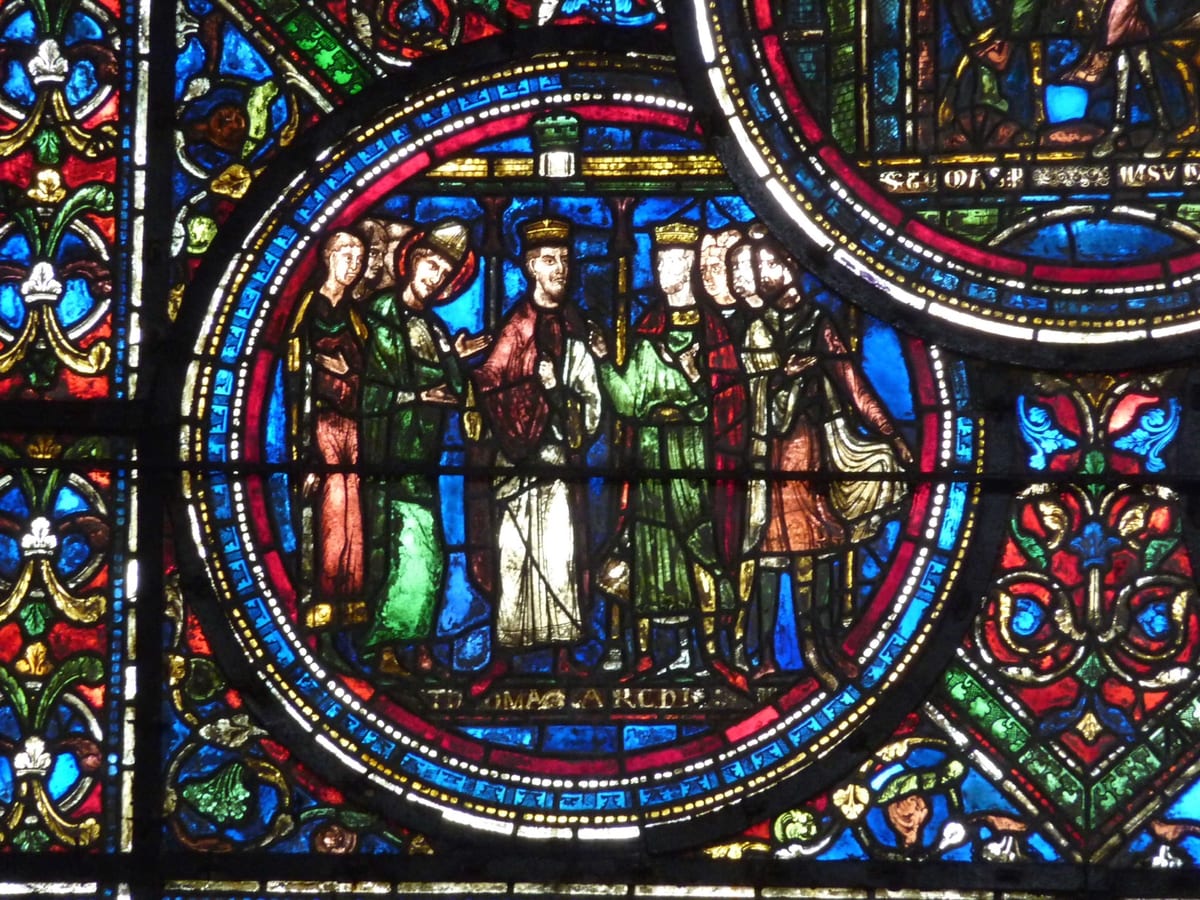
Louis VII of France reconciles Thomas with Henry II: Sens Cathedral, bay 23 (the Becket window), French glaziers; photograph by GFreihalter, first quarter of the 13th century (window); photograph May 8, 2015 AD French glaziers; photograph by GFreihalter, Cathédrale Saint-Étienne, Sens (Palissy IM89000278); photo GFreihalter, CC BY-SA 3.0 King Henry II and St. Thomas Becket made peace at Fréteval on July 22, 1170 AD. But the king refused him the kiss of peace, the usual sign that a reconciliation was sincere. St. Thomas Becket left Sens, his home for most of the exile, on All Saints' Day and landed early in December at Sandwich, a port that belonged to him as archbishop.
On his return he excommunicated several of the king's bishops under sentences the Pope had passed, and when the king's officials asked him to absolve them, he refused, because the sentences were the Pope's. At the king's court in Normandy a baron told King Henry II he would have no good days while the archbishop lived, and the king raged. Four knights of the king's household, Reginald FitzUrse, William de Tracy, Hugh de Morville and Richard le Breton, then left the court, crossed the Channel and on December 28 reached Saltwood Castle in Kent.
“Vado in Angliam mori. (I am going to England to die.)”
St. Thomas Becket to the Bishop of Paris, taking leave before returning to England, November 1170 AD -
December 25–29, 1170 AD
Death in the cathedral
Four knights brought the king's demands to Canterbury, followed St. Thomas Becket into the cathedral at Vespers and killed him there.
On Christmas Day St. Thomas Becket told the people of Canterbury they had one martyred archbishop, St. Alphege, and might soon have another. On December 29 the four knights walked into his chamber after dinner and ordered him, in the king's name, to absolve the bishops, and when he refused they went out through the hall shouting for their men to arm. His monks urged him into the cathedral, where Vespers had begun, and there he forbade them to bar the door.
At sunset the knights burst in shouting for the traitor, and he came down to meet them and, told he would die, said he accepted death in the name of the Lord. Edward Grim, standing beside him, threw out his arm to shield him, and Reginald FitzUrse's first blow nearly cut through it. At the second blow St. Thomas Becket fell face down on the pavement, as if at prayer.
“Ecce ego, non proditor, sed presbyter Dei; et miror, quod in tali habitu ecclesiam Dei ingressi estis. Quid placet vobis? (Here I am, no traitor, but a priest of God; and I wonder that you have come into the church of God dressed like this. What do you want?)”
St. Thomas Becket to the knights, confronting them in the cathedral, December 29, 1170 AD -
1170–1174 AD
The tomb, the saint and the king's penance
A blind woman of Canterbury saw again, Pope Alexander III canonised the martyr, and King Henry II came barefoot to Canterbury to do penance.
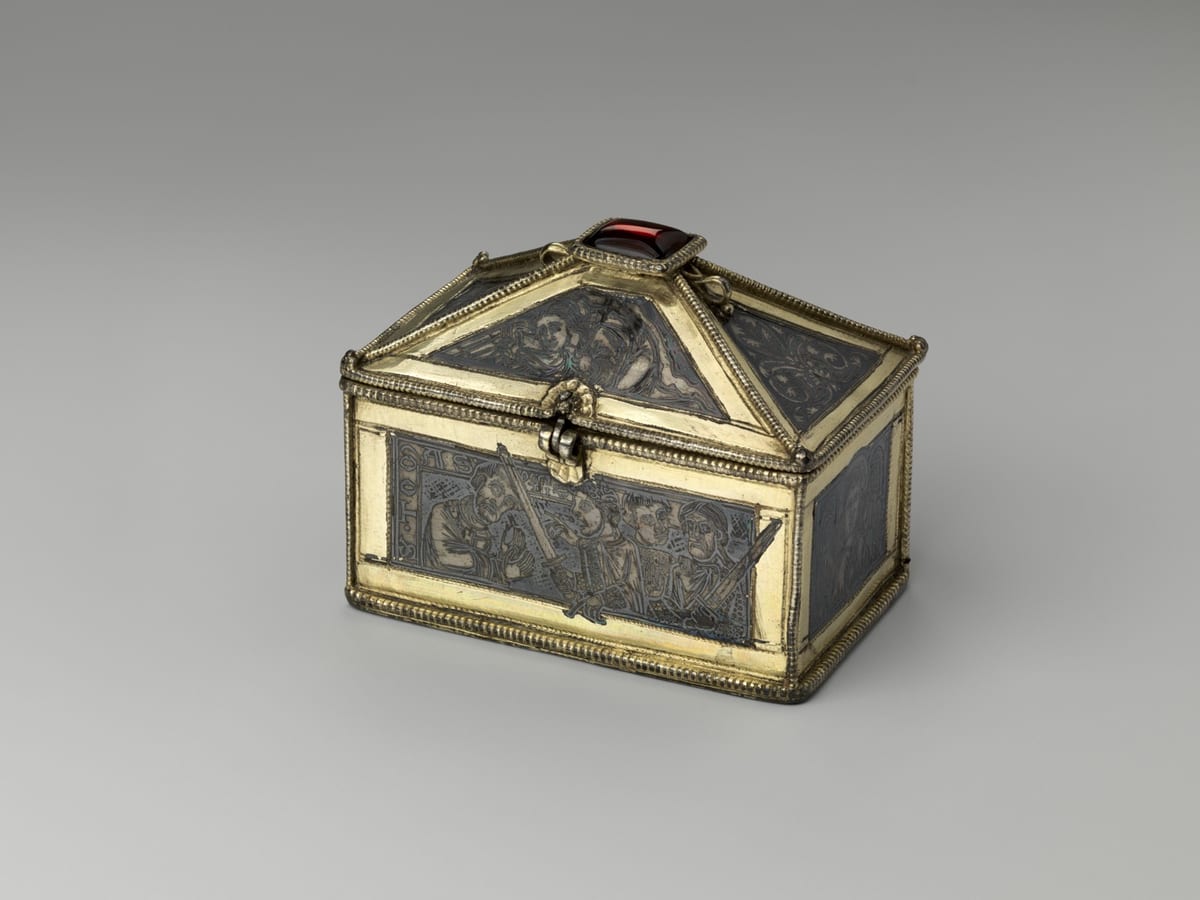
Reliquary Casket with Scenes from the Martyrdom of Saint Thomas Becket, English goldsmith, c. 1173-1180 AD English goldsmith, The Metropolitan Museum of Art, New York, 17.190.520 (Gift of J. Pierpont Morgan, 1917 AD); Open Access Preparing the body, the monks found a hair shirt and hair-cloth drawers under St. Thomas Becket's robes. They buried him in the cathedral crypt on December 30. On January 4, 1171 AD, Brithiva, a blind woman of Canterbury, put a cloth stained with his blood to her eyes and could see again.
Pope Alexander III canonised St. Thomas Becket at Segni on Ash Wednesday, February 21, 1173 AD. The Church set December 29, the day of his death, as his feast. On July 12, 1174 AD, King Henry II walked barefoot to the tomb and was scourged there by bishops and monks.
“AT Canterbury, in England, the birthday of St. Thomas, bishop and martyr, who, for the defence of justice and ecclesiastical immunities, was struck with the sword in his own basilica by a faction of impious men, and thus went to Christ.”
The Roman Martyrology, entry for 29 December


Pray with the Church
Collect for the feast of St. Thomas Becket
The collect of his feast in the medieval Sarum Missal, as translated by F. E. Warren (1911 AD); the same prayer stands in the Roman Breviary for December 29.
O God, in behalf of whose Church thy glorious bishop Thomas fell by the swords of wicked men; grant, we beseech thee, that all who implore his help may effectually obtain their petitions.
All 5 reports on Saint Thomas Becket

About this picture
AI-generated image, in the manner of English manuscript illumination of c. 1220-1240, from the paper's reference portrait based on Becket bids farewell to the Pope: The Becket Leaves (La vie de Seint Thomas de Cantorbéry), f. 1v (English illuminator, possibly Matthew Paris (attribution disputed), c. 1220-1240, Wormsley Library (Sir Paul Getty collection), on loan to the British Library, Loan MS 88) View source artwork.
Pope Alexander III hands Canterbury back to exiled St. Thomas Becket

About this picture
AI-generated image, in the manner of English manuscript illumination of c. 1220, from the paper's reference portrait based on SCS THOMAS CANTUR, apse mosaic of St. Thomas of Canterbury (Byzantine-trained mosaicists working for King William II of Sicily, c. 1178-1189, Cattedrale di Santa Maria Nuova, Monreale; photograph Giorgio Galeotti, CC BY-SA 4.0) View source artwork.
St. Thomas Becket flees England by rowing boat; king's envoys hit storm

About this picture
AI-generated image, in the manner of English manuscript illumination of c. 1220, from the paper's reference portrait based on Louis VII of France reconciles Thomas with Henry II: Sens Cathedral, bay 23 (the Becket window) (French glaziers, first quarter of the 13th century, Cathédrale Saint-Étienne, Sens; photograph GFreihalter, CC BY-SA 3.0) View source artwork.
St. Thomas Becket sets out for Canterbury escorted by a clerk he excommunicated

About this picture
AI-generated image, in the manner of English manuscript illumination of c. 1220, from the paper's reference portrait based on SCS THOMAS CANTUR, apse mosaic of St. Thomas of Canterbury (Byzantine-trained mosaicists working for King William II of Sicily, c. 1178-1189, Cattedrale di Santa Maria Nuova, Monreale; photograph Giorgio Galeotti, CC BY-SA 4.0) View source artwork.
St. Thomas Becket, in hiding, blesses Eastry's churchgoers through a wall

About this picture
AI-generated image, in the manner of English manuscript illumination of c. 1220, from the paper's reference portrait based on SCS THOMAS CANTUR, apse mosaic of St. Thomas of Canterbury (Byzantine-trained mosaicists working for King William II of Sicily, c. 1178-1189, Cattedrale di Santa Maria Nuova, Monreale; photograph Giorgio Galeotti, CC BY-SA 4.0) View source artwork.