
Saints Bishop of Rome · 314–335 AD
Saint Sylvester I
Feast 31 December · Born Rome · Died December 31, 335 AD, Rome
A Roman priest who lived through Diocletian's persecution became bishop of Rome as the Emperor Constantine gave the Church its peace, governed it for nearly twenty-two years while the great basilicas rose and a council met at Nicaea, and was buried in the cemetery of Priscilla.
Begin the life
In brief
Pope Saint Sylvester I, commonly known as St. Sylvester, was bishop of Rome from January 31, 314 AD, until the end of 335 AD, in the reign of the Emperor Constantine. According to longstanding Catholic Tradition, he baptised the emperor at the Lateran and cured him of leprosy. The Church keeps his feast on December 31, the day the Roman Church's list of its bishops' burials gives for his burial in the cemetery of Priscilla.
-
Before 314 AD
A priest of Rome
Catholic Tradition holds that Pope St. Sylvester was brought up from early childhood by a priest named Cyrinus.
Pope St. Sylvester was born in Rome, the son of a man named Rufinus. In Catholic Tradition, a priest named Cyrinus brought him up from early childhood, and the boy followed his teaching and example. Pope St. Marcellinus ordained him a priest before the persecution under the Emperor Diocletian broke the peace of the Church.
-
The persecution years
A guest, a martyr and a prison cell
Catholic Tradition tells how Pope St. Sylvester sheltered a preacher from Antioch, kept watch over his body after his martyrdom and was jailed by the prefect of Rome.
Catholic Tradition holds that Pope St. Sylvester took Timothy, a Christian from Antioch who was preaching Christ openly in Rome, into his house during a persecution. The city prefect, Tarquinius, had Timothy beaten, imprisoned and beheaded for refusing to sacrifice to the idols. Pope St. Sylvester carried the body to his own lodging and kept watch over it all night with Pope St. Miltiades.
Tarquinius then had Pope St. Sylvester seized, hoping Timothy had left money with him, and ordered him to sacrifice or face torture. Pope St. Sylvester warned the prefect that he would die that night. A fishbone stuck in the prefect's throat, he died before he could sit in judgement, and the Christians of Rome led Pope St. Sylvester out of prison.
-
312–314 AD
Bishop of Rome
After the Emperor Constantine's victory outside Rome, Pope St. Sylvester succeeded Pope St. Miltiades as bishop on January 31, 314 AD.
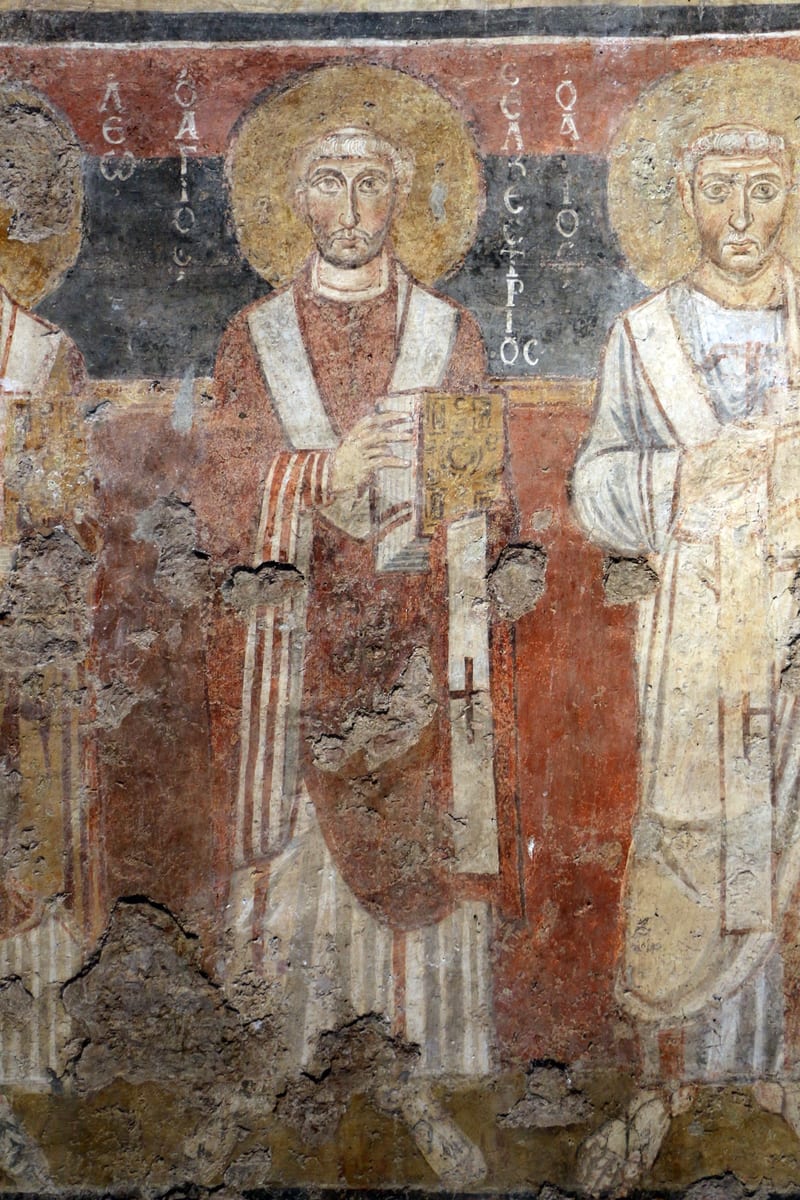
St. Sylvester among the saints of the Roman Church beside Christ enthroned, fresco in Santa Maria Antiqua, Anonymous Roman painter, 757-767 AD Anonymous Roman painter, Santa Maria Antiqua, Rome; photograph by Sailko, CC BY 3.0 Pope St. Sylvester was a priest of Rome when the Emperor Constantine defeated Maxentius within sight of the city on October 28, 312 AD. Constantine and his fellow emperor Licinius granted freedom of religion to Christians and to all. Constantine ordered the Christians' meeting places given back to them without charge.
Pope St. Miltiades died on January 11, 314 AD, and Pope St. Sylvester succeeded him as bishop of Rome on January 31. Pope St. Sylvester lived at the Lateran, in the former imperial palace.
“Silvester ann. XXI m. XI. Fuit temporibus Constantini (Silvester, 21 years, 11 months. He was in the times of Constantine)”
The Liberian Catalogue of the Chronograph of 354, the entry for him in the Roman list of bishops, 354 AD -
August 314 AD
A letter from Arles
Bishops called by Emperor Constantine met at Arles to settle the dispute over Caecilian of Carthage, and Pope St. Sylvester sent four legates in his place.
The Emperor Constantine summoned bishops from many places to Arles to settle the Donatist schism. The quarrel turned on charges brought against Caecilian of Carthage. Pope St. Sylvester stayed in Rome and sent two priests and two deacons in his place.
Before the council broke up, the bishops wrote to him and regretted that he had not been there. They sent their decrees to him before anyone else, so that he would make them known to all. One decree set a single day for Easter throughout the world.
“quoniam recedere a partibus illis minime potuisti, in quibus et apostoli cotidie sedent et cruor ipsorum sine intermissione dei gloriam testatur (since you were by no means able to leave that region, where the Apostles daily sit, and their blood without ceasing bears witness to the glory of God)”
The bishops of the Council of Arles to Pope St. Sylvester, 314 AD -
314–335 AD
The basilicas rise
While Pope St. Sylvester was bishop, the Emperor Constantine built the basilica of St. Peter over the Apostle's tomb.
The great Christian basilicas of Rome were built while Pope St. Sylvester was bishop. The Emperor Constantine raised the Lateran basilica and its baptistery beside the pope's palace, and a basilica over the tomb of St. Peter on the Vatican. The emperor built St. Paul's, on the road to Ostia, at Pope St. Sylvester's suggestion.
Constantine decorated the basilicas with sacred images and endowed them with estates. Pope St. Sylvester built a small cemetery church of his own over the Catacomb of Priscilla on the Via Salaria.
-
In Catholic Tradition
The emperor at the font
In Catholic Tradition, the Emperor Constantine, a persecutor struck with leprosy, sent for Pope St. Sylvester and was baptised by him.
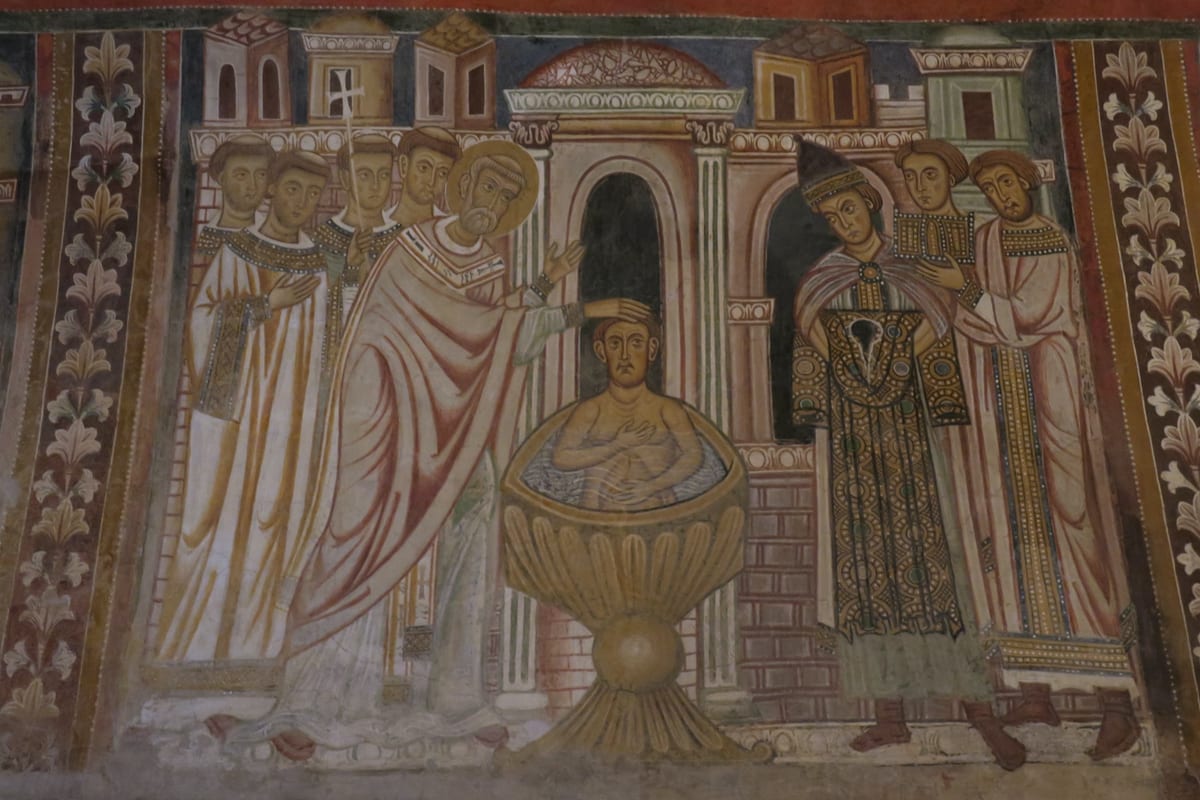
St. Sylvester baptises Constantine (Oratory of St. Sylvester, north wall, scene 6), Anonymous Roman painters of the Oratory of St. Sylvester, 1246 AD Anonymous Roman painters of the Oratory of St. Sylvester, Santi Quattro Coronati, Rome; photograph by LeZibou, CC BY-SA 4.0 As Catholic Tradition tells it, the Emperor Constantine first persecuted the Christians, and Pope St. Sylvester hid from him with his clergy in caves on Mount Soracte. Struck with leprosy, the emperor saw St. Peter and St. Paul in a dream, and they sent him to Pope St. Sylvester. When the emperor's soldiers reached the mountain, Pope St. Sylvester went with them expecting to die a martyr.
Instead the emperor greeted him, and Pope St. Sylvester showed him an image of the Apostles; Constantine knew their faces from his dream. Pope St. Sylvester then baptised him at the Lateran, and the emperor rose from the water cleansed of leprosy.
-
325 AD
Two priests at Nicaea
Too old to travel, Pope St. Sylvester sent two Roman priests to the first general council of the Church.
In 325 AD the Emperor Constantine summoned bishops from every region to a general council at Nicaea, to answer the teaching of Arius. More than two hundred and fifty bishops came. Pope St. Sylvester was too old to make the journey, and two priests of his church, Vito and Vicentius, took his place.
The council condemned Arius and proclaimed Christ the Son of God. Pope St. Sylvester took part in the negotiations over the teaching of Arius and over the council.
-
December 31, 335 AD
Laid to rest in Priscilla
Pope St. Sylvester was buried on December 31, and every Roman calendar has kept his feast on that day since the list of the bishops' burial days drawn up within a year of his death.
Pope St. Sylvester died at Rome at the end of 335 AD, after almost twenty-two years as bishop. On December 31 he was buried in the cemetery of Priscilla on the Via Salaria, three miles outside the city. He lay in a marble sarcophagus in the small church he had built over the catacomb.
Within a year December 31 stood in the Roman Church's list of the days its bishops were buried. The scholar Duchesne found the feast on that date in every calendar from the Depositio episcoporum on, and in the liturgical books from the Leonine Sacramentary on.
“Silvestri, in Priscillae (Silvester, in Priscilla's)”
The Depositio episcoporum of the Chronograph of 354, 354 AD


Pray with the Church
Collect for the feast of Pope St. Sylvester
The collect of the Common of a Confessor Bishop in the Roman Breviary before 1969 AD, said on his feast of December 31 with his name in place of N. In English: Grant, we beseech you, almighty God, that the venerable feast of blessed N., your Confessor and Bishop, may increase in us both devotion and salvation.
Da, quǽsumus, omnípotens Deus: ut beáti N. Confessóris tui atque Pontíficis veneránda solémnitas, et devotiónem nobis áugeat et salútem.