Saints Maronite priest and hermit of Lebanon · 1828–1898 AD
Saint Sharbel Makhluf
Feast 24 July · Born 1828 AD, Beqaa Kafra, North Lebanon · Died 1898 AD, Hermitage of Sts. Peter and Paul, Annaya, Lebanon
A shepherd boy from Lebanon's mountains left home in secret to become a monk, spent his last twenty-three years as a hermit, and was found intact in his waterlogged grave months after he died.
Begin the life
In brief
St. Sharbel Makhluf, widely known as St. Charbel, was a priest and hermit of the Lebanese Maronite Order. Pope St. Paul VI described his life as sixteen years among the monks of Annaya and twenty-three years in complete solitude at the Hermitage of Sts. Peter and Paul, on the ridge above the monastery. Pope St. Paul VI's letter of canonization says he left no writings and preached by silence alone.
-
1828–1851 AD
A shepherd boy in Bekaa Kafra
Youssef Makhlouf, the future St. Sharbel, lost his father at three and grew up tending sheep on the mountain.
St. Sharbel was born Youssef Makhlouf on May 8, 1828 AD, in Bekaa Kafra, in Lebanon's northern mountains. He was the youngest of five children in a poor farming family. In 1831 AD his father was made to haul supplies for the Ottoman army and died on the road home.
His father's brother then became the guardian of the children. At ten, Youssef Makhlouf began work as a shepherd, and he spent his free time praying in a grotto dedicated to the Blessed Virgin Mary. Two of his mother's brothers were hermits of the Lebanese Maronite Order, and he took them as his models.
-
1851 AD
He left without a word
At twenty-three, Youssef Makhlouf left his village to become a monk and never went back.
In 1851 AD, at twenty-three, Youssef Makhlouf left home in secret for the Lebanese Maronite Order's Monastery of Our Lady of Mayfouq. He told no one, not even his mother, and he never went back to his village. A young woman near his home had begun to love him, and he left so that no bond would keep him from God.
His mother and relatives came after him, and he refused to go home. His uncle and guardian, who had wanted him as a partner in his work, was furious. His mother wept, but she thanked God for choosing her son.
-
1851–1859 AD
A new name, and the priesthood
Youssef Makhlouf took the name Sharbel, moved to the remote monastery at Annaya and was ordained a priest.
When he entered the order, Youssef Makhlouf took the religious name Sharbel, after an early martyr he deeply venerated. Mayfouq was ringed by village houses, so St. Sharbel moved to the more remote Monastery of St. Maron at Annaya. He made his solemn vows of poverty, chastity and obedience there in 1853 AD.
When his mother came to Annaya around the time of his vows, he spoke to her only from inside the church and would not let her see him. His superiors sent him to study for the priesthood at Kfifan, where his teachers included St. Nimatullah Kassab Al-Hardini. He was ordained a priest in 1859 AD.
-
1859–1875 AD
Sixteen years among the monks
Back at Annaya, the young priest worked the fields, wept at Mass and obeyed everyone.
After his ordination St. Sharbel was sent back to Annaya, where he lived among the monks for sixteen years. He said Mass every day, and he wept at the altar. He did every kind of work in the fields.
He obeyed superiors, fellow monks and even servants so completely that no one could tell what he liked or disliked. Once lightning struck the altar where he was praying and scorched his habit, and he did not notice.
-
1875–1898 AD
On the ridge above Annaya
St. Sharbel asked to become a hermit and spent his last twenty-three years on the ridge above Annaya.
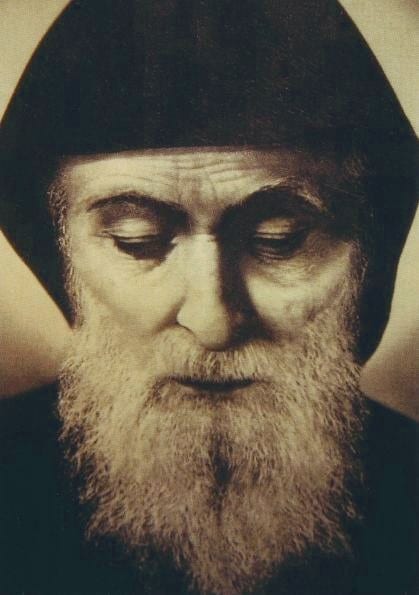
Saint Charbel (القديس شربل) — the familiar devotional portrait, Unknown, Commons says 'before 1898 AD'; Catholic accounts trace the likeness to the Annaya image of May 8, 1950 AD (see description) Unknown, Wikimedia Commons (uploader's source: www.st-charbel.fr) After sixteen years among the monks, St. Sharbel formally asked to live as a hermit, after the example of St. Maron and St. Simeon the Stylite. According to longstanding Catholic Tradition, a brother once filled his lamp with water as a joke, and it burned all night while he prayed. The lamp convinced his superiors that his request came from God.
In 1875 AD they let him move to the Hermitage of Sts. Peter and Paul, on the ridge 200 meters above the monastery. There he wore a hair shirt, ate one meager meal a day, never meat, and slept on boards covered with a skin. Pope St. Paul VI said that even in his lifetime people, Christian or not, came to him for healing of soul and body.
-
December 16–24, 1898 AD
A stroke at the altar
St. Sharbel was struck down while saying Mass, lay paralyzed for eight days and died on Christmas Eve.
On December 16, 1898 AD, St. Sharbel suffered a stroke while saying Mass in the hermitage. He was carried to his cell, where he lay paralyzed for eight days, conscious and clear-minded. Through those days he kept repeating the prayer of offering to the Father that he had begun at the altar.
On Christmas Eve the abbot sent up meat soup to strengthen him, and he refused it because of the Advent fast. He died that day, December 24, 1898 AD. He was buried in his habit, without a coffin, in the monks' common grave.
-
1898–1965 AD
Light over the grave
Monks saw a light over St. Sharbel's grave, and when it was opened his body was found intact.
Many monks swore they saw St. Sharbel's grave lit at night by a light that was not natural. In 1899 AD, with the Maronite patriarch's permission, the grave was opened before the monks and a crowd of villagers. The body lay in rainwater that had soaked the grave, yet it was intact.
A blood-tinged fluid seeped from the body, and the monks changed his habit twice a week to remove the stains. In 1950 AD the tomb was opened again, and three physicians found that the body's arms and legs could still be bent. The fluid kept coming until 1965 AD, the year he was declared Blessed.
-
1950–2025 AD
The Saint of Lebanon, as his people call him
Healings through his intercession led Pope St. Paul VI to beatify St. Sharbel in 1965 AD and canonize him in 1977 AD.
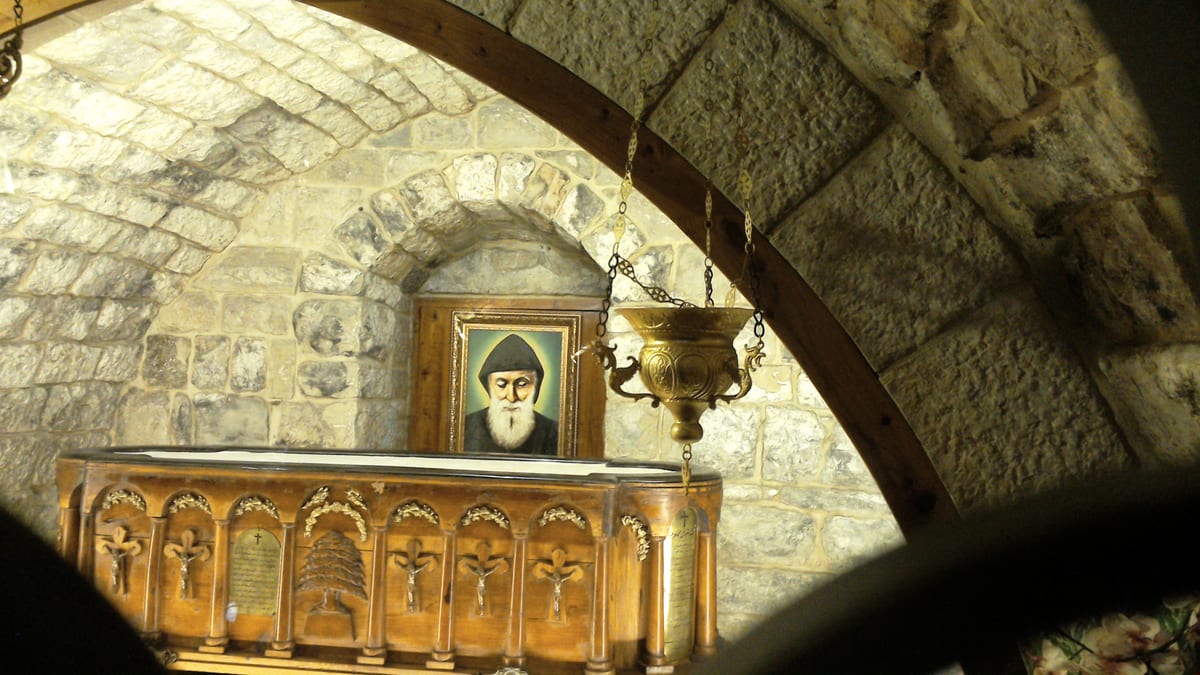
Grób świętego Charbela Makhloufa w Annaya (the tomb of St. Sharbel Makhluf at Annaya), LLEW (Commons user), October 20, 2015 AD LLEW (Commons user), Wikimedia Commons Between April and July 1950 AD, the monastery at Annaya recorded 350 cures, among them 31 blind people and 163 who were paralyzed or lame. The Church approved two healings as miracles for St. Sharbel's beatification: a nun cured of a stomach ulcer, and a blacksmith whose blind eye saw again. Pope St. Paul VI declared him Blessed on December 5, 1965 AD, as the Second Vatican Council closed.
A woman ill with tonsil cancer in 1966 AD was healed after she prayed to him, and Pope St. Paul VI approved her healing as the miracle for his canonization. Pope St. Paul VI canonized him in St. Peter's Basilica on October 9, 1977 AD. On December 1, 2025 AD, Pope Leo XIV prayed at his tomb at Annaya and left a lamp as his gift.
“Next Sunday we will propose to the veneration of the faithful of the whole world the blessed Charbel Makhlouf: we will have then a very special thought for Lebanon, where his holiness shone forth with particular brilliance.”
Pope Paul VI to The new Ambassador of Lebanon to the Holy See, October 7, 1977 AD


Pray with the Church
Prayer to St. Sharbel
The prayer to St. Sharbel printed by the shrine at Annaya
Oh Lord, you inspired Saint Charbel to live and die in the path of Jesus Christ.You taught him how to live his monastic vows with perfection, in absolute silence, conforming his life to yours.Oh mighty God, you spread the power of Saint Charbel’s intercession through his multiple miracles and marvels.Grant us the grace to love you and serve you as he did, and grant us, through his intercession, the petitions that we hold in the silence of our hearts.