
Saints Jesuit priest and Doctor of the Church · 1521–1597 AD
Saint Peter Canisius
Feast 21 December · Born May 8, 1521 AD, Nijmegen, duchy of Guelders (Netherlands) · Died December 21, 1597 AD, Fribourg, Switzerland
The son of a Nijmegen mayor became the first German Jesuit, spent three decades working to keep the German lands Catholic as the Protestant teaching spread, and died at Fribourg in 1597 AD with crowds calling him a saint.
Begin the life
In brief
Saint Peter Canisius, also called Petrus Canisius, was born at Nijmegen on May 8, 1521 AD and died at Fribourg in Switzerland on December 21, 1597 AD. In his lifetime the new Protestant teaching spread through the German-speaking lands, and many Catholics left the Church. As the first German member of the Society of Jesus, he spent three decades preaching, founding colleges and writing catechisms to keep Catholics in the faith and bring back those who had left.
-
1521–1540 AD
A mayor's son at Cologne
St. Peter Canisius lost his mother as a baby, was guided by a devout priest at Cologne and turned down a rich marriage.
St. Peter Canisius's mother, Aegidia van Houweningen, died while he was still an infant. As she lay dying, she warned her husband, Jacob Kanis, the mayor of Nijmegen, to keep away from the new faith spreading among their people and to hold fast to the Catholic faith.
At fifteen St. Peter Canisius was sent to study at Cologne, in the care of a devout priest, Nicolaus van Esche. Esche had him read a chapter of the Gospels every day and learn one saying from it by heart. His father chose a wealthy bride for him and offered him a paid post among the clergy of a church at Cologne, but he refused both and vowed never to marry.
“Igitur cum annos essem natus, ni fallor, novendecim, hoc etiam, quod perfectius erat, inspirasti atque largitus es, ut virginitatem meam sponte dedicarem tibi, et virginitatis amator me voto astringerem ad perpetuum caelibatum. Cuius rei nulla me unquam poenitudo cepit. (So when I was, unless I am mistaken, nineteen years old, you inspired and granted me this too, which was more perfect: to dedicate my virginity freely to you and, as a lover of virginity, to bind myself by vow to perpetual celibacy. I have never once regretted it.)”
St. Peter Canisius to God, in his Confessions, 1540 AD -
1543 AD
The first German Jesuit
At Mainz St. Peter Canisius made the Spiritual Exercises under St. Peter Faber, then vowed to enter the Society of Jesus as its first German member.
In 1543 AD St. Peter Canisius went to Mainz to meet St. Peter Faber, a priest of the new Society of Jesus who was lecturing there on the Psalms. St. Peter Faber had never seen the young man before, but took him into his own house and led him through the Spiritual Exercises, a month of guided prayer. On his birthday, May 8, 1543 AD, St. Peter Canisius vowed to enter the Society, its first German member.
Soon afterwards his father fell gravely ill and called him home, then died the moment he saw his son come in. St. Peter Canisius gave away his inheritance, half to the poor and half to his Jesuit brothers.
“Quod ad me attinet, dici uix potest, quemadmodum exercitationibus illis spiritualibus animum meum ac sensus immutari, mentem nouis coelestis gratiae radijs collustrari, et nouo quodam me uigore affici senserim, sic ut et in corpus redundante diuinae beneficentiae copia totus corroborari, atque in alium prorsus hominem transformari uiderer. (As for me, it can hardly be said how I felt my soul and senses changed by those spiritual exercises, my mind lit up with new rays of heavenly grace, and myself filled with a kind of new vigour, so that, as the abundance of God's kindness overflowed even into my body, I seemed wholly strengthened and transformed into an altogether different man.)”
St. Peter Canisius, letter after the Exercises under Peter Faber, 1543 AD -
1549 AD
Sent to Germany
Pope Paul III blessed St. Peter Canisius's mission to Germany, and St. Peter Canisius then prayed at the tomb of St. Peter the Apostle.
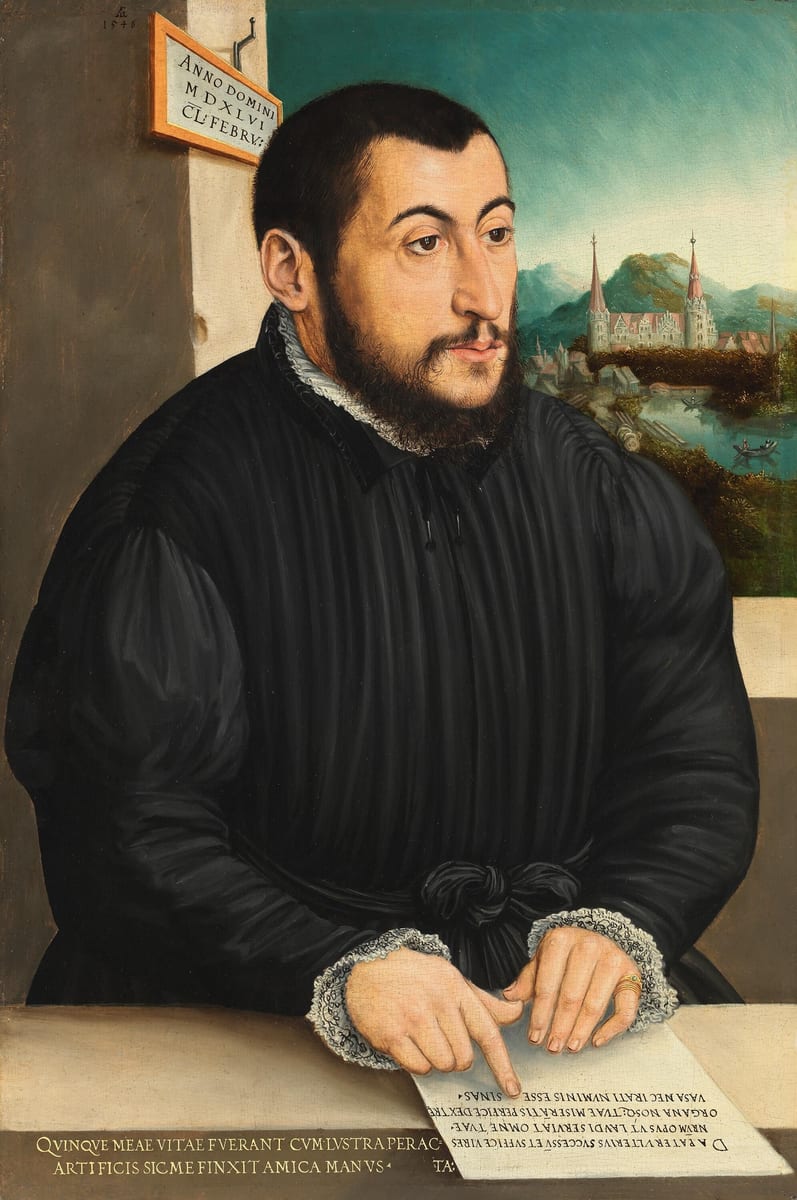
Bildnis des Petrus Canisius (Portrait of Peter Canisius), Monogrammist AE von 1546 AD, 1546 AD Monogrammist AE von 1546 AD, Alte Pinakothek, Munich (Bayerische Staatsgemäldesammlungen), CC BY-SA 4.0 On September 2, 1549 AD Pope Paul III received St. Peter Canisius at Castel Gandolfo and blessed his mission to Germany. St. Peter Canisius then went to St. Peter's Basilica and knelt to pray at the tomb of St. Peter the Apostle.
He wrote later that on that day he understood Germany to be his charge, a land he wished to live and die for. Days later, in the church of Santa Maria della Strada in Rome, he made his solemn vows as a Jesuit before St. Ignatius. On October 4, 1549 AD he received his doctorate in theology at Bologna. On November 13, 1549 AD he reached Ingolstadt in Bavaria to teach theology.
“ubi magnam sensi consolationem praesentemque gratiam tuam quae per tales intercessores mihi dulciter offerebatur. Benedicebant enim et illi, missionem in Germaniam confirmabant, suam mihi velut Apostolo Germaniae concedendam benevolentiam promittere uidebantur. Nosti Domine quantopere et quoties illo ipso die mihi Germaniam commisisti, pro qua dein sollicitus esse pergerem, pro qua sicut Pater ille Faber me totum exhiberem, pro qua vivere morique cuperem. (There I felt that a great consolation and the presence of grace had been granted to me through these intercessors [Peter and Paul]. They confirmed my mission in Germany and seemed to transmit to me, as an apostle of Germany, the support of their benevolence. You know, Lord, in how many ways and how often on that same day you entrusted Germany to me, which I was later to continue to be concerned about and for which I would have liked to live and die.)”
St. Peter Canisius to God, praying at St. Peter's before leaving for Germany, September 2, 1549 AD -
1552–1555 AD
A bishopric refused, a catechism written
At Vienna St. Peter Canisius nursed plague victims, refused to be made bishop and wrote a handbook of the faith that ran through edition after edition.
St. Peter Canisius moved to Vienna on March 9, 1552 AD, and when plague struck the city he nursed the sick in its hospitals and houses. King Ferdinand wanted to make him Bishop of Vienna, but St. Peter Canisius dreaded the office and wrote to St. Ignatius that he did not want it. Instead, Pope Julius III had him run the diocese, which had no bishop, for one year, taking none of its income.
Ferdinand wanted a handbook of Catholic teaching for his Austrian subjects, many of whom had fallen away from the faith, and the work fell to St. Peter Canisius. His Summa of Christian doctrine, set out in questions and answers, came off the press at Vienna in the spring of 1555 AD. At least 25 new editions appeared in several countries by early 1564 AD.
“Quod ad miserum Episcopatum attinet, non possum non in anxia esse expectatione, cum audiam, literas a Rege simul et Legato Pontificis mitti serias, quibus cogar onus subire miserrimum ex Pontificis authoritate. … Utut sit, polliceor R. P. V. septem Missas in honorem Sanctissimi Spiritus, quamprimum nuntiarit conatus istorum in nihilum recidisse. Si secus eveniet, certo deum peccatis meis implacabiliter velut iratum tota vita merito reformidabo. (As for that wretched bishopric, I cannot help waiting in anxious suspense, since I hear that serious letters are being sent by the King and the Papal Legate together, by which I am to be forced to take up this most wretched burden on the Pope's authority. … However it turns out, I promise Your Reverence seven Masses in honour of the Most Holy Spirit as soon as word comes that their efforts have come to nothing. If it turns out otherwise, I shall rightly dread God all my life as implacably angry, as it were, at my sins.)”
St. Peter Canisius to St. Ignatius of Loyola, on hearing he might be made Bishop of Vienna, 1553 AD -
1556–1566 AD
The pulpit at Augsburg
Put in charge of the Jesuits of Upper Germany, St. Peter Canisius spoke for the Catholic side at Worms, was mocked in print and preached some 210 sermons in one year at Augsburg.
In 1556 AD St. Ignatius made St. Peter Canisius, over his protests, the first provincial of Upper Germany, head of the Jesuits in lands from Swabia to Hungary. In September 1557 AD he spoke for the Catholic side at Worms, in a formal debate with Protestant theologians whose spokesman was Philip Melanchthon. Soon afterwards Protestant writers mocked him in satirical verse, and that same year the Duke of Mecklenburg had his teaching formally condemned.
From 1559 AD to 1566 AD he was the cathedral preacher at Augsburg. In 1560 AD the cathedral clergy testified that his sermons had brought nine hundred people back to the Church. The next year he preached about 210 sermons, besides giving retreats and teaching the catechism.
“Amemus persequentes et calumniantes. Laudi nobis ducamus pro Jesu nomine sic insigniri atque tractari. (Let us love those who persecute and slander us. Let us count it praise to be marked out and treated so for the name of Jesus.)”
St. Peter Canisius, on attacks against him and his order -
1567 AD
A pilgrim boy at Ingolstadt
St. Stanislaus Kostka walked from Vienna to beg St. Peter Canisius for a place among the Jesuits, and was sent on to Rome.
At the end of August 1567 AD, as St. Peter Canisius passed through Ingolstadt, a seventeen-year-old dressed as a beggar pilgrim knelt before him. He had walked from Vienna, begging along the way, to ask to join the Society of Jesus. He was St. Stanislaus Kostka, a young Polish noble who had lived at the Jesuits' boarding house for students in Vienna.
At the end of September the young man left Dillingen for Rome, carrying a letter from St. Peter Canisius that recommended him to St. Francis Borgia, the Jesuits' superior general.
-
1569–1596 AD
The college at Fribourg
Arriving at Fribourg in 1580 AD, St. Peter Canisius preached, wrote and saw its Jesuit college built, and lived there until his death.
In 1569 AD St. Peter Canisius handed over the Jesuit province, and in the years that followed he wrote and preached at Dillingen and Innsbruck. On December 10, 1580 AD he entered Fribourg in Switzerland with the papal envoy. Plans for a Jesuit college there met difficulties until the Pope stepped in, and at the end of that year he laid its foundation stone.
In early 1583 AD he wrote that the college had more students than anyone expected, and that more people than ever were receiving Communion in the church of St. Nicholas. In his late sixties his voice and strength failed, and he had to give up regular preaching. He went into the pulpit one last time on August 5, 1596 AD, at the opening of the finished college, which the senators, clergy and people of Fribourg celebrated.
-
1597 AD
The feast of St. Thomas
St. Peter Canisius died at Fribourg on December 21, 1597 AD, and crowds pressed to his bier.
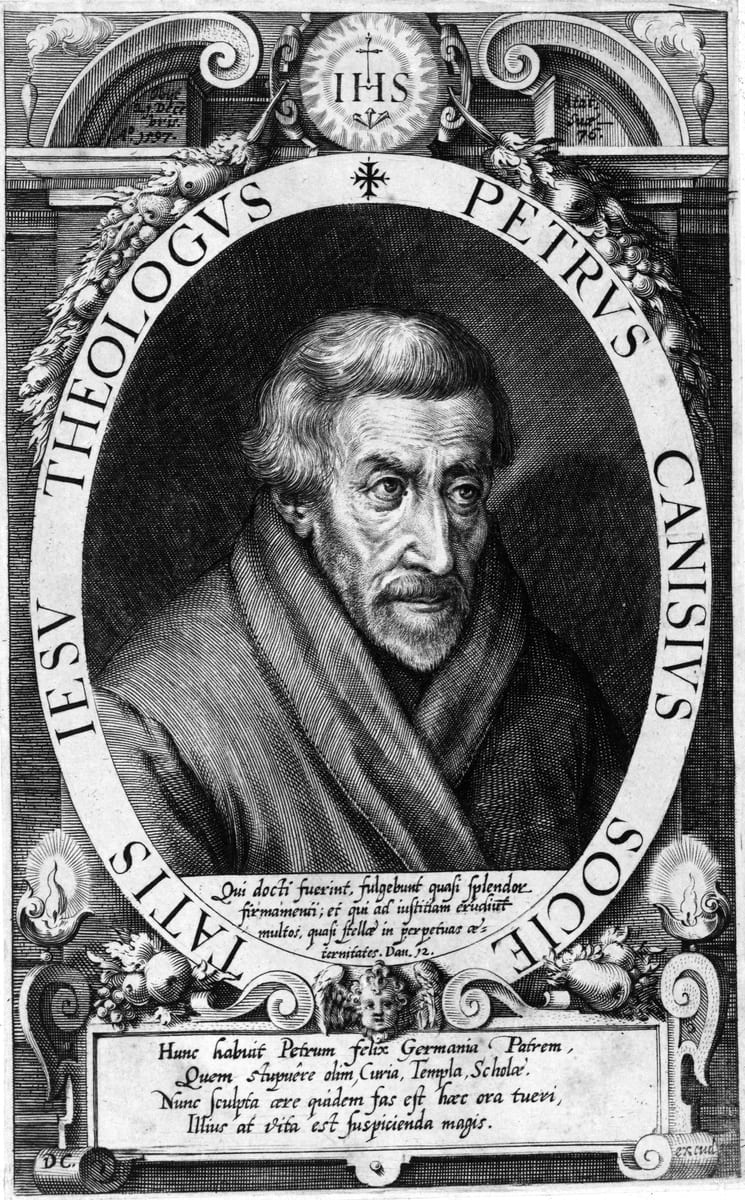
Petrus Canisius Societatis Iesu Theologus, Dominicus Custos, about 1600 AD Dominicus Custos, copperplate engraving By the autumn of 1597 AD a long illness had kept St. Peter Canisius in bed. On the afternoon of December 20 he made his confession and asked for the seven Penitential Psalms to be read for him. That evening he stretched out his hand toward the door and joyfully asked the people in the room whether they could see; they saw nothing.
On the morning of December 21, the feast of St. Thomas the Apostle, he received Communion and kept praising God aloud, his voice rising each time. He died that afternoon. Crowds pressed to his bier, touched it with their rosaries and called him a saint.
“Videtisne, videtis? (Do you see? Do you see?)”
St. Peter Canisius to those at his bedside, pointing toward the door with a joyful face, December 20, 1597 AD


Pray with the Church
Prayer of St. Peter Canisius for faith at the hour of death
From St. Peter Canisius's own prayer book, which he used on his deathbed. In this petition St. Peter Canisius entrusts his faith to the Father of lights. In English: Eternal Father of lights, from whom every good thing comes down, I commend to your almighty power the true and whole faith, to be so practised at the end of my life that by the power of your divinity I may never, at the hour of death, turn aside from the purity of the true and right faith.
Aeterne Pater luminum, a quo bonum omne descendit,commendo omnipotentiae tuae fidem ueram et integramin fine uitae meae sic exercendam, ut uirtute diuinitatis tuaenunquam mortis tempore ab orthodoxae et rectae fidei sinceritate declinem.
All 2 reports on Saint Peter Canisius

About this picture
AI-generated image, in the manner of German and Netherlandish oil on panel of the 16th century, from the paper's reference portrait based on Petrus Canisius Societatis Iesu Theologus (Dominicus Custos, about 1600, copperplate engraving) View source artwork.
Pelted with snow in Bern, St. Peter Canisius rides on to Fribourg

About this picture
AI-generated image, in the manner of German and Netherlandish oil on panel of the 16th century, from the paper's reference portrait based on Bildnis des Petrus Canisius (Portrait of Peter Canisius) (Monogrammist AE von 1546, 1546, Alte Pinakothek, Munich (Bayerische Staatsgemäldesammlungen), CC BY-SA 4.0) View source artwork.