
Saints Martyrs of Carthage
Saints Perpetua and Felicity
Feast 7 March · Born 181 AD, Thuburbo Minus (Tebourba), Roman Africa (the year is St. Perpetua's, who was about twenty-two; St. Felicity's is not recorded) · Died 203 AD, Carthage, Roman Africa (Tunisia)
A matron with a nursing son and a slave in her eighth month, condemned together at Carthage under Septimius Severus.
Begin the life
In brief
Saints Perpetua and Felicity, also called Perpetua and Felicitas, died in the amphitheatre at Carthage on March 7, 203 AD. Saint Perpetua was a married woman of about twenty-two with an infant son at the breast. Saint Felicity was a slave, and eight months pregnant when she was arrested.
-
202–203 AD
Five catechumens are taken
An imperial edict against converts reaches Roman Africa, and the arrests begin.
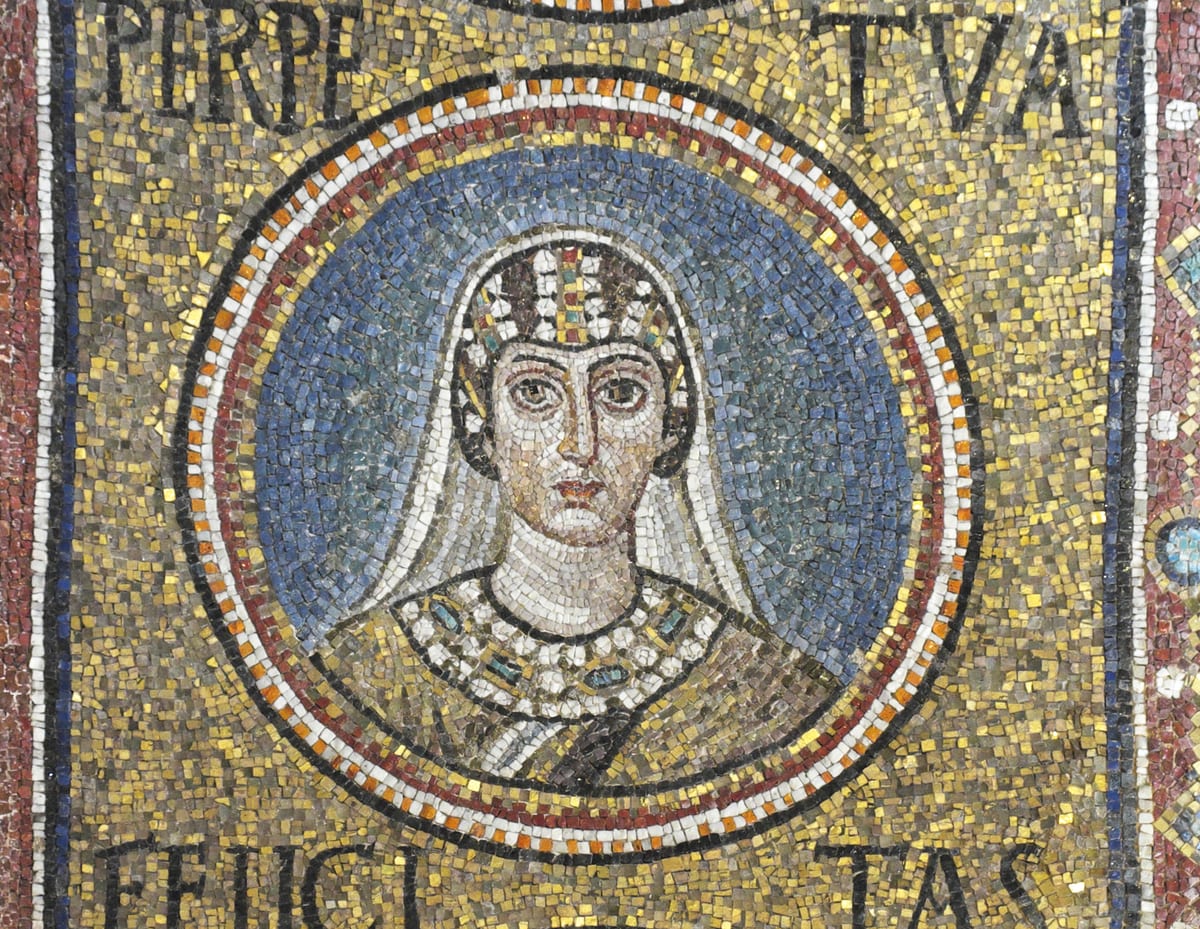
SCA PERPETVA, medallion bust from the second row of medallions in the vault of the Archiepiscopal Chapel, Ravenna, Ravennate mosaicists under Bishop Peter II; photograph by GFreihalter, crop uploaded by Shakko, c. 500 AD Ravennate mosaicists under Bishop Peter II; photograph by GFreihalter, crop uploaded by Shakko, Archiepiscopal Chapel (Chapel of Sant'Andrea), Archiepiscopal Museum, Ravenna In 202 AD an edict of Septimius Severus forbade anyone to become a Jew or a Christian. The next year five catechumens were seized in Roman Africa, among them St. Perpetua and St. Felicity. Their teacher in the faith gave himself up rather than leave them.
St. Perpetua's father was a pagan, advanced in years, who loved her above all his other children. The prisoners were held some days in a private house, and there he pressed her to give up the faith. She pointed to a pitcher lying on the floor and put a question to him about it.
“Neither can I call myself anything else than what I am, a Christian.”
St. Perpetua and Felicity to her father, her father seeking to turn her from the faith -
203 AD
A dark cell and a ladder
Baptised in custody, she is shut in the dungeon, keeps her son with her, and asks for a vision.
The catechumens were baptised within days, before they were led down to the dungeon. St. Perpetua wrote that she was afraid, having never before felt such darkness. Her mother brought the infant, and she obtained leave to keep him at the breast.
Her brother asked her to seek a vision of what was coming. She saw a narrow ladder hung with iron weapons, and a dragon crouching beneath it. At the top a grey-haired shepherd milking sheep called her daughter and gave her curd.
“He shall not hurt me, in the name of Jesus Christ.”
St. Perpetua and Felicity to Saturus, Perpetua's vision of the ladder -
203 AD
Before Hilarianus
The prisoners are taken from dinner to the forum and sentenced to the beasts.
Taken suddenly from dinner, the prisoners were set on a platform in the forum. Hilarianus the procurator held the power of the sword after the proconsul's death. Her father appeared with her son and dragged her down from the step.
Hilarianus urged her to sacrifice for the welfare of the emperors. Her father was thrown down and beaten with rods at the judge's order. The whole company was condemned to the beasts, and went down to the dungeon rejoicing.
“The president Hilarian joined with my father, and said, 'What! will neither the gray hairs of a father, nor the tender innocence of a child, move you? Sacrifice for the prosperity of the emperors.' I replied, 'I will not do it.' 'Are you then a Christian,' said Hilarian. I answered, 'Yes, I am.'”
St. Perpetua and Felicity to Hilarian, trial -
203 AD
The camp prison
Her son is kept from her, she prays for a dead brother, and the condemned are moved for the soldiers' games.
After the sentence her father refused to send the infant back to her. St. Perpetua wrote that the child no longer sought the breast, and her body gave her no pain. At prayer she suddenly named Dinocrates, a brother who had died at seven years old.
She saw him in a gloomy place, parched, the wound of the cancer that killed him still on his face. She prayed for him until she saw him clean and drinking from a golden bowl. The condemned were then moved to the camp prison for the games of Geta Caesar's birthday.
-
March 4, 203 AD
Three days before the games
St. Felicity, kept from execution by her pregnancy, gives birth in prison.
St. Felicity grieved that her pregnancy would keep her from the arena with her companions. The law did not permit a pregnant woman to be exposed to punishment. Three days before the games her companions joined in one prayer for her.
Her pains came on at once, and she laboured in the difficulty of an eighth-month birth. A warder taunted her as she cried out. She bore a girl, whom a Christian woman brought up as her own daughter.
“Now it is I that suffer what I suffer; but then there will be another in me, who will suffer for me, because I also am about to suffer for Him.”
St. Perpetua and Felicity to a servant of the Cataractarii, reply during her labor -
March 6, 203 AD
The night before
A last vision of combat, and a public supper the martyrs turn into a love-feast.
On the day before the games St. Perpetua saw the deacon Pomponius call her to the amphitheatre. In the vision she fought an Egyptian, threw him and trod on his head. She woke knowing that she would fight not with beasts but with the devil.
The condemned turned their last public meal, eaten before sightseers, into a love-feast. Saint Saturus, the catechist who had built them up in the faith, spoke to the crowd that had come to stare at them. All who heard went away astonished, and many of them believed.
“Tomorrow is not enough for you, for you to behold with pleasure that which you hate. Friends today, enemies tomorrow. Yet note our faces diligently, that you may recognise them on that day of judgment.”
Saturus to the onlooking crowd, the last free meal (agape) -
March 7, 203 AD
The amphitheatre
The two women refuse pagan dress at the gate and meet a cow in the arena.
The day of their victory dawned, and they walked into the amphitheatre cheerful of face. At the gate they were told to put on the dress of Saturn's priests and Ceres' priestesses. St. Perpetua resisted to the end, and the tribune conceded that they enter as they were.
A very fierce cow, procured against all custom, was loosed on the two women. Tossed to the ground, St. Perpetua drew her torn tunic over her, mindful of her modesty. Seeing St. Felicity crushed on the ground, she gave her a hand and lifted her up.
“Stand fast in the faith, and love one another, all of you, and be not offended at my sufferings.”
St. Perpetua and Felicity to Rusticus the catechumen and the brother, after the attack -
203–1907 AD
The sword, and the memory
The martyrs die by the sword, and the Church keeps their names from that century to this.
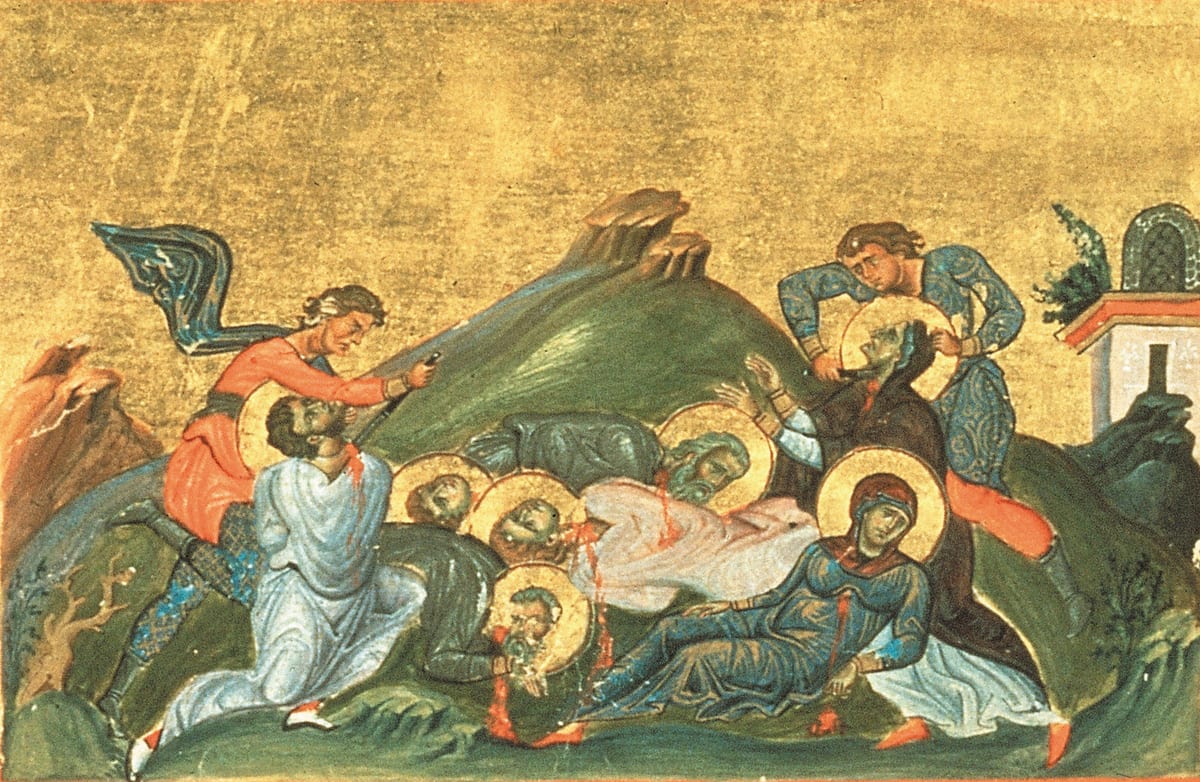
The martyrdom of Perpetua, Felicitas, Revocatus, Saturninus, Saturus and Secundulus, from the Menologion of Basil II, Constantinopolitan illuminators of the Menologion (Pantoleon and his fellow-painters), c. 985 AD Constantinopolitan illuminators of the Menologion (Pantoleon and his fellow-painters), Biblioteca Apostolica Vaticana, Vat. gr. 1613 AD The crowd called for the martyrs to be brought into the middle, where the blow could be seen. They rose of their own accord and went, and first kissed one another with the kiss of peace. St. Perpetua, pierced between the ribs, guided the young gladiator's wavering hand to her throat.
Tertullian, writing at Carthage within a decade, cited St. Perpetua's revelation of paradise. Their names stand together in the Canon of the Mass. In 1907 AD Father Delattre found their tombstone, broken in pieces, in his excavations at Carthage.
“Who could foresee, that with the great historical figures of African martyrs and confessors like Cyprian, Felicity and Perpetua and the outstanding Augustine, we should one day list the beloved names of Charles Lwanga, Matthias Mulumba Kalemba and their twenty companions?”
Pope Paul VI


_-_Perpetua.jpg)
.jpg)
Pray with the Church
Collect for the Memorial of Saints Perpetua and Felicity
The Collect the Church prays at Mass on their memorial, March 7, from the Roman Missal.
O God, at the urging of whose love the Martyrs Saints Perpetua and Felicity defied their persecutors and overcame the torment of earth, grant, we ask, by their prayers, that we may ever grow in your love.Through our Lord Jesus Christ, your Son, who lives and reigns with you in the unity of the Holy Spirit, God, for ever and ever.
All 2 reports on Saints Perpetua and Felicity

About this picture
AI-generated image in the manner of a Ravennate wall mosaic of about 500 AD, after the medallion of St. Perpetua in the vault of the Archiepiscopal Chapel, Ravenna (c. 500 AD) View source artwork.
Roman tribune blushes and gives way to condemned St. Perpetua

About this picture
AI-generated image, in the manner of a Ravennate wall mosaic of about 500 AD, from the paper's reference portrait based on The martyrdom of Perpetua, Felicitas, Revocatus, Saturninus, Saturus and Secundulus, from the Menologion of Basil II (Constantinopolitan illuminators of the Menologion (Pantoleon and his fellow-painters), c. 985 AD, Biblioteca Apostolica Vaticana, Vat. gr. 1613) View source artwork.