
Saints Servite friar of Forlì
Saint Peregrine Laziosi
Feast 1 May · Born 1265 AD, Forlì, Emilia-Romagna, Italy · Died 1345 AD, Servite convent, Forlì, Emilia-Romagna, Italy
A Servite friar of Forlì who, in Catholic Tradition, was healed overnight of a leg his physician meant to amputate. The sick, and people with cancer, pray to him today.
Begin the life
In brief
Saint Peregrine Laziosi was born at Forlì, in the Romagna region of Italy, about 1265 AD. He spent about fifty years as a friar of the Servants of Mary in that one city. The Church invokes St. Peregrine today against cancerous diseases.
-
1265–1281 AD
A son of the Laziosi
His city, Forlì, was in deep turmoil the whole time he lived in the world.
St. Peregrine was born at Forlì about 1265 AD, the only son of the noble Laziosi family. His father was a leader of the Ghibelline faction.
In those years the city was the surest refuge in Romagna for Ghibelline exiles. Romagna had belonged to the Papal State since 1278 AD. Forlì would not obey the Pope, and from the summer of 1281 AD papal troops besieged it.
-
1282–1283 AD
The interdict
Pope Martin IV shut the churches of Forlì, and the friar who came to preach obedience was beaten and driven out.
Pope Martin IV placed Forlì under interdict from March 1282 AD to September 1283 AD, suspending almost all public worship and sacraments in the city. In May 1282 AD papal and French cavalry broke into the city, and its defenders under Guido da Montefeltro killed thousands of them in the streets. St. Peregrine, then about seventeen, was on his city's side against the Pope.
At Pope Martin IV's request, St. Philip Benizi, prior general of the Servants of Mary, came to Forlì and urged its people to return to obedience to the Pope. The people of Forlì beat St. Philip Benizi and drove him out of the city.
“La terra che fé già la lunga prova / e di Franceschi sanguinoso mucchio (The land that once made the long trial, and of Frenchmen a bloody heap)”
Dante Alighieri, 1282 AD -
1282–1283 AD
The pardon
Catholic Tradition holds that St. Philip Benizi prayed for his attackers, and that St. Peregrine went out to beg his pardon.
Catholic Tradition holds that St. Philip Benizi stood outside the walls with his companions, praying for the citizens who had injured him. St. Peregrine had seen how patiently St. Philip Benizi bore the citizens' attack, and he went out to him to ask his forgiveness.
The readings for St. Peregrine's feast, approved by Pope Paul V, name St. Philip Benizi as the guide who led him into religious life.
-
about 1290–1295 AD
Siena, and the road home
St. Peregrine entered the Servants of Mary at about thirty, trained at Siena, and came home to Forlì for good.
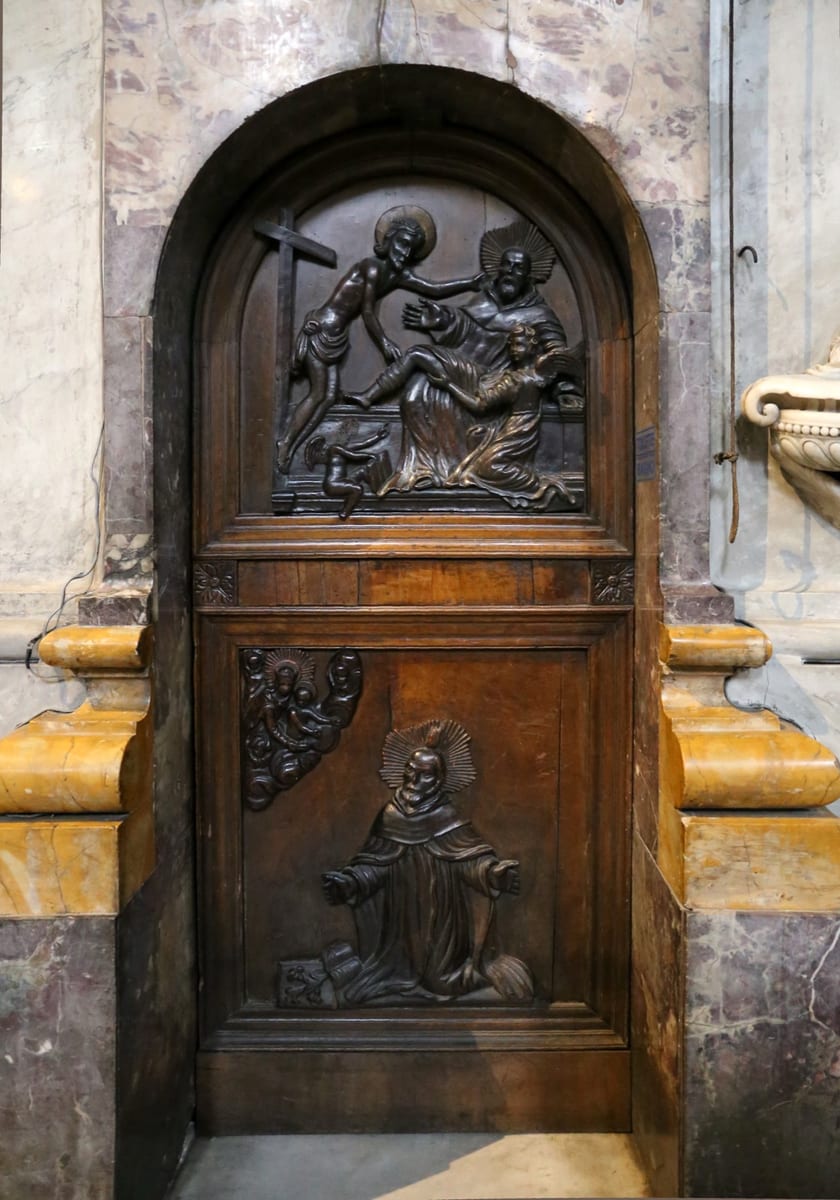
Tribuna dell'Annunziata, porta con san Pellegrino Laziosi ed il beato Francesco da Siena, Photograph by Wikimedia Commons user Sailko; the painted door itself is anonymous, photographed November 2, 2017 AD; the tribune of the Santissima Annunziata was built from 1444 AD Photograph by Wikimedia Commons user Sailko; the painted door itself is anonymous, Basilica della Santissima Annunziata, Florence — the mother church of the Order of the Servants of Mary St. Peregrine was about thirty when he entered the Order of the Servants of Mary, between 1290 AD and 1295 AD. He trained as a novice at Siena, not at Forlì, and there came to know Blessed Francesco da Siena.
When his novice training ended, he was sent home to Forlì. He lived in the convent there until he died.
-
about 1295–1325 AD
Choir, fasting, and the poor of Forlì
Prayer, fasting, work among the poor, and a penance Catholic Tradition holds he kept for thirty years: he would not sit down.
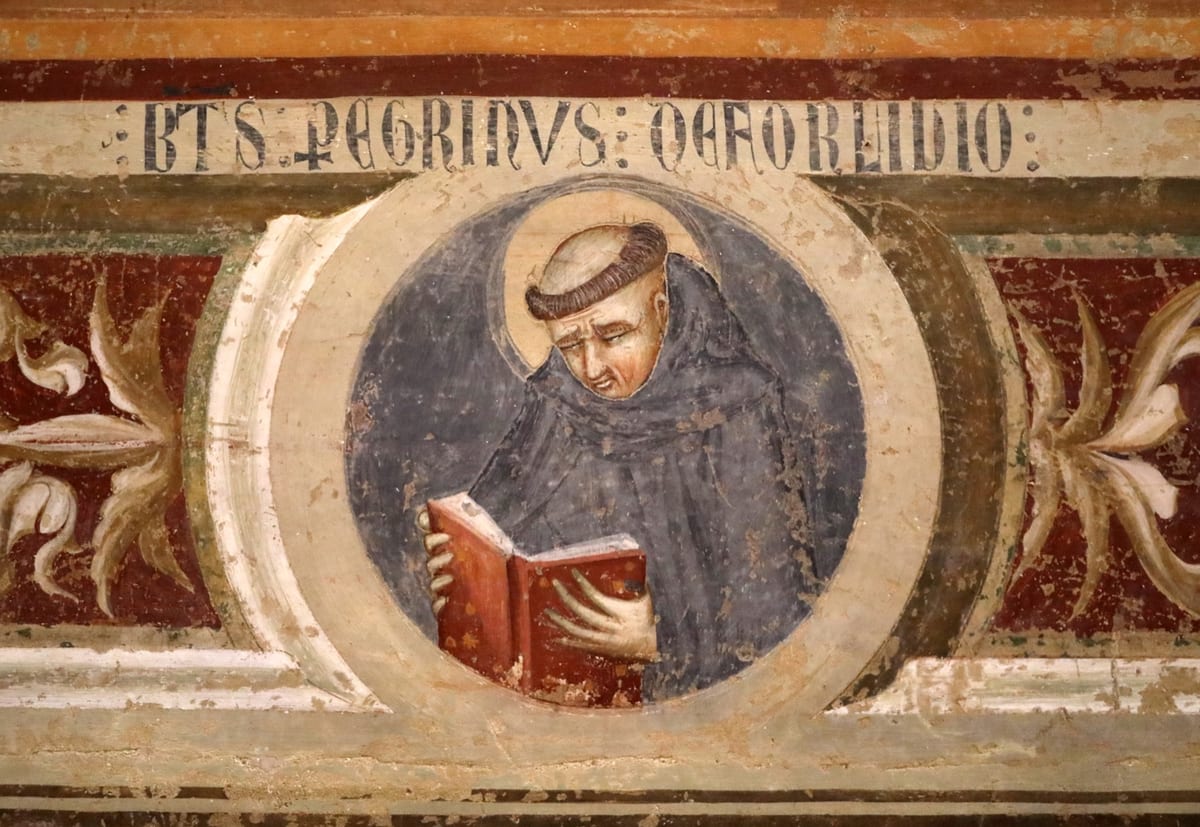
Pietro Lorenzetti (scuola), santi (molto restaurati) entro clipei sulle cornici, pellegrino laziosi 02, School of Pietro Lorenzetti; photograph by Wikimedia Commons user Sailko, 14th century, heavily restored; photographed October 21, 2022 AD School of Pietro Lorenzetti; photograph by Wikimedia Commons user Sailko, Basilica di San Clemente in Santa Maria dei Servi, Siena Back at Forlì, St. Peregrine sang the daily prayers with the friars, fasted, stayed awake at night in prayer, read the Bible and went often to confession. He also worked among the poor and the peasants. His people called him a second Job for his humility and patience.
In Catholic Tradition, he chose as a penance never to sit down, and kept to it for thirty years.
-
1325 AD
The night before the amputation
A sore on St. Peregrine's right leg, a physician ready to amputate it, and the night Catholic Tradition remembers in the chapter room.
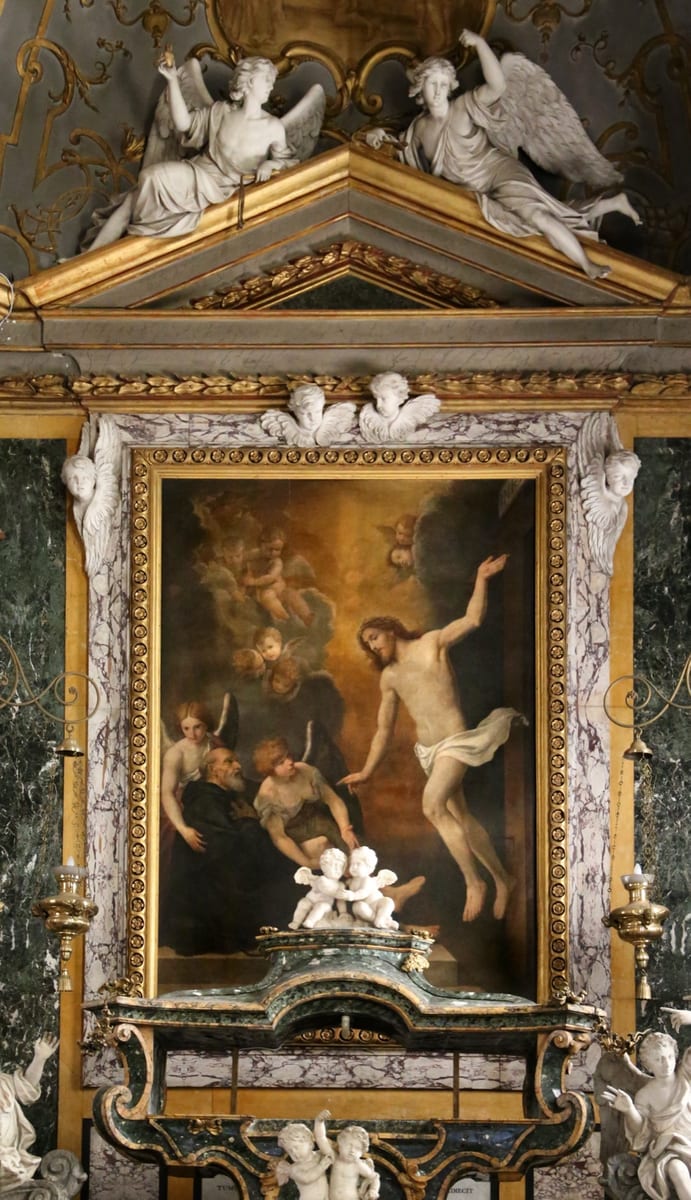
Cristo crocifisso risana la gamba a san Pellegrino Laziosi, Simone Cantarini, from a drawing by Guido Reni (attribution as given on Wikimedia Commons); the Italian description of the basilica attributes the altarpiece to Giovanni Pritelli, likewise after a Guido Reni drawing. Photograph by Wikimedia Commons user Sailko, 17th century Simone Cantarini, from a drawing by Guido Reni (attribution as given on Wikimedia Commons); the Italian description of the basilica attributes the altarpiece to Giovanni Pritelli, likewise after a Guido Reni drawing. Photograph by Wikimedia Commons user Sailko, Basilica di San Pellegrino Laziosi (Santa Maria dei Servi), Forlì — the altarpiece behind the altar of the saint's chapel, over his body At about sixty, a sore opened on St. Peregrine's right leg. It grew so grave that the Forlì physician Paolo de Salaghis judged the leg must be amputated, and came to the convent to operate. As Catholic Tradition tells it, on the night before the operation St. Peregrine got up and, barely able to hold himself upright, made his way to the convent's chapter room.
There he prayed hard for healing before a fresco of the Crucifix. He fell asleep on the benches and, in a dream, saw Jesus come down from the Cross and free him from the disease. He woke and went back to his cell, and in the morning the physician could only confirm that the leg was completely healed.
-
1345 AD
The death of a friar of Forlì
St. Peregrine died at eighty in his convent, and Tradition at Forlì holds that the crowds were too great for the city gates to be shut.
St. Peregrine died of a fever in the convent at Forlì on May 1, 1345 AD, at eighty. His body was laid out in the choir of the Servite church, and everyone wanted to come close and touch objects to it.
He was placed not in the ground but in a niche in the church wall. The Dicastery for the Causes of Saints calls that burial a sign of a veneration granted to few. Local Tradition at Forlì tells that so many people poured in from every side that the city gates could not be closed.
-
1608–1942 AD
The friar the sick pray to
Sworn cures at the tomb, a canonization at Rome, and a basilica where the sick still pray to St. Peregrine every week.
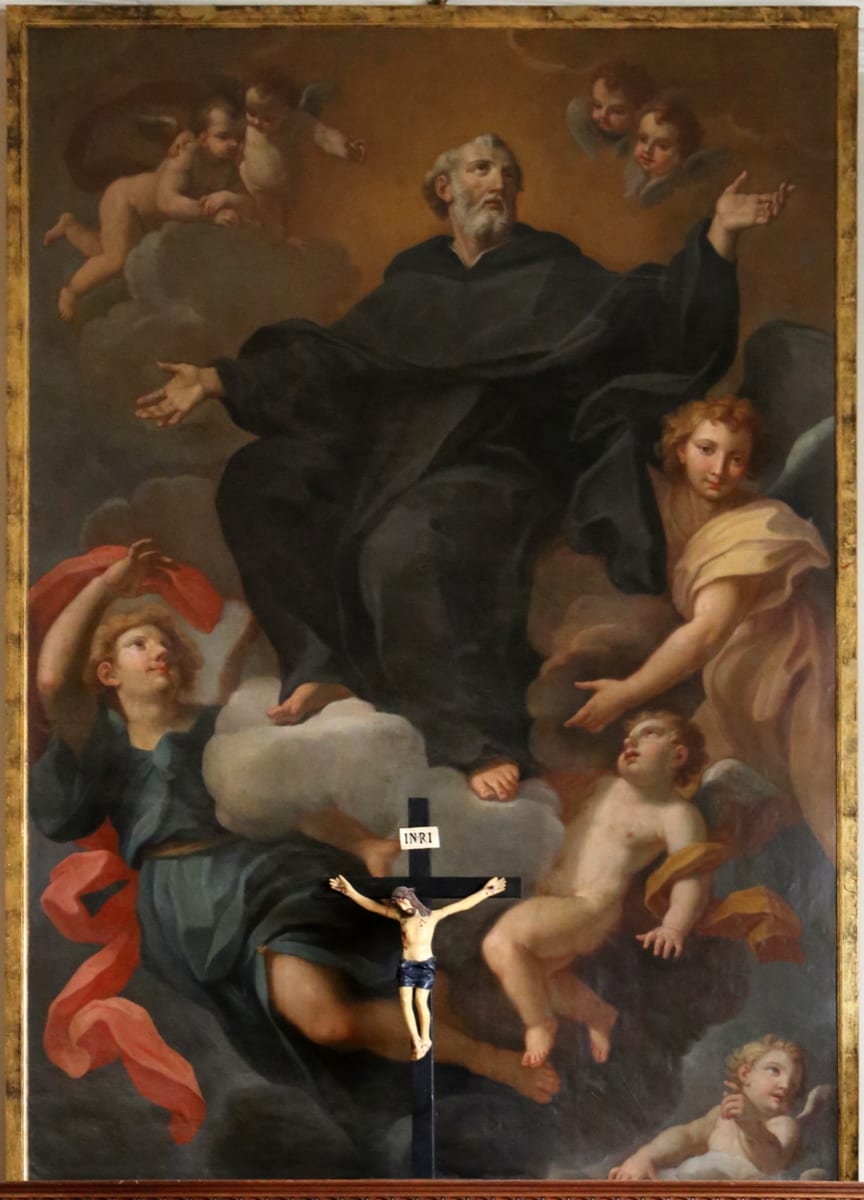
Gloria di San Pellegrino Laziosi, Francesco Trevisani (1656–1746 AD); photograph by Wikimedia Commons user Sailko, 1719 AD Francesco Trevisani (1656–1746 AD); photograph by Wikimedia Commons user Sailko, Sacristy of the Basilica di San Pellegrino Laziosi (Santa Maria dei Servi), Forlì In July 1608 AD the prior of the Servite convent at Forlì opened a formal Church inquiry into St. Peregrine's holiness and miracles. Witnesses swore on the Gospels that the body in the church was his, venerated by the whole city for about two hundred and sixty years. Camilla de Ferramontibus testified that her eight-year-old son Ludovico, dying of dropsy, was cured when touched with the cap St. Peregrine had worn in life.
Pope Benedict XIII canonized St. Peregrine at Rome on December 27, 1726 AD, with St. John of the Cross and St. Francis Solano. St. Peregrine was declared patron of Forlì in 1942 AD, and the city keeps his feast on May 1. Every Wednesday at five in the afternoon, the basilica that holds his body offers prayer for the sick, above all for those with cancer.


,_santi_(molto_restaurati)_entro_clipei_sulle_cornici,_pellegrino_laziosi_02.jpg)
,_cristo_crocifisso_risana_la_gamba_a_san_pellegrino_laziosi.jpg)

Pray with the Church
A prayer to St. Peregrine
The words Isabella de Minardis, a widow of Faenza, prayed before an image of St. Peregrine, and formally attested in November 1670 AD; printed by the Bollandists in the Acta Sanctorum for April 30.
O benedicte Dei, tu olim ab ea quam in crure patiebaris infirmitate fuisti liberatus, libera etiam me a morbo meo. (O blessed one of God, you who were once delivered from the sickness you suffered in your leg, deliver me also from my disease.)
All 2 reports on Saint Peregrine Laziosi

Forlì woman comes unasked to swear St. Peregrine cleared her face

About this picture
AI-generated image, in the manner of oil on canvas of the Italian seventeenth century, from the paper's reference portrait based on Pietro Lorenzetti (scuola), santi (molto restaurati) entro clipei sulle cornici, pellegrino laziosi 02 (School of Pietro Lorenzetti; photograph by Wikimedia Commons user Sailko, 14th century, heavily restored; photographed 21 October 2022, Basilica di San Clemente in Santa Maria dei Servi, Siena) View source artwork.